
Ghumoopedia — Explore, Discover, Experience
Sign in

Religious · Tamil Nadu

Skanda Sashti / Soorasamharam

Tiruchendur, Thoothukudi

Dates

Last verified 17 November 2026. Confirmed: announced by organisers or government. Provisional: from a published almanac, not yet announced. Seasonal: no date announced.

The complete guide

Skanda Sashti / Soorasamharam: everything to know before you go

Also known as
Tiruchendur Soorasamharam, Kanda Sashti, Kantha Sashti Vratam
State & District
Tamil Nadu; Tiruchendur, Thoothukudi District
When
October – November (Sashti tithi, bright fortnight of Aippasi month)
Duration
6 Days
Faith & Community
Hinduism (Tamil Shaivism & Kaumaram)
Type
Sacred Temple Festival, Battle Reenactment & Fasting Ritual
Entry
Free and open to all pilgrims and visitors
Best for
Murugan devotees, lovers of grand outdoor spectacles, and sea-shore rituals

Overview

Skanda Sashti is a dramatic six-day religious festival culminating in the epic outdoor theatrical reenactment of Soorasamharam (the vanquishing of the demon king Soorapadman by Lord Murugan) on the golden seashore of Tiruchendur Subramanya Swamy Temple in Thoothukudi District. Tiruchendur is the second abode among the Arupadai Veedu and the only one situated on the sea coast.

During Skanda Sashti, hundreds of thousands of devotees observe a rigorous six-day total fast (Sashti Vratham). On the sixth evening, over half a million pilgrims gather on the vast sandy beach facing the Bay of Bengal to witness Lord Murugan's deity brought out on a grand palanquin to engage giant effigies of the demon Soorapadman in a legendary beachhead battle.

The setting of the festival adds immense atmospheric grandeur. As waves crash against the temple walls, the setting sun casts a crimson glow across the Gulf of Mannar while half a million voices roar in unison. The battle is not viewed merely as myth, but as an active spiritual triumph of divine light over darkness occurring in real-time.
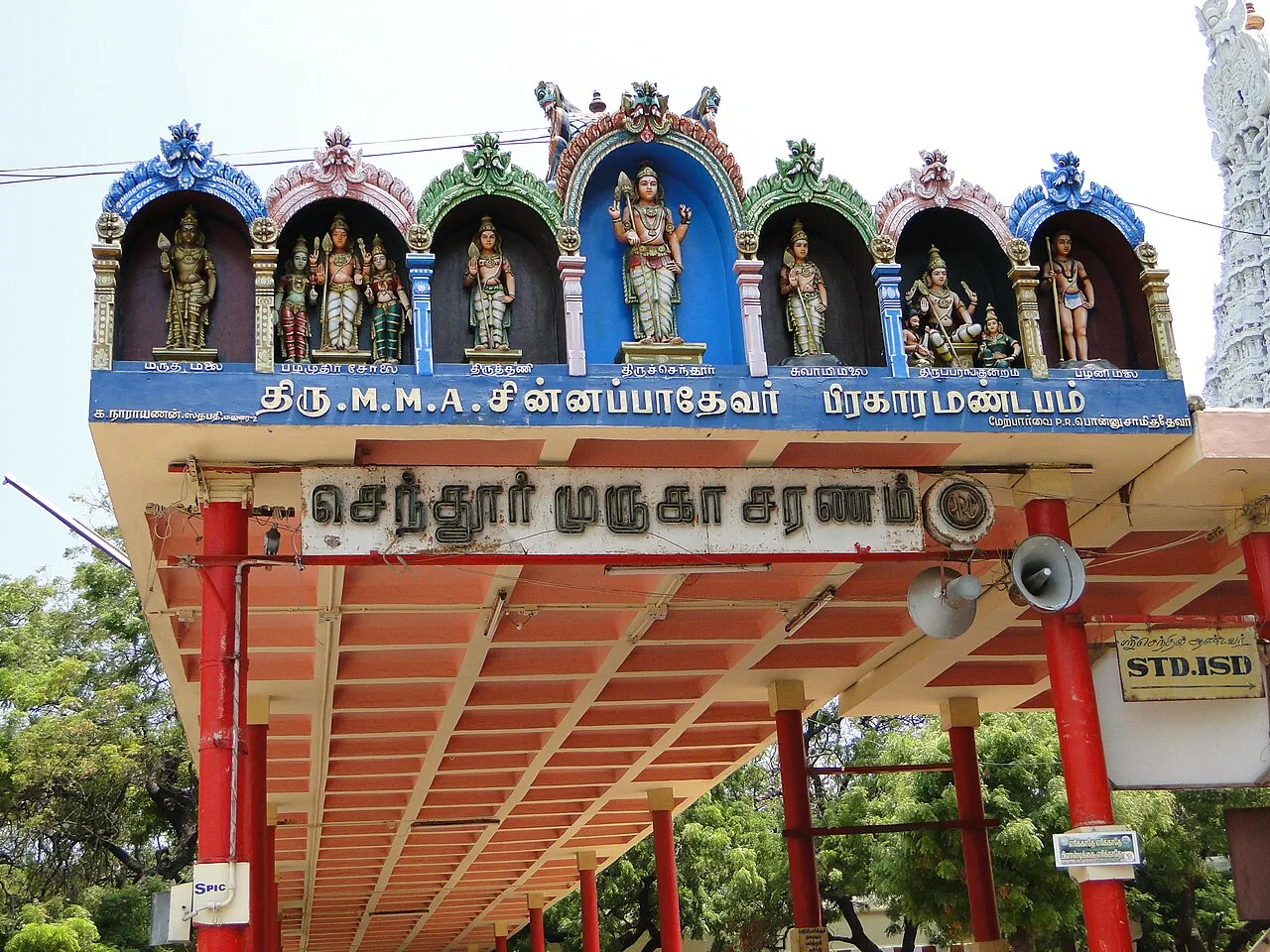
Origins and legend

According to the Skanda Purana, the demon king Soorapadman, along with his brothers Tarakasura and Simhamukha, acquired immense boons from Lord Shiva, rendering them invincible against all forces except a divine entity born of Shiva's own cosmic radiance. Armed with this power, they enslaved the Devas and terrorized the cosmos.

In response to the prayers of the Devas, Lord Shiva emitted six divine sparks from his frontal eye, which were carried by Agni and Vayu to the Saravana Lake, giving birth to Lord Shanmukha (Murugan). Lord Murugan set up his military encampment at Tiruchendur on the southern sea coast. Over six days of intense battle, Murugan defeated the demon forces. On the sixth day, when Soorapadman transformed into a giant mango tree in the ocean, Murugan hurled his divine Vel, splitting the tree into two halves—which were transformed into a peacock (his divine vehicle) and a rooster (his battle banner).

The battlefield victory at Tiruchendur restored peace to the cosmos. Rather than annihilating the demon completely, Lord Murugan's divine grace transformed his adversary into eternal servants—the peacock supporting his feet and the rooster adorning his victorious flag—symbolizing the ultimate transformation of ego into divine service.

How it is celebrated

For six days, devotees abstain completely from food or subsist solely on water or fruit juice, spending their days in temple halls reciting the *Kanda Sashti Kavasam* and *Thiruppugazh* hymns.

On the sixth evening, around 4:30 PM, the sea beach at Tiruchendur becomes an arena. The processional deity of Jayanthinathar (Lord Murugan) is borne on a silver chariot to the shore. Huge 30-foot-tall wooden effigies of Soorapadman (featuring interchangeable heads: Elephant, Lion, and Asura) are maneuvered by teams of temple bearers. In a dramatic duel, Lord Murugan severs each head one by one, culminating in the final victory at sunset, greeted by deafening chants of 'Vetrivel Muruganukku Harohara!'

Following the victory, Lord Murugan proceeds to the seashore for a ceremonial purification bath (Theerthavari) to cool the wrath of battle before returning to the sanctum for grand evening pujas.

The Cultural Days

The 6-day festival progression follows the mythic battle narrative:

Days 1 to 5 (Fasting & Spiritual Devotion): Continuous recitation of Kanda Sashti Kavasam hymns, laksharchana pujas, and special abhishekams inside the seashore temple sanctum.

Day 6 (Soorasamharam Beach Battle): The dramatic sunset climax on the seashore where Lord Murugan vanquishes the demon effigies.

Day 7 (Thirukalyanam): The morning after battle features the celestial wedding ceremony of Lord Murugan with Goddess Deivanai, marking cosmic peace and celebration.

The Pilgrimage Days

Sacred beachhead rituals define the pilgrimage experience at Tiruchendur:

Sea Bathing (Samudra Snanam): Pilgrims take holy dips in the ocean waves of the Gulf of Mannar before entering the temple.

Nazhi Kinaru Sacred Well Dip: Devotees bathe in a small freshwater well located just 200 feet from the salty ocean, believed to have been created by Lord Murugan's spear.

Beach Night Vigil: Thousands of fasting pilgrims camp overnight directly on the beach sand under the open stars, maintaining spiritual contemplation.

Food and flavours

Fasting dishes and local Southern Tamil delicacies dominate the festival environment:

Vratham Paranam (Fast-Breaking Feast): On the 7th morning after Thirukalyanam, pilgrims break their 6-day fast with a gentle meal of hot rice, moong dal payasam, curd rice, and raw banana kootu.

Tiruchendur Karupatti Halwa: A famous regional sweet made from palm jaggery (karupatti), wheat milk, and ghee, offering rich earthy caramel flavors.

Thoothukudi Macaroons: Famous local light egg-white and cashew cookies available in nearby bakeries.

Seashore Coconut Water: Chilled tender coconut water sold fresh along Tiruchendur beach to hydrate pilgrims.

Music, dance, art and dress

Sound and visual drama reach extreme heights during Soorasamharam:

Kanda Sashti Kavasam Chanting: Thousands of voices chant the protective 16th-century hymn composed by Devaraya Swamigal in unison across the beach.

Battle Drums & Horns: Traditional thavil, mridangam, and kombu horn fanfares build cinematic tension during the beachhead duel.

Sacred Attire: Pilgrims wear simple green or yellow veshtis and sarees, bearing holy ash (Vibhuti) marks across their foreheads and chest.

Where to experience it

The primary event takes place on the Seashore Beach directly outside the Subramanya Swamy Temple, Tiruchendur, Thoothukudi District.

Visitor guide

  • Getting There: Tiruchendur has a direct railway station connected to Chennai, Madurai, and Tirunelveli. The nearest airport is Tuticorin Airport (TCR, 40 km) and Madurai Airport (IXM, 170 km).
  • Where to Stay: Devasthanam cottages and private hotels line Tiruchendur town. Many pilgrims stay in Tirunelveli (50 km) or Thoothukudi (35 km).
  • What to Wear & Pack: Light cotton clothes suitable for sandy beach environments, spare clothes for ocean baths, towels, and sun caps.
  • Etiquette: Keep clear of the central beach corridor reserved for the processional deity and demon effigies.
  • Safety & Comfort: The beach hosts over 500,000 people on Soorasamharam evening; keep children close and follow police megaphone directions.

Today and tomorrow

Soorasamharam is broadcast live across major Indian television networks and online channels. The Temple Administration and Tamil Nadu Police utilize drone surveillance, marine police patrols, and temporary medical camps to manage the immense coastal gathering smoothly.

Nearby

Places to see around the festival