
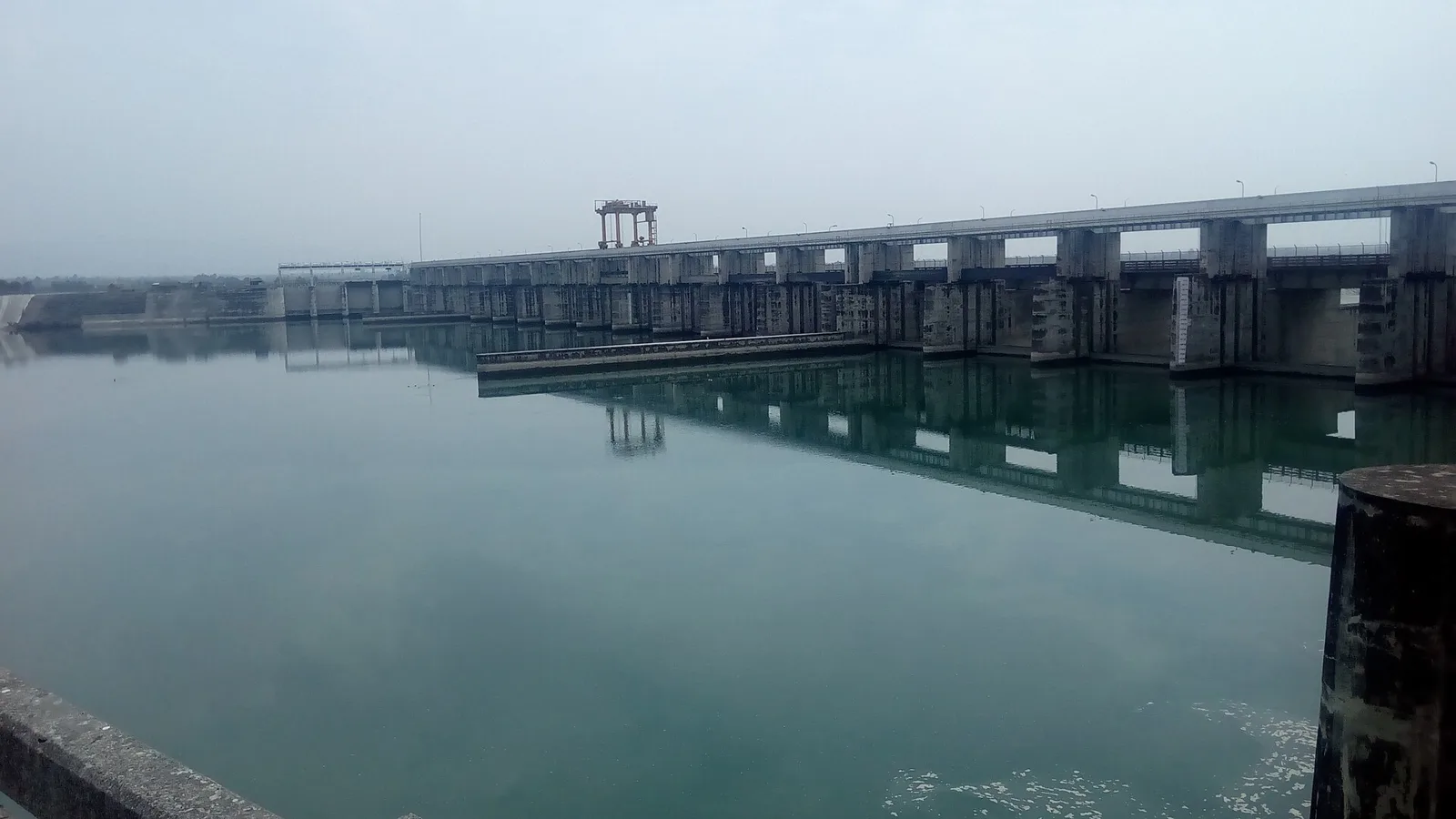
Hathni Kund Barrage
Hathni Kund Barrage is a concrete irrigation structure on the Yamuna in Haryana. Visitors can see the barrage and its reservoir wetland, which supports 31 species of waterbird.
Key facts · verified by Ghumoopedia editors
- Type of place
- Natural attraction
- Best time to visit
- October to March; November to February for birdwatching at Sultanpur
- Nearest railway station
- Yamunanagar Jagadhri · about 35 km (straight line)
- Verified
- 21 Nov 2026
Plan a trip from Hathni Kund Barrage — a day-by-day route through places nearby.
Hathni Kund Barrage is a concrete structure on the Yamuna in Haryana’s Yamuna Nagar district. Built to support irrigation, work began in October 1996 and ended in June 1999. It replaced Tajewala Barrage, three kilometres downstream. Dating from 1873, the older structure is now out of service. Hathni Kund channels river water into the Western and Eastern Yamuna Canals. Plans to replace Tajewala had been under consideration since the early 1970s. Haryana and Himachal Pradesh share the water diverted by the barrage, and their governments reached an agreement in July 1994. Construction was complete by late 1999, but delays meant operations did not start until March 2002. The small reservoir formed by the barrage also provides wetland habitat for 31 waterbird species. The barrage is 360 metres long. Its spillway comprises ten main floodgates, five undersluices on the right and three on the left. Its maximum discharge is 28,200 cubic metres per second, corresponding to a flood with a 1-in-500-year return period. The structure diverts 90 per cent of the river’s volume, leaving the other 10 per cent in the original channel. Haryana carries the legends of Kurukshetra and the Mahabharata, a strong wrestling (akhara) and folk tradition, and fast-growing modern cities around Gurugram and Faridabad. Haryana is hot and dry from April to June, humid in the July–September monsoon, and cool with fog in December and January. The Aravalli outcrops in the south are rocky and dry. The usual best time to visit is October to March; November to February for birdwatching at Sultanpur. Timings, fees and access arrangements must be confirmed locally. For official information, see Haryana Tourism at https://haryanatourism.gov.in.
Why it matters
Hathni Kund Barrage is an important water-management structure on the Yamuna in Yamuna Nagar district, Haryana. Its principal documented purpose is irrigation: it diverts river water into the Western and Eastern Yamuna Canals and replaced the older Tajewala Barrage. The structure also creates a small reservoir that serves as a wetland for waterbirds, giving it local interest for nature observation as well as engineering. Its role in managing a shared river links it to regional water planning involving Haryana and Himachal Pradesh. It is a working barrage, not simply a recreational waterfront. No UNESCO or Archaeological Survey of India protected-site designation is established in the available information; visitors should check current local access arrangements.
The Hathni Kund Barrage was built on the Yamuna in Yamuna Nagar district to replace the Tajewala Barrage, an older structure constructed in 1873 about three kilometres downstream. Tajewala had become outdated and is now out of service. Plans for its replacement were under consideration from the early 1970s, but agreement between Haryana and Himachal Pradesh, which share the water diverted by the barrage, was reached in July 1994. Construction took place between October 1996 and June 1999. Although the structure was completed in late 1999, delays meant it did not become operational until March 2002. It is 360 metres long. Its spillway has ten main floodgates, with five undersluices on the right and three on the left. The stated maximum discharge is 28,200 cubic metres per second, associated with a one-in-500-year flood. The barrage directs water into the Western and Eastern Yamuna Canals; the reference account estimates that about 90 per cent of river volume is diverted, leaving the remainder in the original channel. No later restoration project is established in the available information.
Origin stories & folklore
There is no well-documented origin legend specifically attached to Hathni Kund Barrage. The wider Haryana region is strongly associated with stories of Kurukshetra and the Mahabharata, and local conversations may refer to this broader epic tradition, but those stories should not be presented as the history of the barrage or as a site-specific belief. Hathni Kund is a modern water-control structure built for irrigation, rather than an ancient shrine or pilgrimage place. Visitors interested in local oral history can ask residents or a local guide whether any particular account is told in the area, while treating it as tradition rather than verified history.
Spend unhurried time at Hathni Kund Barrage: walk the marked paths, use official viewpoints and ask locally whether a guide, entry ticket or permit is needed. Admire the water from safe points rather than climbing wet rocks or entering unknown currents. Wildlife sightings are never guaranteed — patience and quiet improve your chances. A comfortable itinerary is one main visit in the morning, a local meal at midday and a short nearby stop before an afternoon return. Use the district list on this site to find other places in Yamunanagar, but check the actual road route and its condition before combining stops. If a festival or fair is on, local roads and stays can be busy — and the experience can be unforgettable. Leave no litter: many sites are protected by the communities around them.
Suggested itineraries
Half day: Travel to the barrage, spend about 1–2 hours at permitted viewpoints observing the structure and water, then return or stop for a meal in a nearby town. Full day: Visit the barrage in the morning, take a break for a local meal, then choose one confirmed nearby attraction such as Kalesar National Park or the Adi Badri area before returning; allow flexible road time. Gentler option: Keep the visit to a short stop at an accessible, authorised viewpoint, with a vehicle close by if local access allows; avoid uneven riverbanks and combine it with a relaxed meal rather than a second long walk.
The barrage sits within Haryana’s living rural and small-town culture, where Hindi and Haryanvi are widely used and Punjabi may also be heard. Everyday customs, food and social life reflect the wider region rather than a distinct tradition created by the barrage. Haryana is known for akhara wrestling and folk performance traditions, including singing and dance at community gatherings, though performances should not be expected at the site. Visitors may encounter practical, agricultural rhythms in nearby settlements and a strong connection to land and water. Dress is generally informal; modest, comfortable clothing and respectful behaviour around local people and working infrastructure are appropriate.
Local communities
People connected with Hathni Kund include residents of nearby settlements, farmers who depend on canal irrigation, and workers involved in managing or maintaining water infrastructure. The Yamuna and its canals are shared resources, so water allocation also concerns communities beyond the immediate area. Birdwatchers and other visitors may come to observe the reservoir, but it is not a purpose-built visitor centre. Be considerate of local livelihoods: do not block access roads, disturb fishing or agricultural activity, or assume that riverbanks and operational areas are open for recreation. Ask before photographing people or entering private land.
Festivals & events
No regular festival is established as being held at the barrage itself. In the wider district and region, Hindu festivals such as Holi, Teej, Dussehra and Diwali are observed seasonally, with local customs varying by community. The Kapal Mochan fair, held near Bilaspur in Yamuna Nagar district, is a notable religious gathering, usually associated with the Kartik season. It is separate from Hathni Kund, and travel in its vicinity can be busier during the fair. Check local announcements before combining a festival visit with a trip to the barrage, and allow for possible crowding on regional roads.
Local food in Haryana includes bajra khichdi, singri ki sabzi, kachri chutney, bathua raita, fresh milk, curd and ghee, and sweets such as ghevar and rewri. Ask what is fresh that day; many small eateries cook a limited daily menu. Vegetarian travellers eat very well across this region, and most towns also have simple non-vegetarian dhabas. Remote sites may have no restaurant at all. Carry water and snacks, eat a proper breakfast before long drives, and ask your accommodation for a packed lunch if you are heading out early. Try a home-cooked or dhaba meal when you can — it is often the best food on the route. Choose busy, clean places and carry your packaging back to town.
Shopping & local experiences
There is no established shopping centre or dedicated souvenir market at the barrage. For practical supplies or local food, look in nearby towns such as Yamuna Nagar or Jagadhri rather than relying on stalls at the water. District markets may offer everyday goods, regional snacks and locally made items, but availability varies. Haryana food to look for includes seasonal home-style dishes and dairy-based preparations; ask locally about reliable places to eat. Avoid buying or collecting anything from the riverbank or natural surroundings, and carry reusable water containers and a bag for rubbish.
Hathni Kund lies on the Yamuna, where the barrage forms a small reservoir and alters the flow into the downstream river channel and canals. The reservoir is also described as a wetland used by 31 species of waterbird. Birds may be easier to observe when conditions are quiet, but species and sightings vary with season, water levels and disturbance; no sighting is guaranteed. The surrounding landscape includes river margins and cultivated areas, while the broader district contains more varied woodland and foothill environments. The barrage is a working water structure, and currents, releases and water levels can change. Keep to safe, permitted viewpoints, avoid entering the water, and take all litter away.
October to March; November to February for birdwatching at Sultanpur
The nearest principal railway station by straight-line distance is Yamunanagar Jagadhri, roughly 35 km away. The nearest operating airport by straight-line distance is Shaheed Bhagat Singh International Airport, Chandigarh, roughly 85 km away. These figures are calculated from map coordinates — actual road distance may differ. Delhi, Chandigarh and Amritsar are the main rail and air hubs, and most long-distance journeys connect through them. For the final leg, Haryana Roadways buses and private coaches on the main national highways link district towns; shared taxis usually leave early in the morning. A private taxi gives more flexibility for remote sites. When comparing train, bus and flight, count the complete door-to-door time: a flight saves the most time only if the onward road transfer is short, while an overnight train plus a road journey can save a hotel night. Book your return before you leave, because seats fill quickly on weekends and holidays. Current train numbers, timings, return services and fares are not listed here; check IRCTC and NTES for trains and the airline's own schedule for flights. No permit is needed to visit Haryana. Bird sanctuaries and heritage sites charge entry tickets, and some protected monuments close on one weekday.
Confirm onward and return timings on IRCTC / NTES, the state bus operator or your airline before travel. A dash means current timings or fares have not been verified.
Getting around
The final approach is easiest to plan with a private car or taxi, particularly if visiting from Yamuna Nagar or Jagadhri; confirm the route and road condition before departure. Local buses may serve district towns and main roads, but onward access to the barrage may require a taxi or other local transport. Shared vehicles can be less predictable for a return journey, so arrange the return in advance. Auto-rickshaws are more likely to be useful within towns than for the entire rural approach. Walk only where there is a safe, permitted path; do not use boats or enter the water unless an authorised local operator confirms that this is allowed.
Hours, tickets & permissions
Access may depend on current management, security conditions, water operations and any restrictions on the barrage or its approaches. Do not assume that every part of the structure or riverbank is open to visitors. Confirm current visiting hours, entry requirements and any fees with the managing authority or locally before setting out. Follow posted notices and instructions from staff, especially during high flows or maintenance.
Facilities
Toilets, drinking water, food stalls, guides and an ATM should not be assumed to be available on site. Check locally and carry drinking water and any essentials you need. Food, cash services and other basic facilities are more likely in nearby towns, so plan before travelling out. Parking arrangements may depend on current access rules; use only designated or locally approved spaces and keep operational roads clear.
Accessibility
The visitor experience may involve uneven ground, exposed approaches and walking near water, and the amount of accessible path or shade can vary. No wheelchair ramps, lifts or step-free viewing facilities are confirmed. Ask locally about the current surface, vehicle access and distance from parking to an authorised viewpoint before travelling. Wet or muddy ground and strong currents make river edges unsuitable for casual access. Strollers may be difficult to use on rough paths. Older visitors and anyone with limited mobility may prefer a brief visit from the nearest safe point, with assistance and a seated rest available in a vehicle if needed.
No permit is needed to visit Haryana. Bird sanctuaries and heritage sites charge entry tickets, and some protected monuments close on one weekday. Carry a photo ID at all times and save the emergency number 112 and your accommodation's contact offline. Heat in summer and dense fog in winter are the main weather risks; carry water and allow extra travel time on foggy December–January mornings. Stay on marked paths, keep away from cliff edges and fast water, and never approach wild animals. Check official advisories for the region before travel, and follow local guidance if access changes.
Photography
Soft morning or late-afternoon light can bring out the water, sky and structure, but conditions change with weather and river level. Use only authorised public viewpoints and do not climb barriers, cross operational areas or stand on wet rocks for a better composition. Photography rules may be restricted around infrastructure; check signs and ask staff before taking pictures. Drone use can be subject to aviation, security and site permissions, so do not fly without confirming all applicable approvals. Ask permission before photographing local people, and avoid disturbing birds or other wildlife.
Choose a stay by the full journey to Hathni Kund Barrage, not just the district name. Main towns in Yamunanagar usually offer hotels, state tourism lodges and guesthouses with better transport, meals and medical access, while village homestays offer a closer connection to local life. In the plains, check fans or air-conditioning in summer and heating in the December–January cold wave. Book in advance for weekends, festival dates and the peak season (October to March; November to February for birdwatching at Sultanpur). Confirm the exact location, meals included, check-in time and cancellation terms in writing. Many homestays accept payment on arrival; avoid sending money to unverified contacts. Mobile network and digital payments can be unreliable in remote areas, so carry some cash.
Within Yamuna Nagar district, Kalesar National Park offers a contrasting woodland landscape, while the Adi Badri area is associated with archaeological and religious sites in the district’s northern foothills. Kapal Mochan, near Bilaspur, is known for its religious complex and seasonal fair; it is not part of the barrage. The former Tajewala Barrage, about three kilometres downstream according to the reference account, is a historical waterworks site but is out of service, so access should be checked. Yamuna Nagar and Jagadhri are useful district towns for services and onward travel. Confirm road routes and site access before combining stops.
For couples, Hathni Kund Barrage rewards a slow pace: arrive early for soft light and fewer crowds, share a local meal and keep the evening free. Public displays of affection can be frowned upon in conservative communities and at religious sites, so be discreet. A homestay or a small heritage hotel can make the trip memorable — confirm privacy, hot water and transport back. Keep a buffer in your itinerary, because weather and traffic can delay plans in Haryana.
Q: How much time should I allow for a visit? A: A short visit to permitted viewpoints can fit into a half-day outing; allow extra time for road travel and any nearby stop. Q: When is a good season to visit? A: October to March is generally the more comfortable period in Haryana. Bird activity varies, and conditions at the river should be checked locally. Q: Is there an entry ticket or permit? A: Ask the managing authority or check locally about access, permits, fees and restricted areas before travelling. Q: Is the barrage suitable for children and elderly visitors? A: It can be a brief observation stop, but uneven ground, changing water conditions and limited confirmed facilities call for close supervision and caution. Q: Where can I stay nearby? A: Look for accommodation in Yamuna Nagar or Jagadhri and confirm availability and transport arrangements before your trip.
Be the first to share photos, stories, advice or a helpful contact for Hathni Kund Barrage.
Loading…