
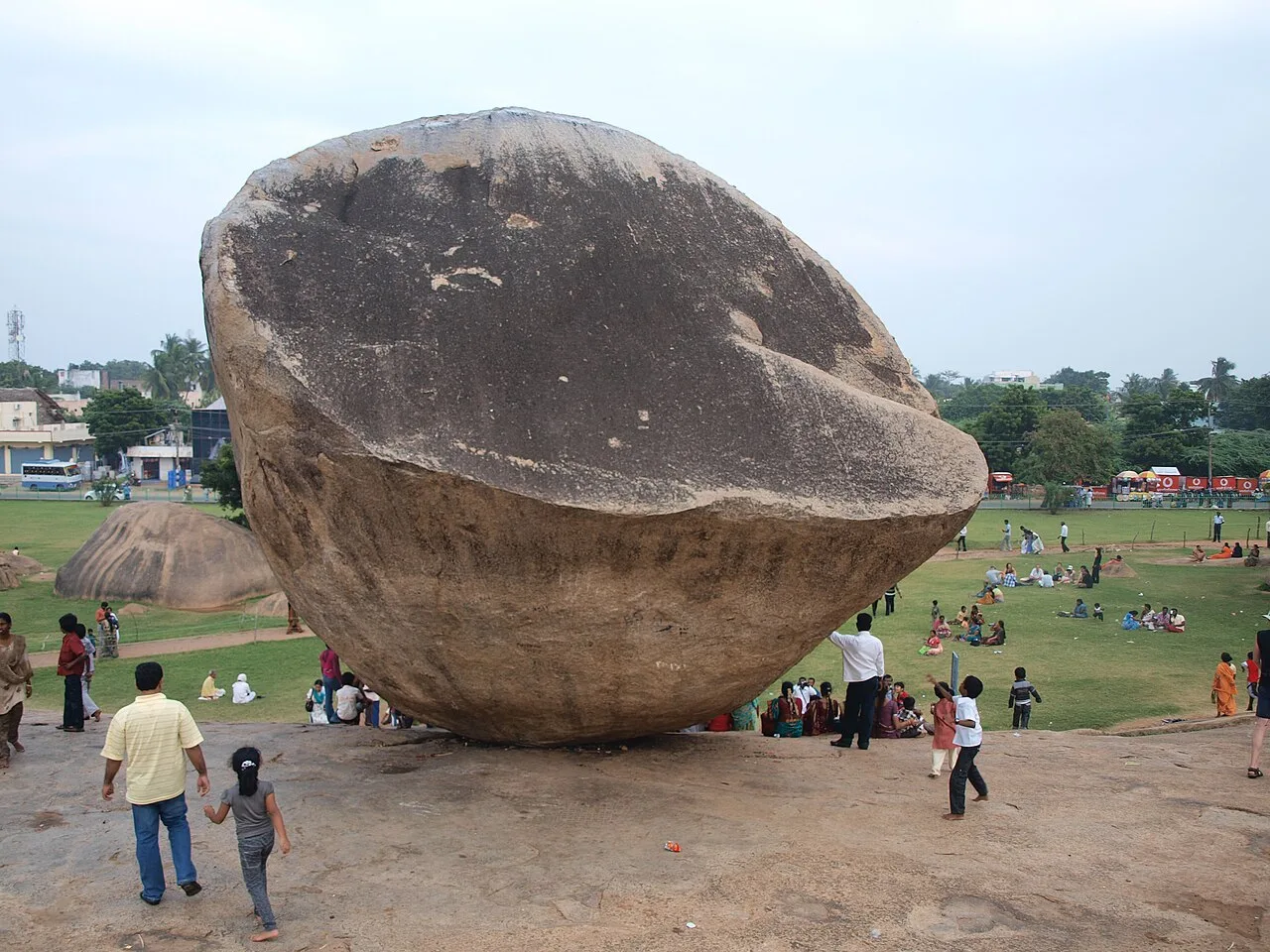
Krishna's Butterball
Krishna's Butterball is a huge granite balancing rock in Mamallapuram. Visitors come to see its striking position and its setting among the town’s Pallava-era monuments.
Key facts · verified by Ghumoopedia editors
- Type of place
- Natural attraction
- Best time to visit
- November to February; April to June for the hill stations
- Nearest railway station
- Chengalpattu Junction · about 25 km (straight line)
- Nearest airport
- Chennai International Airport · about 42 km (straight line)
- Verified
- 21 Nov 2026
Plan a trip from Krishna's Butterball — a day-by-day route through places nearby.
In Chengalpattu district, Tamil Nadu, this massive granite rock rests on a gentle slope in the coastal town of Mamallapuram. It is also called Vaan Irai Kal and Krishna's Gigantic Butterball. The boulder stands within the Group of Monuments at Mamallapuram, a UNESCO World Heritage Site. Built under the Pallava dynasty in the seventh and eighth centuries CE, these monuments were created for Hindu religious purposes. The rock is a popular local attraction. The Archaeological Survey of India recognises it as a protected national monument. Tamil Nadu is the land of great living temples — Madurai's Meenakshi, Thanjavur's Brihadeeswara, Srirangam, Chidambaram and Rameswaram — along with the Pallava shore monuments of Mamallapuram, the Chettinad mansions, the hill stations of Ooty and Kodaikanal and the meeting of three seas at Kanyakumari. The state is hot from March to June, gets light southwest-monsoon rain from June to September, and receives its main rainfall from the northeast monsoon between October and December. January to March is the most comfortable season; the Nilgiri and Kodaikanal hills are cool year-round. The usual best time to visit is November to February; April to June for the hill stations. Timings, fees and access arrangements must be confirmed locally. For official information, see Tamil Nadu Tourism at https://www.tamilnadutourism.tn.gov.in.
Why it matters
Krishna’s Butterball is a distinctive natural landmark in Mamallapuram, a coastal town in Chengalpattu district. The granite boulder balances on a sloping rock surface and is known locally and to visitors by names including Vaan Irai Kal and Krishna’s Gigantic Butterball. Its unusual position makes it a popular stop among the town’s historic monuments, though the boulder itself is a natural formation rather than a Pallava sculpture. The Archaeological Survey of India lists it as a protected national monument. It also lies within the Group of Monuments at Mamallapuram, recognised by UNESCO as a World Heritage Site. The attraction adds a natural feature to a heritage landscape renowned for Pallava-era temples, rock-cut caves and reliefs.
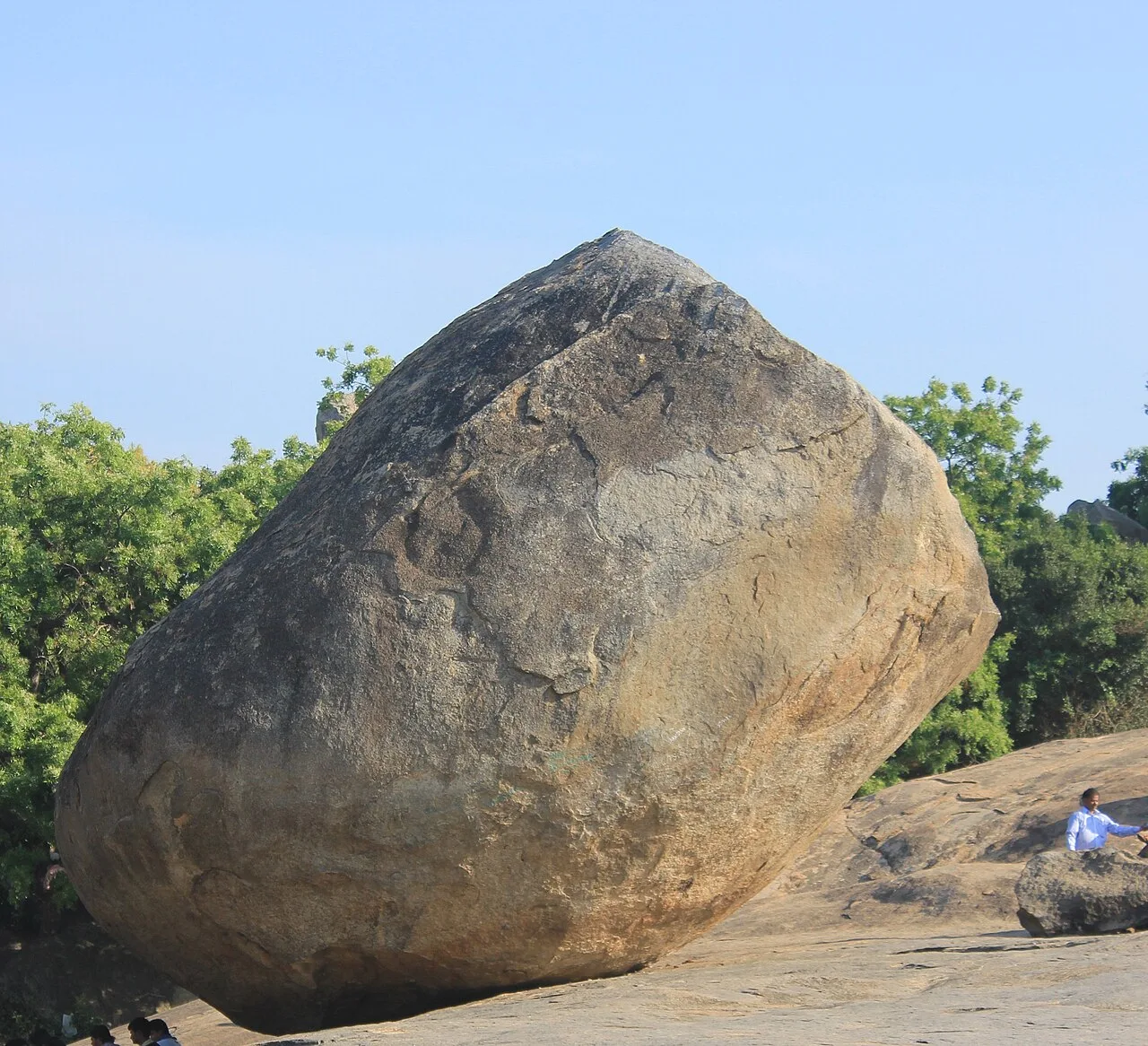
Krishna’s Butterball is a natural granite boulder, not a monument carved or placed by a known ruler. Its distinctive balance on a short, sloping rock surface has made it a feature of Mamallapuram’s historic landscape for generations. The town’s better-known religious monuments were created under the Pallava dynasty, particularly during the seventh and eighth centuries CE. These include rock-cut shrines, sculpted reliefs, monolithic structures and the Shore Temple. The boulder is part of this wider setting, but its formation predates the town’s built heritage and there is no documented date for when it assumed its present position. Mamallapuram developed as a Pallava-era centre and later became an important destination for visitors interested in South Indian temple architecture and stone carving. The Group of Monuments at Mamallapuram is recognised by UNESCO as a World Heritage Site, and the Butterball is listed as a protected national monument by the Archaeological Survey of India. The boulder’s appearance has prompted stories about attempts to move it, but accounts of such efforts should be treated as popular lore unless verified through a reliable historical record. No specific restoration of the natural formation is documented in the available guide information; conservation attention is directed at protecting the monument and its setting.
Origin stories & folklore
According to local tradition, the boulder resembles a lump of butter dropped by the Hindu god Krishna, giving rise to its familiar English name. Vaan Irai Kal is another traditional name associated with the rock. Stories also circulate that people, including elephants in some tellings, tried unsuccessfully to shift it. These accounts add to the attraction’s reputation, but they are folklore rather than established explanations of the boulder’s geology or history. The rock’s precarious-looking balance is striking, yet visitors should not climb on it or test its stability. Treat the stories as part of Mamallapuram’s popular heritage, not as documented events.
Explore Krishna's Butterball slowly and read the interpretation boards, use the official audio guide where available or hire an authorised guide to understand its history. Check opening days, ticket counters and camera rules in advance; many monuments and museums close on one weekday and on some public holidays. Early morning gives softer light, cooler air and smaller crowds. A comfortable itinerary is one main visit in the morning, a local meal at midday and a short nearby stop before an afternoon return. Use the district list on this site to find other places in Chengalpattu, but check the route and its condition before combining stops. If a festival is on — such as Pongal in January, the Madurai Chithirai festival, the Mahamaham at Kumbakonam or the Chennai music season in December — roads and stays can be busy, and the experience can be unforgettable. Leave no litter: many sites are protected by the communities around them.
Suggested itineraries
Half day: Visit Krishna’s Butterball (30–45 minutes), then explore nearby Pallava monuments such as Arjuna’s Penance and Krishna Mandapam (1–2 hours), with a meal break. Full day: Begin at the Butterball and nearby rock reliefs (1–2 hours), continue to the Shore Temple and Pancha Rathas (2–3 hours), take a relaxed lunch, then visit a local sculpture workshop or the beach area (1–2 hours). Gentler option: See the Butterball and one nearby monument at an unhurried pace, take seated breaks in shaded spots where available, and use a taxi between farther stops.
Mamallapuram’s cultural life combines its Pallava-era heritage with a working coastal town and a busy visitor economy. Tamil is the principal local language; English is also commonly useful in tourism-facing settings, though availability varies. The town is known for stone carving, and visitors may encounter workshops and artisans producing sculptures and decorative objects. Classical dance and music are associated with cultural programming in the region, including performances staged in Mamallapuram during festival periods. Everyday customs reflect Tamil Nadu’s broader traditions, including temple visits and seasonal celebrations. At the Butterball, observe the site respectfully, follow posted conservation guidance and avoid treating nearby religious monuments as props.
Local communities
The place is connected with Mamallapuram’s residents, heritage workers and visitors. Local livelihoods include tourism services, guiding, hospitality, food businesses, transport and stone carving. Fishing is also part of the wider coastal economy, although not every resident is involved in it. Artisans contribute to the town’s reputation for sculpture, while conservation staff and public authorities help manage protected heritage sites. The attraction is visited by domestic and international travellers, so the town’s working life and visitor activity often meet in the same streets. Be considerate when photographing residents or workers, and ask permission before making close portraits.
Festivals & events
Pongal, the Tamil harvest festival, is celebrated across the region in January and can bring more local travel and activity. Mamallapuram is also associated with a dance festival season, often held during the cooler months, when performances and visitor numbers can increase; check current local listings before planning around it. Temple festivals in nearby towns may also affect road traffic and accommodation demand. Festival schedules vary from year to year, and events are not necessarily held at the Butterball itself. During busy periods, allow extra time for moving between attractions and be mindful of queues, parking pressure and local residents’ access.
Local food in Tamil Nadu includes idli, dosa and filter coffee, Chettinad chicken and pepper curries, Madurai's kari dosa and jigarthanda, Thanjavur's banana-leaf vegetarian meals, Kanyakumari's seafood, and sweets such as Mysore pak, adhirasam and Tirunelveli halwa. Ask what is fresh that day; many small eateries cook a limited daily menu. Tamil Nadu is a paradise for vegetarian meals served on banana leaf; Chettinad and Madurai are the centres for meat and spice lovers. Filter coffee is a ritual — have it at a local 'hotel' (eatery). Remote sites may have no restaurant at all. Carry water and snacks, eat a proper breakfast before long drives, and ask your accommodation for a packed lunch if you are heading out early. Try a home-cooked or local thali meal when you can — it is often the best food on the route. Choose busy, clean places, drink sealed or filtered water, and carry your packaging back with you.
Shopping & local experiences
Mamallapuram is known for stone-carving workshops and shops selling sculpted figures, decorative objects and other craft goods. Look for locally made work and ask about the material, carving process and packing options before buying. Small shops may also carry textiles, souvenirs and everyday travel supplies. The town’s cafés and restaurants offer opportunities to try Tamil meals and coastal dishes, with menus and availability varying by season. Compare items and handle fragile pieces carefully, especially if travelling onward. Buy from responsible sellers, avoid purchasing objects presented as antiquities, and do not remove stones or other material from protected sites.
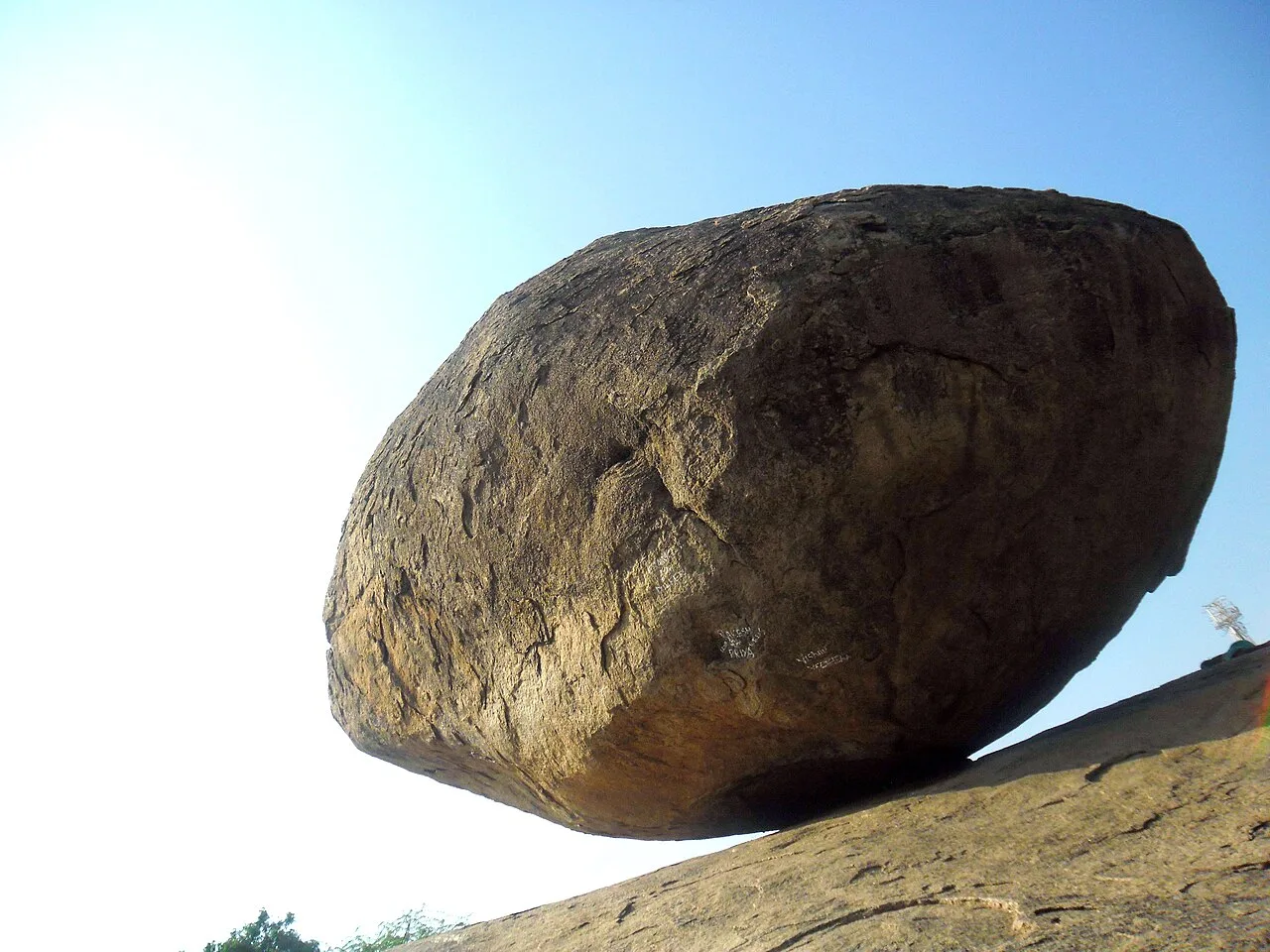
The Butterball is a large granite boulder resting on a short incline, set among exposed rock surfaces in coastal Mamallapuram. The surrounding landscape is largely open and sun-exposed, with built-up streets and heritage sites nearby and the Bay of Bengal within the wider town setting. The rock’s form and balance are the principal natural features to observe. Vegetation in the immediate area is limited compared with wooded landscapes, and shade may be scarce around the boulder. Coastal weather can be hot and humid, especially outside the cooler season. Common urban and coastal birds may be present, but sightings vary and should not be expected. Stay on permitted paths and do not climb, scratch or remove material from the rock.
November to February; April to June for the hill stations
The nearest principal railway station by straight-line distance is Chengalpattu Junction, roughly 25 km away. The nearest operating airport by straight-line distance is Chennai International Airport, roughly 42 km away. These figures are calculated from map coordinates — actual road distance is longer. Chennai is the main gateway; Coimbatore serves the west and Mettupalayam is the railhead for the Ooty toy train; Madurai and Tiruchirappalli serve the south and centre; Rameswaram and Kanniyakumari have their own rail termini. For the final leg, TNSTC and SETC buses reach nearly every town, with private sleeper coaches between cities and app cabs in Chennai, Coimbatore and Madurai link district towns. A private taxi gives more flexibility for remote sites such as hill stations, forest gates and coastal temples. When comparing train, bus and flight, count the complete door-to-door time: a flight saves the most time only if the onward road transfer is short, while an overnight train can save a hotel night. Book your return before you leave, because seats fill quickly on weekends, festivals and holidays. Current train numbers, timings, return services and fares are not listed here; check IRCTC and NTES for trains and the airline's own schedule for flights. No permit is needed to visit Tamil Nadu. The Nilgiri Mountain Railway toy train to Ooty must be booked well in advance on IRCTC — seats are few and sell out weeks ahead. Major temples such as Madurai Meenakshi and Srirangam have darshan queues and some enforce a dress code (dhoti or formal trousers for men, saree or salwar for women); phones and cameras are not allowed inside several temple sanctums. Boating to the Vivekananda Rock at Kanyakumari depends on sea conditions.
Confirm onward and return timings on IRCTC / NTES, the state bus operator or your airline before travel. A dash means current timings or fares have not been verified.
Getting around
Mamallapuram is compact enough for many visitors to explore its central monuments on foot, though the heat and uneven surfaces can make walking tiring. Auto-rickshaws and taxis can help with longer hops between attractions or with luggage; agree the destination clearly before setting off. Local buses serve the town and connect it with other places, but check routes locally. Parking availability and restrictions can change, particularly on busy weekends and festival days, so use signed or designated areas. Boats are not needed to reach the Butterball. For visitors arriving by private vehicle, plan for a short walk from an appropriate parking area.
Hours, tickets & permissions
Entry arrangements can depend on the site authority, the monument area being visited and any temporary conservation or event measures. Tickets, permits, camera rules, restrictions on tripods, and access on public holidays may differ across Mamallapuram’s attractions. The Butterball is listed as a protected national monument, so follow signs and instructions from the Archaeological Survey of India or other staff on site. Confirm current opening arrangements and any applicable fees with the managing authority before travelling. Do not assume that rules for one monument apply to every nearby site.
Facilities
Facilities at the Butterball itself may be limited. Toilets, drinking water, snacks and restaurants are more readily found around Mamallapuram’s visitor areas, but availability and upkeep can vary, so check locally and carry water. Parking may be available in designated areas near the monument zone, subject to local restrictions and crowd levels. Guides and interpretation resources may be available around the main attractions; confirm that a guide is authorised if you hire one. ATMs and shops are found in town, but do not rely on services being immediately beside the boulder. Keep litter with you until you find a proper bin.
Accessibility
The attraction is outdoors, and the approach may include uneven ground, exposed rock and a sloping surface. Walking distance depends on the chosen entrance and where a vehicle can stop; ask locally about the current route before setting out. Shade can be limited, and heat may make the visit difficult for older people or anyone with reduced stamina. Wheelchair and stroller access should not be assumed, as natural terrain and heritage protections can restrict movement. There may not be a step-free route to every viewing point. Visitors with mobility needs may find it more comfortable to view the boulder from the nearest permitted accessible area and avoid climbing on rocks.
No permit is needed to visit Tamil Nadu. The Nilgiri Mountain Railway toy train to Ooty must be booked well in advance on IRCTC — seats are few and sell out weeks ahead. Major temples such as Madurai Meenakshi and Srirangam have darshan queues and some enforce a dress code (dhoti or formal trousers for men, saree or salwar for women); phones and cameras are not allowed inside several temple sanctums. Boating to the Vivekananda Rock at Kanyakumari depends on sea conditions. Carry a photo ID at all times and save the emergency number 112 and your accommodation's contact offline. Heat in summer and heavy rain in the monsoon are the main weather risks; carry water, avoid midday sun and allow extra time when roads flood. Watch your belongings in crowds and on public transport, and follow posted instructions.
Photography
Early morning or later in the day can provide softer light and a more comfortable visit; the open setting can be harsh under midday sun. Photograph the boulder from permitted ground-level viewpoints and include surrounding rock for scale, but do not climb on it or obstruct other visitors. Personal photography is commonly permitted at outdoor attractions, though restrictions and camera fees can vary across protected monuments; check signs and staff instructions. Do not fly a drone without confirming current permissions and aviation rules. Ask before photographing residents, artisans or performers, and be especially considerate around worship and ceremonies.
Choose a stay by the full journey to Krishna's Butterball, not just the district name. Chennai, Coimbatore, Madurai and Tiruchirappalli offer the widest choice; Ooty and Kodaikanal have everything from heritage hotels to cottages — book far ahead for the April–June school holidays and the Pongal weekend. In summer, check air-conditioning; in the monsoon, check that the property is accessible if roads flood. Book in advance for weekends, festivals and the peak season (November to February; April to June for the hill stations). Confirm the exact location, meals included, check-in time and cancellation terms in writing. Avoid sending money to unverified contacts or touts at stations. Carry some cash, as card and digital payments can be unreliable in remote areas.
Mamallapuram’s other well-known heritage attractions include the Shore Temple, the Pancha Rathas, Arjuna’s Penance, Krishna Mandapam and the rock-cut caves. These sites are part of the town’s Pallava heritage and can be combined according to available time and mobility. The Sculpture Museum and local stone-carving workshops offer additional context on the region’s artistic traditions; check current access before visiting. Tiger Cave, near Saluvankuppam, is another nearby heritage stop often considered by visitors with transport. The Bay of Bengal coastline is also close to the town, but observe local safety advice and conditions. Verify routes and entry arrangements before combining stops.
For couples, Krishna's Butterball rewards a slow pace: arrive early for soft light and fewer crowds, share a local meal and keep the evening free. Sunrise at Kanyakumari, a boat ride on Kodaikanal lake or an evening stroll through Mamallapuram's shore monuments makes the trip memorable. Public displays of affection can be frowned upon in conservative communities and at religious sites, so be discreet. Keep a buffer in your itinerary, because weather and road conditions can delay plans.
Q: How much time should I allow for Krishna’s Butterball? A: Around half an hour is enough for a brief look, while a longer visit lets you read site information and combine it with nearby monuments. Q: When is a comfortable season to visit? A: November to February is generally more comfortable in Tamil Nadu. Expect hot conditions in warmer months and check the forecast before travelling. Q: Is there an entry fee? A: Rules and fees can vary by monument and change over time. Confirm current arrangements with the managing authority before your visit. Q: Is it suitable for children and elderly visitors? A: The open setting can appeal to families, but the ground may be uneven and exposed to sun. Supervise children and consider mobility needs before approaching. Q: Can I stay nearby? A: Mamallapuram has visitor accommodation and places to eat. Check current availability and choose a location that suits your transport and access needs.
Be the first to share photos, stories, advice or a helpful contact for Krishna's Butterball.
Loading…