
Ghumoopedia — Explore, Discover, Experience
Sign in

Religious · Puducherry

Karaikal Ammaiyar Mango Festival

Karaikal

Dates

Last verified 17 November 2026. Confirmed: announced by organisers or government. Provisional: from a published almanac, not yet announced. Seasonal: no date announced.

The complete guide

Karaikal Ammaiyar Mango Festival: everything to know before you go

Also known as
Mangani Thiruvizha, Karaikal Mangani Festival
State & District
Union Territory of Puducherry (Karaikal District)
When
June–July (Full Moon day of Tamil Aani month)
Duration
4 Days
Faith & Community
Shaivite Hinduism & Tamil Devotional Tradition
Type
Temple Chariot Procession & Devotional Mango Showering Festival
Entry
Free public access
Best for
Devotees of 63 Nayanmars, cultural anthropologists, and mango lovers

Overview

The Karaikal Ammaiyar Mango Festival, locally celebrated as 'Mangani Thiruvizha', is a world-unique temple festival celebrated in Karaikal, an enclave of the Union Territory of Puducherry. Occurring annually during the Tamil month of Aani (June–July), this 4-day grand spectacle honors Karaikal Ammaiyar (Punithavathi), one of the 63 Nayanmars (revered Shaivite saint-poets) and one of the earliest female poets of Tamil literature. The defining hallmark of this festival is the astounding spectacle where thousands of devotees assemble on rooftops and balconies along the temple streets to shower hundreds of thousands of fresh ripe mangoes onto the grand street procession of Lord Bikshatanar (a form of Lord Shiva).

The festival combines intense religious devotion, literary pride, and joy as millions of ripe mangoes rain down upon the crowds. Caught with outstretched towels and bare hands, these mangoes are consumed as sacred prasadam believed to grant health, fertility, and divine blessings.

The street procession of Lord Bikshatanar through Karaikal's ancient avenues creates an unmatchable visual phenomenon, transforming the town into a sea of golden mangoes and joyful devotees. It is a festival where charity, literature, and divine love intersect.

The vibrant energy of Karaikal town during Mangani Thiruvizha showcases Tamil Nadu and Puducherry's deep-rooted devotion to Shaivite Bhakti saints.

Pilgrims and tourists travel from across South India to participate in this colorful event, which turns the entire heritage town of Karaikal into an open-air celebration of spiritual abundance.
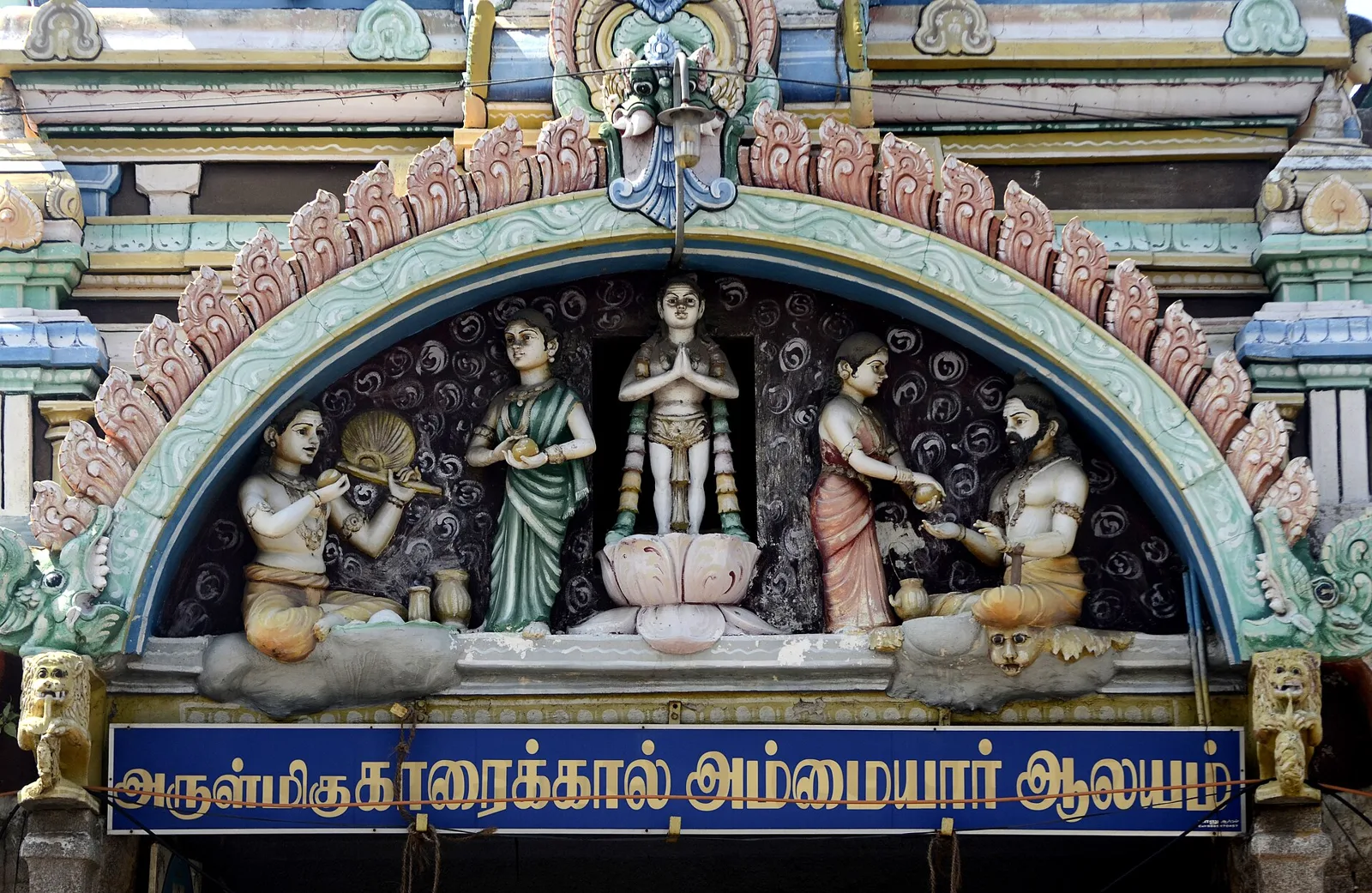

Origins and legend

The legend of Karaikal Ammaiyar dates back to the 6th century CE. Punithavathi, a devout woman born to a wealthy merchant in Karaikal, was married to Paramadathan. One day, her husband sent two fresh mangoes home with his assistant. Punithavathi served one mango to a hungry Shaivite ascetic who came to her doorstep seeking alms. When her husband returned for lunch, he ate the remaining mango and asked for the second one. Unable to deny him, Punithavathi prayed intensely to Lord Shiva. Miraculously, a divine mango appeared in her palm, which she served to her husband.

Astounded by its divine sweetness, Paramadathan asked how she obtained it. Upon learning the truth, he requested another mango to prove her claim. She prayed again, and a second mango appeared, which vanished the moment her husband touched it. Realizing his wife was a divine being, Paramadathan left Karaikal in awe. Punithavathi then shed her youth and beauty, praying to Lord Shiva to grant her a skeletal form so she could walk on her head to Mount Kailash to worship the Lord. Lord Shiva addressed her affectionately as 'Amma' (Mother). The Mangani Thiruvizha reenacts this divine story of faith, selfless charity, and devotion.

The festival celebrates both the miraculous power of faith and the spirit of unhesitating hospitality ('Annadhanam') that defines Tamil culture.

Her devotional hymns, composed in complex Tamil meters, represent foundational jewels of Tamil literature and early Shaivite Bhakti philosophy.

Her selfless act of feeding a hungry monk with a prized fruit emphasizes the cardinal virtue of charity, which remains the emotional core of the festival.

The historical temple dedicated to Karaikal Ammaiyar stands on the exact site of her ancestral home, serving as a beacon of female empowerment and literary heritage in Tamil culture.

How it is celebrated

The festival commences with the celestial wedding (Thirukalyanam) of Karaikal Ammaiyar and Paramadathan, conducted with elaborate Vedic rituals. On the third and main day, the magnificent silver chariot carrying Lord Bikshatanar glides through the ancient streets of Karaikal. As the chariot moves, devotees standing on balconies, building terraces, and elevated platforms hurl sweet, ripe mangoes into the crowd as an offering to the Lord. Tens of thousands of spectators catch these flying mangoes with outstretched towels, viewing them as divine prasad that brings health and prosperity.

In the evening, the idol of Karaikal Ammaiyar is brought to meet Lord Bikshatanar, where sacred curds and rice ('Amudhappadai') are offered to the deity and distributed to thousands of gathered pilgrims.

Devotees from nearby rural districts bring truckloads of fresh mangoes to donate to the temple procession, ensuring a continuous shower of fruits throughout the day.

Local merchant guilds set up free food distribution centers (Pandal) serving buttermilk, tender coconut, and curd rice to pilgrims arriving from distant regions.

The Cultural Days

Evening cultural programs feature classical music, discourses on Panniru Tirumurai (Shaivite canon), and drama recitals portraying the life of Karaikal Ammaiyar. Renowned Tamil scholars deliver lectures highlighting her contributions to Tamil literature and music.

Classical dance dramas reenacting Ammaiyar's journey to Mount Kailash and her famous compositions ('Arputha Thiruvanthathi' and 'Tiruvalangattu Mootha Thirupathigam') captivate audiences during the festival nights.

The Pilgrimage Days

Pilgrims visit the Karaikal Ammaiyar Temple and partake in 'Amudhappadai'—a grand feast where curd rice and sweet mangoes are served to thousands of devotees without discrimination.

Couples praying for children participate fervently, believing that consuming the sacred mango offered to Lord Bikshatanar grants the blessing of parenthood.

Food and flavours

The festival is a feast of mangoes! Varieties like Neelam, Banginapalli, Alphonso, and Malgova dominate. Curd rice served with sweet mango chutney and mango pachadi is the traditional prasad.

Street stalls sell mango ice cream, fresh mango juice, and traditional South Indian sweets flavored with ripe mango pulp.

Music, dance, art and dress

Devotional Tevaram hymns ring throughout Karaikal, accompanied by traditional Nadaswaram and Thavil drummers. Devotees wear traditional Tamil silk attire, carrying flower baskets and mango garlands.

Where to experience it

Karaikal Ammaiyar Temple and the surrounding Car Street in Karaikal town (135 km south of Puducherry).

Visitor guide

  • Getting there: Karaikal is reachable by road and rail from Puducherry, Nagapattinam, and Chennai.
  • Where to stay: Book hotels in Karaikal town well in advance.
  • What to wear & pack: Wear casual cottons; bring a towel or bag to catch flying mangoes!
  • Etiquette: Be mindful of falling mangoes in crowded streets.
  • Safety & comfort: Watch out for heavy crowds around the moving chariot.

Today and tomorrow

The festival remains one of the most vibrant living traditions of Tamil Nadu and Puducherry, drawing pilgrims from around the world while promoting community hunger relief.

Nearby

Places to see around the festival