
Ghumoopedia — Explore, Discover, Experience
Sign in

Fair & Mela · Himachal Pradesh

Lavi Fair

Rampur Bushahr

Dates

Last verified 17 November 2026. Confirmed: announced by organisers or government. Provisional: from a published almanac, not yet announced. Seasonal: no date announced.

The complete guide

Lavi Fair: everything to know before you go

Also known as
Lavi Mela; Rampur Lavi Fair; Lavi Trade Fair
State and district
Himachal Pradesh; Shimla district (Rampur Bushahr, on the Sutlej river)
When
November, traditionally in the middle of the month
Duration
About 4 days
Faith and community
Hindu and Buddhist; Bushahri, Kinnauri and Spitian traders and villagers, with devotion centred on Lord Raghunath
Type
Trade fair with cultural programmes
Entry
Free
Best for
Woollens, pashmina and dry fruits, local horses and livestock, folk music, Himalayan trade history

Overview

Lavi is the great winter trade fair of the upper Sutlej valley. Each November, as snow begins to close the high passes, traders, herders and villagers from Kinnaur, Lahaul-Spiti and the surrounding hills come down to Rampur Bushahr, a market town on the banks of the Sutlej, to sell the produce of the year and stock up for winter. The ground fills with stalls of woollen shawls, caps, blankets and pashmina, sacks of dry fruits such as chilgoza (pine nuts), almonds and apricots, and sturdy hill ponies and mules. Alongside trade, the fair is a social gathering: families meet relatives from distant valleys, young people look for friends, and evenings are filled with folk songs and dances. The fair is held around the temple of Lord Raghunath, and begins with a religious procession. Though modern markets have changed what is sold, Lavi remains one of the best places in the state to see how the high Himalaya and the lower hills have long depended on each other.
Origins and legend

Lavi is rooted in the old trade routes that linked the plains of India with Tibet. The Hindustan–Tibet road ran through the Sutlej valley, and Rampur, then the capital of the Bushahr state, sat at a natural meeting point where traders from the mountains and the plains could exchange goods. According to local history, the fair began after a trade understanding between the Bushahr rulers and their neighbours across the mountains. Some accounts trace this to the seventeenth century and credit Raja Kehri Singh, while others point to later rulers, so the exact origin is debated. What is clear is that the fair was held every year at the end of the harvest season, when the passes were about to close and traders needed to complete their business.

The word Lavi is often linked to lohi, a woollen cloth or blanket, a reminder that wool has always been central to the trade. For centuries, Tibetan and Kinnauri traders brought raw wool, pashmina, salt, borax and horses, and took back grain, cloth, tea and metalware. The fair also had a role in affirming relationships between states and communities. After the border with Tibet closed in the twentieth century, the old trade fell away, but Lavi continued as a regional market. Today it is a fair of shared memory, where the older generation recalls the caravans and the younger one enjoys the modern market, side by side.

How it is celebrated

Lavi opens with a procession in honour of Lord Raghunath, whose temple is a focal point of the town. The deities of nearby villages sometimes join the procession, and people line the streets to watch. After the opening ceremony the market ground comes alive: stalls are set up in long rows, traders lay out shawls and dry fruits, and buyers bargain loudly. Early days are known for animal trading, with horses and mules shown, tested and sold, while later days turn towards food stalls, entertainment and cultural events. In the evenings, lights are strung up and the ground is filled with families walking through the stalls. The fair closes with a final day of performances and shopping, after which traders pack up and head back before the roads are blocked by snow.

The cultural days

The cultural programme at Lavi shows the mix of people who attend. On stage, groups from Kinnaur, Lahaul-Spiti, Shimla and Kullu perform folk songs and dances in their local dress, and visitors can hear several dialects in a single evening. Nati, the circle dance in which performers link hands and step in time to drums and pipes, is popular, and folk singers perform ballads about love, harvest and mountain life. Government departments and cultural groups hold exhibitions, and local schools and colleges take part in competitions. Sports contests, including traditional games, bring in more spectators. There are also exhibitions of handicrafts, and in recent years some stalls have focused on organic produce and local enterprises. These days give a lively sense of how the Himalayan communities express themselves through music and dress.

The pilgrimage days

Although Lavi is mainly a trade fair, it has a strong religious element. The Raghunath temple in Rampur is the centre of devotion, and worshippers come to offer prayers at the start of the fair. People often visit the temple before they begin buying and selling, as a way of asking for a good season. Some travel to the Bhimakali Temple at Sarahan, about 40 km away, one of the best-known shrines of the Bushahr region, which was once the royal family's temple. The Sutlej, which flows through the town, is also regarded as sacred, and families sometimes make offerings at the river. For many Buddhist visitors from the upper valleys, the fair is also a chance to meet relatives and pay respects at monasteries and shrines along the route.

Food and flavours

Food at Lavi follows the traders. Dry fruits are the main speciality: chilgoza (pine nuts) from Kinnaur, almonds, walnuts, dried apricots and raisins are sold from open sacks, and sampling is part of buying. Kinnaur's apples are another draw, and apple products such as juice and jam appear at many stalls. Hot stalls sell siddu with ghee, momos and thukpa, a noodle soup from the Tibetan tradition that suits the cold. Buckwheat breads, called ogla or phaphra in the Kinnauri tradition, may appear at village-style stalls, along with barley-based foods and butter tea. For the sweet-toothed there is jalebi, halwa and fried snacks. In the evening, tea and roasted corn are popular. Rich mountain meat dishes, served at some stalls, are often cooked with local spices such as black cumin. It is best to eat at busy stalls and carry water, as food is often prepared in the open air.

Music, dance, art and dress

Music at Lavi is rooted in the traditions of Bushahr and Kinnaur. Folk singers perform to the beat of the dhol, the long pipes and the flute, and dances such as the Nati are performed in the evenings, with circles of dancers growing as more people join. Songs may be about the seasons, love or the hardships of mountain life.

Clothing is a feature in its own right. Men wear the Bushahri or Kinnauri cap, a round woollen cap with a coloured band, often green, together with long woollen coats. Women wear the dohru, a rectangular woollen wrap pinned at the shoulders, with silver jewellery and bright scarves. The stalls themselves are an exhibition of crafts: hand-woven shawls with geometric borders, pashmina, woollen socks and gloves, wood carving, and silver ornaments. Rampur is also known for its fine woollen chaddars, and visitors often buy them as gifts.

Where to experience it

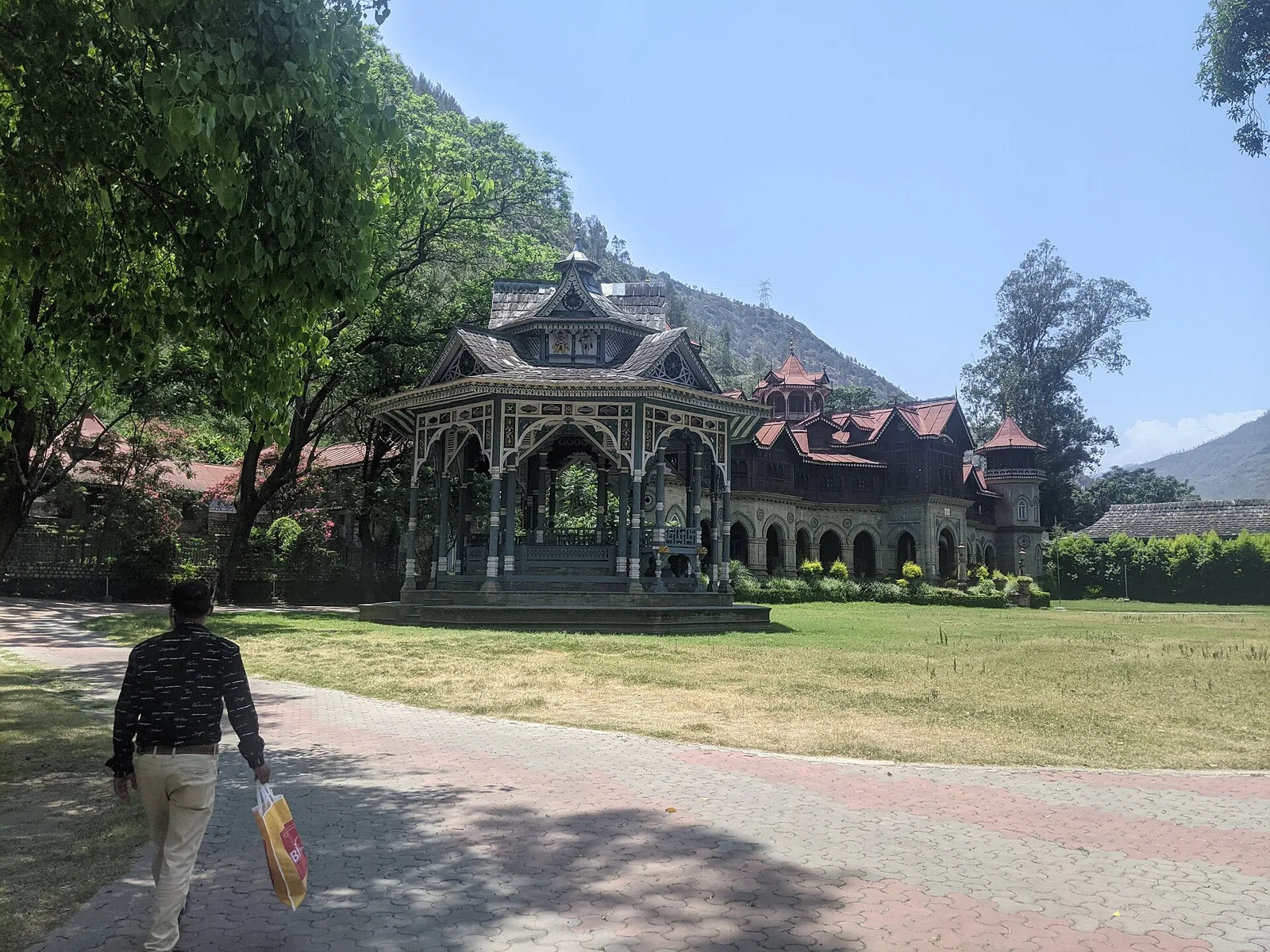
The main venue is the fairground in Rampur Bushahr, on the banks of the Sutlej, where stalls, stages and the animal market are set up. The Raghunath temple in the town is the heart of the religious activity and the place where the opening procession gathers. The Padam Palace, built for the former Bushahr rulers, stands in the town and gives a glimpse of royal history, although access may be limited. Beyond Rampur, the Bhimakali Temple at Sarahan is a half-day trip and is known for its wooden architecture and mountain backdrop. For a longer visit, you can continue up the Sutlej valley to Kinnaur and see the villages from which many of the traders come. A walk along the river in the morning, before the fair opens, is a quiet way to take in the setting.

Visitor guide

  • Getting there. Rampur is about 130 km from Shimla by road on the Hindustan–Tibet highway, a journey of four to five hours. The nearest airport is at Shimla (Jubbarhatti), and the nearest main railheads are Kalka and Shimla.
  • Where to stay. Rampur has a number of hotels and guest houses, which fill during the fair, so book ahead. Sarahan, about 40 km away, is a scenic alternative.
  • What to wear and pack. November nights are cold, often near freezing. Pack thermals, a down jacket, a woollen cap, gloves and shoes with a good grip.
  • Etiquette. Bargaining is expected at the stalls, but stay polite. Ask before taking photographs of traders and their animals. Remove shoes at temples and dress modestly.
  • Safety and comfort. The highway can be affected by landslides or early snow, so check road conditions. Keep valuables safe in crowds, and be careful around animals in the market area.

Today and tomorrow

Lavi has moved from barter to modern retail. Factory-made goods now sit beside hand-woven wool, and the number of animals sold has dropped. Even so, the fair is a rare chance for artisans to sell directly and for communities of the upper valleys to meet. The task for the future is to keep the fair a place for local crafts and culture, not just for mass-produced goods, and to manage crowds and waste.

Nearby

Places to see around the festival