
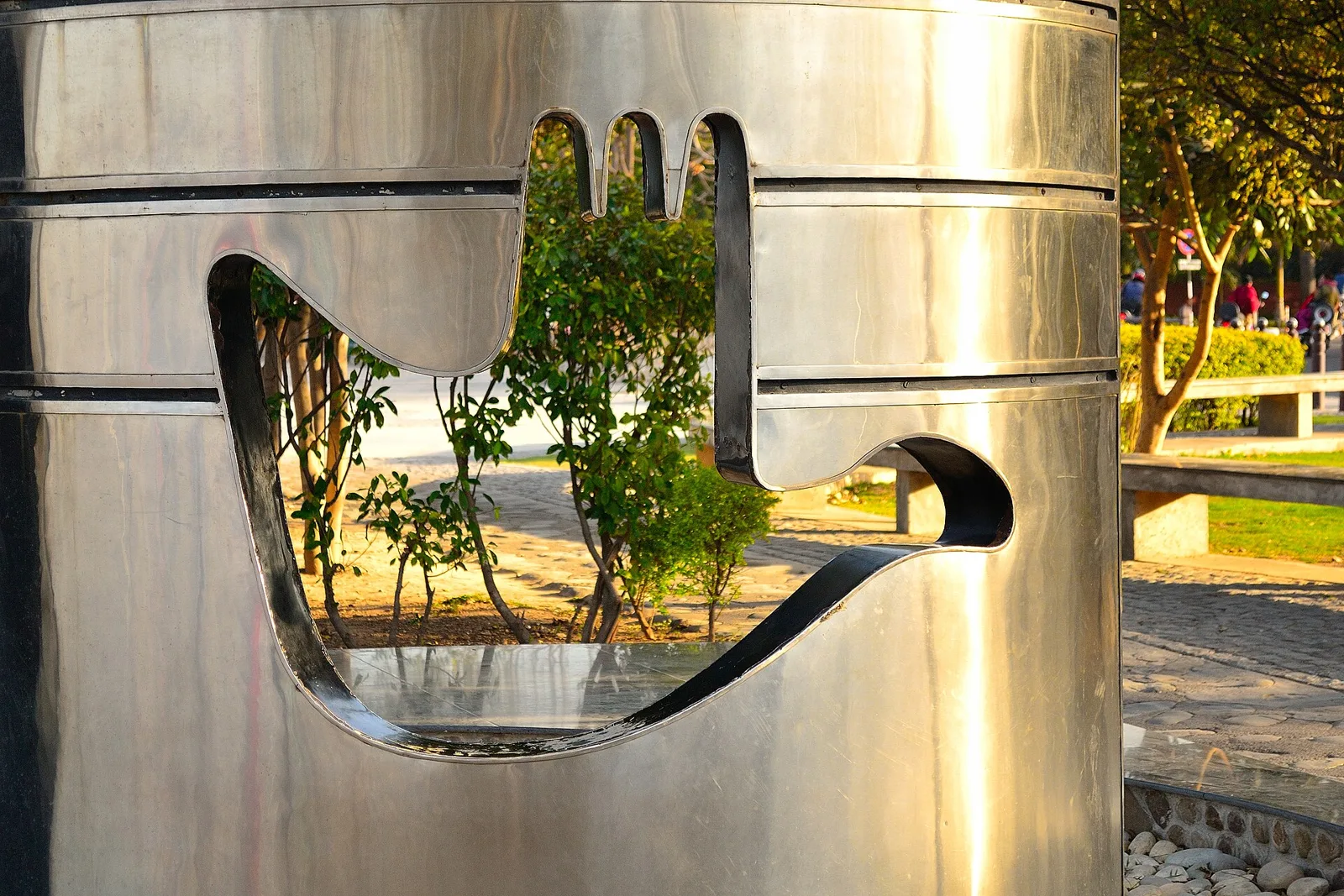
Open Hand Monument
The Open Hand Monument is a symbolic work by Le Corbusier in Chandigarh’s Capitol Complex, representing exchange, peace, prosperity and human unity. Visitors can see its large, wind-responsive metal form.
Key facts · verified by Ghumoopedia editors
- Type of place
- Heritage monument
- Best time to visit
- October to March
- Nearest railway station
- Chandigarh Junction · about 6 km (straight line)
- Nearest airport
- Chandigarh International Airport · about 10 km (straight line)
- Verified
- 21 Nov 2026
Plan a trip from Open Hand Monument — a day-by-day route through places nearby.
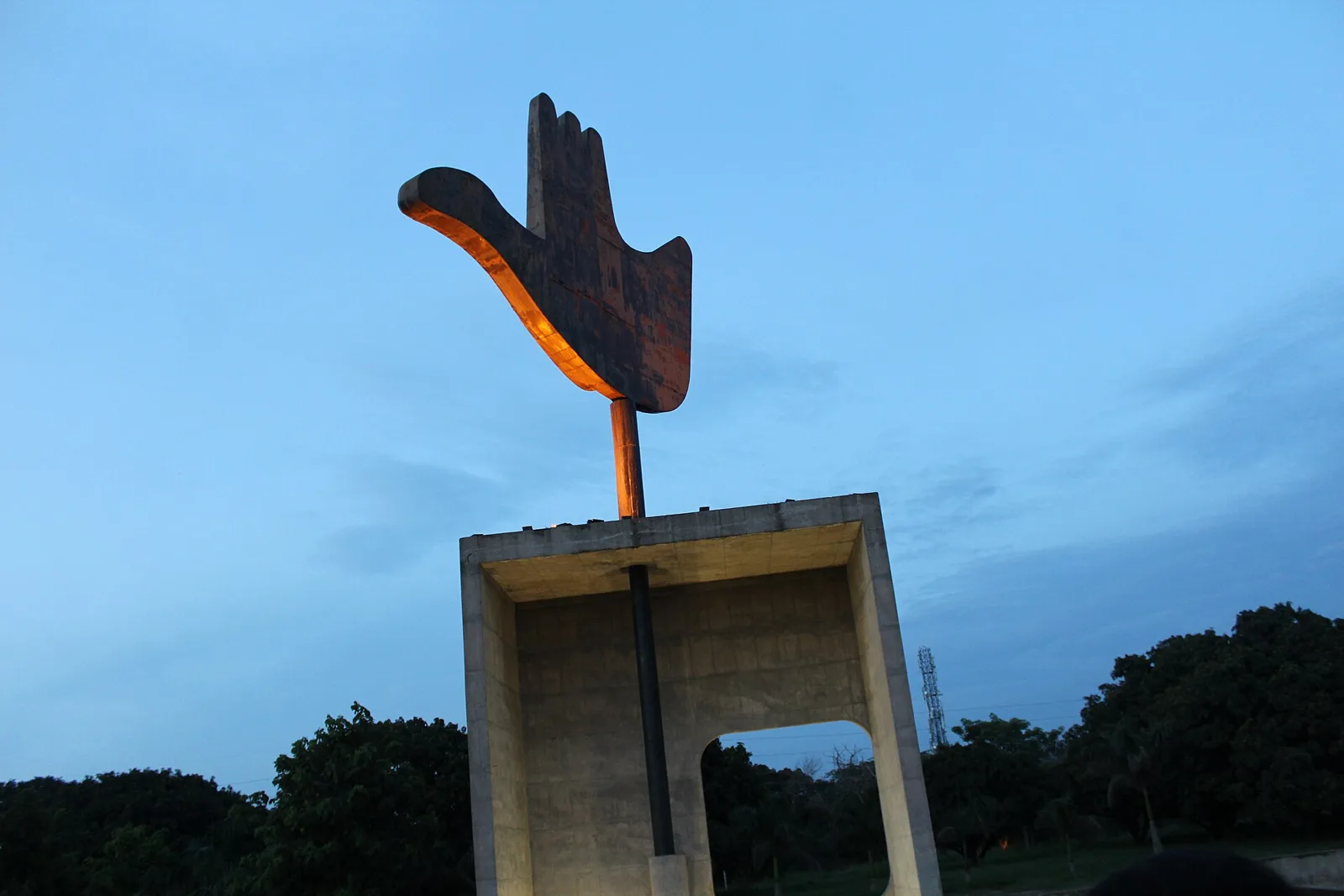
Within Chandigarh’s Capitol Complex, the monument stands as a symbolic creation of architect Le Corbusier. It also functions as the emblem of the Chandigarh government. Its open-hand design expresses both giving and receiving, as well as peace, prosperity and unity among people. The complete structure rises 26 metres (85 ft), making it the largest of Le Corbusier’s many sculptures based on this design. The metal section, fitted with vanes, is 14 metres (46 ft) tall and weighs 50 short tons (100,000 lb). It was built so that the wind can set it turning. Chandigarh is India's best-known planned city, designed by Le Corbusier in the 1950s with a grid of self-contained sectors, wide tree-lined avenues, the modernist Capitol Complex, Nek Chand's Rock Garden of recycled sculptures, Sukhna Lake and the Shivalik hills on its northern edge; it is the shared capital of Punjab and Haryana. Summers from April to June are very hot, often above 40 °C; the monsoon brings rain in July and August; winters are cold and foggy, especially in December and January. October–November and February–March are the most pleasant. The usual best time to visit is October to March. Timings, fees and access arrangements must be confirmed locally. For official information, see Chandigarh Tourism at https://chandigarhtourism.gov.in.
Why it matters
The Open Hand Monument is a civic symbol of Chandigarh and the emblem of the Chandigarh administration. Designed by Le Corbusier, it expresses the idea of a hand that gives and takes, associated with peace, prosperity and human unity. Its place in the Capitol Complex links it to the city’s post-independence plan and its modernist public architecture. UNESCO inscribed the Capitol Complex as part of the serial World Heritage property The Architectural Work of Le Corbusier, an Outstanding Contribution to the Modern Movement, in 2016; the monument is within that complex, rather than a separately inscribed property. It is an important local landmark and a recognised expression of Chandigarh’s planned-city identity.
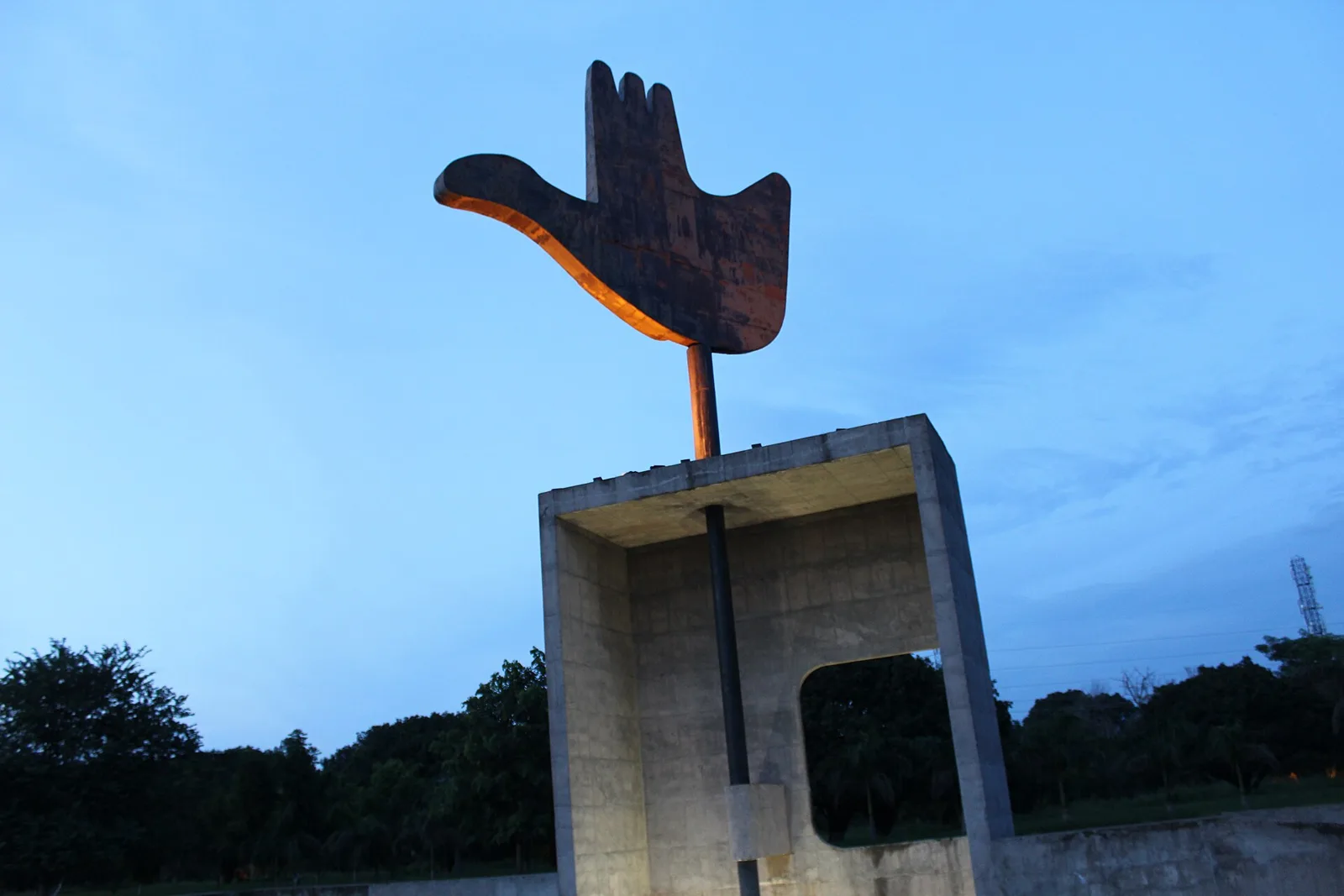
The Open Hand was conceived by Le Corbusier as part of Chandigarh’s Capitol Complex, the monumental administrative centre planned for the new capital shared by Punjab and Haryana. Chandigarh’s development began in the 1950s, after the partition of India created the need for a new capital for Indian Punjab. Le Corbusier and his team designed the city and its principal government buildings, while Indian architects and public agencies carried out much of the work on the ground. The hand was intended as more than a sculpture: its open form represented exchange and the possibility of opposing ideas coexisting. Though part of the original vision, the monument was realised later, in 1985, after Le Corbusier’s death. It became an emblem of the Chandigarh administration and a prominent feature of the Capitol Complex. The complex was inscribed by UNESCO in 2016 as part of a World Heritage property recognising Le Corbusier’s architectural work. The monument remains in its original civic setting. Specific restoration records are not consistently available to visitors, so check current conservation or access notices before travelling.
Origin stories & folklore
There is no widely documented local legend about the monument’s origin. Its meaning is instead explained through Le Corbusier’s stated symbolism: an open hand that gives and takes, representing peace, prosperity and the unity of humankind. Visitors may encounter different personal readings of the gesture, including welcome, generosity or exchange, but these should be understood as interpretations rather than established folklore. The monument’s movement in the wind can add to the impression that the hand is responsive to its surroundings. For the most reliable account of its intended meaning, look for official interpretation on site or ask an authorised guide.
Architecture & design
The monument is a large modernist sculpture within the open civic landscape of Chandigarh’s Capitol Complex. Its defining feature is a broad, open palm raised above the ground, designed by Le Corbusier as a simple, legible symbol rather than a naturalistic figure. The overall structure stands about 26 metres (85 feet) high. Its metal hand and vane assembly is about 14 metres (46 feet) high and weighs approximately 50 short tons. Designed to turn with the wind, the metal form makes movement part of the work’s engineering and meaning. Its scale is balanced against the spacious setting and the monumental government buildings nearby. The spare construction and lack of ornamental carving reflect the modernist character of the Capitol Complex. Visitors can view it from the surrounding open area, subject to current security boundaries and access arrangements.
Important objects & sculptures
The principal object to see is the monumental open hand itself, especially the palm and the metal vane assembly designed to turn in the wind. The work is not a shrine and has no idol or ritual offering tradition. Its significance rests on the gesture and the idea of giving and taking, rather than on detailed carving or a collection of smaller artefacts. Look for any official interpretation panels in the visitor-accessible area; their availability and placement can change. The wider setting is also worth noticing: the hand belongs to the Capitol Complex landscape, where open space and monumental civic buildings form part of the experience.
Explore Open Hand Monument slowly and read the interpretation boards, or hire an authorised guide to understand its history. Check opening days, ticket counters and camera rules in advance; many monuments and museums close on one weekday and on some public holidays. Early morning gives softer light, cooler air and smaller crowds. A comfortable itinerary is one main visit in the morning, a local meal at midday and a short nearby stop before an afternoon return. Visit gardens and Sukhna Lake in the early morning or evening; spend the hottest hours in a museum. Use the district list on this site to find other places in Chandigarh, but check the route and its condition before combining stops. If a festival is on — such as the Rose Festival in February, the Chrysanthemum Show in December, the Mango Festival in summer or Teej — transport and stays can be busy, and the experience can be unforgettable. Keep the city's gardens clean, and use the bins provided.
Suggested itineraries
Half day: Join an authorised Capitol Complex visit; see the Open Hand Monument and, where access permits, the principal government buildings; allow time for interpretation and photographs. Full day: Visit the Capitol Complex in the morning; pause for a meal; spend the afternoon at the Rock Garden and finish with a relaxed walk by Sukhna Lake. Gentler option: Arrange a vehicle drop-off at the permitted visitor point, focus on the monument and nearby accessible viewpoints, and keep the rest of the visit seated or vehicle-based; confirm the route and walking conditions in advance.
The monument is a civic landmark rather than a place of worship or a regular venue for folk performance. Its symbolism is often discussed by residents, students, architecture enthusiasts and visitors as part of Chandigarh’s identity as a planned city. Hindi and Punjabi are widely used in the city, alongside English in many official and visitor settings. Chandigarh’s everyday culture reflects both Punjabi traditions and its role as a regional administrative and educational centre. Visitors should follow security instructions, avoid disturbing official activity and treat the public landscape respectfully. Guided visits can help explain how the monument fits into the city’s planning and architectural history.
Festivals & events
The Open Hand Monument is not known as the regular venue for a major annual festival. Chandigarh’s seasonal events can nevertheless affect visitor numbers and traffic around the city. The Rose Festival is generally held in February, while the Chrysanthemum Show is usually associated with December; summer also brings events such as the Mango Festival. Teej is observed in the region, with celebrations varying by venue and year. These events are held at designated locations, not necessarily at the Capitol Complex. Check the city’s current event information before combining a monument visit with a festival, as transport and accommodation may be busier.
Local food in Chandigarh includes Punjabi dhaba food such as dal makhani, sarson da saag with makki di roti, butter chicken, chole bhature and amritsari kulcha, lassi, and the cafés and food streets of Sectors 17, 22 and 35. Ask what is fresh that day; many small eateries cook a limited daily menu. The sector markets have food for every budget, from street-side chole bhature to cafés; Sector 35 is known for Punjabi restaurants. Remote sites may have no restaurant at all. Carry water and snacks, eat a proper breakfast before long journeys, and ask your accommodation for a packed lunch if you are heading out early. Try a home-cooked or local meal when you can — it is often the best food on the route. Choose busy, clean places, drink sealed or filtered water, and carry your packaging back with you.
Shopping & local experiences
There is no need to expect a large souvenir market at the monument itself. For Chandigarh-themed keepsakes, local crafts or everyday shopping, look in the city’s established commercial areas, including Sector 17 Plaza and markets in other sectors. Visitors may find locally made items, textiles, small handicrafts and books on Chandigarh’s architecture. Food is part of the wider experience: seek out Punjabi dishes and the city’s diverse cafés and restaurants outside the Capitol Complex. Check whether shops or food outlets are open before making them part of a tight itinerary.
October to March
The nearest principal railway station by straight-line distance is Chandigarh Junction, roughly 6 km away. The nearest operating airport by straight-line distance is Chandigarh International Airport, roughly 10 km away. These figures are calculated from map coordinates — actual road distance is longer. Chandigarh International Airport has flights from most metros, and Chandigarh Junction has fast trains from Delhi such as the Shatabdi and Vande Bharat expresses. Interstate buses run from the Sector 17 and Sector 43 bus stands. For the final leg, CTU city buses, app cabs, autos and rented bicycles on the city's cycle tracks cover the local area. A private taxi gives more flexibility for spread-out sights. When comparing train, bus and flight, count the complete door-to-door time: a flight saves the most time only if the onward transfer is short, while an overnight train can save a hotel night. For Chandigarh, a morning Shatabdi or Vande Bharat train from New Delhi (about three to four hours) is often as quick as flying once airport time is counted, and lands in the city; flights save time from distant cities. Book your return before you leave, because seats fill quickly on weekends, festivals and holidays. Current train numbers, timings, return services, ferry departures and fares are not listed here; check IRCTC and NTES for trains, the airline's own schedule for flights and the official operator for ships and ferries. No permit is needed to visit Chandigarh. Visits to the Capitol Complex (a UNESCO World Heritage Site) are by guided tour only: register at the tourist information point with your original photo ID, and expect security checks and limited days and timings. Traffic rules are strictly enforced, including helmets for all two-wheeler riders and seatbelts.
Confirm onward and return timings on IRCTC / NTES, the state bus operator or your airline before travel. A dash means current timings or fares have not been verified.
Getting around
The Capitol Complex is within Chandigarh’s urban area and can be reached by city bus, auto-rickshaw, app-based cab or taxi. A taxi or cab is convenient if you plan to combine the visit with attractions spread across the city. Local buses serve major sectors, but check the route and stop nearest the current visitor entrance. Walking within the complex may involve open, exposed stretches, so allow time and carry water. Parking availability and permitted drop-off points can be affected by security arrangements; follow posted directions rather than assuming you can drive up to the monument.
Hours, tickets & permissions
Access to the monument is governed by the Capitol Complex’s visitor arrangements and security rules. Entry may require advance registration, an authorised guided visit or identity checks, depending on current policy. Ticketing, camera permissions and access to particular parts of the complex can also vary. There may be restrictions during official events or security operations. Confirm current visiting hours, fees, entry requirements and photography rules with the managing authority or Chandigarh Tourism before setting out; do not assume that access is unrestricted just because the monument is visible from nearby public areas.
Facilities
Facilities within the Capitol Complex may be limited or subject to security controls. Toilets, drinking water and visitor assistance are usually easier to find at designated visitor facilities or nearby public areas; check locally before relying on them. Food outlets, shops and ATMs are more likely to be found outside the complex, particularly in nearby sectors. Parking and drop-off arrangements may change with security requirements. Authorised guides or organised visits may be available, but confirm how to book and what is included through official visitor information. Carry water and any essentials you need for the visit.
Accessibility
The monument is viewed from an open civic setting, but the visit can involve walking across broad, exposed spaces and following a route set by security staff. Shade may be limited around the monument, and the walking surface or permitted route can vary. Do not assume that every area has step-free access, ramps or seating. Wheelchair users, visitors with strollers and people who find long walks difficult should contact the visitor authority beforehand to ask about the current route, drop-off points and assistance. Older visitors may prefer a short visit in cooler weather, with water and rest breaks planned.
No permit is needed to visit Chandigarh. Visits to the Capitol Complex (a UNESCO World Heritage Site) are by guided tour only: register at the tourist information point with your original photo ID, and expect security checks and limited days and timings. Traffic rules are strictly enforced, including helmets for all two-wheeler riders and seatbelts. Carry a photo ID at all times and save the emergency number 112 and your accommodation's contact offline. Summer heat and winter fog are the main weather risks — carry water and a hat in summer, and allow extra time for trains and flights in foggy weather. Watch your belongings in crowds and on public transport, and follow posted instructions.
Photography
Early morning often offers softer light and fewer people; late afternoon can also suit photographs, depending on access and weather. The open setting allows views of the hand against the sky, while wider compositions can include the Capitol Complex buildings. Photography rules may differ within this security-controlled site, and camera equipment or specific viewpoints may be restricted. Ask staff before photographing restricted areas or people at work. Do not fly a drone without explicit legal and site permission. Keep paths clear and be considerate of other visitors.
Choose a stay by the full journey to Open Hand Monument, not just the district name. Chandigarh has hotels in every range across the sectors, with the most choice near Sector 17, Sector 35 and the Industrial Area; Panchkula and Mohali next door add more options. In the hot months, check air-conditioning; in the monsoon, check that the property is reachable if roads flood or ferries are cancelled. Book in advance for weekends, festivals and the peak season (October to March). Confirm the exact location, meals included, check-in time and cancellation terms in writing. Avoid sending money to unverified contacts or touts at stations, airports and jetties. Carry some cash, as card and digital payments can be unreliable in remote areas.
The Open Hand Monument is part of Chandigarh’s Capitol Complex, where visitors may also see the High Court, Secretariat and Palace of Assembly when access rules permit. The Nek Chand Rock Garden is a major nearby attraction, known for sculptures made from recycled materials. Sukhna Lake offers a waterside walk and views towards the Shivalik hills. The Government Museum and Art Gallery provides a further stop for art and regional history, while Sector 17 Plaza is a central area for shops and food. Check travel routes and entry arrangements before combining multiple stops.
For couples, Open Hand Monument rewards a slow pace: arrive early for soft light and fewer crowds, share a local meal and keep the evening free. Sunset boating on Sukhna Lake, an evening in the Rose Garden, the Rock Garden's winding paths or dinner in Sector 26 makes the trip memorable. Public displays of affection can be frowned upon in conservative communities and at religious sites, so be discreet. Keep a buffer in your itinerary, because weather and transport can delay plans.
Q: How much time should I allow for the Open Hand Monument? A: Allow a short visit for the monument alone, or longer if you join a Capitol Complex tour and explore other buildings. Q: When is the best season to visit? A: October to March is generally more comfortable; summer can be very hot, while monsoon weather may bring rain. Q: Is entry free, and can I visit without a guide? A: Entry rules can change and may involve registration or an authorised visit. Confirm current requirements and fees with the managing authority. Q: Is the visit suitable for children and older visitors? A: It can be, but walking may be exposed and shade limited. Plan breaks and check the route and facilities in advance. Q: Where should I stay nearby? A: Chandigarh has accommodation options across the city. Choose a location that suits your onward transport and planned visits, and check current availability.
Be the first to share photos, stories, advice or a helpful contact for Open Hand Monument.
Loading…