
India Gate
India Gate is a New Delhi war memorial designed by Edwin Lutyens. Visitors come to see its inscriptions and memorial flame, while the site also hosts public demonstrations and Republic Day tributes.
Key facts · verified by Ghumoopedia editors
- Type of place
- Heritage monument
- Best time to visit
- October to March (check air quality from November to January)
- Verified
- 21 Nov 2026
Plan a trip from India Gate — a day-by-day route through places nearby.
At the eastern end of New Delhi’s ceremonial axis, beside Kartavya Path, stands India Gate, a memorial arch once called the All India War Memorial. Its designer, Sir Edwin Lutyens, drew on the form of ancient Roman victory arches, including Rome’s Arch of Constantine. The structure is also commonly likened to Paris’s Arc de Triomphe and Mumbai’s Gateway of India. The monument commemorates 74,187 Indian soldiers serving in the British Indian Army who died from 1914 to 1921. Their deaths occurred in the First World War, across places including France, Flanders, Mesopotamia, Persia, East Africa, Gallipoli, the Near and Far East, as well as in the 1919 Third Anglo-Afghan War. Inscribed on the arch are roughly 13,300 names of British Empire service personnel, among them soldiers and officers from the United Kingdom. After the 1971 Indo-Pakistani war, a memorial was placed beneath the arch: a black marble base bearing an inverted rifle and a soldier’s helmet, surrounded by four eternal flames. Known as Amar Jawan Jyoti, or Flame of the Immortal Soldier, it served as India’s Tomb of the Unknown Soldier from 1971 until 2019, when the Indian National War Memorial replaced it. India Gate is regarded as one of the country’s largest war memorials. Each Republic Day, the Prime Minister pays tribute at the site before the parade begins. The grounds also draw tourists and provide a setting for civil society protests. Delhi layers many historic cities — from the Delhi Sultanate and the Mughal capital to Lutyens' New Delhi — with Sufi shrines, gurdwaras, temples, busy markets and India's national monuments. Delhi has very hot summers from April to June, a humid monsoon from July to September and cold, foggy winters in December and January. Air quality is often very poor from late October to January. The usual best time to visit is October to March (check air quality from November to January). Timings, fees and access arrangements must be confirmed locally. For official information, see Delhi Tourism at https://delhitourism.gov.in.
Why it matters
India Gate is a prominent national war memorial in New Delhi, on the eastern side of the ceremonial avenue now called Kartavya Path. Its commemorative account records 74,187 Indian soldiers of the British Indian Army who died in the First World War and the 1919 Third Anglo-Afghan War. The arch also bears the names of around 13,300 British Empire servicemen. The memorial is part of the capital’s public and ceremonial landscape and a familiar place for visitors, commemorations and civic gatherings. The nearby National War Memorial, opened in 2019, honours members of India’s armed forces. India Gate is not a UNESCO World Heritage Site; check with the relevant authorities for its current conservation and access arrangements.
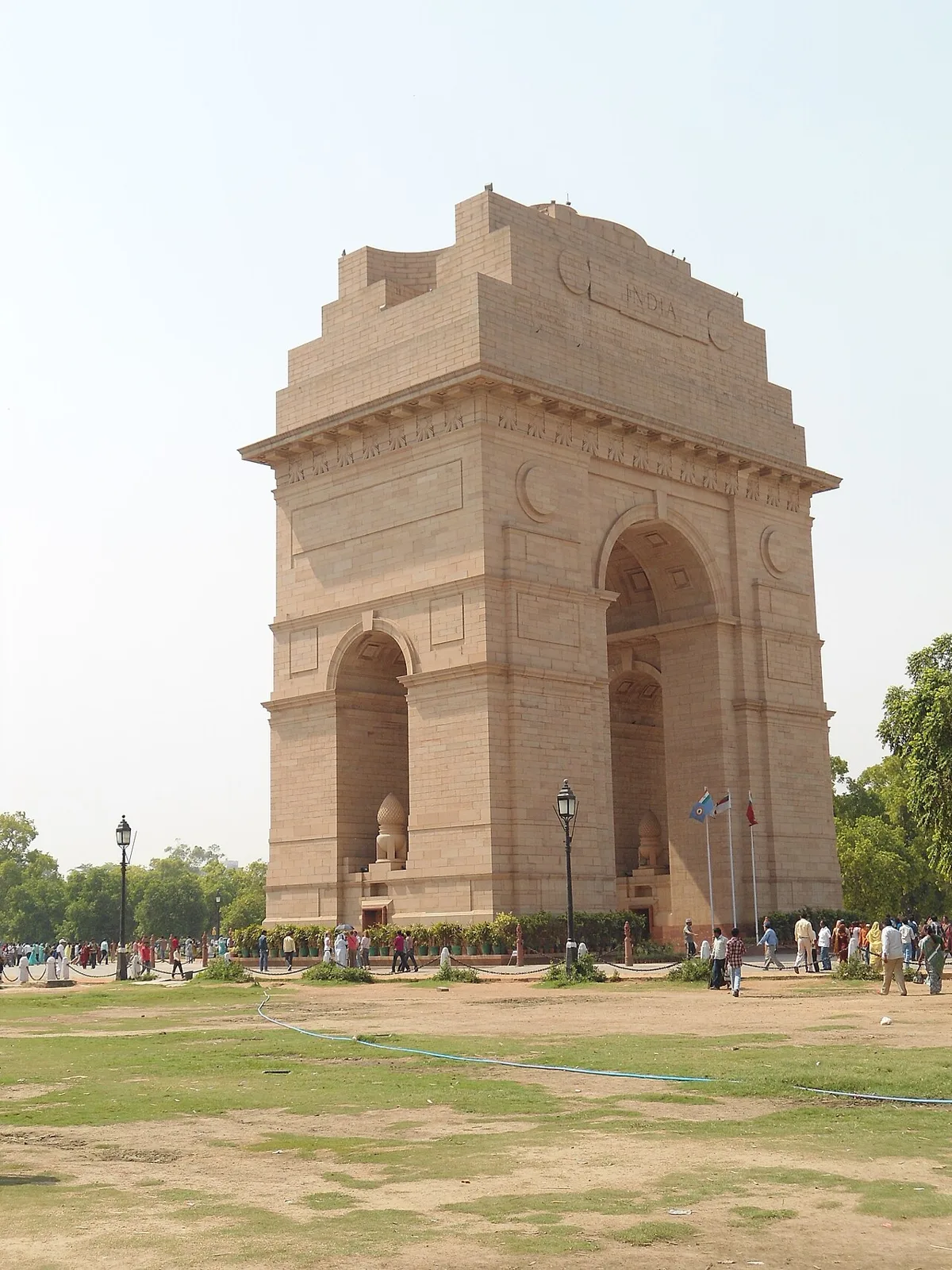
India Gate was commissioned as a memorial to Indian soldiers who died in the First World War and the 1919 Third Anglo-Afghan War. Designed by British architect Sir Edwin Lutyens, it was originally known as the All India War Memorial. Its foundation stone was laid in 1921, and it was inaugurated in 1931 by Viceroy Lord Irwin. The memorial commemorates service and deaths across several theatres, including France, Flanders, Mesopotamia, East Africa and the Near and Far East. Around 13,300 British Empire servicemen’s names are inscribed on the arch. After the 1971 Indo-Pakistani War, the Amar Jawan Jyoti was established beneath it as a tribute to Indian soldiers. Its flame was ceremonially merged with the flame at the National War Memorial in January 2022; the National War Memorial itself had opened in 2019. India Gate remains a setting for public remembrance and national ceremonies. Maintenance and conservation are ongoing, but details of current work or access restrictions should be checked locally.
Origin stories & folklore
India Gate is a modern war memorial, and no widely established local origin legend is associated with its construction. Its meaning comes principally from the recorded history of the soldiers it commemorates. Visitors may hear the arch described as a symbolic gateway or as a reminder of sacrifice, but these are interpretations rather than documented folklore. The Amar Jawan Jyoti, once located beneath the arch, became a powerful focus of public remembrance after its establishment in 1972. Since its flame was merged with that of the National War Memorial in 2022, accounts that describe it as still burning beneath India Gate are outdated. Treat stories about hidden symbols or supernatural events as unverified unless a reliable source supports them.
Architecture & design
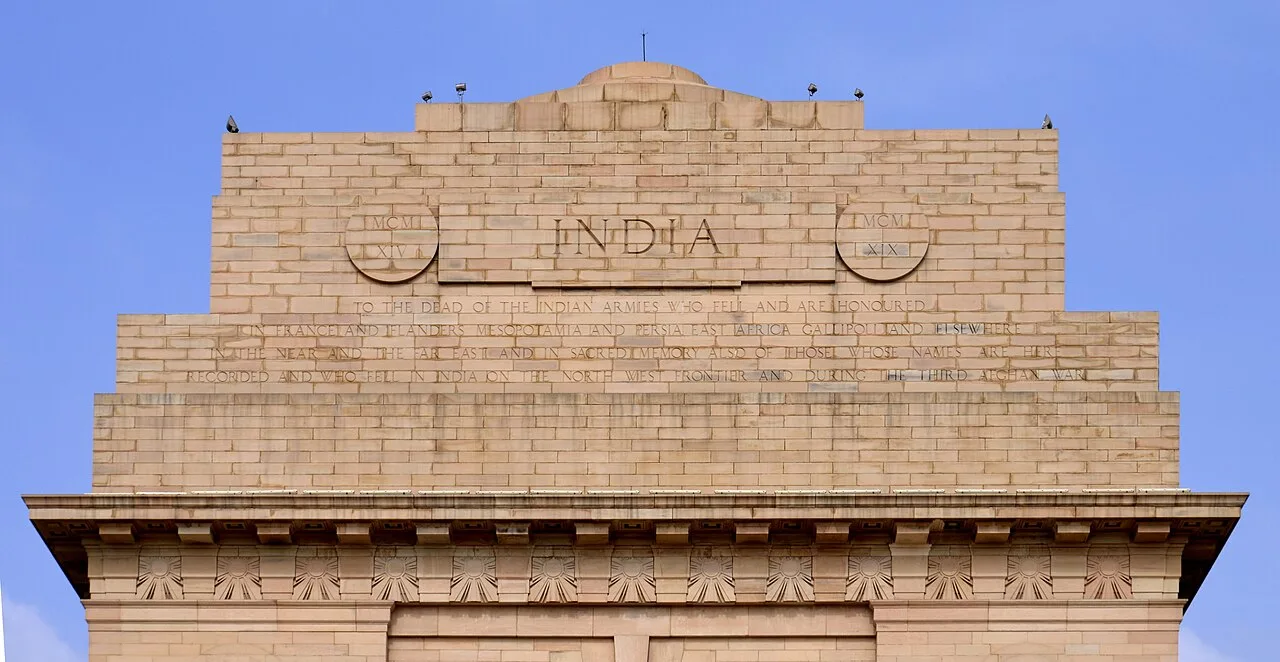
Designed by Sir Edwin Lutyens, India Gate is a freestanding triumphal arch drawing on the monumental language of classical Roman arches. It is about 42 metres high and stands on a broad, low base in the open ceremonial landscape of New Delhi. Red and pale stone give the structure a restrained contrast, while the massive central opening frames views along the avenue. Its symmetrical composition, heavy piers and projecting cornice create a formal, monumental profile without extensive sculptural decoration. The arch sits within a planned urban setting of broad roads and open spaces, rather than a dense historic street. Its scale is intended to be legible from a distance as well as up close. The memorial is often compared with the Arc de Triomphe in Paris, though the two differ in design and context. Inscriptions and carved lettering are integral to its commemorative purpose.
Important objects & sculptures
Look for the carved inscriptions on the arch, including the memorial dedication and the names of servicemen. The name lists are part of the structure, although some lettering may be difficult to read from ground level or in changing light. India Gate is not a museum and does not contain a visitor collection of movable objects. The Amar Jawan Jyoti’s former location beneath the arch is historically significant, but its flame was merged with the National War Memorial flame in 2022. The National War Memorial nearby has its own commemorative design and should not be confused with the inscriptions on India Gate. Do not touch or climb on the memorial surfaces; follow any barriers and instructions in place.
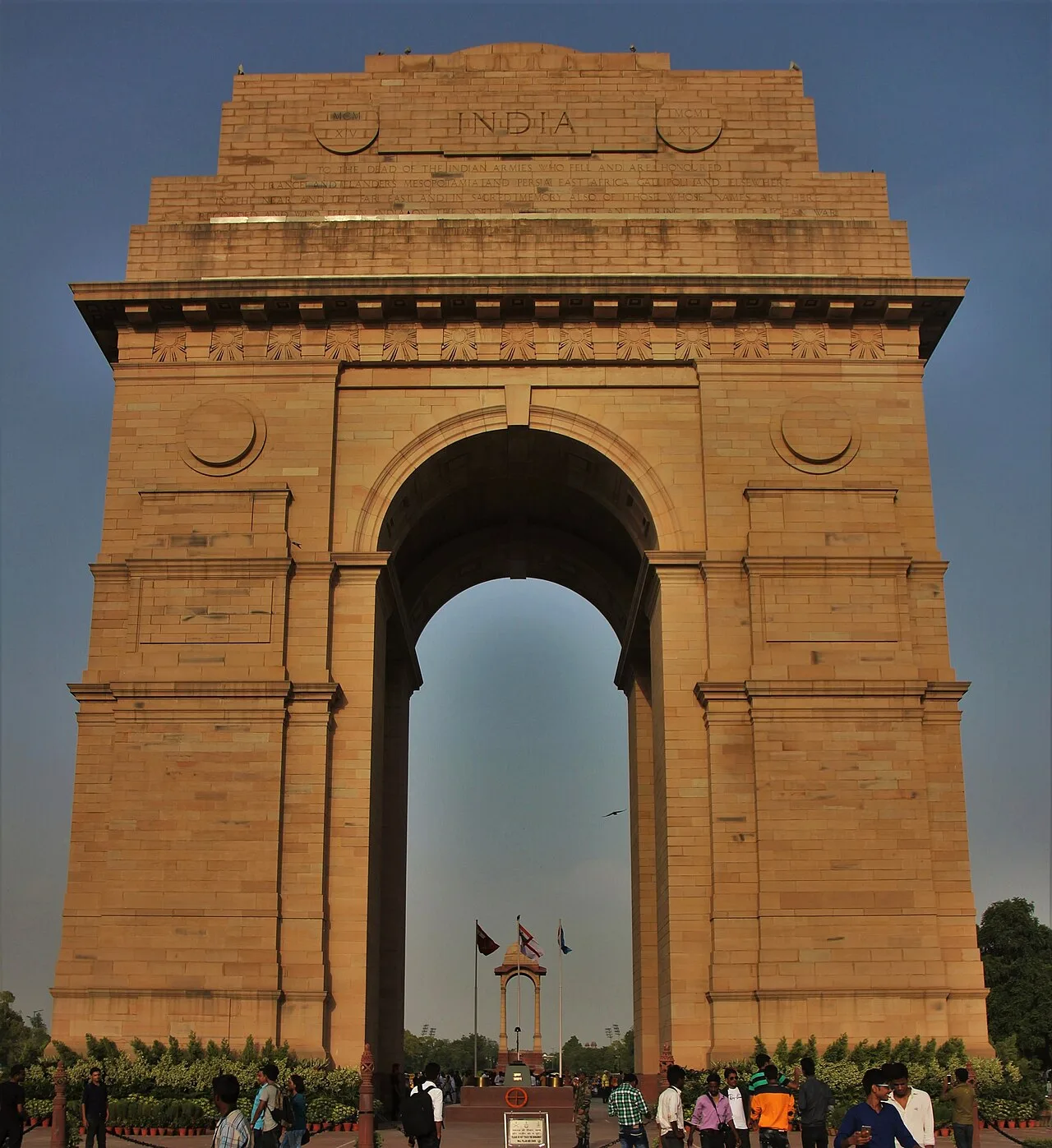
Explore India Gate slowly and read the interpretation boards, use the official audio guide where available or hire an authorised guide to understand its history. Check opening days, ticket counters and camera rules in advance; many monuments and museums close on one weekday and on some public holidays. Early morning gives softer light, cooler air and smaller crowds. A comfortable itinerary is one main visit in the morning, a local meal at midday and a short nearby stop before an afternoon return. Use the district list on this site to find other places in New Delhi, but check the route and its condition before combining stops. If a festival or fair is on, roads and stays can be busy — and the experience can be unforgettable. Leave no litter: many sites are protected by the communities around them.
Suggested itineraries
Half day: Spend 45–60 minutes at India Gate reading the inscriptions and viewing the arch; allow 30–45 minutes at the National War Memorial; take a relaxed walk along an accessible section of Kartavya Path. Full day: Begin with India Gate and the National War Memorial (about 2 hours); continue to the National Gallery of Modern Art (1–2 hours); pause for lunch; visit Purana Qila or the National Museum (allow 2–3 hours, checking opening arrangements). Gentler option: View India Gate from a convenient drop-off point, take a seated break nearby, and choose one nearby indoor attraction rather than walking the full ceremonial avenue.
India Gate is both a place of remembrance and a popular public gathering point. Residents and visitors come to walk along the avenues, view the monument and spend time in nearby open spaces; access and activity can change during ceremonies or security restrictions. National commemorations give the area a formal character, while ordinary visits are more informal. Delhi’s languages are heard here, especially Hindi and English, alongside languages spoken by visitors from across India. There is no single dress code for a visit, but modest, weather-appropriate clothing is practical. The site is not a venue for a regular traditional music or dance performance, and visitors should keep noise and behaviour respectful around memorial areas.
Festivals & events
Republic Day in January brings major national ceremonies and parade activity along Kartavya Path and around the central government district; security arrangements can restrict access and roads. Independence Day in August is also marked across Delhi, though India Gate is not the main flag-hoisting venue. Diwali, usually in autumn, and year-end holidays can draw larger crowds to central Delhi’s public spaces. These occasions do not guarantee a festival programme at the monument itself. Check official announcements before travelling, since event security, traffic controls or temporary closures may affect a visit.
Local food in Delhi includes chaat, stuffed parathas and jalebi in Chandni Chowk, chole bhature, kebabs and Mughlai dishes around Jama Masjid, butter chicken, momos and kulfi. Ask what is fresh that day; many small eateries cook a limited daily menu. Vegetarian travellers eat very well across this region, and most towns also have non-vegetarian options. Street food is part of the Delhi experience: pick busy stalls with fast turnover, prefer freshly cooked items and drink sealed or filtered water. Try a home-cooked or dhaba meal when you can — it is often the best food on the route. Choose busy, clean places and carry your packaging back with you.
Shopping & local experiences
There is no need to expect a permanent craft market at the memorial itself; vendors and access rules can vary. For books, gifts and everyday shopping, visitors can explore Connaught Place, Janpath or Khan Market, checking local conditions before travelling. Delhi’s markets offer textiles, jewellery, handicrafts and souvenirs, but compare quality and ask about materials before buying. Food is part of the wider outing: central Delhi has cafés, restaurants and street-food options, though temporary vendors may not always be present near India Gate. Choose clean, busy food outlets and dispose of litter responsibly.
October to March (check air quality from November to January)
Within Delhi, the Delhi Metro is usually the quickest and cheapest way to reach India Gate; find the nearest station on the official DMRC website or app, and use an app-based auto, e-rickshaw or cab for the last stretch. Road traffic is heavy at peak hours, so allow extra time and avoid driving yourself in Old Delhi lanes. Long-distance trains use New Delhi, Old Delhi, Hazrat Nizamuddin and Anand Vihar terminals, and flights use Indira Gandhi International Airport. The nearest of these railway terminals is New Delhi, roughly 5 km away in a straight line. Indira Gandhi International Airport, Delhi is roughly 15 km away in a straight line. When comparing train, bus and flight, count the complete door-to-door time: a flight saves the most time only if the onward road transfer is short, while an overnight train can save a hotel night. Book your return before you leave, because seats fill quickly on weekends, festivals and holidays. Current train numbers, timings, return services and fares are not listed here; check IRCTC and NTES for trains and the airline's own schedule for flights. No permit is needed to visit Delhi. Many monuments are protected by the Archaeological Survey of India and need an entry ticket, often cheaper when bought online; the Red Fort and several museums close on Mondays. Security checks are routine at metro stations and major sites.
Confirm onward and return timings on IRCTC / NTES, the state bus operator or your airline before travel. A dash means current timings or fares have not been verified.
Getting around
Delhi Metro is usually a convenient way to reach the central area; check the Delhi Metro Rail Corporation map or app for the most suitable station and route, then continue on foot, by auto-rickshaw, e-rickshaw or cab as conditions allow. Buses serve parts of central Delhi, but routes and stops may change during events. Walking between nearby landmarks is possible, though distances across the broad avenues can feel longer than they look. Road traffic is often heavy, and security closures can divert vehicles. Parking is limited or restricted near the monument, so avoid relying on a space close to the arch.
Hours, tickets & permissions
India Gate is an outdoor public monument, but access to the arch, adjoining lawns and nearby roads may be controlled or temporarily restricted for security, ceremonies or maintenance. Entry arrangements can differ from those at ticketed museums and monuments. Do not assume that every surrounding area is open, or that photography rules are identical across the precinct. There is no special dress requirement generally associated with viewing the exterior, but security staff may issue instructions. Confirm current hours, any fees, camera rules and access conditions with the relevant managing authority before setting out.
Facilities
Facilities immediately beside the arch may be limited or affected by event controls. Public toilets and food options are usually available in the wider central area, but their locations and operating status can change; check locally. Carry drinking water, especially in warm weather, and use bins where provided. Nearby cafés and restaurants offer more dependable meal choices than relying on temporary vendors. Parking is not assured close to the monument. Authorised guides may be available for Delhi sightseeing, but confirm credentials before hiring one. ATMs are more likely to be found in nearby commercial areas than at the memorial itself.
Accessibility
The ceremonial precinct is broadly level, but reaching the arch can involve a long walk across open spaces and roads. Paving, kerbs, lawns and temporary barriers may make some routes difficult for wheelchair users, people using walking aids and strollers. Do not assume that a particular ramp or step-free crossing is available; check the route locally and ask staff about current access. Shade and seating can be limited in exposed areas, making heat a concern for older visitors and young children. A drop-off closer to the intended viewing point may help, subject to traffic and security rules. Allow extra time and plan rest stops.
No permit is needed to visit Delhi. Many monuments are protected by the Archaeological Survey of India and need an entry ticket, often cheaper when bought online; the Red Fort and several museums close on Mondays. Security checks are routine at metro stations and major sites. Carry a photo ID at all times and save the emergency number 112 and your accommodation's contact offline. Summer heat and winter smog are the main health risks: drink plenty of water, check the air-quality index and wear a good mask on poor-air days. Watch your belongings in crowded markets and metro coaches. Respect community rules, private property and posted instructions. Follow local guidance if access changes.
Photography
The arch is photogenic in the softer light of early morning or late afternoon, when the stone and avenue may appear less harsh than in midday sun. Try views from the surrounding public spaces while keeping clear of roadways, barriers and ceremonial areas. Personal photography is commonly practised outdoors, but follow any temporary restrictions or instructions from security staff. Do not use a drone without the required permissions; the central government district is security-sensitive. Ask before photographing identifiable people at close range, and be especially considerate during commemorations or moments of prayer and remembrance.
Choose a stay by the full journey to India Gate, not just the district name. Central areas such as Connaught Place, Paharganj and Karol Bagh, or areas near your metro line, save time; check the exact location and how far the hotel is from the nearest metro station. In summer, check air-conditioning or coolers; in December and January, check heating and hot water. Book in advance for weekends, festivals and the peak season (October to March (check air quality from November to January)). Confirm the exact location, meals included, check-in time and cancellation terms in writing. Avoid sending money to unverified contacts or touts at stations. Carry some cash, as card and digital payments can be unreliable in remote areas.
The National War Memorial is beside India Gate and is the most direct related visit. Kartavya Path and the Central Vista landscape extend west towards Rashtrapati Bhavan, though access may be restricted during official events. The National Gallery of Modern Art is nearby, as is the National Museum farther into central Delhi. Purana Qila is another well-known historic site within the wider area. Connaught Place offers shops and places to eat, while Khan Market is another central option for dining and browsing. Check opening arrangements and routes before combining stops, as traffic controls can affect even nearby journeys.
For couples, India Gate rewards a slow pace: arrive early for soft light and fewer crowds, share a local meal and keep the evening free. Evenings at a garden, heritage site or a rooftop café near the monuments make a good end to the day. Public displays of affection can be frowned upon in conservative communities and at religious sites, so be discreet. Keep a buffer in your itinerary, because weather and traffic can delay plans.
Q: How much time should I allow for India Gate? A: Allow about an hour to view the arch and inscriptions at a relaxed pace; add time for the National War Memorial or a walk along Kartavya Path. Q: When is a good season to visit? A: October to March is generally more comfortable, but winter air quality can be poor. Check conditions, especially from November to January. Q: Is there an entry ticket? A: The exterior is generally visited as an outdoor public site, but access controls can apply. Confirm current rules and any fees with the managing authority. Q: Is the visit suitable for children and older visitors? A: It can be, but open areas involve walking and may have limited shade or seating. Plan rests and check the route for barriers or closures. Q: Where can I stay nearby? A: Central Delhi areas such as Connaught Place have accommodation options and transport links. Compare location, access and current travel conditions before booking.
Be the first to share photos, stories, advice or a helpful contact for India Gate.
Loading…