
Jama Masjid, Delhi
Jama Masjid is a major Mughal-era mosque in Old Delhi, known for its scale, continuing religious use and historical role. Visitors come to see a landmark closely associated with the city’s past.
Key facts · verified by Ghumoopedia editors
- Type of place
- Temple / pilgrimage site
- Best time to visit
- October to March (check air quality from November to January)
- Verified
- 21 Nov 2026
Plan a trip from Jama Masjid, Delhi — a day-by-day route through places nearby.
In Delhi’s Central district, within India’s capital territory, this mosque bears the formal name Masjid-i-Jehan-Numa and is commonly called Jama Masjid. It is counted among India’s largest mosques. Shah Jahan commissioned its construction, carried out between 1644 and 1656. Syed Abdul Ghafoor Shah Bukhari, its first imam, led its inauguration. The mosque stood in Shahjahanabad, the Mughal capital now called Old Delhi, and served as the emperors’ mosque until the empire ended in 1857. The mosque expressed Mughal power across India and held political importance at various times under British rule. It remains in active use, with its religious role enduring beyond the end of the empire. The building is designated a Monument of National Importance and remains one of Delhi’s best-known landmarks, closely associated with Old Delhi’s character. Delhi layers many historic cities — from the Delhi Sultanate and the Mughal capital to Lutyens' New Delhi — with Sufi shrines, gurdwaras, temples, busy markets and India's national monuments. Delhi has very hot summers from April to June, a humid monsoon from July to September and cold, foggy winters in December and January. Air quality is often very poor from late October to January. The usual best time to visit is October to March (check air quality from November to January). Timings, fees and access arrangements must be confirmed locally. For official information, see Delhi Tourism at https://delhitourism.gov.in.
Why it matters
Jama Masjid, formally Masjid-i-Jehan-Numa, is an active congregational mosque and one of Old Delhi’s best-known Mughal landmarks. Built as the imperial mosque of Shahjahanabad, it reflects the religious and political life of Shah Jahan’s capital and remains an important place of worship for Delhi’s Muslim community. Its scale and prominent position have made it a defining feature of the historic city. The mosque also witnessed political change during British rule and after the end of the Mughal Empire. The mosque structure is recognised as a Monument of National Importance, as stated in the existing guide. It is not a UNESCO World Heritage Site in its own right.
The Mughal emperor Shah Jahan commissioned Jama Masjid for his new capital, Shahjahanabad, now part of Old Delhi. Construction took place between 1644 and 1656. Its first Imam, Syed Abdul Ghafoor Shah Bukhari, inaugurated the mosque. It served as the imperial mosque of the Mughal rulers and was both a place of worship and a visible expression of the dynasty’s authority. The mosque remained central to the religious and public life of the walled city as political power shifted. During the upheaval of 1857 and the end of Mughal rule, it became a site of political significance under British authority. The mosque continued to function as a place of Muslim worship in subsequent periods and remains active today. Its role has therefore extended beyond its original imperial setting: it is a historic monument as well as a living religious institution. The building has undergone upkeep and repairs over time, as is necessary for a busy historic structure; details of current conservation work should be checked with the managing authority.
Origin stories & folklore
Stories associated with Jama Masjid are often tied to the revered objects said to be kept at the mosque. Some accounts describe relics connected with the Prophet Muhammad, including a hair and other sacred items. These are matters of religious tradition and belief; visitors should not assume that such objects are on public display or accessible during a visit. The mosque’s popular name, Jama Masjid, refers to a congregational mosque, while its formal name, Masjid-i-Jehan-Numa, is commonly understood as “the mosque that reflects the world.” This evocative name is sometimes retold as a poetic description of the building’s grandeur, rather than as a supernatural origin story.
Architecture & design
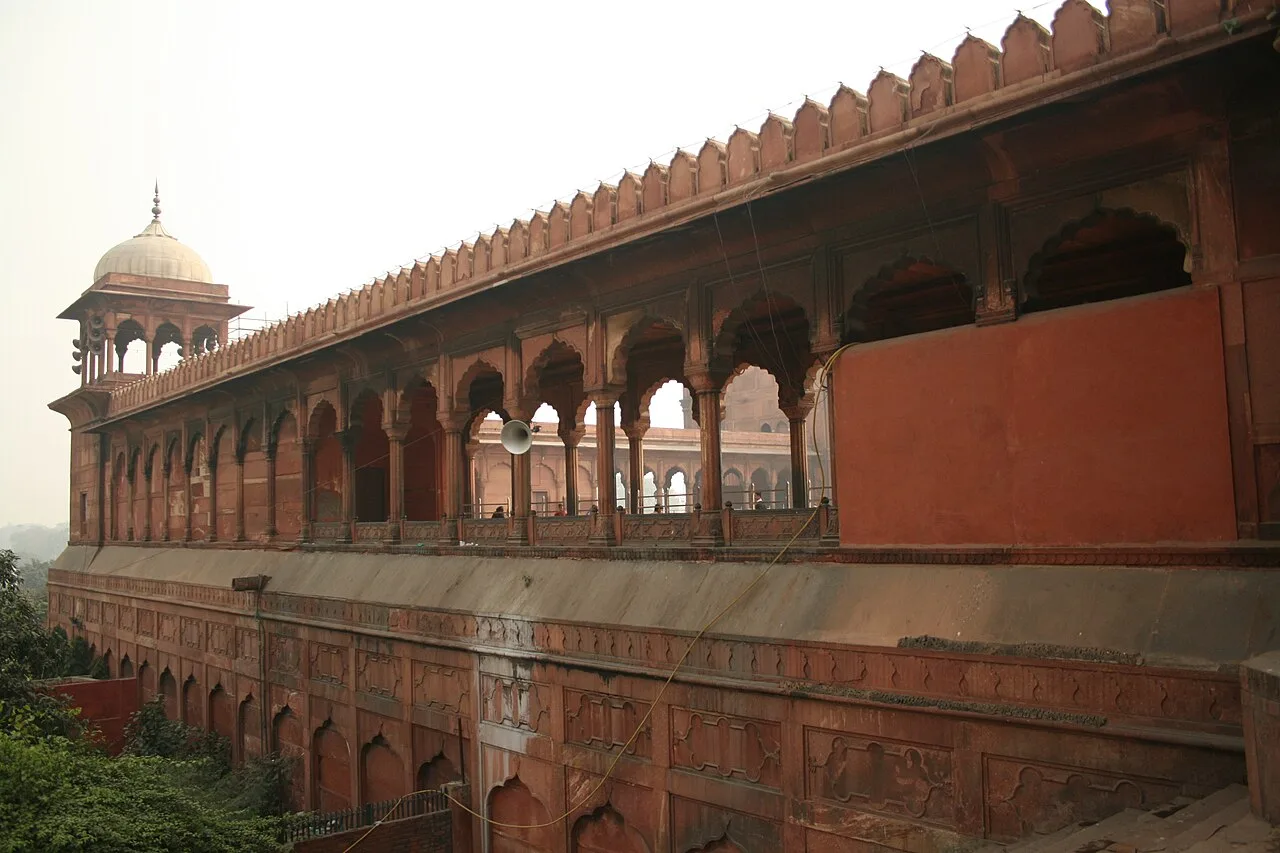
Jama Masjid is a major example of Mughal religious architecture, built principally of red sandstone with white marble detailing. Its broad courtyard is enclosed by arcades and entered through monumental gateways reached by flights of steps. At the western side, the prayer hall faces the direction of Mecca. The hall’s façade has a series of arches and a central high arch; above it rise three prominent marble-clad domes. Two tall minarets, marked by bands of red sandstone and white marble, frame the main structure. The plan accommodates large congregations while giving the courtyard an open, ceremonial character. Arched galleries, domed pavilions and carefully proportioned openings help organise the large complex. Calligraphic decoration and contrasting stonework provide detail without obscuring the overall symmetry. The mosque’s elevated position and broad approach make it a striking feature of the dense Old Delhi streetscape.
Important objects & sculptures
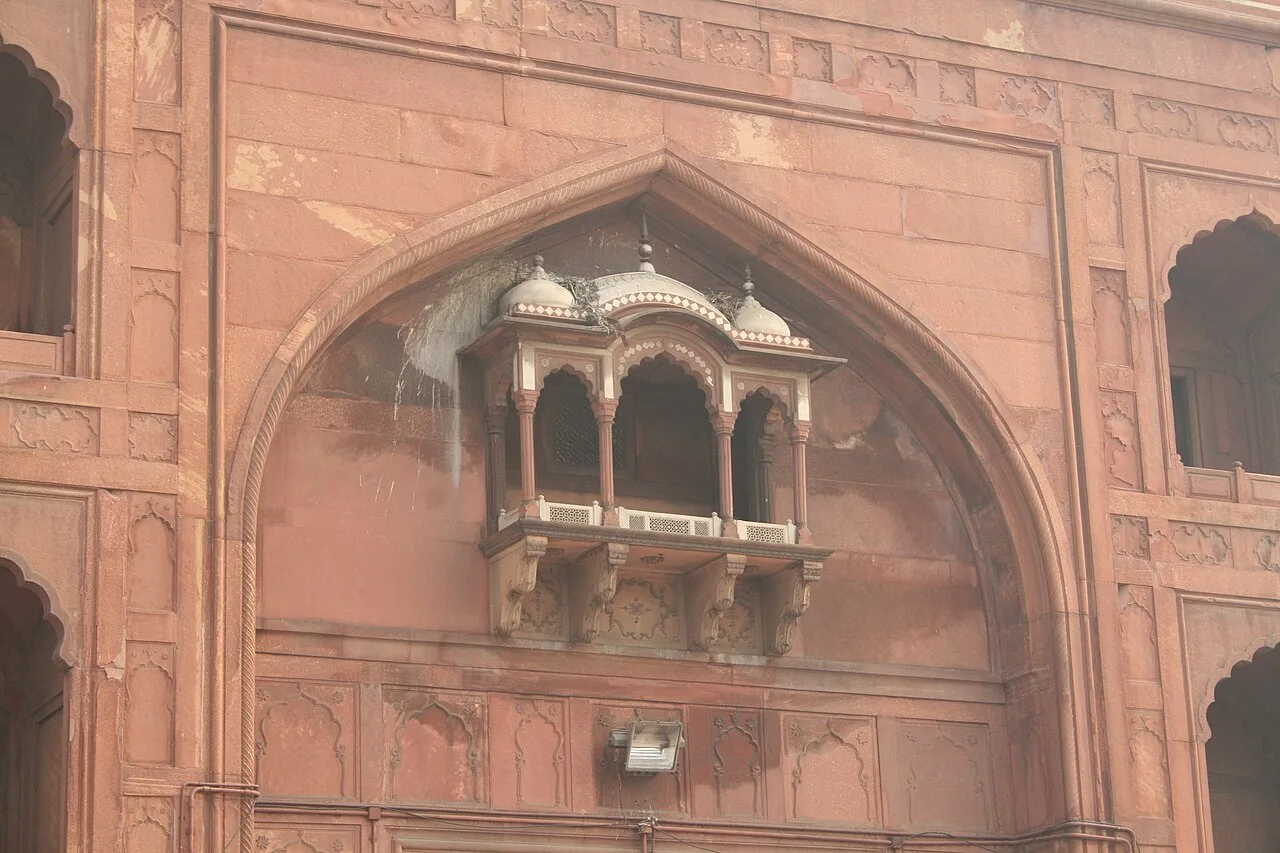
Look for the mosque’s stone and marble detailing, including calligraphic inscriptions, carved ornament and the contrasting bands on the minarets. The domes and the prayer hall’s arched façade are among the most visible features; take time to notice how their materials and patterns differ from the red sandstone courtyard surrounds. Accounts of the mosque also refer to sacred relics associated with the Prophet Muhammad. Their presence and access arrangements are matters for the mosque’s caretakers, and they may not be viewable by visitors. Do not enter closed rooms or touch objects, inscriptions or architectural surfaces.
Religious significance
Jama Masjid is a Sunni Muslim mosque and remains an active place of worship. Its name describes its role as a congregational mosque, where worshippers gather for the Friday prayer and for the daily prayers. The prayer hall is oriented towards Mecca, and the mihrab marks the direction of prayer. For worshippers, the site is not only a historic monument but a continuing centre of religious life and community. Visitors who are not attending prayers should move quietly, dress modestly and follow instructions from mosque staff or caretakers. Prayer areas may be unavailable to sightseers at certain times or during services. Ask before entering any space whose use is unclear, and avoid interrupting worship or photographing people without consent.
Visit Jama Masjid with time to observe daily prayers and rituals respectfully. Dress modestly with arms and legs covered; at many dargahs both men and women cover their heads, and some inner areas may be closed to women — follow the caretakers' guidance. Ask caretakers which areas are open to visitors, and beware of unofficial 'guides' asking for donations. A comfortable itinerary is one main visit in the morning, a local meal at midday and a short nearby stop before an afternoon return. Use the district list on this site to find other places in Central Delhi, but check the route and its condition before combining stops. If a festival or fair is on, roads and stays can be busy — and the experience can be unforgettable. Leave no litter: many sites are protected by the communities around them.
Suggested itineraries
Half day: Jama Masjid visit and courtyard (about 1–2 hours), then walk through nearby Old Delhi lanes and pause for a local meal (about 1–2 hours). Full day: Jama Masjid (about 1–2 hours), explore Chandni Chowk and nearby historic religious sites (2–3 hours), take a meal break, then visit the Red Fort (allow 2–3 hours, subject to access). Gentler option: Arrange a vehicle drop as close as permitted, visit the mosque at an unhurried pace, rest and eat nearby, and skip the longer market walk.
The mosque is part of the living cultural landscape of Old Delhi, where religious practice, historic streets and everyday commerce meet. Urdu and Hindi are widely heard in the surrounding area, alongside other languages spoken by residents and visitors. Modest dress and respectful conduct are expected inside the mosque; worshippers remove footwear where directed. The call to prayer and congregational prayers shape the site’s daily rhythms. Nearby lanes are known for food traditions and busy market life, but the mosque itself is a place of worship rather than a performance venue. Visitors should keep conversations subdued and give worshippers room.
Festivals & events
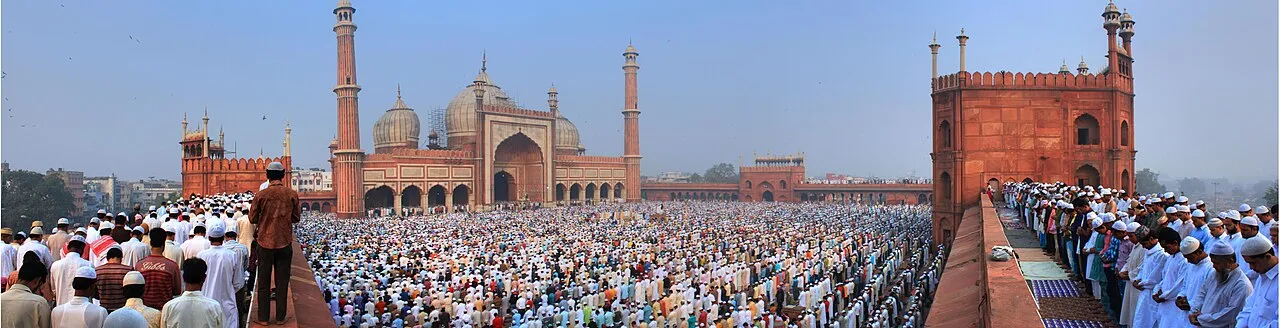
Ramadan brings a particular sense of activity to the mosque and surrounding Old Delhi, with increased worship and busy evening food streets. The two major Muslim festivals, Eid al-Fitr and Eid al-Adha, are important occasions for congregational prayer; attendance can be very large, so access and nearby traffic may change. Friday prayers also draw worshippers and can make the precinct busier than on an ordinary weekday. Festival observances follow the Islamic lunar calendar, so their season shifts from year to year. Check locally before planning a visit around a major religious occasion.
Local food in Delhi includes chaat, stuffed parathas and jalebi in Chandni Chowk, chole bhature, kebabs and Mughlai dishes around Jama Masjid, butter chicken, momos and kulfi. Ask what is fresh that day; many small eateries cook a limited daily menu. Vegetarian travellers eat very well across this region, and most towns also have non-vegetarian options. Street food is part of the Delhi experience: pick busy stalls with fast turnover, prefer freshly cooked items and drink sealed or filtered water. If prasad or langar is offered, accept it according to local custom. Choose busy, clean places and carry your packaging back with you.
Shopping & local experiences
Chandni Chowk and the surrounding Old Delhi lanes offer a lively market experience, with textiles, household goods, jewellery, spices and traditional foods among the things to browse. Shops and specialities vary street by street, and the lanes can be crowded, so keep belongings secure and allow time to move slowly. Nearby food stalls and eateries are popular for local meals and sweets; choose places with suitable hygiene and dietary options. Bargaining may be customary in some shops, but keep it polite. Buy souvenirs from established sellers rather than people pressuring visitors inside the mosque.
October to March (check air quality from November to January)
Within Delhi, the Delhi Metro is usually the quickest and cheapest way to reach Jama Masjid; find the nearest station on the official DMRC website or app, and use an app-based auto, e-rickshaw or cab for the last stretch. Road traffic is heavy at peak hours, so allow extra time and avoid driving yourself in Old Delhi lanes. Long-distance trains use New Delhi, Old Delhi, Hazrat Nizamuddin and Anand Vihar terminals, and flights use Indira Gandhi International Airport. The nearest of these railway terminals is Old Delhi (Delhi Junction), roughly 5 km away in a straight line. Indira Gandhi International Airport, Delhi is roughly 15 km away in a straight line. When comparing train, bus and flight, count the complete door-to-door time: a flight saves the most time only if the onward road transfer is short, while an overnight train can save a hotel night. Book your return before you leave, because seats fill quickly on weekends, festivals and holidays. Current train numbers, timings, return services and fares are not listed here; check IRCTC and NTES for trains and the airline's own schedule for flights. No permit is needed to visit Delhi. Many monuments are protected by the Archaeological Survey of India and need an entry ticket, often cheaper when bought online; the Red Fort and several museums close on Mondays. Security checks are routine at metro stations and major sites.
Confirm onward and return timings on IRCTC / NTES, the state bus operator or your airline before travel. A dash means current timings or fares have not been verified.
Getting around
The Jama Masjid Metro station is a practical arrival point; check the DMRC network and service information before travelling. From there, follow local directions and expect a short walk through busy streets. App-based taxis, autos and e-rickshaws can help with the last stretch, though traffic and narrow lanes may limit where vehicles can stop. Local buses serve parts of the wider area, but walking or a short auto ride is often simpler within Old Delhi. Parking is limited and congestion is common, so avoid driving into the lanes if possible.
Hours, tickets & permissions
Entry arrangements can differ for worshippers and sightseers, and access may be restricted during prayers or religious events. Visitors may be subject to entry or camera rules, and modest dress and footwear instructions apply. Some areas are reserved for worship or closed to the public. Requirements can change, so confirm current opening arrangements, permitted visitor areas and any fees with the mosque’s managing authority or caretakers before setting out. Do not rely on informal touts for access information.
Facilities
Facilities inside the mosque may include washing and ablution areas, but visitor access and availability should be checked locally. Toilets, drinking water and seating may not be convenient in every part of the complex, so plan ahead. Old Delhi has many food shops, small eateries, pharmacies and cash machines, though queues and crowded lanes are common. Guide services may be offered, but agree on the scope and terms before accepting one; beware of unofficial approaches seeking donations. Parking and vehicle access near the mosque are limited.
Accessibility
The mosque stands above the surrounding streets and its entrances involve substantial flights of steps. Within the complex, surfaces can be hard, uneven or crowded, and visitors may need to walk considerable distances across the courtyard. Shade is limited in open areas, especially in hot weather. These conditions can make the visit difficult for wheelchair users, people with limited mobility and some elderly visitors; do not assume step-free access, ramps or lifts. Strollers may also be awkward to manage. Consider visiting with a companion, taking frequent rests and asking staff about the least demanding available approach.
No permit is needed to visit Delhi. Many monuments are protected by the Archaeological Survey of India and need an entry ticket, often cheaper when bought online; the Red Fort and several museums close on Mondays. Security checks are routine at metro stations and major sites. Carry a photo ID at all times and save the emergency number 112 and your accommodation's contact offline. Summer heat and winter smog are the main health risks: drink plenty of water, check the air-quality index and wear a good mask on poor-air days. Watch your belongings in crowded markets and metro coaches. Respect community rules, private property and posted instructions. Follow local guidance if access changes.
Visitor rules
Dress modestly, covering arms and legs, and follow local guidance about head coverings and footwear. Remove shoes where instructed and keep them secure. The mosque is an active place of worship: speak quietly, do not interrupt prayers, and stay out of restricted areas. Follow staff directions on photography and any visitor or camera requirements. Do not touch religious objects or architectural surfaces, leave litter, or use plastic irresponsibly. Avoid unsolicited guides or donation demands, and ask a caretaker if you are unsure whether an area is open to visitors.
Photography
Morning or later-afternoon light can bring out the contrast between the red sandstone and pale marble, though conditions and access vary. The courtyard and exterior are natural viewpoints; be considerate of worshippers and avoid blocking entrances or prayer routes. Photography may be subject to rules or a camera charge, so ask staff before taking pictures and follow any restrictions inside the prayer hall. Do not photograph people at prayer without permission. Drone use should not be assumed to be permitted; check current regulations and respect security restrictions around this historic site.
Choose a stay by the full journey to Jama Masjid, not just the district name. Central areas such as Connaught Place, Paharganj and Karol Bagh, or areas near your metro line, save time; check the exact location and how far the hotel is from the nearest metro station. In summer, check air-conditioning or coolers; in December and January, check heating and hot water. Book in advance for weekends, festivals and the peak season (October to March (check air quality from November to January)). Confirm the exact location, meals included, check-in time and cancellation terms in writing. Avoid sending money to unverified contacts or touts at stations. Carry some cash, as card and digital payments can be unreliable in remote areas.
The Red Fort and Chandni Chowk are natural nearby combinations for a visit focused on Shahjahanabad and Old Delhi. Other historic religious landmarks in the wider area include Gauri Shankar Temple, Sis Ganj Gurudwara and Fatehpuri Masjid; treat each as an active place of worship and check visitor access separately. Raj Ghat, the memorial to Mahatma Gandhi, is another Central Delhi site that can be combined by road, depending on traffic and available time. Routes through Old Delhi can be crowded, so check conditions before planning several stops in one outing.
For couples, Jama Masjid rewards a slow pace: arrive early for soft light and fewer crowds, share a local meal and keep the evening free. Evenings at a garden, heritage site or a rooftop café near the monuments make a good end to the day. Public displays of affection can be frowned upon in conservative communities and at religious sites, so be discreet. Keep a buffer in your itinerary, because weather and traffic can delay plans.
Q: How much time should I allow for Jama Masjid? A: Allow about one to two hours for a considered visit, with extra time if you plan to explore the surrounding Old Delhi lanes. Q: When is a good season to visit? A: October to March is generally more comfortable, though winter air quality can be poor. Check conditions before travelling. Q: Is there an entry fee or a visitor permit? A: Entry and camera arrangements can change. Confirm current rules and any fees with the mosque’s managing authority or caretakers. Q: Is the mosque suitable for children or elderly visitors? A: Families can visit respectfully, but crowds, steps and hard walking surfaces may be tiring, especially for elderly visitors or anyone with limited mobility. Q: Where can I stay nearby? A: Central Delhi and Old Delhi have accommodation options across a range of types. Compare locations and access, and check reviews and transport connections before booking.
Be the first to share photos, stories, advice or a helpful contact for Jama Masjid, Delhi.
Loading…