
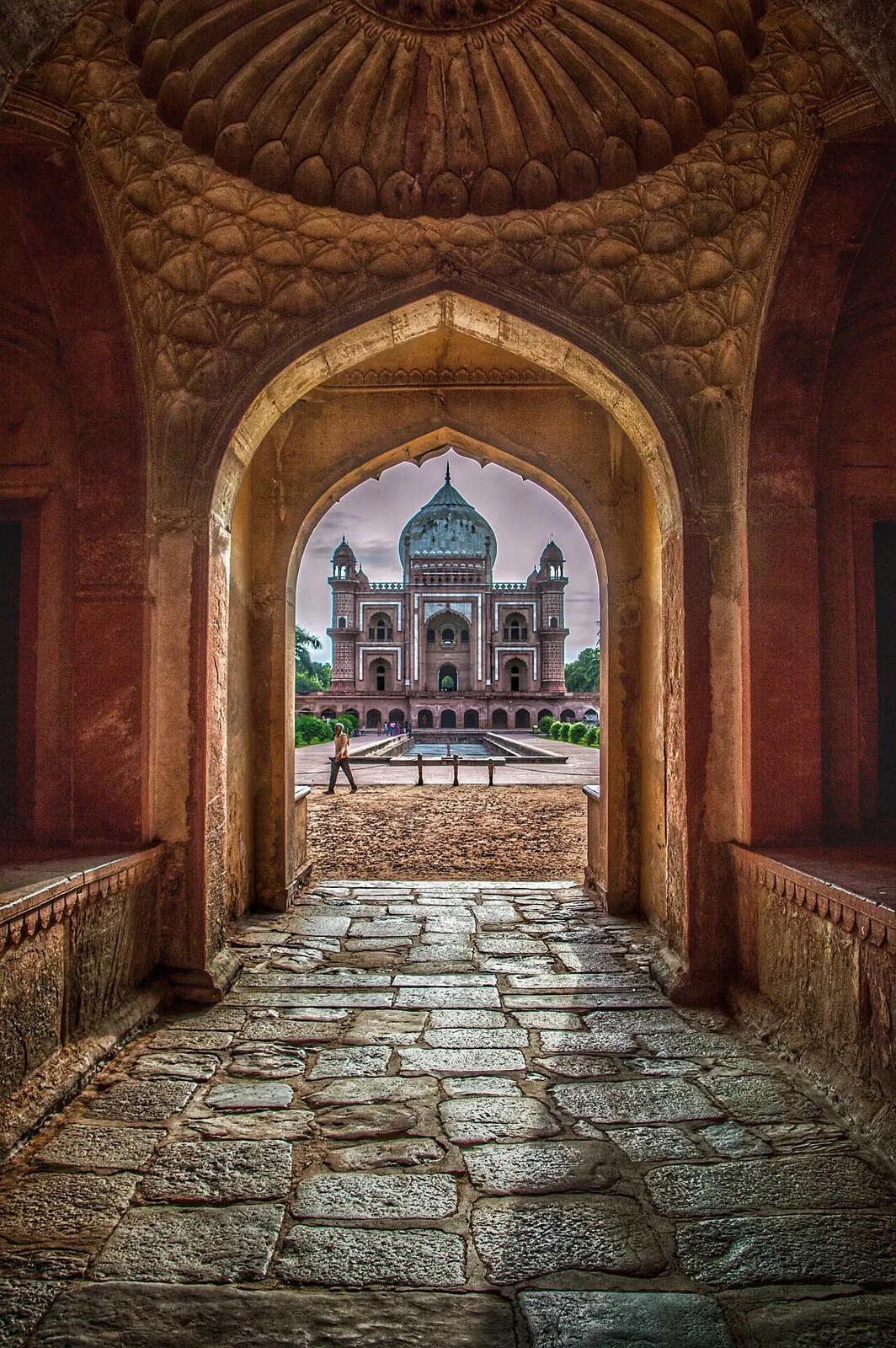
Tomb of Safdar Jang
This Delhi mausoleum, built in 1754 for Nawab Safdarjung, is made of sandstone and marble. Visitors come to view its late Mughal design, domed tomb and four-part garden.
Key facts · verified by Ghumoopedia editors
- Type of place
- Heritage monument
- Best time to visit
- October to March (check air quality from November to January)
- Verified
- 21 Nov 2026
Plan a trip from Tomb of Safdar Jang — a day-by-day route through places nearby.
Situated in Delhi’s New Delhi district, within India’s capital territory, the mausoleum was completed in 1754 for Safdarjung, the Nawab of Awadh. After Ahmed Shah Bahadur took the Mughal throne in 1748, Safdarjung became the empire’s chief minister, holding the title Wazir ul-Mamlak-i-Hindustan. Set within a garden, the building is a late interpretation of designs used for earlier Mughal rulers’ tombs, with the Taj Mahal among its best-known precedents. Beneath the dome, a central chamber is encircled by eight rooms, a layout called hasht bihisht, meaning eight paradises. The grounds are arranged in four sections. This was the first tomb-and-garden complex of its kind commissioned by someone beyond the emperor’s immediate family. Its construction reflects the substantial decline in Mughal authority by this period. Delhi layers many historic cities — from the Delhi Sultanate and the Mughal capital to Lutyens' New Delhi — with Sufi shrines, gurdwaras, temples, busy markets and India's national monuments. Delhi has very hot summers from April to June, a humid monsoon from July to September and cold, foggy winters in December and January. Air quality is often very poor from late October to January. The usual best time to visit is October to March (check air quality from November to January). Timings, fees and access arrangements must be confirmed locally. For official information, see Delhi Tourism at https://delhitourism.gov.in.
Why it matters
The Tomb of Safdar Jang is an important late Mughal mausoleum in New Delhi, built in 1754 for Safdar Jang, a powerful Nawab of Awadh who served as the Mughal emperor’s prime minister. Its garden plan and domed tomb continue the imperial tradition associated with earlier Mughal monuments, while its patronage by someone outside the immediate imperial family reflects the changing political balance of the eighteenth century. It is a notable heritage site within Delhi’s wider collection of Sultanate, Mughal and colonial-era landmarks. The monument is protected and managed by the Archaeological Survey of India (ASI); visitors should check the ASI’s current information for entry and access arrangements.
Safdar Jang, born Muhammad Muqim, became Nawab of Awadh and was appointed prime minister of the Mughal Empire in 1748, during the reign of Ahmad Shah Bahadur. After Safdar Jang’s death in 1754, his son Shuja-ud-Daulah commissioned the tomb in his memory. The mausoleum was completed in 1754 and set within a formal garden, following a Mughal funerary tradition developed most famously at Humayun’s Tomb and the Taj Mahal. The monument belongs to the late Mughal period, when imperial authority had weakened and regional rulers and nobles exercised greater power. Its scale and garden setting retain the language of imperial architecture, but its patronage outside the emperor’s immediate family marks a significant shift in who could claim such a memorial. The tomb was built of sandstone and marble and remains a landmark of eighteenth-century Delhi. Over time, the complex experienced the effects of weathering and urban change. The Archaeological Survey of India is responsible for its conservation and upkeep. Details of particular restoration campaigns may change or require specialist documentation, so visitors seeking a technical conservation history should consult ASI records or on-site interpretation.
Origin stories & folklore
No widely established local legend about the tomb’s construction or its occupants is consistently documented. Its history is instead linked to Safdar Jang’s political career and to his son Shuja-ud-Daulah’s commission of the mausoleum. Visitors may encounter stories or interpretations from guides, but these should be distinguished from the documented account of the monument. The tomb’s name refers to Safdar Jang, the honorific by which Muhammad Muqim is known. As with other historic sites in Delhi, personal memories and informal tales may circulate locally; treat them as oral tradition unless they can be supported by reliable historical sources.
Architecture & design
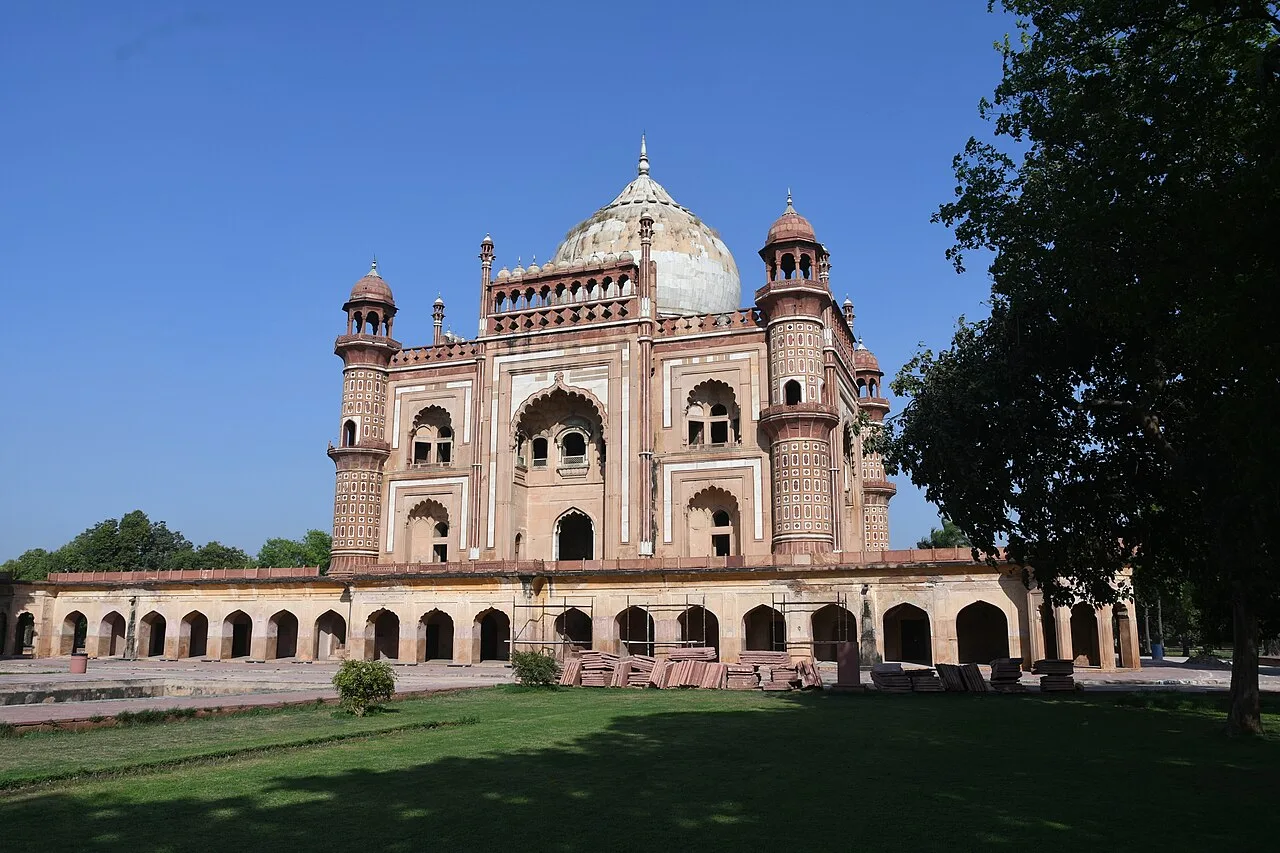
The tomb combines red and buff sandstone with marble details and stands at the centre of a walled garden. Its composition follows the Mughal charbagh idea: paths and water channels divide the garden into four principal sections. The main mausoleum is elevated on a plinth and has a prominent central dome, with smaller domed kiosks and decorative pavilions contributing to its skyline. Arched openings mark the façades, while the plan inside follows the hasht bihisht, or “eight paradises,” arrangement of chambers around a central space. The architecture draws on earlier Mughal imperial tombs but belongs to a later, more restrained phase of the style. Garden paths, gateways and the central axis organise the approach and frame views of the building. The layout also reflects the practical Mughal preference for a tomb set within a planned landscape.
Important objects & sculptures
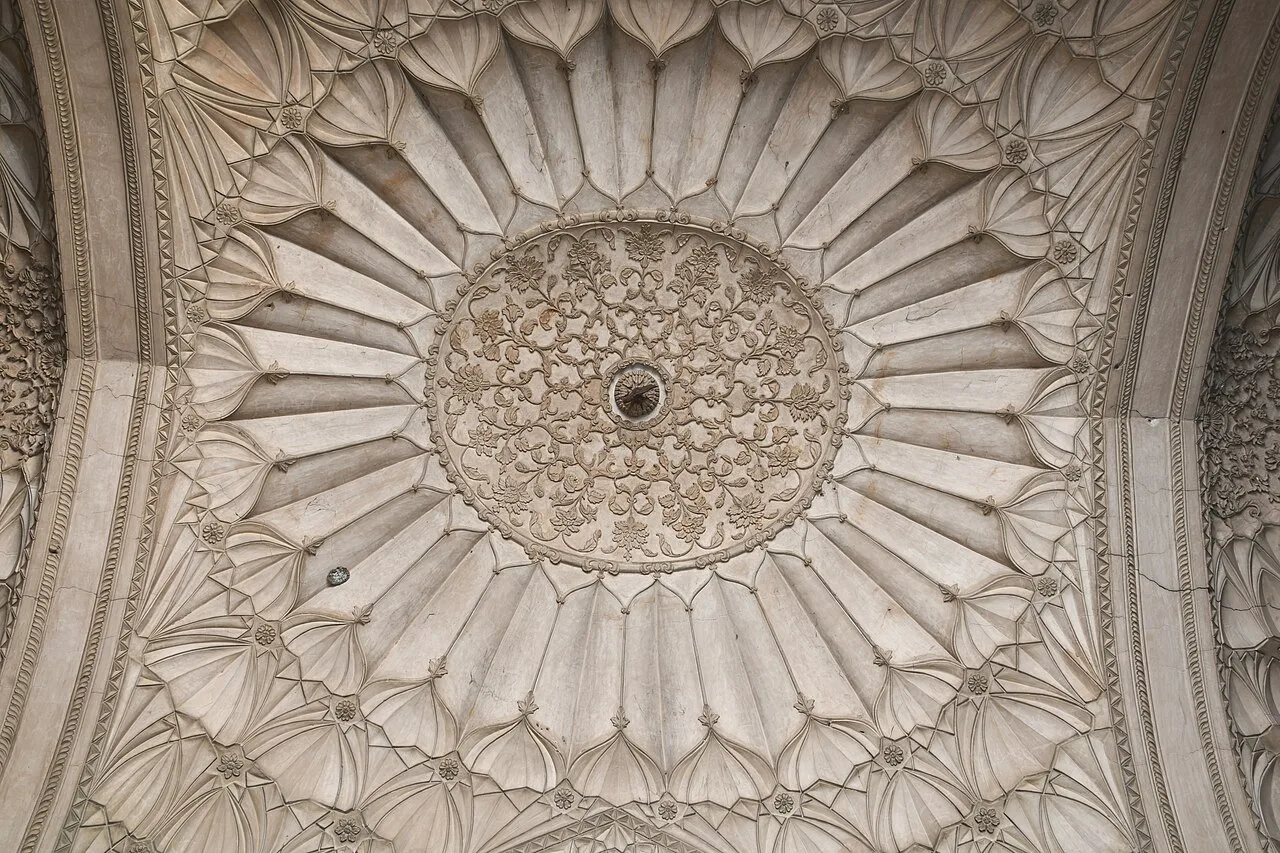
The main object to look for is the cenotaph in the central chamber, which marks the burial below; access to lower or enclosed areas can be restricted. Look closely at the contrast between sandstone and marble, the arched openings, ornamental surface details and the shaping of the dome and corner kiosks. The entrance and interior include architectural inscriptions and decorative work, though their visibility and legibility vary with conservation conditions. This is a mausoleum rather than a museum, so visitors should not expect a gallery of movable artefacts or a large collection of sculptures. Do not touch carved or painted surfaces, and follow any barriers or signs protecting the fabric.
Explore Tomb of Safdar Jang slowly and read the interpretation boards, use the official audio guide where available or hire an authorised guide to understand its history. Check opening days, ticket counters and camera rules in advance; many monuments and museums close on one weekday and on some public holidays. Early morning gives softer light, cooler air and smaller crowds. A comfortable itinerary is one main visit in the morning, a local meal at midday and a short nearby stop before an afternoon return. Use the district list on this site to find other places in New Delhi, but check the route and its condition before combining stops. If a festival or fair is on, roads and stays can be busy — and the experience can be unforgettable. Leave no litter: many sites are protected by the communities around them.
Suggested itineraries
Half day: Allow about 1.5–2 hours to explore the garden, gateway and tomb; take a nearby meal break, then spend about 1–2 hours at Lodhi Garden. Full day: Spend about 2 hours at Safdar Jang’s Tomb, take a meal break, visit Lodhi Garden for about 1–2 hours, then continue to Humayun’s Tomb for about 2–3 hours if travel and energy allow. Gentler option: Focus on the main garden paths and exterior views, take seated rest breaks, and skip the raised interior if steps or uneven surfaces are difficult.
The tomb is primarily a protected heritage monument, not an active venue for regular public worship or scheduled performances. Its present-day cultural life is shaped by visitors, local residents, students and heritage walks, alongside the wider multilingual life of Delhi, where Hindi, Urdu, Punjabi and English are commonly heard. People often come to appreciate the garden, architecture and history; keep voices low inside the mausoleum and follow site rules. The nearby city has diverse religious and community traditions, but these should not be assumed to take place within the tomb complex. Guides and interpretation can help connect the monument to the history of Awadh and the late Mughal court.
Festivals & events
The tomb is not generally known as a venue for a major annual festival or fair. Delhi-wide celebrations such as Diwali, Holi and Eid can bring more visitors and heavier traffic to the city, though activity at the monument depends on current site arrangements. Nearby cultural and religious venues may host programmes at different times of the year; check with those venues rather than assuming events occur at the tomb. The Urs and qawwali traditions associated with Hazrat Nizamuddin Dargah are part of Delhi’s broader Sufi heritage, not an event at Safdar Jang’s Tomb. Festival periods can affect road conditions and accommodation demand.
Local food in Delhi includes chaat, stuffed parathas and jalebi in Chandni Chowk, chole bhature, kebabs and Mughlai dishes around Jama Masjid, butter chicken, momos and kulfi. Ask what is fresh that day; many small eateries cook a limited daily menu. Vegetarian travellers eat very well across this region, and most towns also have non-vegetarian options. Street food is part of the Delhi experience: pick busy stalls with fast turnover, prefer freshly cooked items and drink sealed or filtered water. Try a home-cooked or dhaba meal when you can — it is often the best food on the route. Choose busy, clean places and carry your packaging back with you.
Shopping & local experiences
There is no major shopping market within the tomb complex. For books, small souvenirs or refreshments, look to shops and cafés in nearby New Delhi neighbourhoods, and check whether any authorised site publications are available at the entrance. Khan Market is a nearby option for retail and food; Dilli Haat INA offers stalls featuring crafts and regional dishes from different parts of India. Stock and stall participation can change. Buy responsibly, avoid items made from protected wildlife or archaeological material, and keep food and packaging out of the monument grounds.
October to March (check air quality from November to January)
Within Delhi, the Delhi Metro is usually the quickest and cheapest way to reach Tomb of Safdar Jang; find the nearest station on the official DMRC website or app, and use an app-based auto, e-rickshaw or cab for the last stretch. Road traffic is heavy at peak hours, so allow extra time and avoid driving yourself in Old Delhi lanes. Long-distance trains use New Delhi, Old Delhi, Hazrat Nizamuddin and Anand Vihar terminals, and flights use Indira Gandhi International Airport. The nearest of these railway terminals is Hazrat Nizamuddin, roughly 5 km away in a straight line. Indira Gandhi International Airport, Delhi is roughly 10 km away in a straight line. When comparing train, bus and flight, count the complete door-to-door time: a flight saves the most time only if the onward road transfer is short, while an overnight train can save a hotel night. Book your return before you leave, because seats fill quickly on weekends, festivals and holidays. Current train numbers, timings, return services and fares are not listed here; check IRCTC and NTES for trains and the airline's own schedule for flights. No permit is needed to visit Delhi. Many monuments are protected by the Archaeological Survey of India and need an entry ticket, often cheaper when bought online; the Red Fort and several museums close on Mondays. Security checks are routine at metro stations and major sites.
Confirm onward and return timings on IRCTC / NTES, the state bus operator or your airline before travel. A dash means current timings or fares have not been verified.
Getting around
Delhi Metro is usually a practical way to reach the area; check the DMRC map or app for the most suitable station and plan the final leg on foot, by auto-rickshaw, e-rickshaw or app-based cab. Local buses also serve parts of New Delhi, but routes and traffic conditions can make the last stretch less convenient. Walking around the complex is possible, though the garden paths and raised tomb require additional effort. Parking availability near the entrance can vary, so check locally and avoid blocking access roads. Road traffic is often slow at peak periods; allow a buffer if connecting to a train or flight.
Hours, tickets & permissions
Entry is subject to the monument’s current rules, ticketing arrangements and any temporary closures. Camera permissions, restrictions on tripods or other equipment, and rules for groups may also apply. Carry identification if requested, and follow notices about restricted areas; do not assume that every chamber or garden section is open. Dress respectfully for a heritage site and avoid touching the structure. Confirm current opening days, hours, entry fees and photography rules with the Archaeological Survey of India or on-site notices before travelling.
Facilities
Facilities within the monument can be limited and may change. Toilets, drinking water, seating, interpretation boards and authorised guides may be available, but check locally rather than relying on them. Food and everyday services are easier to find beyond the entrance in the surrounding New Delhi area. ATMs are not guaranteed within the complex. Parking arrangements should be confirmed on arrival, and visitors with specific needs should check access and facilities with the managing authority in advance. Carry water, especially in warm weather, and take litter away if bins are unavailable.
Accessibility
Expect outdoor walking on garden paths and some uneven surfaces, followed by steps to reach the raised mausoleum and its interior. The extent of step-free access may be limited; do not assume that ramps or lifts are available. The garden offers space for a slower visit, but shade and seating may be intermittent, particularly in exposed areas. Wheelchair users and visitors with strollers may be able to see parts of the grounds, while access to the building itself can be difficult. Older visitors or anyone with limited mobility may benefit from a companion, frequent rests and checking current access conditions with ASI before visiting.
No permit is needed to visit Delhi. Many monuments are protected by the Archaeological Survey of India and need an entry ticket, often cheaper when bought online; the Red Fort and several museums close on Mondays. Security checks are routine at metro stations and major sites. Carry a photo ID at all times and save the emergency number 112 and your accommodation's contact offline. Summer heat and winter smog are the main health risks: drink plenty of water, check the air-quality index and wear a good mask on poor-air days. Watch your belongings in crowded markets and metro coaches. Respect community rules, private property and posted instructions. Follow local guidance if access changes.
Photography
Early morning often gives softer light, cooler conditions and fewer visitors; light later in the day can also bring out the sandstone and marble. The garden paths provide views of the tomb from several angles, while the central approach frames the main façade. Photography rules can vary, so check signs and confirm whether additional restrictions apply to cameras, tripods or commercial shoots. Do not use a drone without the required permissions and confirmation that flight is lawful in the area. Be considerate of other visitors, avoid obstructing paths and respect any restricted spaces.
Choose a stay by the full journey to Tomb of Safdar Jang, not just the district name. Central areas such as Connaught Place, Paharganj and Karol Bagh, or areas near your metro line, save time; check the exact location and how far the hotel is from the nearest metro station. In summer, check air-conditioning or coolers; in December and January, check heating and hot water. Book in advance for weekends, festivals and the peak season (October to March (check air quality from November to January)). Confirm the exact location, meals included, check-in time and cancellation terms in writing. Avoid sending money to unverified contacts or touts at stations. Carry some cash, as card and digital payments can be unreliable in remote areas.
Lodhi Garden is a nearby green space with historic tombs and garden paths, and makes a natural companion visit. Humayun’s Tomb, a major Mughal-era monument, is another notable destination in New Delhi, though allow for road travel between sites. Khan Market offers shops and places to eat, while Dilli Haat INA is a city market for regional crafts and food. These are separate destinations, not parts of the Safdar Jang complex. Check routes and traffic before combining stops, and choose fewer sites if you want time to explore the tomb and its garden at an unhurried pace.
For couples, Tomb of Safdar Jang rewards a slow pace: arrive early for soft light and fewer crowds, share a local meal and keep the evening free. Evenings at a garden, heritage site or a rooftop café near the monuments make a good end to the day. Public displays of affection can be frowned upon in conservative communities and at religious sites, so be discreet. Keep a buffer in your itinerary, because weather and traffic can delay plans.
Q: How much time should I allow for a visit? A: About one to two hours is a reasonable starting point for the tomb and garden; allow longer if you want to read the interpretation or take breaks. Q: When is a good season to visit? A: October to March is generally more comfortable, but Delhi’s winter air quality can be poor, so check conditions before setting out. Q: Is entry ticketed, and what are the rules? A: Entry arrangements and camera rules can change. Confirm current requirements, fees and opening information with ASI before visiting. Q: Is the monument suitable for children and elderly visitors? A: The garden can suit a relaxed family visit, but steps, walking and uneven surfaces may be challenging; plan rests and supervise children. Q: Where can I stay nearby? A: New Delhi has accommodation across several neighbourhoods, including areas around central Delhi. Choose based on your onward transport and check travel conditions to the monument.
Be the first to share photos, stories, advice or a helpful contact for Tomb of Safdar Jang.
Loading…