
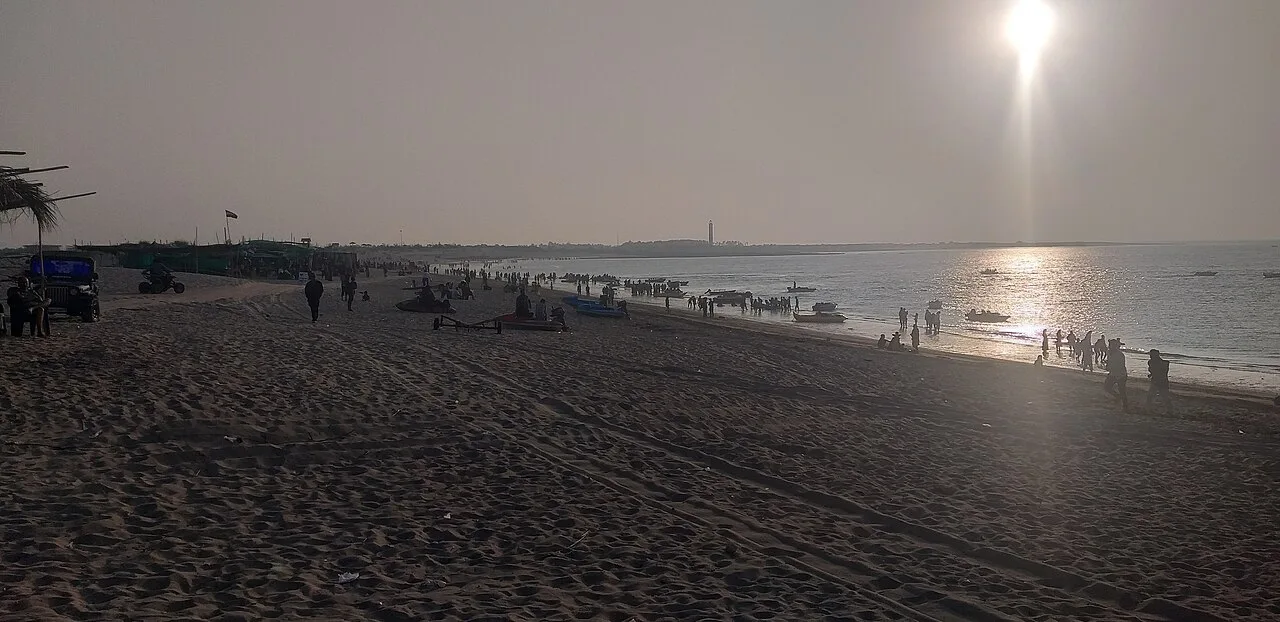
Shivrajpur Beach
Beside Shivrajpur village in Gujarat’s Devbhumi Dwarka district, Shivrajpur Beach draws visitors for its white sand, shallow clear water and Blue Flag certification.
Key facts · verified by Ghumoopedia editors
- Type of place
- Natural attraction
- Best time to visit
- November to February
- Nearest railway station
- Dwarka · about 10 km (straight line)
- Nearest airport
- Porbandar Airport · about 105 km (straight line)
- Verified
- 21 Nov 2026
Plan a trip from Shivrajpur Beach — a day-by-day route through places nearby.
Shivrajpur Beach lies beside Shivrajpur village in Gujarat’s Devbhumi Dwarka district. Its pale sand and clear blue water meet a shallow shoreline. In October 2020, the beach earned Blue Flag certification from the Foundation for Environment Education, a voluntary organisation based in Denmark. The village was established by the Baroda State in the early nineteenth century. According to local belief, Maharao Deshalji, ruler of Kachchh, also known as Katuch, built a small fort there. It had an 11-metre black masonry beacon that was unlit. The fort gave Kachchhi vessels shelter and protection, and offered boat repairs, rations and drinking water. Kacchighadh Lighthouse is near the beach. In 1977, a battery-powered flashing light was fitted atop its cabin; it was the first light in the region. The lighthouse was damaged in the earthquake of 26 January 2001 and restored soon afterwards. Gujarat combines Harappan cities at Dholavira and Lothal, the stepwells and Sultanate mosques of Ahmedabad and Patan, the Jain hills of Palitana and Girnar, Gandhi's Sabarmati Ashram, the Asiatic lions of Gir and the white salt desert and craft villages of Kutch. Gujarat is very hot from March to June (Kutch and north Gujarat often exceed 42°C), receives monsoon rain from late June to September, heaviest in the south and the Dangs, and is pleasant and dry from November to February with cold desert nights in Kutch. The usual best time to visit is November to February. Timings, fees and access arrangements must be confirmed locally. For official information, see Gujarat Tourism at https://www.gujarattourism.com.
Why it matters
Shivrajpur Beach is a coastal natural attraction near Shivrajpur village in Devbhoomi Dwarka district, Gujarat. Its pale sand and clear, shallow water make it a popular place for seaside visits, though swimming conditions can change with weather and tides. The beach received Blue Flag certification in October 2020 from the Foundation for Environmental Education, an international environmental organisation based in Denmark. The designation recognises beaches that meet environmental, safety, access and visitor-management criteria; it does not remove the need to follow local safety advice. Shivrajpur also has regional historical interest through its association with maritime shelter and the nearby Kacchighadh Lighthouse. It is one of several coastal and religious destinations in the Dwarka area, and can be combined with visits to places in the wider district.
Shivrajpur village is reported to have been established by the Baroda State in the early nineteenth century. The coast also has a maritime history linked to vessels travelling along the Saurashtra shore. Local accounts attribute a small fort near the beach to Maharao Deshalji, a ruler of Kachchh. The fort is described as having an approximately 11-metre-high black masonry beacon without a light. It is believed to have offered shelter and safety to Kachchhi vessels; facilities for emergency boat repairs, provisions and drinking water are also associated with it. These details are traditionally reported, and should not be treated as a complete archaeological account. The nearby Kacchighadh Lighthouse reflects a later phase of coastal navigation. A battery-operated flashing light was installed atop its cabin in 1977, described as the first light in the region. The lighthouse was damaged in the earthquake of 26 January 2001 and was restored soon afterwards. In more recent years, the beach gained wider visitor recognition after receiving Blue Flag certification in October 2020. This brought attention to its environmental management and visitor facilities alongside its coastal heritage.
Origin stories & folklore
There is no widely documented body of folklore specific to Shivrajpur Beach. A local belief associated with the coast holds that Maharao Deshalji of Kachchh arranged for a small fort and beacon to be built to protect Kachchhi vessels. The structure is traditionally described as a refuge where crews could find shelter, drinking water, provisions and help with boat repairs. The account connects the beach with the practical dangers of coastal sailing rather than with a supernatural origin story. Visitors can ask local residents about versions of the story, while keeping in mind that details may vary and that the account is not the same as a verified historical record.
Enjoy Shivrajpur Beach early in the morning or at sunset, when the sand is cooler and the light is best. Swim only where lifeguards are posted and the beach is marked safe — rip currents are strong, especially in the monsoon, when swimming is often banned. Try local seafood at busy stalls and ask about tide times before walking out on rocks or sandbars. A comfortable itinerary is one main visit in the morning, a local meal at midday and a short nearby stop before an afternoon return. Use the district list on this site to find other places in Devbhoomi Dwarka, but check the route and its condition before combining stops. If a festival is on — such as Navratri garba, the Rann Utsav or Uttarayan kite flying — roads and stays can be busy, and the experience can be unforgettable. Leave no litter: many sites are protected by the communities around them.
Suggested itineraries
Half day: Visit Shivrajpur Beach in the cooler part of the day (about 2–3 hours), walk or sit by the shore, check local swimming advice, then have a meal in the area or return to Dwarka. Full day: Spend the morning at Shivrajpur Beach (about 2–3 hours), take a midday break in Dwarka, then visit Dwarkadhish Temple or Rukmini Devi Temple and return with enough time for the road journey. Gentler option: Choose a vehicle drop-off near the permitted beach access, enjoy a short seated visit from a firm, suitable spot, and skip soft-sand walking or swimming.
Life around Shivrajpur reflects the coastal culture of Saurashtra and the wider Dwarka region. Gujarati is widely spoken; visitors may also hear regional Saurashtrian speech and other languages used by people travelling or working along the coast. Fishing and maritime activity are part of the local setting, while pilgrimage and tourism shape life in nearby Dwarka. Navratri garba, devotional music and seasonal kite flying are familiar parts of Gujarati cultural life. Customs vary between families and communities, so visitors should ask before photographing people, religious observances or working areas. Modest, practical clothing is useful for sun and wind, and respectful behaviour is appreciated around temples and community spaces.
Local communities
The beach is connected with residents of Shivrajpur and nearby settlements, as well as people from across Devbhoomi Dwarka district. Fishing households and other coastal workers have longstanding ties to the sea; tourism, transport, food service and small businesses also provide livelihoods in the area. The wider district includes communities with varied occupational, linguistic and religious backgrounds, and Dwarka attracts pilgrims from across India. These connections should not be reduced to a single identity or way of life. Visitors can support local livelihoods by buying from legitimate vendors, following safety directions and keeping clear of boats, nets and other working equipment.
Festivals & events
Navratri, usually observed in autumn, brings garba and devotional gatherings across Gujarat, including the Dwarka region. Janmashtami is especially significant in Dwarka because of the town's association with Krishna, and can draw many pilgrims to temples and roads nearby. Uttarayan, the winter kite festival, is celebrated across Gujarat and may add activity in towns and villages. Shivrajpur Beach itself is not necessarily the venue for these observances. During major festival periods, accommodation, roads and popular religious sites in the district can be busier than usual. Check local arrangements before planning a beach visit around a festival.
Local food in Gujarat includes dhokla, khandvi, thepla, fafda-jalebi, undhiyu in winter, the Gujarati thali, Kutchi dabeli, Surti locho and ponk, kadhi-khichdi, and sweets such as mohanthal and shrikhand; much of Gujarat's food is vegetarian and lightly sweet. Ask what is fresh that day; many small eateries cook a limited daily menu. Vegetarian travellers eat superbly here; non-vegetarian food is available in cities but limited in pilgrimage towns such as Palitana, Dwarka and Ambaji, where it may be banned. Remote sites may have no restaurant at all. Carry water and snacks, eat a proper breakfast before long drives, and ask your accommodation for a packed lunch if you are heading out early. Try a home-cooked or local thali meal when you can — it is often the best food on the route. Choose busy, clean places, drink sealed or filtered water, and carry your packaging back with you.
Shopping & local experiences
Dwarka town is a more reliable place than the beach itself to browse for local goods and travel essentials. Look for Gujarati textiles, embroidered items, small devotional souvenirs and packaged regional snacks, while checking the source and quality before buying. Food stalls near the coast may serve refreshments or local seafood when operating; availability varies, so ask about ingredients and preparation. Choose vendors responsibly and avoid buying shells, coral or other natural material collected from the shore. Carry reusable water bottles where safe refill points are available and take packaging back with you.
Shivrajpur is a coastal landscape of pale sand, open shoreline and shallow-looking clear water in suitable conditions. The Arabian Sea, tides, wind and seasonal weather all affect the water and beach environment. Conditions can change quickly, and the shore is not uniformly safe for swimming or walking over rocks and sandbars. The surrounding coast is exposed, with limited natural shade; do not assume that vegetation or shelter is available along the beach. Coastal birds may be seen in the area, but sightings vary by season and disturbance, and are never guaranteed. The beach and nearshore habitat are sensitive to litter and careless activity. Keep a respectful distance from wildlife, take rubbish away and follow lifeguard or local safety instructions, particularly during monsoon conditions.
November to February
The nearest principal railway station by straight-line distance is Dwarka, roughly 10 km away. The nearest operating airport by straight-line distance is Porbandar Airport, roughly 105 km away. These figures are calculated from map coordinates — actual road distance is longer. Ahmedabad, Vadodara, Surat and Rajkot are the main rail and air gateways; Bhuj serves Kutch, and Veraval, Junagadh, Dwarka and Porbandar serve Saurashtra. For the final leg, Gujarat State Road Transport Corporation (GSRTC) buses, private sleeper coaches and shared chhakdas and autos in rural areas link district towns. A private taxi gives more flexibility for remote sites. When comparing train, bus and flight, count the complete door-to-door time: a flight saves the most time only if the onward road transfer is short, while an overnight train can save a hotel night. Book your return before you leave, because seats fill quickly on weekends, festivals and holidays. Current train numbers, timings, return services and fares are not listed here; check IRCTC and NTES for trains and the airline's own schedule for flights. No permit is needed to visit Gujarat. Gujarat is a dry state: alcohol sale and consumption are prohibited except with a liquor permit, which visitors from outside the state can apply for at authorised hotel liquor shops with ID — never carry alcohol across the state border without one. Lion safaris in Gir and entry to parts of the Rann of Kutch near the border need advance online booking or a permit, and the White Rann around Dhordo is busiest during the Rann Utsav (roughly November to February).
Confirm onward and return timings on IRCTC / NTES, the state bus operator or your airline before travel. A dash means current timings or fares have not been verified.
Getting around
Dwarka is the main nearby town for onward travel to Shivrajpur. Taxis and auto-rickshaws may be available there, while local buses and shared vehicles can serve parts of the district; frequency and access to the beach should be checked locally. A hired car or taxi offers more flexibility for combining the beach with other stops. Walking is practical within the beach area only if the sand, heat and distance suit you. Check where parking is permitted and avoid blocking local access or working areas. Boats are not a routine substitute for road transport to the beach; arrange any boat activity only through authorised local operators and when conditions allow.
Hours, tickets & permissions
Entry arrangements can vary with beach management, season, weather and safety conditions. Visitors may encounter designated access points, restricted swimming zones, temporary closures or rules governing commercial activity. Do not assume that swimming is permitted simply because the beach is open to visitors. Ticketing, permits, photography rules, identification requirements and any charges can change; confirm current details with the managing authority or local tourism information before travelling. Check current access conditions as well as weather and sea-safety notices, especially during the monsoon or after rough seas.
Facilities
Visitor facilities may include managed access, toilets, changing areas, waste bins, food stalls and parking, but availability and condition can vary by season and beach operations. Blue Flag certification indicates that the beach met defined management standards when assessed; it is not a guarantee that every facility is open on every visit. Carry drinking water and sun protection, and check locally for safe drinking-water points, lifeguard presence and food options. Dwarka is more likely than the beach itself to have a wider choice of shops, accommodation, cash services and visitor assistance. Guides and first-aid support should not be assumed to be continuously available.
Accessibility
The beach surface is mainly sand, which can be difficult for wheelchairs, strollers and anyone with limited mobility. Loose or sloping sand, heat and the distance from vehicle access to a suitable resting point can add to the effort. Do not assume that a continuous firm path, ramp, accessible toilet or beach wheelchair is available; confirm arrangements with the local operator before travelling. Shade may be limited, so plan for sun exposure and rests. Older visitors and families with young children may find a short visit easier than a long shoreline walk. Avoid uneven rocks and wet areas, and follow staff advice about tides and safe access.
No permit is needed to visit Gujarat. Gujarat is a dry state: alcohol sale and consumption are prohibited except with a liquor permit, which visitors from outside the state can apply for at authorised hotel liquor shops with ID — never carry alcohol across the state border without one. Lion safaris in Gir and entry to parts of the Rann of Kutch near the border need advance online booking or a permit, and the White Rann around Dhordo is busiest during the Rann Utsav (roughly November to February). Carry a photo ID at all times and save the emergency number 112 and your accommodation's contact offline. Coastal weather can turn quickly: follow lifeguard flags and cyclone warnings, and keep away from the water in rough seas. Stay on marked paths, keep away from cliff edges and fast water, and never approach wild animals.
Photography
Early morning and sunset often provide softer light and cooler conditions for photographing the shoreline. The beach, lighthouse and changing sea can make useful subjects, but tides and access conditions affect viewpoints. Ordinary personal photography is generally suitable in public areas, subject to local restrictions; ask permission before close portraits or photographing workers and families. Do not photograph restricted or sensitive areas if directed not to. Drone use may be subject to aviation rules, local permissions and temporary restrictions, so check before flying and do not assume it is allowed. Keep equipment and visitors clear of lifeguards, boats and beach operations.
Choose a stay by the full journey to Shivrajpur Beach, not just the district name. Ahmedabad, Vadodara, Rajkot and Bhuj offer the widest choice; pilgrim towns have dharamshalas and trust guesthouses, and Gir has resorts near Sasan Gir. In summer, check air-conditioning; in the monsoon, check that the property is accessible if roads flood. Book in advance for weekends, festivals and the peak season (November to February). Confirm the exact location, meals included, check-in time and cancellation terms in writing. Avoid sending money to unverified contacts or touts at stations. Carry some cash, as card and digital payments can be unreliable in remote areas.
Dwarka town is the main nearby base and offers the Dwarkadhish Temple, a major Krishna pilgrimage site, as well as the Rukmini Devi Temple. Nageshwar Jyotirlinga is another well-known religious destination in Devbhoomi Dwarka district. Bet Dwarka, an island destination reached through local transport arrangements, is also commonly included in regional travel plans; confirm current access and crossing arrangements before setting out. These sites have distinct religious and visitor customs, so check local guidance and allow time for road transfers. The best combination depends on current routes, opening arrangements and how much time you want to spend at each stop.
For couples, Shivrajpur Beach rewards a slow pace: arrive early for soft light and fewer crowds, share a local meal and keep the evening free. A full-moon night on the White Rann, sunset at Shivrajpur or an evening on the Sabarmati Riverfront makes the trip memorable. Public displays of affection can be frowned upon in conservative communities and at religious sites, so be discreet. Keep a buffer in your itinerary, because weather and road conditions can delay plans.
Q: How much time should I allow for Shivrajpur Beach? A: A few hours is enough for a relaxed beach visit; allow extra time for travel and any nearby stops. Q: When is a good season to visit? A: November to February is generally pleasant and dry in Gujarat. Check sea conditions year-round, especially during the monsoon. Q: Is there an entry ticket or permit? A: Rules and charges can change. Confirm current entry requirements with the beach manager or local tourism authority before travelling. Q: Is the beach suitable for children and elderly visitors? A: It can be enjoyable, but soft sand, heat and changing sea conditions require care. Swim only where lifeguards indicate it is safe. Q: Where can I stay nearby? A: Dwarka town is the usual base, with a broader choice of accommodation than the beach area. Check availability and transport arrangements before your visit.
Be the first to share photos, stories, advice or a helpful contact for Shivrajpur Beach.
Loading…