
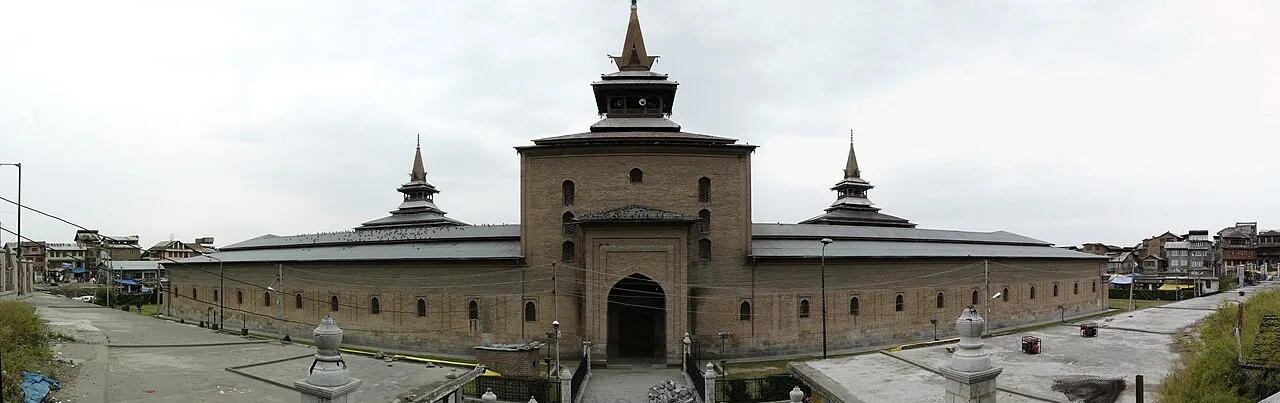
Jama Masjid, Srinagar
Jama Masjid, also called Jamia Masjid, is a Friday mosque in Srinagar’s Nowhatta area; visitors encounter a place central to the city’s religious and political life.
Key facts · verified by Ghumoopedia editors
- Type of place
- Temple / pilgrimage site
- Best time to visit
- April to October for the Kashmir Valley and meadows; December to February for snow at Gulmarg; October to March for Jammu and the plains
- Nearest railway station
- Srinagar (Nowgam) · about 10 km (straight line)
- Verified
- 21 Nov 2026
Plan a trip from Jama Masjid, Srinagar — a day-by-day route through places nearby.
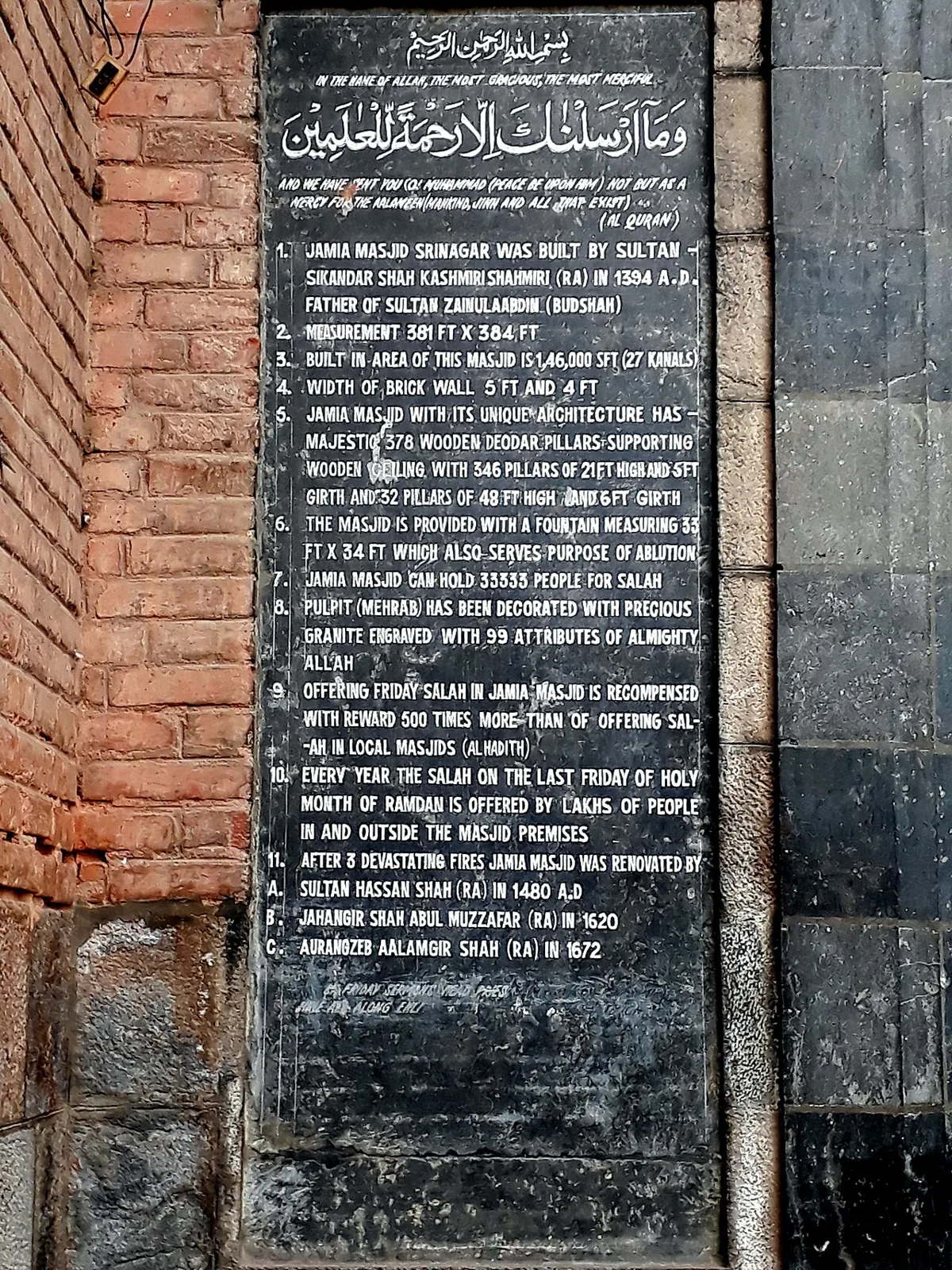
Known as Jamia Masjid as well, this Friday mosque stands in Nowhatta, in Srinagar’s old city and Srinagar district, within the union territory of Jammu and Kashmir. Its Kashmiri name is بٔڈ مٔشیٖد. Sultan Sikandar commissioned the building in 1394 CE at the behest of Mir Mohammad Hamadani, son of Mir Sayyid Ali Hamadani. Work was completed in 1402 CE. The mosque is among Kashmir’s most significant and holds a central place in Srinagar’s religious and political life. Kashmir’s mirwaiz leads it. For generations, it has witnessed anti-Indian protests and provided a setting for debate about the politics of the Kashmir conflict. Kashmir is known for its Sufi shrines, Mughal gardens, houseboats and crafts such as pashmina, papier-mâché and carpets, while the Jammu region is the land of Dogra heritage and major Hindu pilgrimages. The Kashmir Valley has mild summers, colourful autumns and snowy winters, with Chillai Kalan (late December to January) the coldest spell; meadows such as Gulmarg and Sonamarg get heavy snow. Jammu and the plains are hot from April to June. Snow and landslides can close the Jammu–Srinagar highway and mountain roads. The usual best time to visit is April to October for the Kashmir Valley and meadows; December to February for snow at Gulmarg; October to March for Jammu and the plains. Timings, fees and access arrangements must be confirmed locally. For official information, see Jammu and Kashmir Tourism at https://jktourism.jk.gov.in.
Why it matters
Jamia Masjid, also known as Jama Masjid or Bud Mashid in Kashmiri, is a major congregational mosque in Nowhatta, in Srinagar’s Old City. Commissioned by Sultan Sikandar and completed in 1402 CE, it has long served as a place of worship and a landmark in the city’s religious and civic life. The mosque is associated with Kashmir’s Muslim history and with the office of the mirwaiz, a religious leader whose role has also carried public importance. Its courtyard and distinctive wooden construction make it notable within the region’s architectural heritage. The mosque has also been a setting for public debate and political gatherings; access and activity can vary with local conditions.
Historical accounts date the commissioning of Jamia Masjid to 1394 CE, under Sultan Sikandar, with completion in 1402 CE. The work was undertaken at the behest of Mir Mohammad Hamadani, son of the Persian Sufi scholar Mir Sayyid Ali Hamadani. The mosque became an important Friday congregation and a centre of religious life in Srinagar. Its leadership is associated with the mirwaiz of Kashmir, an office with religious and public significance. The building has undergone damage and rebuilding over the centuries, including after fires. Accounts commonly associate later repair and reconstruction with successive Kashmiri rulers, but details and dates differ between sources; the present structure reflects repeated work rather than an unchanged medieval fabric. The mosque is also remembered as a gathering place during periods of political change. In modern times, public meetings and protests have taken place there, although activity and access may be affected by local circumstances. Visitors should treat the mosque as a living place of worship as well as a historic monument.
Origin stories & folklore
There is no single widely established supernatural legend that visitors need to know to understand the mosque. Local and religious memory instead centres on its founding: tradition connects the project with Mir Mohammad Hamadani and the broader influence of his father, Mir Sayyid Ali Hamadani, in Kashmir. The name Bud Mashid is commonly understood as “Great Mosque” in Kashmiri, reflecting its standing in the city. Stories told locally may differ, and should be understood as community memory rather than independently verified history. Ask respectfully before recording or repeating oral accounts, particularly when worshippers or caretakers are present.
Architecture & design
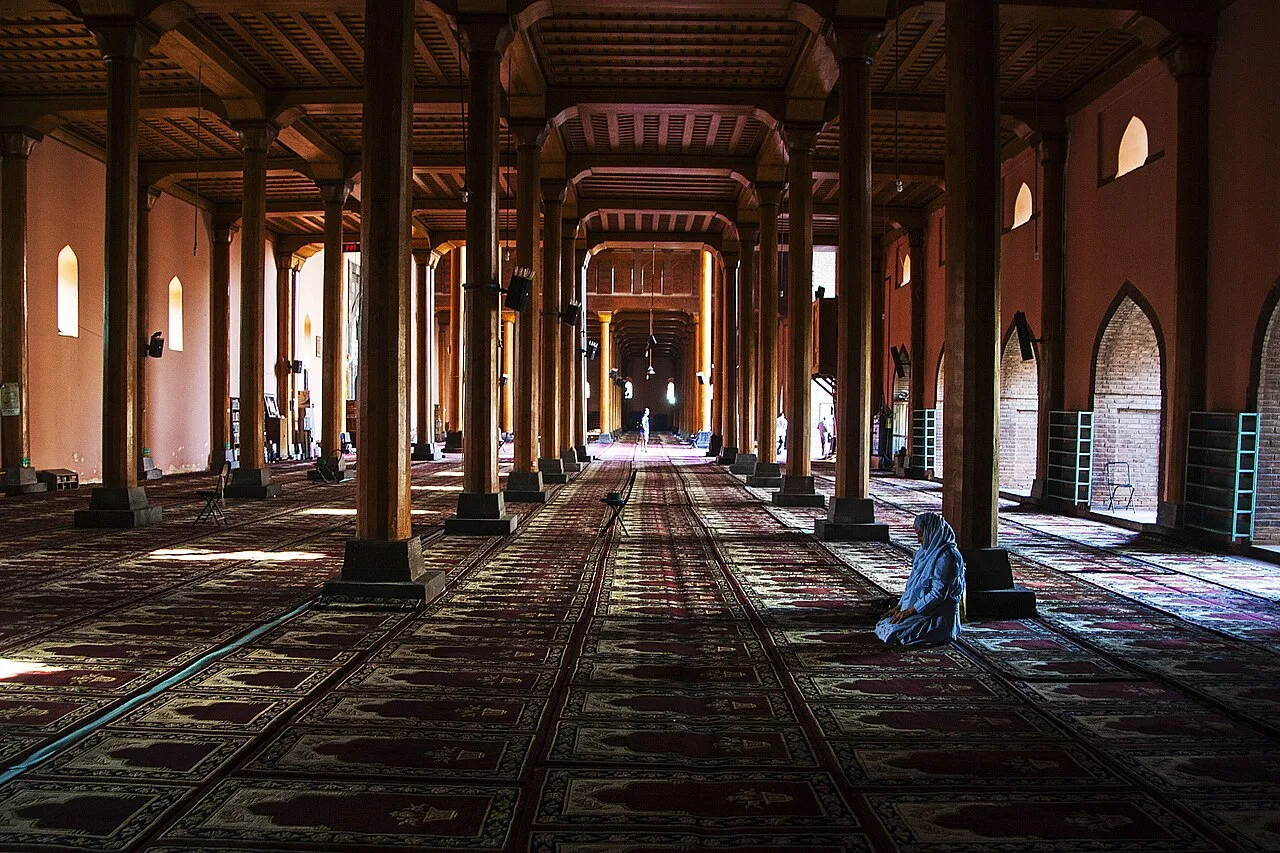
Jamia Masjid combines Kashmiri building traditions with influences associated with Persian and Central Asian religious architecture. Its broad rectangular complex is arranged around a large open courtyard, with a water feature at its centre and a covered prayer hall on one side. Four entrances give access to the compound. The most recognisable elements are the timber columns and the tiered, pyramidal roofs, which have a form often compared to pagoda roofs. The prayer hall is supported by numerous wooden pillars; published descriptions commonly give a total of 378. Deodar timber is associated with the building’s traditional construction, alongside masonry and brick. The roof form and deep eaves suit a climate with rain and snow, while the courtyard accommodates large congregations. The building has been repaired and altered over time, so not every visible element should be assumed to date from its original construction.
Important objects & sculptures
The mosque is a place of Islamic worship and does not contain devotional idols or sculpted deities. Visitors may notice the mihrab, which indicates the direction of prayer, and the minbar, used for the Friday sermon, along with calligraphic or other religious detailing where visible. Its most striking features are architectural: the wooden pillars, carved or finished timber surfaces, roof structure and courtyard. The central water feature is part of the courtyard setting. Displays and access to interior details can vary, and some areas may be reserved for worshippers. Avoid touching furnishings or treating religious objects as props for photographs.
Religious significance
Jamia Masjid is a Sunni Muslim congregational mosque, where worshippers gather for daily prayers and especially for the Friday congregational prayer. The mihrab marks the direction of prayer, and the sermon from the minbar is part of Friday worship. The mosque is also associated with the mirwaiz of Kashmir, whose religious leadership has an important place in the region’s public life. For local worshippers, it is not simply a historic building but an active place of prayer, learning and community gathering. Visitors who are not attending worship should keep a respectful distance from prayer areas, speak quietly and follow caretakers’ instructions. Access to particular sections may be limited, including at prayer times.
Visit Jama Masjid with time to observe daily prayers and rituals respectfully. Dress modestly with arms and legs covered; at many dargahs both men and women cover their heads, and some inner areas may be closed to women — follow the caretakers' guidance. Ask caretakers which areas are open to visitors, and beware of unofficial 'guides' asking for donations. A comfortable itinerary is one main visit in the morning, a local meal at midday and a short nearby stop before an afternoon return. Use the district list on this site to find other places in Srinagar, but check the route and its condition before combining stops. If a festival or fair is on, roads and stays can be busy — and the experience can be unforgettable. Leave no litter: many sites are protected by the communities around them.
Suggested itineraries
Half day: Spend 45–90 minutes at Jamia Masjid, allowing time for quiet observation; walk through nearby Old City lanes with a local meal stop; finish with a short visit to Khanqah-e-Moula if access and conditions permit. Full day: Begin at Jamia Masjid; explore the Old City and its markets on foot; visit Khanqah-e-Moula and Ziyarat Naqshband Sahib; take a meal break; end with a visit to Hari Parbat if transport, access and time allow. Gentler option: Arrange a taxi drop-off as close as local access permits, visit the courtyard or other areas the caretakers identify as accessible, and keep the outing to one site with a nearby seated meal break.
The mosque sits within the living fabric of Srinagar’s Old City, where Kashmiri is widely spoken alongside Urdu and other languages. Friday congregations, religious teaching and community visits are central to its everyday role. The mirwaiz’s public and religious position links the mosque with local traditions of sermon and public address. Kashmir’s wider cultural life includes Sufi devotional traditions, poetry, craft and music, though performances should not be assumed to take place inside the mosque. Modest dress and quiet conduct are customary for visitors. The Old City’s lanes, markets and neighbourhood food traditions form part of the experience around the site; ask before photographing residents or worshippers.
Festivals & events
The mosque is especially busy for Friday prayers and during the Islamic festivals of Eid al-Fitr and Eid al-Adha, whose dates follow the lunar calendar and therefore shift each year. Ramadan brings a distinct rhythm of fasting, evening meals and increased religious activity across Srinagar; prayer and access arrangements may change during the month. Large gatherings can make nearby streets crowded, and traffic or visitor access may be restricted. There is no need to assume that a public fair or performance is held at the mosque. Check locally before planning a visit around a festival or major religious gathering.
Local food in Jammu and Kashmir includes Kashmiri Wazwan dishes such as rogan josh, yakhni, gushtaba and rista, nadru (lotus stem), haak saag, dum aloo, kahwa and salty noon chai; in the Jammu region, rajma-chawal, kalari cheese and Dogra dishes such as ambal and auria. Ask what is fresh that day; many small eateries cook a limited daily menu. Vegetarian travellers eat very well across this region, and most towns also have non-vegetarian options. Remote sites may have no restaurant at all. Carry water and snacks, eat a proper breakfast before long drives, and ask your accommodation for a packed lunch if you are heading out early. If prasad or langar is offered, accept it according to local custom. Choose busy, clean places and carry your packaging back with you.
Shopping & local experiences
The Old City has neighbourhood shops and markets where visitors may find everyday goods, snacks and locally made items. Srinagar is known for crafts including papier-mâché, carved wood, carpets and pashmina, though specialist shopping may be easier in larger markets elsewhere in the city. Ask about material, provenance and product certification before buying higher-value textiles or crafts. Bargaining practices vary by shop. Food stalls and small eateries nearby offer a chance to try local Kashmiri dishes, but availability depends on the day and season. Keep shopping discreet around prayer periods and do not block narrow lanes.
April to October for the Kashmir Valley and meadows; December to February for snow at Gulmarg; October to March for Jammu and the plains
The nearest principal railway station by straight-line distance is Srinagar (Nowgam), roughly 10 km away. The nearest operating airport by straight-line distance is Sheikh ul-Alam International Airport, Srinagar, roughly 15 km away. These figures are calculated from map coordinates — mountain roads wind a lot, so actual road distance and travel time are usually much longer. Jammu Tawi and Shri Mata Vaishno Devi Katra are the main long-distance rail gateways, and the line through the Chenab bridge now continues into the Kashmir Valley — check current services to Srinagar. Srinagar and Jammu airports have the most flights. For the final leg, J&K Road Transport Corporation (JKRTC) buses, private minibuses and shared Sumo taxis link district towns; shared taxis usually leave early in the morning. A private taxi gives more flexibility for remote sites. When comparing train, bus and flight, count the complete door-to-door time: a flight saves the most time only if the onward road transfer is short, while an overnight train can save a hotel night. Book your return before you leave, because seats fill quickly on weekends, festivals and holidays. Current train numbers, timings, return services and fares are not listed here; check IRCTC and NTES for trains and the airline's own schedule for flights. Indian visitors do not need a permit for the main destinations in Jammu and Kashmir. Areas close to the Line of Control, such as Gurez, Bangus, Keran and Machil, may require registration at police or army check posts, and foreign nationals face extra restrictions in some areas. Prepaid mobile SIM cards issued outside Jammu and Kashmir do not work here, so carry a postpaid connection. The Amarnath Yatra needs advance registration and a compulsory health certificate, and Vaishno Devi pilgrims need a yatra registration (RFID) card. Read your government's travel advisory and current local advisories before you go.
Confirm onward and return timings on IRCTC / NTES, the state bus operator or your airline before travel. A dash means current timings or fares have not been verified.
Getting around
Jama Masjid is in Nowhatta, in the Old City, where lanes can be narrow and busy. Taxis and auto-rickshaws can bring visitors to an accessible nearby drop-off point, but may not be able to reach the mosque entrance. Local buses and shared vehicles serve parts of Srinagar; ask locally about the most suitable stop and current routes. The final approach is usually on foot. Parking can be limited in the old neighbourhood, so avoid relying on being able to park beside the mosque. Allow extra time for congestion, prayer gatherings or changes in local traffic arrangements.
Hours, tickets & permissions
Entry arrangements depend on prayer schedules, religious observances and local conditions. The mosque is an active place of worship, so visitors may be asked to wait, remain in designated areas or leave sections clear for worshippers. Do not assume that a tourist ticket, camera fee or permit is required, or that every part of the complex is open to visitors. Dress modestly and follow any instructions about footwear, head covering or identification. Confirm current visiting hours, access rules and any fees with the mosque’s caretakers or managing authority before setting out.
Facilities
Facilities within the mosque compound may be limited or reserved for worshippers. Toilets and drinking water may be available nearby, but visitors should check locally rather than rely on them. The surrounding Old City has small food shops and places to eat, though choices and opening arrangements vary. Parking close to the entrance is not assured. Guides may offer services in the neighbourhood, but use a guide only if you have agreed on the scope of the visit and any fee in advance. ATMs and broader visitor services are easier to find elsewhere in Srinagar than in the immediate lanes.
Accessibility
The approach through Nowhatta’s Old City can involve uneven surfaces, narrow lanes, crowds and vehicle restrictions. Inside, the courtyard is relatively open, but access to prayer halls or other sections may involve thresholds or steps; do not assume ramps, lifts or wheelchair-accessible toilets are present. Wheelchair users and visitors with strollers may need assistance and should check conditions with caretakers before entering. Older visitors may find the walk from a vehicle drop-off tiring, particularly during busy periods. Shade is available in some covered areas, but much of the courtyard is exposed. Plan a short visit and bring any mobility support needed.
Indian visitors do not need a permit for the main destinations in Jammu and Kashmir. Areas close to the Line of Control, such as Gurez, Bangus, Keran and Machil, may require registration at police or army check posts, and foreign nationals face extra restrictions in some areas. Prepaid mobile SIM cards issued outside Jammu and Kashmir do not work here, so carry a postpaid connection. The Amarnath Yatra needs advance registration and a compulsory health certificate, and Vaishno Devi pilgrims need a yatra registration (RFID) card. Read your government's travel advisory and current local advisories before you go. Carry a photo ID at all times and save the emergency number 112 and your accommodation's contact offline. Heat in summer and fog in winter are the main weather risks; carry water and allow extra travel time on foggy December–January mornings. Respect community rules, private property and posted instructions. Follow local guidance if access changes.
Visitor rules
Wear modest clothing that covers shoulders and legs, and follow caretakers’ guidance on head coverings and footwear. Remove shoes where instructed and keep them out of prayer spaces. Speak quietly, do not interrupt prayers, and avoid entering areas marked as private or restricted. Ask before photographing people, worshippers or religious activity; photography may be limited in some areas. Do not touch religious furnishings or climb on architectural features. Carry litter out and avoid single-use plastic where possible. Be cautious about unsolicited offers of guiding or donation collection, and make any contribution only through a channel identified by the caretakers.
Photography
The courtyard and timber roof forms can be attractive subjects in soft morning or late-afternoon light, but the best viewpoint depends on which areas are open. Ask caretakers before photographing inside, during prayer or near religious furnishings. Never photograph worshippers at close range without permission, and keep people out of posed or intrusive images. Photography rules may change during gatherings or local security restrictions. Do not use a drone without the required permissions and confirmation that flying is lawful and safe; airspace restrictions may apply. Put the camera away if asked.
Choose a stay by the full journey to Jama Masjid, not just the district name. Srinagar houseboats, Jammu and Katra hotels and resort towns such as Gulmarg and Pahalgam offer the widest choice; book houseboats only through registered owners. In summer, check air-conditioning or coolers; in December and January, check heating and hot water. Book in advance for weekends, festivals and the peak season (April to October for the Kashmir Valley and meadows; December to February for snow at Gulmarg; October to March for Jammu and the plains). Confirm the exact location, meals included, check-in time and cancellation terms in writing. Avoid sending money to unverified contacts or touts at stations. Carry some cash, as card and digital payments can be unreliable in remote areas.
Within Srinagar’s Old City, Khanqah-e-Moula, a historic shrine on the Jhelum, and Ziyarat Naqshband Sahib are notable religious sites to consider, subject to their own access rules. Hari Parbat, with its historic fort and religious sites, is another possible stop if transport and conditions allow. The old neighbourhood’s bridges, lanes and markets are worth exploring at a respectful pace. Further across Srinagar, Dal Lake and the Mughal gardens of Shalimar Bagh and Nishat Bagh can be combined with a separate city outing. Check routes and current access before joining distant stops to a visit at the mosque.
For couples, Jama Masjid rewards a slow pace: arrive early for soft light and fewer crowds, share a local meal and keep the evening free. A shikara ride or a houseboat night in Srinagar is a classic addition. Public displays of affection can be frowned upon in conservative communities and at religious sites, so be discreet. Keep a buffer in your itinerary, because weather and traffic can delay plans.
Q: How much time should I allow for a visit? A: Allow about 45–90 minutes for the mosque itself, with extra time for the Old City approach and any prayer-related access restrictions. Q: When is a good season to visit? A: April to October is generally comfortable for exploring the Kashmir Valley, but the mosque can be visited in other seasons if local conditions and access permit. Q: Is entry open to all visitors? A: The mosque is an active place of worship. Access rules can vary by area and circumstance, so ask caretakers and follow their guidance. Q: Is it suitable for children or elderly visitors? A: It can be, but busy lanes, uneven surfaces and possible steps may be challenging. Keep children close and plan a short visit with assistance if needed. Q: Where can I stay nearby? A: Srinagar has accommodation across the city. Choose a stay based on current road access and transport needs, and confirm the route to Nowhatta before travelling.
Be the first to share photos, stories, advice or a helpful contact for Jama Masjid, Srinagar.
Loading…