
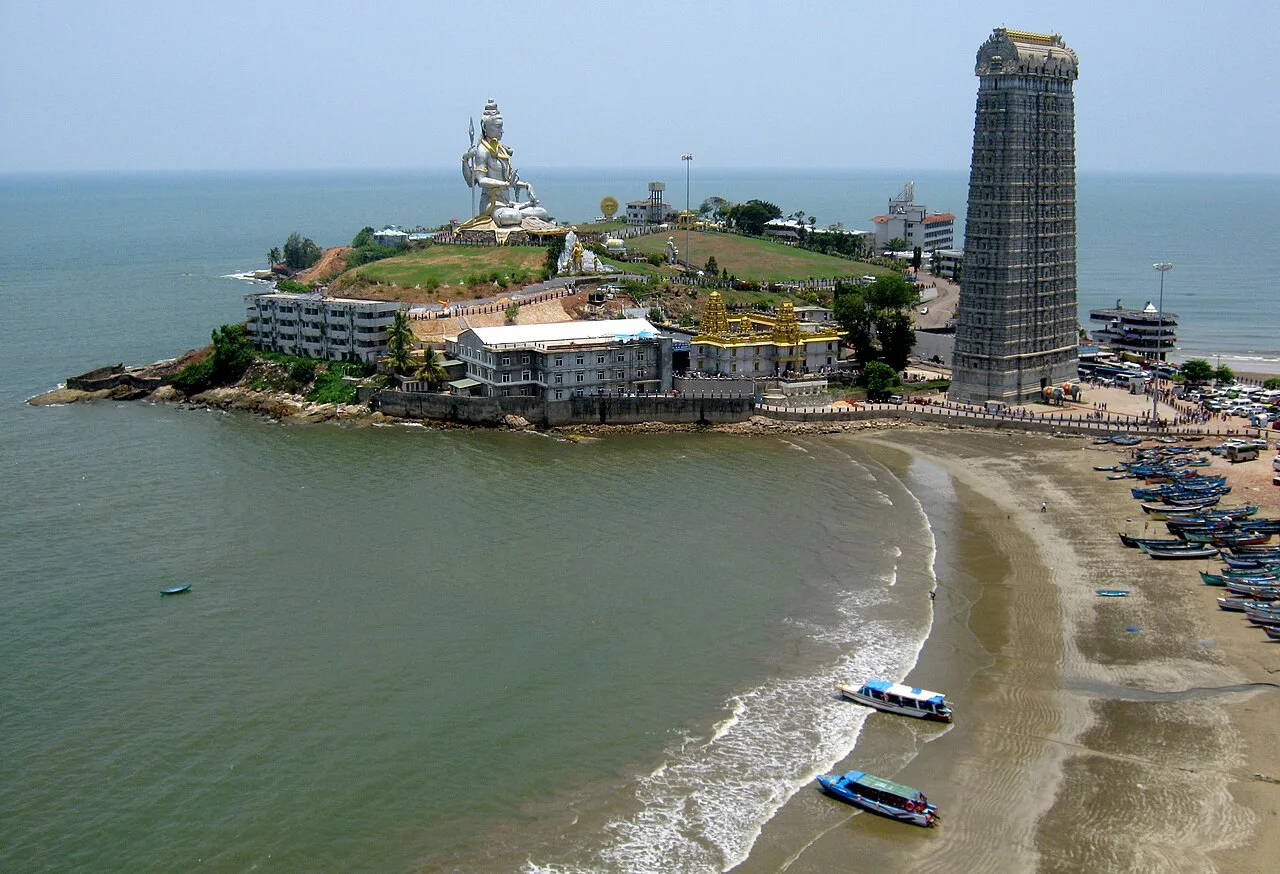
Murudeshwar Temple and Beach
Murudeshwar is a coastal town in Karnataka, known for its temple, the world’s third tallest Shiva statue and a beach beside the Arabian Sea.
Key facts · verified by Ghumoopedia editors
- Type of place
- Temple / pilgrimage site
- Best time to visit
- October to February; June to September for monsoon greenery in the Western Ghats
- Nearest railway station
- Murdeshwar · about 0 km (straight line)
- Nearest airport
- Shivamogga (Kuvempu) Airport · about 125 km (straight line)
- Verified
- 21 Nov 2026
Plan a trip from Murudeshwar Temple and Beach — a day-by-day route through places nearby.
Murudeshwar, also called Murdeshwar or Murudeshwara, is a town in Karnataka’s Uttara Kannada district. It sits beside the Arabian Sea, and the destination is associated with both a beach and a temple. Murudeshwara Temple is a notable feature of the town. Murudeshwar also has a Shiva statue described as the world’s third tallest. The temple, statue and coastal setting are among the reasons visitors come to the area. The town has a railway station on the Konkan route connecting Mangalore and Mumbai. Karnataka holds the boulder-strewn ruins of Hampi, the Hoysala temple jewels of Belur and Halebidu, the Chalukyan monuments of Badami, Aihole and Pattadakal, the palaces of Mysuru, the coffee hills of Coorg and Chikkamagaluru, the temple-and-beach town of Gokarna and the tiger forests of Bandipur and Nagarhole. Bengaluru and the plateau are mild most of the year; the coast is hot and humid; the Malnad hills (Coorg, Chikkamagaluru, Agumbe) get very heavy monsoon rain from June to September. October to February is pleasant almost everywhere. The usual best time to visit is October to February; June to September for monsoon greenery in the Western Ghats. Timings, fees and access arrangements must be confirmed locally. For official information, see Karnataka Tourism at https://karnatakatourism.org.
Why it matters
Murudeshwar is a coastal pilgrimage town in Uttara Kannada district, Karnataka, where the Arabian Sea forms the setting for a major Shiva shrine. The temple complex is known for its large Shiva statue and a tall entrance tower, making it a prominent landmark on this stretch of the Konkan coast. The statue is commonly described as the world’s third tallest Shiva statue; this ranking can vary with how statues are measured. For local worshippers, the temple is a place of devotion and darshan, while travellers also visit for its sea-facing setting. No UNESCO World Heritage listing or specific ASI protection status for the temple is asserted here; check official records for current designations.
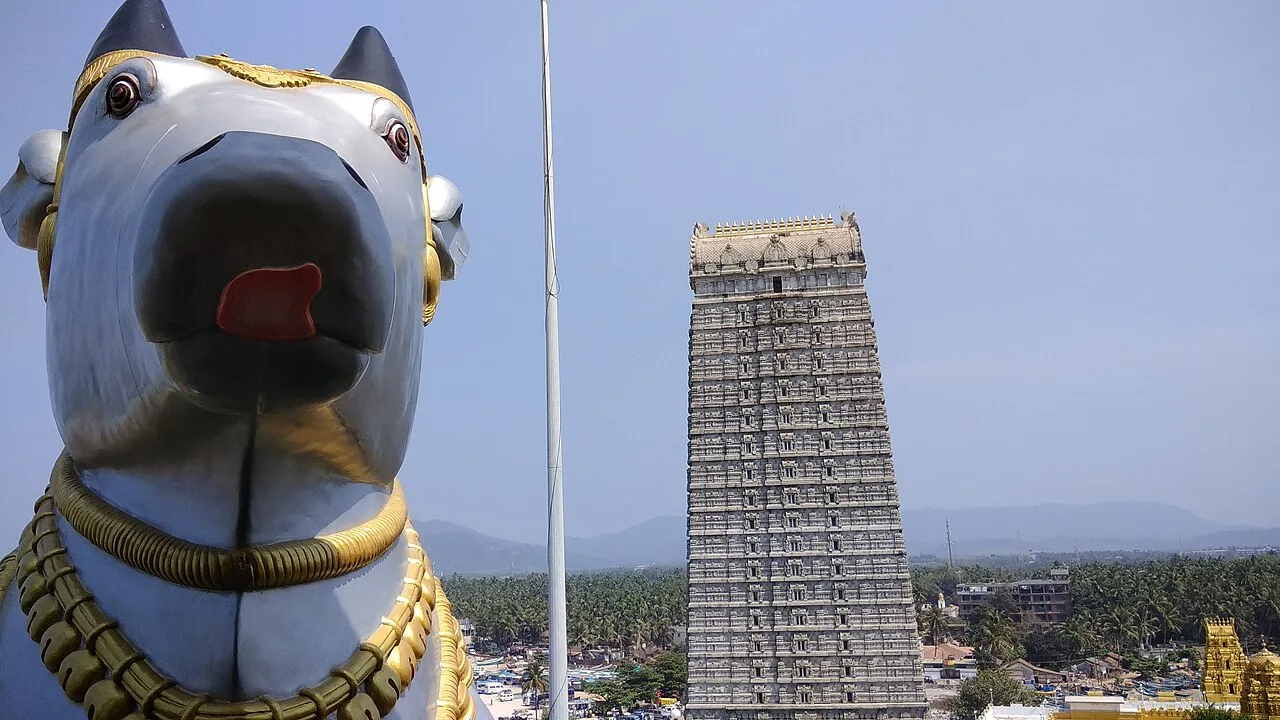
The exact founding date, early builders and original form of Murudeshwar Temple are not consistently documented in widely available accounts. The shrine is dedicated to Shiva and is associated with an older coastal place of worship, but its beginnings should not be assigned a precise century without stronger evidence. The present complex has been substantially developed and renewed in modern times, combining a functioning temple with prominent visitor-facing structures. Public accounts often credit industrialist and philanthropist R. N. Shetty and associated organisations with supporting the modern development, including the monumental Shiva statue and the tall entrance tower. The statue and tower brought renewed attention to Murudeshwar as both a pilgrimage destination and a coastal landmark. The town’s position on the Konkan Railway route has also made it more accessible to visitors. The name and the shrine’s origin are closely connected in local telling to the story of Shiva’s Atma Linga, though that account belongs to religious tradition rather than verifiable local history. Visitors should distinguish the continuing worship at the shrine from the more recent expansion of the surrounding complex.
Origin stories & folklore
According to Hindu legend, Ravana sought Shiva’s Atma Linga and received it after intense devotion. Shiva set a condition that it must not be placed on the ground before Ravana reached Lanka. The gods, worried about Ravana’s growing power, arranged for Ganesha to intervene. Disguised as a young boy, Ganesha took the linga and set it down when Ravana was delayed; it could not then be lifted. Local tradition connects the name Murudeshwar with this episode and with the linga’s fragments. The story is also associated with other sacred places along the Karnataka coast, including Gokarna. These accounts are matters of religious belief and form part of the region’s pilgrimage lore.
Architecture & design
The temple stands on Kanduka Hill, with the Arabian Sea around much of the site. Its best-known architectural feature is a towering, multi-storey entrance gopura in a South Indian, broadly Dravidian temple idiom. The modern complex has been developed around a Shiva shrine and includes large sculptural works that are visible from the surrounding coastal area. A monumental Shiva statue faces the sea and is a defining feature of the approach and skyline. The complex combines conventional temple spaces for worship with broad exterior areas used by visitors. Stone and concrete construction are evident in the buildings and contemporary additions; the site should not be read as a single, untouched historic-era structure. Visitors can observe the contrast between the sacred inner spaces, where temple customs apply, and the more open grounds outside. The sea-facing position shapes views and circulation, while steps and changes in level may occur between parts of the complex.
Important objects & sculptures
The principal feature to look for is the large seated Shiva statue overlooking the coast. Its scale and placement make it visible from several parts of the complex, though access to particular viewing points can depend on local arrangements. The tall gopura has sculptural details and painted or coloured elements typical of contemporary South Indian temple gateways; observe these from outside without blocking worshippers. Inside the temple, the Shiva shrine and its linga are the focus of devotion, but viewing access is governed by temple practice. Sculptural scenes connected with Hindu deities and familiar episodes may be present around the complex. Do not assume every object is an antiquity: much of the prominent monumental work belongs to the temple’s modern development.
Religious significance
Murudeshwar is a Shiva temple and an active place of Hindu worship. Devotees come for darshan, prayer and offerings, and daily worship is conducted according to temple practice. The Atma Linga legend gives the shrine a wider place in coastal Karnataka’s sacred geography, linking it in popular belief with Gokarna and other sites associated with the story. Visitors who are not participating in worship can observe respectfully from areas open to them, following staff instructions and any rules for entering inner spaces. Ritual access, queues and the treatment of offerings may differ on ordinary days and during religious observances. Ask temple staff before approaching restricted areas, photographing rituals or handling anything used in worship.
Visit Murudeshwar Temple and Beach with time to observe daily prayers and rituals respectfully. Follow the posted rules on footwear, photography, phones, head covering and dress — many major temples require modest clothing, prohibit leather items and phones inside, and have separate darshan queues; non-Hindus may not be admitted to some sanctums. Ask caretakers which areas are open to visitors, and beware of unofficial 'guides' or agents offering quick darshan for a fee. A comfortable itinerary is one main visit in the morning, a local meal at midday and a short nearby stop before an afternoon return. Use the district list on this site to find other places in Uttara Kannada, but check the route and its condition before combining stops. If a festival is on — such as Mysuru Dasara, the Hampi Utsav, the Kambala buffalo races on the coast or the Karaga in Bengaluru — roads and stays can be busy, and the experience can be unforgettable. Leave no litter: many sites are protected by the communities around them.
Suggested itineraries
Half day: Arrive in the morning; spend about 1–2 hours at the temple and statue, allowing time for darshan and respectful viewing; take a short beach walk; have a local meal before leaving. Full day: Visit the temple in the morning; pause for a meal and rest; spend the afternoon at the beach or explore a nearby town or coastal attraction, checking road conditions and return transport. Gentler option: Focus on the temple’s more accessible outer areas and sea views, take frequent rests, and skip longer beach walks or steps if they are uncomfortable.
Murudeshwar reflects the living culture of Karnataka’s coastal communities, where temple worship, fishing, trade and tourism share the same shoreline. Kannada is widely used, and Konkani is also spoken in parts of the coastal region; visitors may hear other languages in tourist-facing settings. Modest dress and courteous conduct are appropriate around the shrine. Yakshagana, a distinctive form of Kannada-region dance-drama, is part of the broader cultural heritage of coastal Karnataka, though performances should not be assumed to take place at the temple during every visit. Local food traditions draw on coastal ingredients, including fish in many eateries, alongside vegetarian meals for pilgrims. The beach and temple are closely connected in the everyday life and image of the town.
Festivals & events
Maha Shivaratri is the most relevant major observance for a Shiva shrine and can bring increased worship, queues and visitor numbers. Other Hindu calendar observances and temple rituals may also draw local devotees, but schedules and the scale of celebrations vary; confirm locally rather than planning around an assumed programme. The wider coastal region is known for seasonal Yakshagana performances and, in some areas, Kambala buffalo races, though these are not necessarily held at Murudeshwar itself. During major holidays and school breaks, the temple, beach, roads and nearby accommodation can be busier. If attending a festival, allow extra time and follow crowd-control directions.
Local food in Karnataka includes bisi bele bath, Mysore masala dosa, ragi mudde with sambar, Coorg's pandi (pork) curry, Mangalorean fish curry with neer dosa, Davangere benne dosa, Dharwad pedha and filter coffee everywhere. Ask what is fresh that day; many small eateries cook a limited daily menu. Vegetarian travellers eat very well across the state; the coast is the place for seafood, and Coorg has its own distinctive cuisine. Don't miss a tiffin breakfast of idli, vada and filter coffee. Remote sites may have no restaurant at all. Carry water and snacks, eat a proper breakfast before long drives, and ask your accommodation for a packed lunch if you are heading out early. If prasad is offered, accept it according to local custom. Choose busy, clean places, drink sealed or filtered water, and carry your packaging back with you.
Shopping & local experiences
Small shops near the temple and beach usually sell devotional items such as flowers, incense, pictures and souvenirs, alongside snacks and beach essentials. Look for locally made goods in town markets, but check where an item was made if you are seeking regional handicrafts. Coastal food is another part of the visit: eateries may serve local vegetarian dishes as well as seafood, depending on the establishment. Choose food that suits your dietary needs and ask about ingredients. Avoid buying shells, wildlife products or items whose collection may harm the coast. Carry reusable bags and keep purchases and packaging out of the beach and temple grounds.
October to February; June to September for monsoon greenery in the Western Ghats
The nearest principal railway station by straight-line distance is Murdeshwar, roughly 0 km away. The nearest operating airport by straight-line distance is Shivamogga (Kuvempu) Airport, roughly 125 km away. These figures are calculated from map coordinates — actual road distance is longer. Bengaluru is the hub for the south and centre; Hubballi and Belagavi serve the north; Mangaluru serves the coast; Mysuru is the gateway to Coorg, and Hosapete is the railhead for Hampi. KSRTC buses connect the district towns, and the coast is served by the Konkan Railway with frequent buses from Mangaluru and Udupi. For Hampi, take a train or bus to Hosapete and an autorickshaw for the last 13 km. When comparing train, bus and flight, count the complete door-to-door time: a flight saves the most time only if the onward road transfer is short, while an overnight train can save a hotel night. Book your return before you leave, because seats fill quickly on weekends, festivals and holidays. Current train numbers, timings, return services and fares are not listed here; check IRCTC and NTES for trains and the airline's own schedule for flights. No permit is needed to visit Karnataka. Tiger safaris in Bandipur, Nagarhole and the Kali Tiger Reserve must be booked in advance through the forest department or authorised lodges — weekend slots sell out. Treks in Kudremukh National Park and some Western Ghat peaks need forest entry permission. Hampi's monuments have ASI entry tickets; the core zone is best seen with a bicycle, moped or autorickshaw for the day.
Confirm onward and return timings on IRCTC / NTES, the state bus operator or your airline before travel. A dash means current timings or fares have not been verified.
Getting around
Murudeshwar railway station is in the town, and the temple and beach are reached from the station area by local road transport or on foot, depending on where you are staying. Auto-rickshaws and taxis are commonly useful for moving between the station, accommodation and nearby stops; local buses serve routes in the region, but confirm their route and availability locally. The temple complex and adjoining shoreline can be explored on foot, though distances, steps and heat may make short rides preferable for some visitors. Parking is generally available in the area, but can become congested during busy periods. Boat trips, where offered, depend on operators, sea conditions and current local permissions.
Hours, tickets & permissions
Entry arrangements can differ between the temple’s outer grounds and inner worship areas. The temple may apply separate rules for darshan, footwear, clothing, phones, cameras and access to particular spaces; permissions can also change during rituals or crowded periods. Some areas may be restricted to worshippers or governed by customary practice. Do not rely on informal claims about access or paid shortcuts. Confirm current opening arrangements, entry requirements and any fees with the temple’s managing authority before travelling, especially on festival days or public holidays.
Facilities
The temple and surrounding town usually have basic visitor facilities, with toilets, food outlets and small shops available in or near the area; exact availability and cleanliness can vary. Drinking water may be sold nearby, but carrying a refillable bottle is useful. Parking is generally available, though it can fill during busy periods. Accommodation and additional restaurants are found in town. ATMs and other services may be available locally, but do not assume every facility is open or accessible when needed. Guide services, if offered, should be verified through an authorised source; check locally for current facilities and any temporary closures.
Accessibility
The site includes outdoor walking areas, changes in level and steps, and visitors may need to walk between the shrine, statue and viewpoints. The exact route and access to individual spaces can vary. Coastal sun, humidity and limited shade on some stretches can be tiring, so plan rests and carry water. Wheelchair and stroller access should not be assumed throughout the temple complex, especially in inner or stepped areas; ask staff about the most suitable route before entering. Older visitors or anyone with limited mobility may prefer to focus on accessible outer viewpoints and avoid attempting every level. The beach itself may have soft sand and uneven ground.
No permit is needed to visit Karnataka. Tiger safaris in Bandipur, Nagarhole and the Kali Tiger Reserve must be booked in advance through the forest department or authorised lodges — weekend slots sell out. Treks in Kudremukh National Park and some Western Ghat peaks need forest entry permission. Hampi's monuments have ASI entry tickets; the core zone is best seen with a bicycle, moped or autorickshaw for the day. Carry a photo ID at all times and save the emergency number 112 and your accommodation's contact offline. Heat in summer and heavy rain in the monsoon are the main weather risks; carry water, avoid midday sun and allow extra time when roads flood. Watch your belongings in crowds and on public transport, and follow posted instructions.
Visitor rules
Dress modestly and follow posted instructions at the temple. Remove footwear where required and ask staff about rules for leather items, phones, head covering and entry to inner areas; policies can differ by space. Do not enter restricted sanctums or cross barriers, and avoid interrupting prayers or touching ritual objects. Photography may be prohibited in certain areas, so check signs and ask before taking pictures. Keep voices low, give worshippers room and follow queue directions. Dispose of litter in bins or carry it out, and avoid single-use plastic where possible. Do not accept unsolicited offers for paid shortcuts or special access without verifying them with temple staff.
Photography
The large Shiva statue, gopura and sea-facing setting offer strong exterior subjects, especially in softer morning or late-afternoon light. Views change with weather and haze, so allow time to find an unobstructed public viewpoint without blocking pathways. Photography rules may differ between the grounds and inner temple spaces; obey signs and ask staff if uncertain. Avoid photographing worshippers close-up or during private moments without consent, and never interrupt a ritual for a picture. Drone use should not be assumed to be permitted: check local restrictions and obtain any required permissions before flying. Protect cameras from sea spray and sand.
Choose a stay by the full journey to Murudeshwar Temple and Beach, not just the district name. Bengaluru, Mysuru and Mangaluru offer the widest choice; Hampi has guesthouses on both banks of the Tungabhadra, Coorg has plantation homestays and resorts, and the forest lodges at Bandipur and Nagarhole book out early. In summer, check air-conditioning; in the monsoon, check that the property is accessible if roads flood. Book in advance for weekends, festivals and the peak season (October to February; June to September for monsoon greenery in the Western Ghats). Confirm the exact location, meals included, check-in time and cancellation terms in writing. Avoid sending money to unverified contacts or touts at stations. Carry some cash, as card and digital payments can be unreliable in remote areas.
Netrani Island, offshore from Murudeshwar, is known for marine activities, but boat access and conditions depend on operators, weather and local permissions. Idagunji is a nearby pilgrimage destination with a well-known Maha Ganapati temple. Honnavar offers a further coastal-town stop, while Apsarakonda is known for its waterfall and coastal scenery; check local access and conditions before combining it with a temple visit. Gokarna, another important coastal pilgrimage town, can be considered as a separate or longer excursion. Bhatkal is also nearby and has a distinct coastal and trading-town history. Travel times vary with route and road conditions, so verify the journey before planning several stops.
For couples, Murudeshwar Temple and Beach rewards a slow pace: arrive early for soft light and fewer crowds, share a local meal and keep the evening free. A sunset over Hampi's boulders, a coffee-estate walk in Coorg or a quiet evening on a Gokarna beach makes the trip memorable. Public displays of affection can be frowned upon in conservative communities and at religious sites, so be discreet. Keep a buffer in your itinerary, because weather and road conditions can delay plans.
Q: How much time should I allow for Murudeshwar Temple and Beach? A: A half day is enough for a temple visit and a short beach walk; allow longer if you want a relaxed meal or nearby stop. Q: When is the best season to visit? A: October to February is generally more comfortable. The coast is hot and humid, and monsoon weather from June to September can affect outdoor plans. Q: Is entry available to every part of the temple? A: Access depends on temple rules and customary practice. Follow posted instructions and ask staff about visitor access to inner areas. Q: Is the site suitable for children and elderly visitors? A: Families can visit, but expect walking, possible steps, sun and uneven beach ground. Plan rests and check access needs locally. Q: Can I stay near the temple? A: Accommodation is available in Murudeshwar and nearby towns. Availability varies with season and festivals, so check and arrange a stay ahead of busy periods.
Be the first to share photos, stories, advice or a helpful contact for Murudeshwar Temple and Beach.
Loading…