
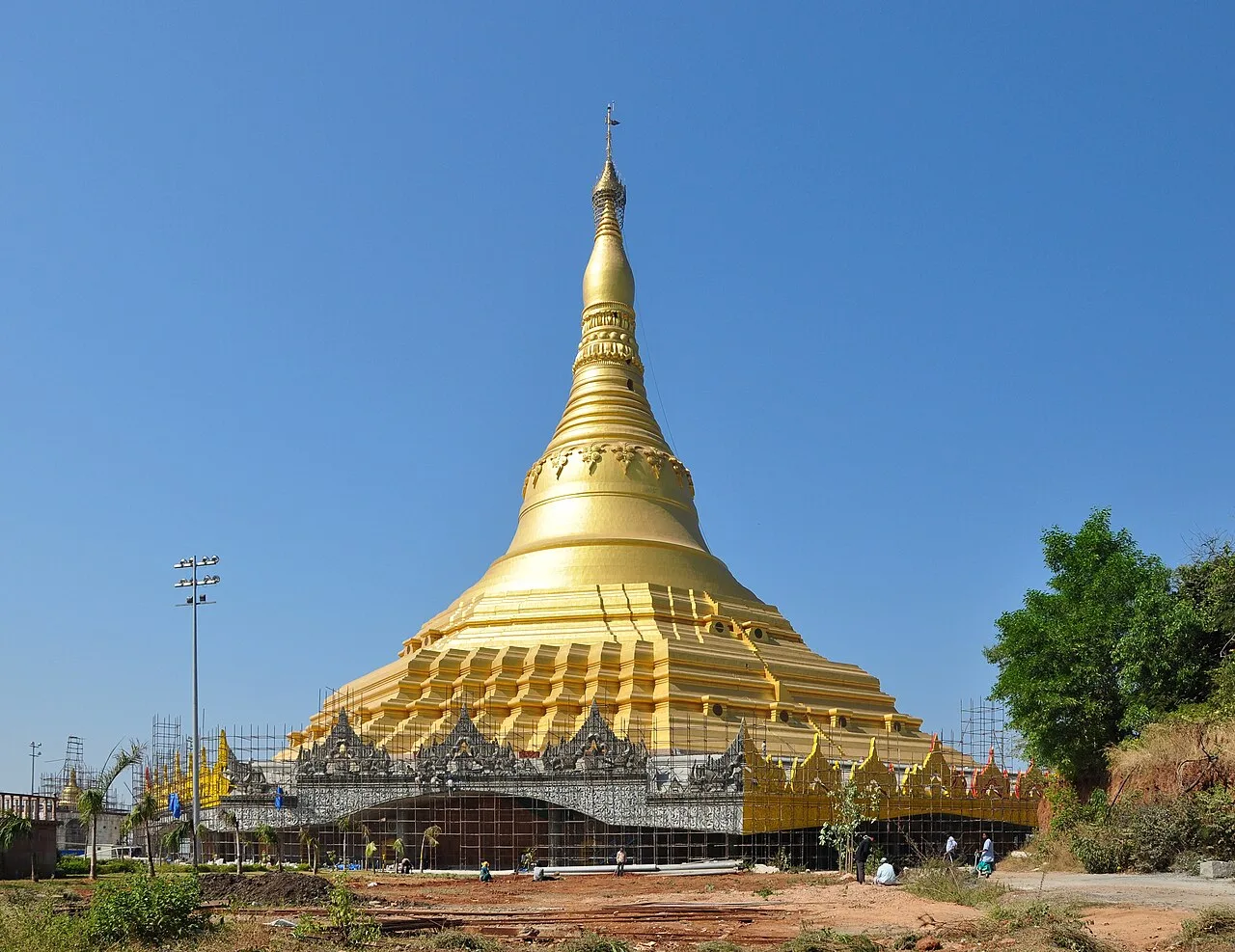
Global Vipassana Pagoda
The Global Vipassana Pagoda is a large meditation centre near Gorai in north-west Mumbai. Visitors come to learn about Vipassana and the Buddha’s teachings, and to see its Burmese-inspired architecture.
Key facts · verified by Ghumoopedia editors
- Type of place
- Destination
- Best time to visit
- October to March; June to September for green monsoon landscapes on the Ghats (expect closures)
- Nearest railway station
- Borivali · about 5 km (straight line)
- Verified
- 21 Nov 2026
Plan a trip from Global Vipassana Pagoda — a day-by-day route through places nearby.
Located in Mumbai Suburban district, Maharashtra, the pagoda is a meditation complex near Gorai. Its main dome can hold about 8,000 people practising Vipassana, making it the largest meditation hall of this kind in the world. The site occupies donated land on a peninsula edged by Gorai Creek and the Arabian Sea. In 2013, the Maharashtra Tourism Development Corporation and Marathi news channel ABP Majha named it one of Maharashtra’s Seven Wonders. Their selection followed a review of 350 destinations, and the results were announced on 6 June. India’s then President, Pratibha Patil, formally opened the pagoda on 8 February 2009. Built entirely with voluntary contributions, it commemorates Sayagyi U Ba Khin (1899–1971), a Vipassana instructor and the first Accountant-General of independent Burma. He helped bring the practice back to India, where it originated. The complex aims to make information about Vipassana, the Buddha and his teachings available to visitors, while standing as a symbol of peace and harmony. Vipassana is presented here as the practical core of the Buddha’s universal, non-sectarian teaching. The structure’s Burmese style expresses gratitude to Myanmar for safeguarding the practice. Its form follows that of Yangon’s Shwedagon Pagoda, also known as the Golden Pagoda. Ancient Indian building methods were combined with modern technology in its construction, with the intention that the structure endure for a thousand years. Maharashtra spans Mumbai's Gothic and Art Deco skyline, the rock-cut cave temples of Ajanta, Ellora, Karla and Elephanta, the hill forts of Chhatrapati Shivaji Maharaj, the Konkan's sea forts and beaches, and the great pilgrimages of Pandharpur, Shirdi and the Jyotirlingas. The coast is hot and humid most of the year with very heavy monsoon rain from June to September; the Western Ghats hill stations are cool and misty in the monsoon and pleasant in winter; the Deccan and Vidarbha are dry, with harsh summers above 40°C in Nagpur and Chandrapur. The usual best time to visit is October to March; June to September for green monsoon landscapes on the Ghats (expect closures). Timings, fees and access arrangements must be confirmed locally. For official information, see Maharashtra Tourism at https://www.maharashtratourism.gov.in.
Why it matters
The Global Vipassana Pagoda is a major meditation and visitor landmark near Gorai in Mumbai Suburban district. Its central dome is designed to accommodate around 8,000 Vipassana meditators; the organisation describes it as the world’s largest meditation hall of its kind. The pagoda promotes awareness of Vipassana meditation and the Buddha’s teachings, and commemorates the role of Burmese teacher Sayagyi U Ba Khin in helping Vipassana return to India. Its Burmese-inspired design also expresses gratitude to Myanmar for preserving the practice. Maharashtra Tourism Development Corporation and ABP Majha selected it as one of the “Seven Wonders of Maharashtra”; the selection results were announced in 2013. It is not identified here as a UNESCO World Heritage Site or an ASI-protected monument.
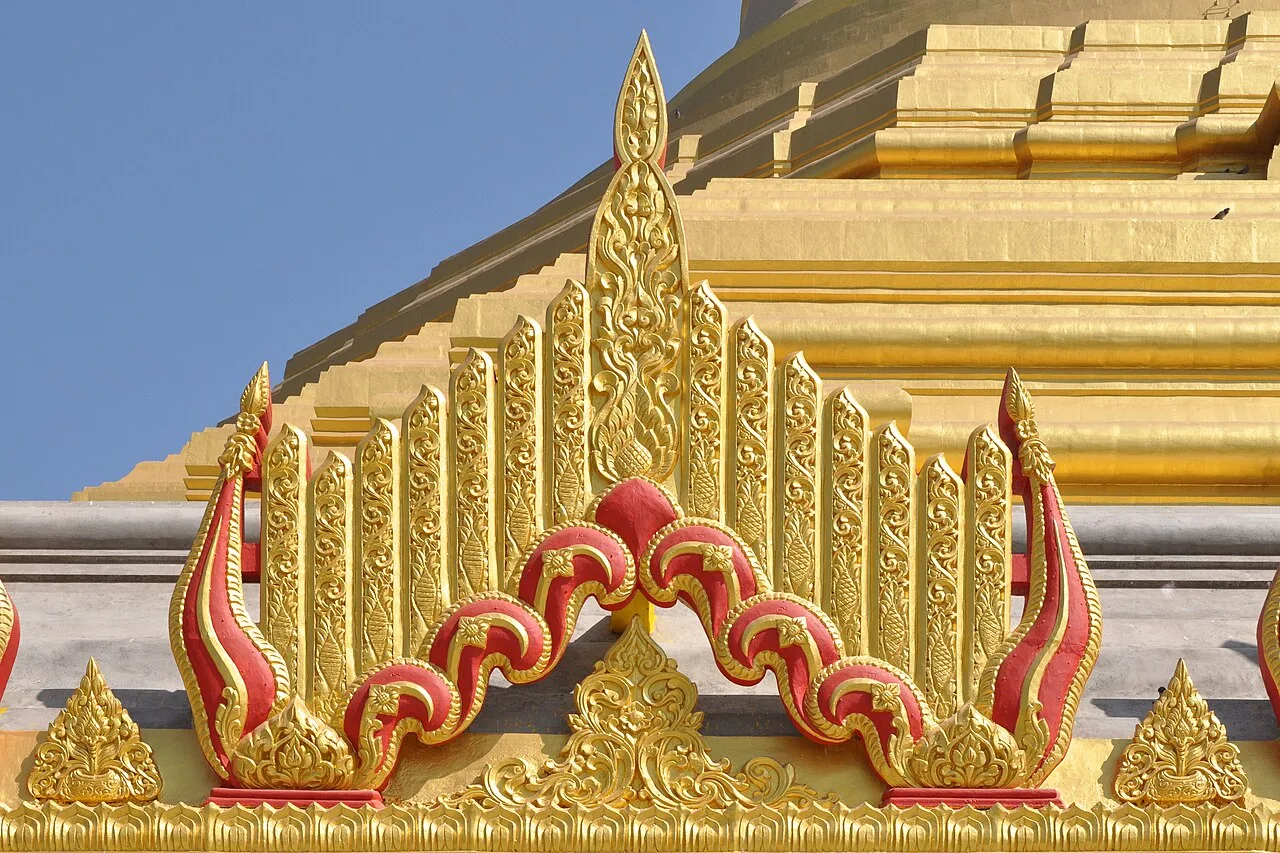
The pagoda was developed as a monument to peace and harmony and as a place to introduce visitors to Vipassana and the Buddha’s teachings. Its organisers built it in gratitude to Sayagyi U Ba Khin (1899–1971), a Burmese Vipassana teacher and the first Accountant-General of independent Burma, whose teaching helped the practice return to India. The project was supported by voluntary donations and built on donated land on a peninsula between Gorai Creek and the Arabian Sea. The design draws on Myanmar’s Buddhist architecture: the pagoda’s form is modelled on Yangon’s Shwedagon Pagoda. Its builders combined this traditional inspiration with modern construction methods, intending the structure to endure for a very long time. The main dome was planned as a meditation hall for around 8,000 people. India’s then President, Pratibha Patil, inaugurated the pagoda on 8 February 2009. In 2013, Maharashtra Tourism Development Corporation and ABP Majha included it among their selected “Seven Wonders of Maharashtra.” The complex continues to serve as a public-facing centre for learning about Vipassana, alongside its role as a place of meditation.
Visit Global Vipassana Pagoda with time to observe daily prayers and rituals respectfully. Follow the posted rules on footwear, photography, phones, head covering and dress, and avoid interrupting worshippers; popular temples may have separate queues, dress codes or mobile-phone deposit counters. Ask caretakers which areas are open to visitors, and beware of unofficial 'guides' or agents offering quick darshan for a fee. A comfortable itinerary is one main visit in the morning, a local meal at midday and a short nearby stop before an afternoon return. Use the district list on this site to find other places in Mumbai Suburban, but check the route and its condition before combining stops. If a festival is on — such as Ganeshotsav, Gudi Padwa or the Ashadhi Wari to Pandharpur — roads and stays can be busy, and the experience can be unforgettable. Leave no litter: many sites are protected by the communities around them.
Suggested itineraries
Half day: Arrive in Gorai; allow 1–2 hours to visit the pagoda and visitor areas quietly; take a meal or refreshment nearby; return by road or ferry. Full day: Visit the pagoda in the morning; have a local meal; spend the afternoon at Gorai or Manori beach, allowing for travel and weather; return before your chosen transport becomes inconvenient. Gentler option: Arrange a drop-off close to the visitor entrance, focus on the most accessible open areas, take seated breaks, and skip additional beach or neighbourhood stops.
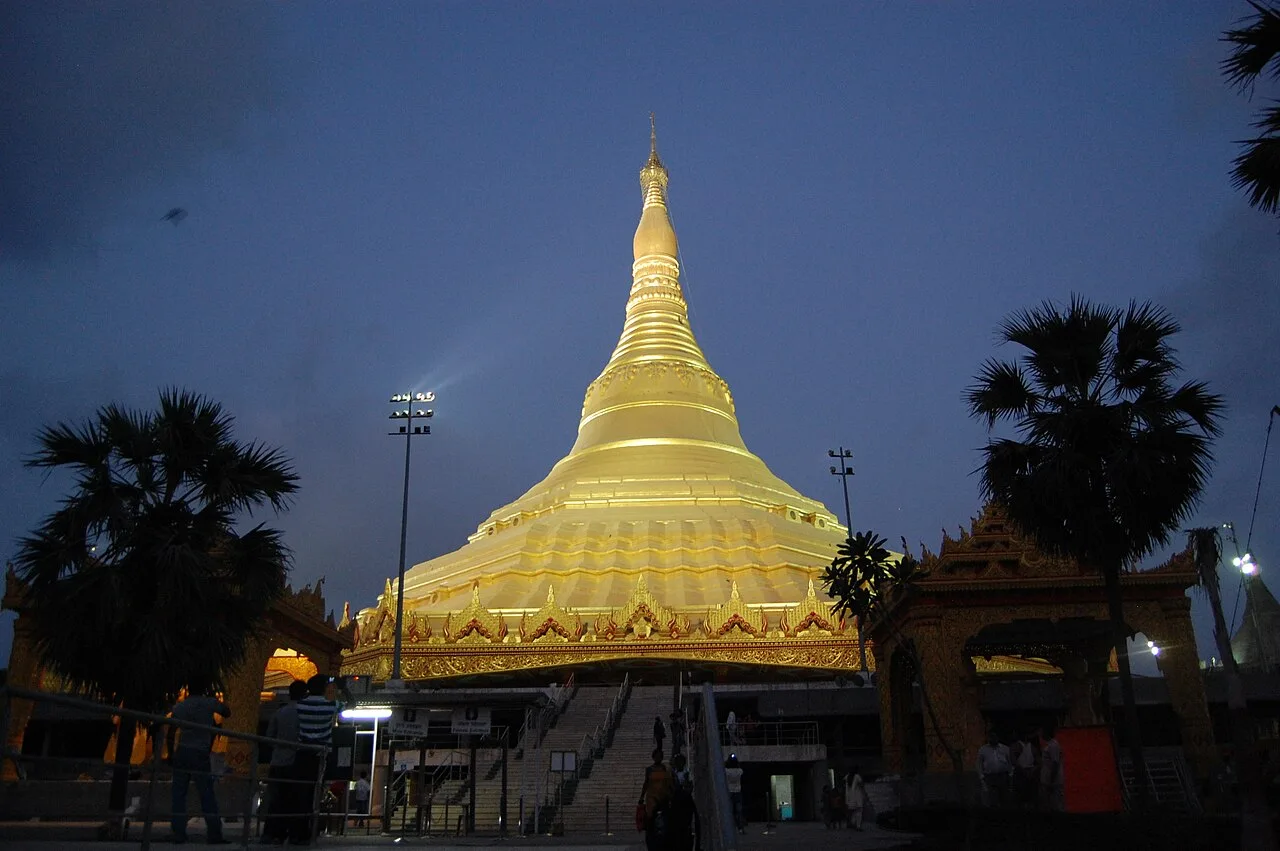
The site’s living tradition centres on Vipassana, a meditation practice taught as a practical, non-sectarian path associated with the Buddha’s teachings. Visitors may encounter people meditating or attending organised learning activities; silence and consideration are important in and around practice areas. The pagoda’s Burmese-style architecture reflects a cultural connection with Myanmar, while its setting is part of contemporary Mumbai. Marathi and Hindi are widely used in the surrounding region, and English is also commonly encountered at a major visitor attraction. This is a meditation centre rather than a performance venue, so visitors should not expect regular music or dance programmes. Follow posted guidance on footwear, dress, phones and conduct.
Festivals & events
Buddha Purnima, usually in April or May, is an important Buddhist observance across India, but visitors should check whether any public programme is scheduled at the pagoda rather than assume one is held there. Mumbai’s Ganesh Chaturthi season, generally in August or September, brings major processions and crowds across the city and can affect transport. Diwali, usually in October or November, is widely observed in the region. Local celebrations and events around Gorai and neighbouring communities may vary from year to year. On festival days, allow extra time for road and ferry connections, expect busier public spaces, and confirm access arrangements with the site before travelling.
Local food in Maharashtra includes vada pav, misal pav, pav bhaji, poha, puran poli, modak at Ganesh Chaturthi, Kolhapuri mutton with tambda and pandhra rassa, Malvani fish curry and sol kadhi on the Konkan coast, and Nagpur oranges and saoji food in Vidarbha. Ask what is fresh that day; many small eateries cook a limited daily menu. Vegetarian travellers eat well across the state, and most towns also have fish and meat dishes. Remote sites may have no restaurant at all. Carry water and snacks, eat a proper breakfast before long drives, and ask your accommodation for a packed lunch if you are heading out early. If prasad or langar is offered, accept it according to local custom. Choose busy, clean places, drink sealed or filtered water, and carry your packaging back with you.
Shopping & local experiences
Shopping immediately around the pagoda is likely to be modest rather than a major market experience. Check whether the visitor complex has an authorised book or information counter for material about Vipassana and the site; do not assume souvenirs are always available. In Gorai and nearby neighbourhoods, small shops may sell everyday goods and snacks. Local eateries are a better reason to pause than searching for a particular craft specialty; coastal menus may include seafood, alongside familiar Mumbai snacks and vegetarian options. For a broader choice of crafts, books and souvenirs, look in established Mumbai shopping areas and allow for the extra journey.
October to March; June to September for green monsoon landscapes on the Ghats (expect closures)
The nearest principal railway station by straight-line distance is Borivali, roughly 5 km away. The nearest operating airport by straight-line distance is Chhatrapati Shivaji Maharaj International Airport, Mumbai, roughly 15 km away. These figures are calculated from map coordinates — actual road distance is longer. Mumbai and Pune are the main rail and air gateways in the west, Chhatrapati Sambhajinagar (Aurangabad) for Ajanta and Ellora, Nagpur for Vidarbha and the tiger reserves, and the Konkan Railway serves the coast down to Sindhudurg. Within Mumbai, suburban local trains on the Western, Central and Harbour lines are the fastest way around outside rush hours (roughly 8–11 am and 5–9 pm); each train has ladies' compartments, and the Metro and app cabs are more comfortable alternatives. When comparing train, bus and flight, count the complete door-to-door time: a flight saves the most time only if the onward road transfer is short, while an overnight train can save a hotel night. Book your return before you leave, because seats fill quickly on weekends, festivals and holidays. Current train numbers, timings, return services and fares are not listed here; check IRCTC and NTES for trains and the airline's own schedule for flights. No permit is needed to visit Maharashtra. Tiger safaris in Tadoba, Pench and Melghat must be booked in advance through the official online portals. Many hill forts are popular monsoon treks: since several accidents, some districts restrict access to waterfalls, forts and ghats during heavy rain — check current district orders before setting out. Ganeshotsav (August–September) brings very large crowds to Mumbai and Pune.
Confirm onward and return timings on IRCTC / NTES, the state bus operator or your airline before travel. A dash means current timings or fares have not been verified.
Getting around
From elsewhere in Mumbai, travel towards Borivali or Malad and continue to Gorai by road or by a local ferry connection serving the area. Ferry services and onward connections can change, so check locally before relying on a crossing. Auto-rickshaws and app-based or metered taxis may be available around the main approach points; agree the destination clearly, especially after a ferry ride. Local buses also serve parts of the wider area, but routes may not take you to the entrance. The site is spread out, so expect some walking once there. Check parking availability and road conditions before driving, particularly on weekends and holidays.
Hours, tickets & permissions
Entry arrangements can vary by area and activity: the public visitor spaces may have different rules from meditation or course areas, which can be reserved for participants. Follow notices and staff instructions on footwear, dress, mobile phones, photography and quiet conduct. Do not assume that every part of the complex is open to walk-in visitors. There may be separate procedures for organised groups or meditation sessions. Confirm current opening hours, access rules and any fees directly with the pagoda’s managing authority before setting out.
Facilities
The complex is organised for visitors and may have information or exhibition areas; availability of guided explanations and meditation activities can vary. Toilets and drinking water are usually the first practical facilities to check on arrival, and visitors should carry water in hot weather. Food options at or near the site may be limited or subject to change, so plan a meal in Gorai or along your route. Parking may be available, but check locally. Do not rely on an ATM, shop, or guide service being available on site; carry essentials and use official staff for visitor information.
Accessibility
The pagoda grounds and approach involve walking, and the large complex may require time between its entrance and visitor areas. Paths, surfaces and access to particular levels can vary; interior routes may include steps. Do not assume that ramps, lifts or wheelchair-accessible toilets are available throughout. Visitors using wheelchairs or strollers should contact the managing authority in advance to ask which areas are accessible and where a vehicle can drop them off. Shade and seating may not be continuous, so plan rest breaks, especially in warm or humid weather. Older visitors may find a focused visit more comfortable than combining the pagoda with a long beach outing.
No permit is needed to visit Maharashtra. Tiger safaris in Tadoba, Pench and Melghat must be booked in advance through the official online portals. Many hill forts are popular monsoon treks: since several accidents, some districts restrict access to waterfalls, forts and ghats during heavy rain — check current district orders before setting out. Ganeshotsav (August–September) brings very large crowds to Mumbai and Pune. Carry a photo ID at all times and save the emergency number 112 and your accommodation's contact offline. Heat in summer and heavy rain in the monsoon are the main weather risks; carry water, avoid midday sun and allow extra time when roads flood. Watch your belongings in crowds and on public transport, and follow posted instructions.
Photography
The pagoda’s exterior and broad dome are especially striking in soft morning or late-afternoon light; views from the grounds can help show its scale. Photography rules may differ between outdoor areas, exhibitions and meditation spaces, so check posted signs and ask staff before taking pictures indoors. Avoid photographing people who are meditating or attending a course without their permission, and keep phones silent. Do not use flash where it could disturb visitors. Drone use may be restricted by site rules and aviation regulations; do not launch one without explicit permission and checking applicable rules.
Choose a stay by the full journey to Global Vipassana Pagoda, not just the district name. Mumbai is expensive, so book early; Colaba and Fort suit sightseeing, while Bandra and Juhu suit nightlife and beaches. In summer, check air-conditioning; in the monsoon, check that the property is accessible if roads flood. Book in advance for weekends, festivals and the peak season (October to March; June to September for green monsoon landscapes on the Ghats (expect closures)). Confirm the exact location, meals included, check-in time and cancellation terms in writing. Avoid sending money to unverified contacts or touts at stations. Carry some cash, as card and digital payments can be unreliable in remote areas.
Gorai and Manori beaches are the most natural nearby additions for a relaxed coastal outing; check local conditions and access before swimming. Marve Beach and the ferry area offer another way to experience Mumbai’s western shore. For a longer excursion within Mumbai Suburban district, Sanjay Gandhi National Park and the Kanheri Caves provide a contrasting landscape and archaeological visit, but allow substantial travel time and check park access separately. Gorai’s neighbourhood has local eateries and small shops. These places are not all within easy walking distance of the pagoda, so confirm routes and transport before planning several stops in one day.
For couples, Global Vipassana Pagoda rewards a slow pace: arrive early for soft light and fewer crowds, share a local meal and keep the evening free. Sunset on Marine Drive, a misty monsoon morning in Mahabaleshwar or a quiet Konkan beach makes the trip memorable. Public displays of affection can be frowned upon in conservative communities and at religious sites, so be discreet. Keep a buffer in your itinerary, because weather and road conditions can delay plans.
Q: How much time should I allow for a visit? A: Allow a few hours for the pagoda and visitor areas, with additional time for travel to and from Gorai. A beach stop makes it a longer outing. Q: When is the best season to visit? A: October to March is generally more comfortable. The monsoon can bring heavy rain and travel disruption; check conditions before going. Q: Is entry available to everyone? A: Visitor access depends on current site rules and which areas are open. Confirm arrangements with the managing authority before travelling. Q: Is the visit suitable for children and older visitors? A: It can be, if everyone is comfortable with a quiet setting and walking. Supervise children, respect meditation areas, and plan breaks for older visitors. Q: Where can I stay nearby? A: Check current accommodation options in Gorai and Manori; for a wider selection, consider Borivali or other parts of Mumbai and plan the onward journey.
Be the first to share photos, stories, advice or a helpful contact for Global Vipassana Pagoda.
Loading…