
Marine Drive
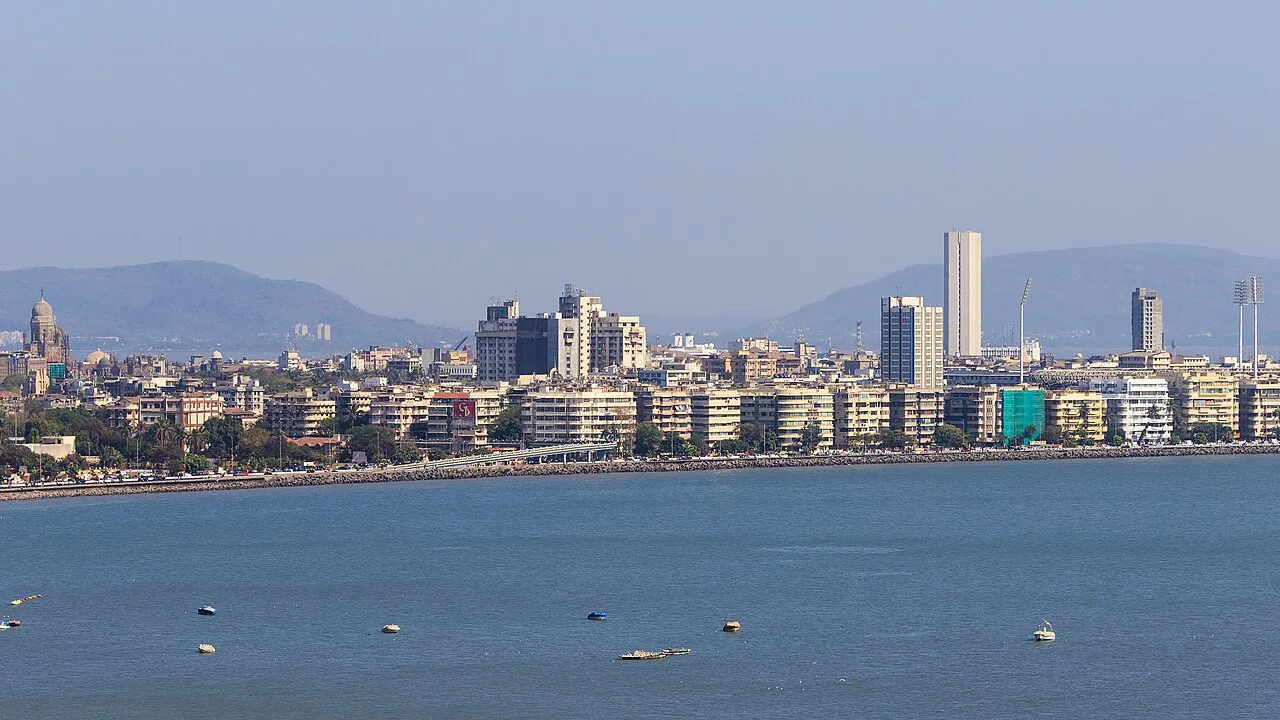
Marine Drive is a coastal road and promenade in Mumbai, known for its curved shoreline setting and the lights that give it the name Queen’s Necklace. Visitors come to walk by the sea and enjoy food at Chowpatty Beach.
Key facts · verified by Ghumoopedia editors
- Type of place
- Natural attraction
- Best time to visit
- October to March; June to September for green monsoon landscapes on the Ghats (expect closures)
- Nearest railway station
- Mumbai CSMT · about 5 km (straight line)
- Verified
- 21 Nov 2026
Plan a trip from Marine Drive — a day-by-day route through places nearby.
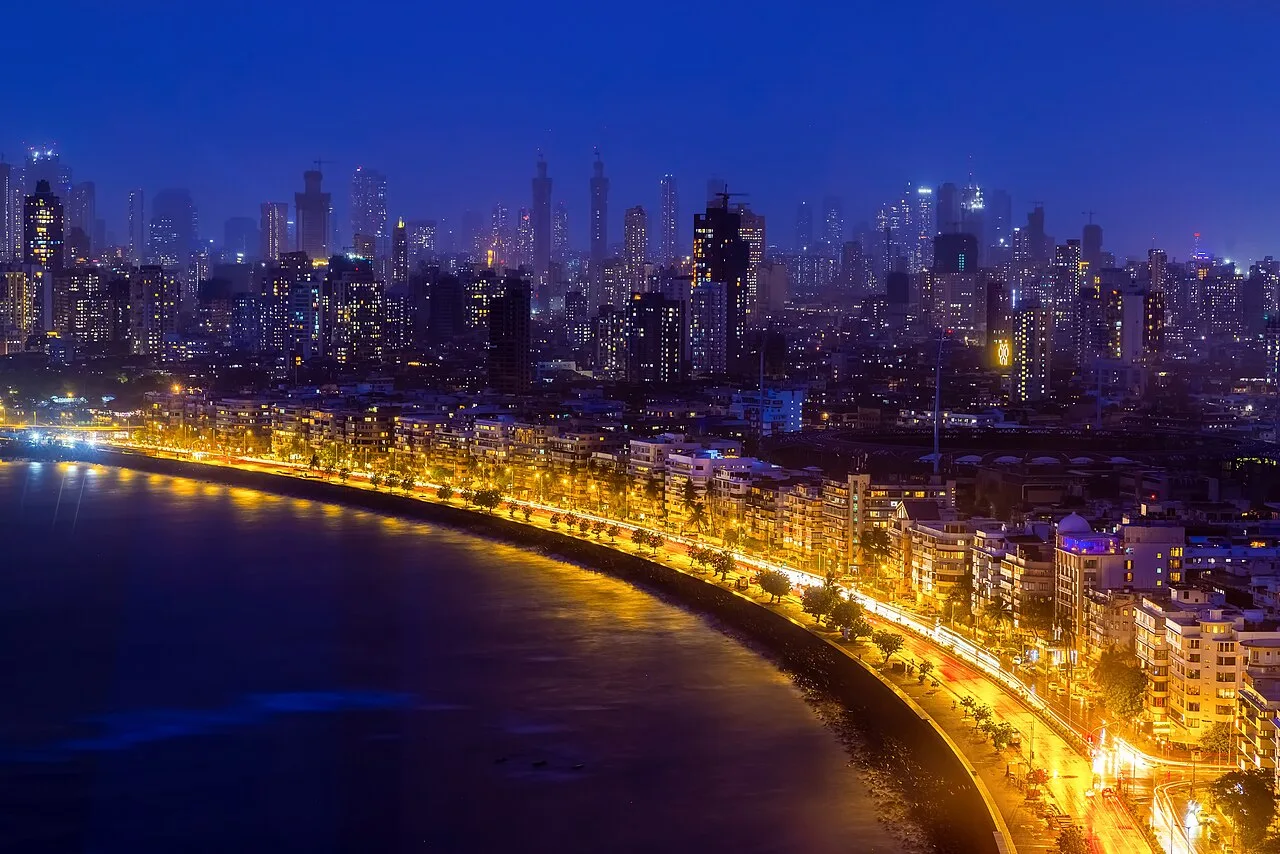
In Mumbai City district, Maharashtra, Marine Drive follows a curve beside a natural bay. The road is about three kilometres in length, has six lanes and is built of concrete. It stands on reclaimed land and faces west-south-west. Pallonji Mistry constructed the road and promenade in 1940. Its formal road name is Netaji Subhash Chandra Bose Road, though people seldom use it. Palm trees line the pedestrian stretch. The route links Nariman Point at its southern end with Babulnath and Malabar Hill towards the north. Girgaon Chowpatty lies at the northern end; the nearby beach is also known as Chowpatty Beach. In the evening, the line of street lamps can look like pearls when seen from above, giving rise to the nickname Queen’s Necklace. Chowpatty draws people for bhel puri, a local quick meal, and restaurants are found along the drive. Further along is Walkeshwar, an affluent part of Mumbai and the home of the Governor of Maharashtra. Many residences built by wealthy Parsi families in the area feature Art Deco design, a style popular during the 1920s and 1930s. Kapur Mahal, Zaver Mahal and Keval Mahal rank among Marine Drive’s earliest examples of this architecture. Built from 1937 to 1939 at a combined cost of one million rupees, they belong to the UNESCO World Heritage Site known as the Victorian Gothic & Art Deco Ensembles of Mumbai. Property values along the promenade are high. A number of hotels occupy the stretch, including the five-star Oberoi, the Intercontinental, Hotel Marine Plaza and Sea Green Hotel, as well as several smaller establishments. Maharashtra spans Mumbai's Gothic and Art Deco skyline, the rock-cut cave temples of Ajanta, Ellora, Karla and Elephanta, the hill forts of Chhatrapati Shivaji Maharaj, the Konkan's sea forts and beaches, and the great pilgrimages of Pandharpur, Shirdi and the Jyotirlingas. The coast is hot and humid most of the year with very heavy monsoon rain from June to September; the Western Ghats hill stations are cool and misty in the monsoon and pleasant in winter; the Deccan and Vidarbha are dry, with harsh summers above 40°C in Nagpur and Chandrapur. The usual best time to visit is October to March; June to September for green monsoon landscapes on the Ghats (expect closures). Timings, fees and access arrangements must be confirmed locally. For official information, see Maharashtra Tourism at https://www.maharashtratourism.gov.in.
Why it matters
Marine Drive is one of Mumbai’s best-known public waterfronts: a curved promenade and road along the city’s western shore, facing the Arabian Sea. Locally, it is valued as a place to walk, sit by the water and watch the changing light over the bay. Its night-time arc of streetlights gives rise to the familiar nickname “Queen’s Necklace.” The route is also an important link between Nariman Point and the Girgaon Chowpatty end of the coast. The UNESCO World Heritage property Victorian Gothic and Art Deco Ensembles of Mumbai includes Art Deco buildings along Marine Drive; the inscription was made in 2018. This recognition applies to the listed ensemble and its buildings, not to the promenade as a separate UNESCO site.
Marine Drive is part of the reshaping of Mumbai’s shoreline through land reclamation and urban development. The present coastal road and promenade were built along reclaimed land, facing west-south-west across a natural bay. The road is commonly credited to builder Pallonji Mistry and is traditionally dated to 1940. Its official name is Netaji Subhash Chandra Bose Road, though the name Marine Drive is more widely used. The crescent-shaped route connected the growing southern business district around Nariman Point with the northern neighbourhoods near Chowpatty and Malabar Hill. During the 1930s, wealthy residents and developers built apartment blocks along the seafront in the Art Deco style then popular in Mumbai. Kapur Mahal, Zaver Mahal and Keval Mahal are among the early examples, constructed between 1937 and 1939; they form part of the UNESCO-listed Victorian Gothic and Art Deco Ensembles of Mumbai. Marine Drive’s buildings and public spaces have continued to serve a changing city, while the seafront remains a popular gathering place. The promenade is exposed to monsoon weather and sea conditions, and maintenance and access can vary; check local notices for current works or restrictions.
Origin stories & folklore
Marine Drive’s best-known story is the origin of its nickname, “Queen’s Necklace.” According to local usage, when the curved road is viewed from an elevated point after dark, its line of streetlights resembles pearls strung around a necklace. This is a visual comparison rather than an ancient legend, and the effect depends on the viewpoint, visibility and lighting. The bay and reclaimed shoreline also invite stories about Mumbai’s changing coast, but accounts of reclamation and construction belong to the city’s documented history. Visitors may hear personal memories and local anecdotes about evening walks, monsoon waves or meeting friends here; these are part of the promenade’s living urban lore, not fixed folklore.
Explore Marine Drive slowly and read the interpretation boards, use the official audio guide where available or hire an authorised guide to understand its history. Check opening days, ticket counters and camera rules in advance; many monuments and museums close on one weekday and on some public holidays. Early morning gives softer light, cooler air and smaller crowds. A comfortable itinerary is one main visit in the morning, a local meal at midday and a short nearby stop before an afternoon return. Use the district list on this site to find other places in Mumbai City, but check the route and its condition before combining stops. If a festival is on — such as Ganeshotsav, Gudi Padwa or the Ashadhi Wari to Pandharpur — roads and stays can be busy, and the experience can be unforgettable. Leave no litter: many sites are protected by the communities around them.
Suggested itineraries
Half day: Walk a chosen section of Marine Drive (1–2 hours), pause for the sea view, then visit Girgaon Chowpatty and try local chaat (1–2 hours). Full day: Begin with a morning walk along Marine Drive (1–2 hours), explore nearby Art Deco architecture (1–2 hours), have lunch nearby, then visit Babulnath Temple or the Hanging Gardens area (2–3 hours); allow time for traffic and rest. Gentler option: Take a taxi to a convenient promenade access point, enjoy a short seated visit and nearby meal, and avoid attempting the full length.
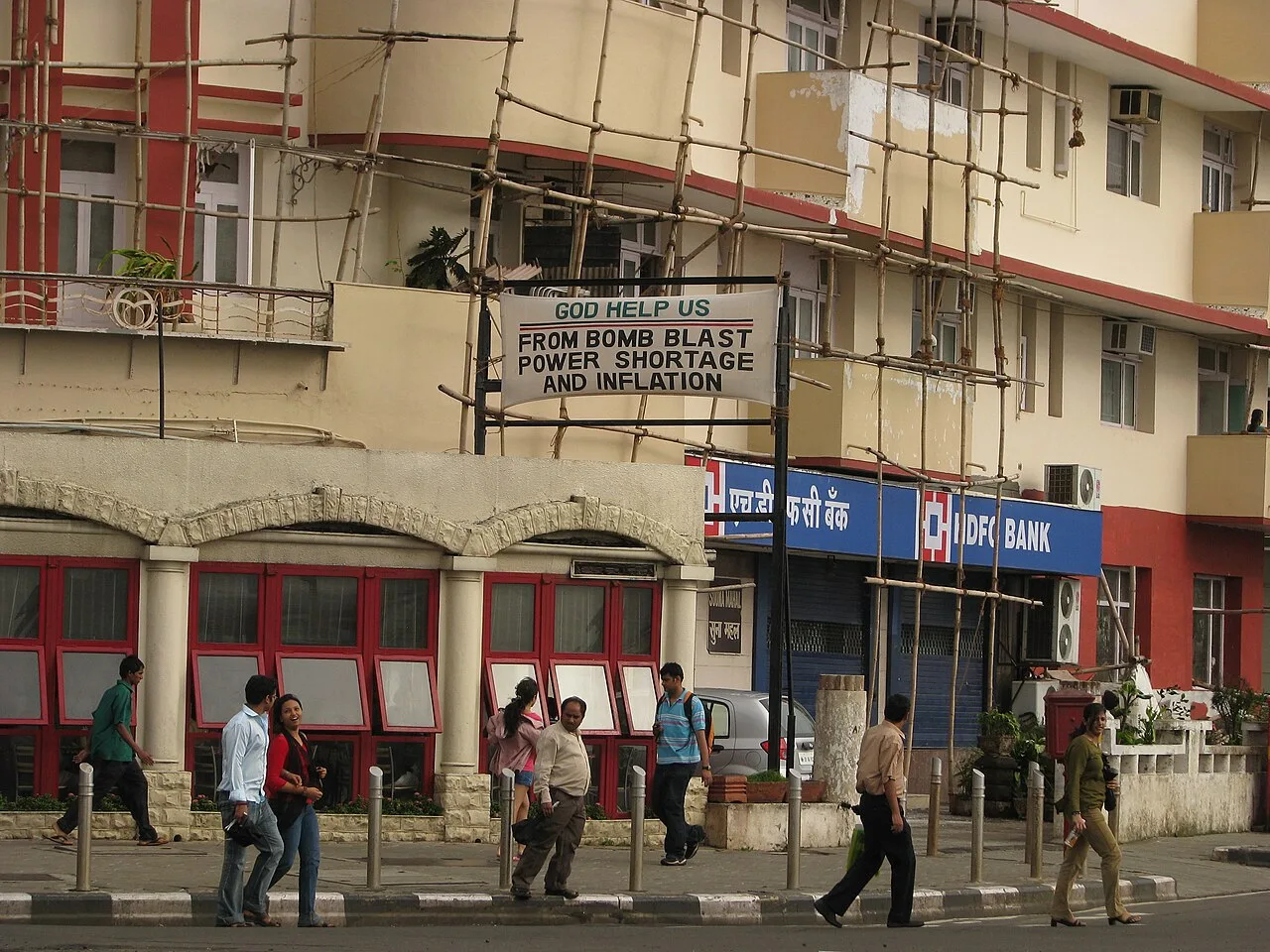
Marine Drive is a shared public space used for evening walks, exercise, conversation and watching the sunset or monsoon seas. Its everyday culture reflects Mumbai’s multilingual city life: Marathi, Hindi, Gujarati and English are commonly heard, alongside many other languages. People dress in ordinary city clothing, with practical footwear and rain protection especially useful in wet weather. Street snacks associated with the nearby Girgaon Chowpatty include bhel puri and other chaat; vendors and availability can change. The promenade also appears in Indian films, music and popular imagery as a recognisable Mumbai seafront. Visitors should keep pathways clear, use bins where available and be considerate of people exercising, resting or gathering with family.
Local communities
The promenade is used by residents from many parts of Mumbai, including walkers, runners, families, students and office-goers. Nearby neighbourhoods have long been home to diverse communities, including Marathi-speaking residents and Parsi families associated with some of the area’s historic Art Deco buildings. The wider seafront economy supports hotel and restaurant staff, shopkeepers, transport workers, maintenance crews and food sellers, particularly around Chowpatty. The city’s public agencies maintain roads and public spaces, while local businesses serve visitors and residents. Marine Drive is a shared civic setting; avoid treating people’s routines or homes as attractions, and ask before photographing individuals.
Festivals & events
Ganeshotsav, usually held in the monsoon season, brings processions and immersion activity to Mumbai’s waterfronts, including the broader Girgaon Chowpatty area near Marine Drive. Crowds, traffic diversions and restricted access can affect visits. Navratri and Diwali, generally in autumn, add activity across the city, though events are not necessarily held on the promenade itself. New Year’s Eve and other holiday periods can also draw large numbers to the seafront. Festival arrangements and routes vary from year to year; check current municipal and police notices before travelling, allow extra time and follow instructions around barriers and immersion areas.
Local food in Maharashtra includes vada pav, misal pav, pav bhaji, poha, puran poli, modak at Ganesh Chaturthi, Kolhapuri mutton with tambda and pandhra rassa, Malvani fish curry and sol kadhi on the Konkan coast, and Nagpur oranges and saoji food in Vidarbha. Ask what is fresh that day; many small eateries cook a limited daily menu. Vegetarian travellers eat well across the state, and most towns also have fish and meat dishes. Remote sites may have no restaurant at all. Carry water and snacks, eat a proper breakfast before long drives, and ask your accommodation for a packed lunch if you are heading out early. Try a home-cooked or local thali meal when you can — it is often the best food on the route. Choose busy, clean places, drink sealed or filtered water, and carry your packaging back with you.
Shopping & local experiences
Marine Drive itself is primarily a promenade rather than a dedicated shopping street. Restaurants and snack sellers near Chowpatty offer a chance to try local chaat, including bhel puri, where available. Shops and markets in the surrounding city sell clothing, books, household goods and souvenirs, but offerings vary by neighbourhood. For a broader range of crafts and gifts, visitors can explore established shopping areas elsewhere in Mumbai City, such as Colaba or Kala Ghoda, and check current shop hours independently. Buy from legitimate sellers, carry reusable bags where practical and dispose of food packaging responsibly.
Marine Drive curves beside Back Bay, an inlet of the Arabian Sea, with a broad view across open water and the changing Mumbai shoreline. The road and promenade occupy reclaimed land, so this is an urban coastal landscape rather than a natural beach throughout its length. Palm trees line sections of the promenade, while the nearby Chowpatty shoreline has sand and tidal water. Sea conditions can be rough, especially during the southwest monsoon from June to September, when waves may wash over exposed areas. Urban birds such as crows and pigeons are familiar; gulls and other shorebirds may be seen at times, but sightings vary. The water is not a promise of safe swimming, and visitors should heed barriers and local warnings. Take litter away and avoid feeding wildlife.
October to March; June to September for green monsoon landscapes on the Ghats (expect closures)
The nearest principal railway station by straight-line distance is Mumbai CSMT, roughly 5 km away. The nearest operating airport by straight-line distance is Chhatrapati Shivaji Maharaj International Airport, Mumbai, roughly 15 km away. These figures are calculated from map coordinates — actual road distance is longer. Mumbai and Pune are the main rail and air gateways in the west, Chhatrapati Sambhajinagar (Aurangabad) for Ajanta and Ellora, Nagpur for Vidarbha and the tiger reserves, and the Konkan Railway serves the coast down to Sindhudurg. Within Mumbai, suburban local trains on the Western, Central and Harbour lines are the fastest way around outside rush hours (roughly 8–11 am and 5–9 pm); each train has ladies' compartments, and the Metro and app cabs are more comfortable alternatives. When comparing train, bus and flight, count the complete door-to-door time: a flight saves the most time only if the onward road transfer is short, while an overnight train can save a hotel night. Book your return before you leave, because seats fill quickly on weekends, festivals and holidays. Current train numbers, timings, return services and fares are not listed here; check IRCTC and NTES for trains and the airline's own schedule for flights. No permit is needed to visit Maharashtra. Tiger safaris in Tadoba, Pench and Melghat must be booked in advance through the official online portals. Many hill forts are popular monsoon treks: since several accidents, some districts restrict access to waterfalls, forts and ghats during heavy rain — check current district orders before setting out. Ganeshotsav (August–September) brings very large crowds to Mumbai and Pune.
Confirm onward and return timings on IRCTC / NTES, the state bus operator or your airline before travel. A dash means current timings or fares have not been verified.
Getting around
Taxis and app-based cabs can drop visitors at suitable points along the route, subject to traffic restrictions. Mumbai’s suburban railway is useful for reaching the area: Churchgate is convenient for the southern end, while Marine Lines serves the northern stretch. Local buses run on nearby roads; routes and stops should be checked locally. Walking is the best way to experience the promenade, but the full curved stretch is several kilometres, so choose a section if time or mobility is limited. Parking is limited and can be difficult in busy periods; do not assume a space will be available. There are no regular visitor boats serving Marine Drive as a transport route.
Hours, tickets & permissions
Marine Drive is a public road and promenade, and ordinary visits generally do not require a monument ticket or permit. Temporary closures, traffic controls or restricted access may apply during festivals, severe weather, maintenance or security operations. There is no single visitor-entry arrangement for the full route, and rules can differ around adjacent attractions and event areas. Confirm current access conditions, any applicable fees and facility availability with the relevant municipal or site authority before setting out. Follow posted safety notices and police or civic instructions, particularly near the water.
Facilities
Food and drinks are available at restaurants and snack stalls along or near the route, especially around Chowpatty, though offerings and operating status vary. Public toilets and drinking-water points may be available at intervals or at nearby establishments; check locally rather than relying on a particular facility. Hotels, cafés, shops and ATMs are found in the surrounding neighbourhoods. Seating is present along parts of the promenade, but shade is limited in exposed sections. Parking can be constrained. There is no single visitor desk or standard guided-tour service for the entire drive; authorised city or architecture guides may be available through local operators.
Accessibility
The promenade follows a long, exposed coastal road, and visiting even one section can involve substantial walking. Surface condition, kerbs and access points vary, and crossing busy roads requires care. Some stretches have seating, but shade is limited and the sea-facing route can be windy or wet. Do not assume that every entrance is step-free or that a continuous accessible path is available; wheelchair users and visitors with strollers may need to select an access point in advance and check current conditions locally. Older visitors may find a short visit with rests more comfortable than walking the full route. Taxis can help reduce the distance on foot.
No permit is needed to visit Maharashtra. Tiger safaris in Tadoba, Pench and Melghat must be booked in advance through the official online portals. Many hill forts are popular monsoon treks: since several accidents, some districts restrict access to waterfalls, forts and ghats during heavy rain — check current district orders before setting out. Ganeshotsav (August–September) brings very large crowds to Mumbai and Pune. Carry a photo ID at all times and save the emergency number 112 and your accommodation's contact offline. Heat in summer and heavy rain in the monsoon are the main weather risks; carry water, avoid midday sun and allow extra time when roads flood. Watch your belongings in crowds and on public transport, and follow posted instructions.
Photography
Early morning and late afternoon often provide softer light, while evening views capture the lights associated with the “Queen’s Necklace” nickname. The promenade, bay and Art Deco façades offer different viewpoints; use public access areas and avoid obstructing walkers. Personal photography is generally customary in public spaces, but rules may differ at nearby buildings or during events, so check posted notices. Do not fly a drone without confirming current aviation rules and any local permissions. Ask before taking close portraits, and be especially respectful around families, religious activity and festival processions.
Choose a stay by the full journey to Marine Drive, not just the district name. Mumbai is expensive, so book early; Colaba and Fort suit sightseeing, while Bandra and Juhu suit nightlife and beaches. In summer, check air-conditioning; in the monsoon, check that the property is accessible if roads flood. Book in advance for weekends, festivals and the peak season (October to March; June to September for green monsoon landscapes on the Ghats (expect closures)). Confirm the exact location, meals included, check-in time and cancellation terms in writing. Avoid sending money to unverified contacts or touts at stations. Carry some cash, as card and digital payments can be unreliable in remote areas.
Girgaon Chowpatty is at the northern end of Marine Drive and is known for its beachside food stalls. Nearby city attractions include Babulnath Temple, the Hanging Gardens and Kamala Nehru Park on Malabar Hill. At the southern end, Nariman Point is a major business district with sea views. Visitors interested in architecture can look for the Art Deco buildings along Marine Drive, some of which form part of the UNESCO-listed Victorian Gothic and Art Deco Ensembles of Mumbai. Further into Mumbai City, the Gateway of India, Chhatrapati Shivaji Maharaj Vastu Sangrahalaya and Kala Ghoda are established cultural destinations; allow for city traffic when combining them.
For couples, Marine Drive rewards a slow pace: arrive early for soft light and fewer crowds, share a local meal and keep the evening free. Sunset on Marine Drive, a misty monsoon morning in Mahabaleshwar or a quiet Konkan beach makes the trip memorable. Public displays of affection can be frowned upon in conservative communities and at religious sites, so be discreet. Keep a buffer in your itinerary, because weather and road conditions can delay plans.
Q: How much time should I allow for Marine Drive? A: A short stop can suit a limited schedule; walking a longer section and visiting Chowpatty takes a few hours, depending on pace and crowds. Q: What is the best season to visit? A: October to March is generally more comfortable for outdoor visits. Monsoon brings dramatic seas but also heavy rain and rough conditions. Q: Is there an entry ticket? A: The public promenade generally has no routine monument ticket, but temporary restrictions or event rules may apply. Check current local notices. Q: Is Marine Drive suitable for children and elderly visitors? A: It can be, with supervision near the water and a short route with rest breaks. Surfaces, crossings, weather and access vary. Q: Can I stay near Marine Drive? A: Hotels are available along and near the route, from larger properties to smaller options. Check location, access and current availability before booking.
Be the first to share photos, stories, advice or a helpful contact for Marine Drive.
Loading…