
Pipili
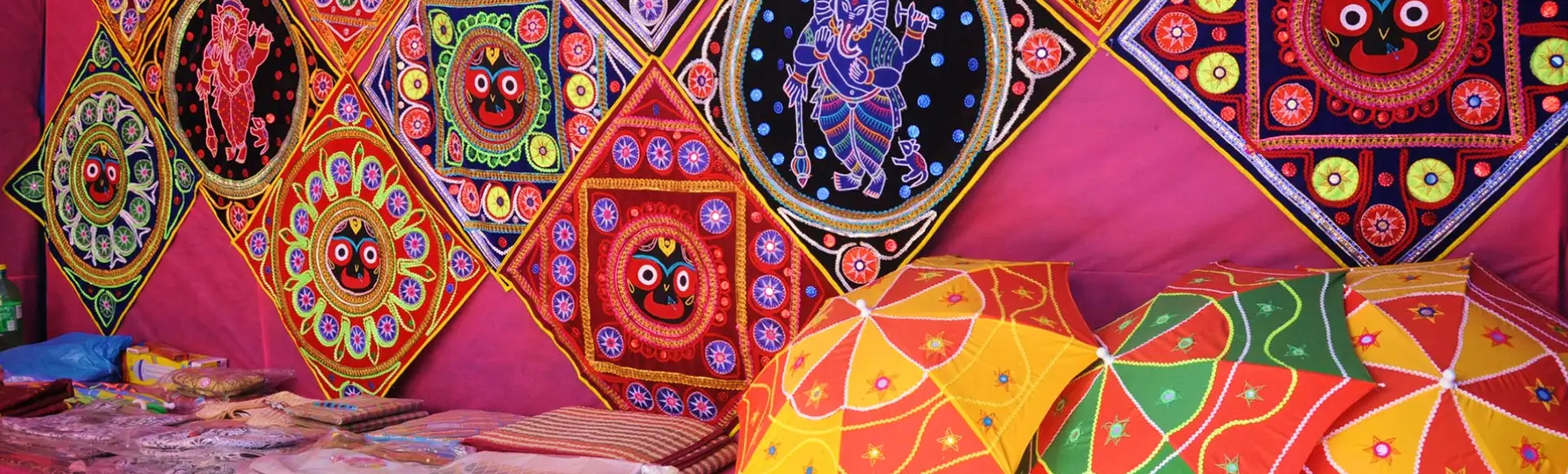
Pipili, in Odisha’s Puri district, is known for Chandua, a traditional cloth appliqué craft. Visitors come to see artisans’ work and browse the colourful handicrafts sold along its streets.
Key facts · verified by Ghumoopedia editors
- Type of place
- Community & living culture
- Best time to visit
- October – March
- Verified
- 21 Nov 2026
Plan a trip from Pipili — a day-by-day route through places nearby.
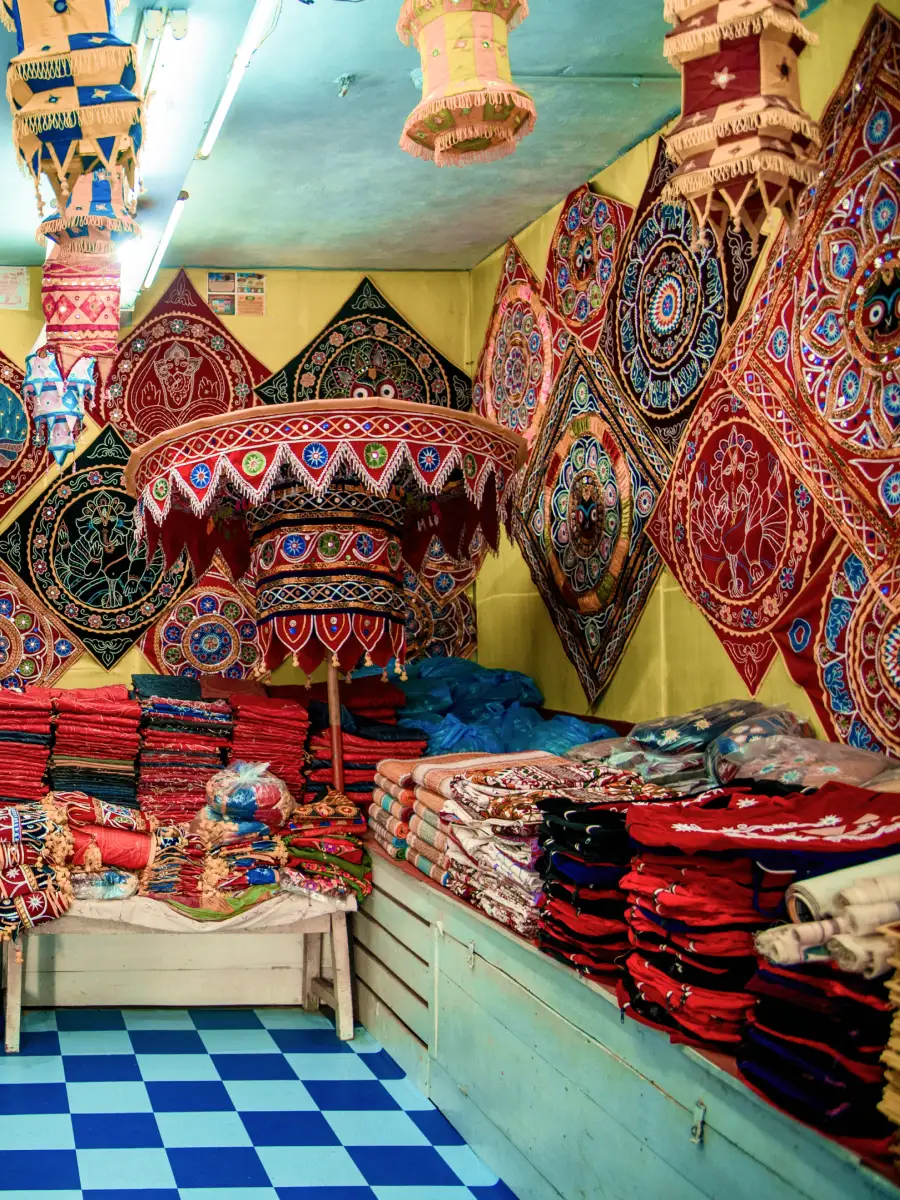
Pipili is closely associated with Chandua, Odisha’s traditional appliqué work. Artisans cut cloth into shapes and stitch them onto a background to form designs featuring flowers, animals, mythological subjects and geometric motifs. The craft has been practised for generations and has a strong connection with Puri’s Jagannath Temple. Appliqué pieces have a ceremonial role there, including as decoration for chariots during Ratha Jatra. The streets of the village have shops displaying a broad range of appliqué goods. These include umbrellas, canopies, handbags, lampshades, cushion covers and wall hangings. Vivid colours and balanced arrangements are characteristic of the work. Visitors may also see craftspeople sewing and learn how the designs are assembled. The work supports many local families and helps sustain a longstanding craft tradition. Pipili’s artisans continue inherited methods while making items suited to contemporary tastes. The appliqué craft has received Geographical Indication (GI) status. The village is often included in journeys between Bhubaneswar and Puri, making it a convenient place to pause and explore Odisha’s handicraft heritage. Its shops and workshops offer insight into both the practical skills involved and the cultural traditions associated with the craft. Plan your visit around October – March. The official suggested visit duration is 1–2 hours; treat this as time at the attraction, not the complete journey from your hotel. Odisha’s coast and plains can be hot and humid, while southern hill districts may feel cooler after sunset. Heavy monsoon rain can affect road travel and access to outdoor sites. Check the local forecast before setting out, and keep a flexible alternative for bad weather. Official destination reference: https://odishatourism.gov.in/en/places/pipili
Why it matters
Pipili is an important craft centre in Puri district, best known for appliqué work called Chandua. Its artisans make stitched cloth panels and objects with bold colours and patterned motifs, serving both local markets and visitors. The craft is traditionally associated with the Jagannath Temple in Puri, including the decoration of chariots and other ceremonial items for Ratha Jatra. India’s Geographical Indications Registry recognises Pipli Applique Work as a geographical indication, acknowledging its regional identity. Today, Pipili is both a working artisan community and a convenient craft stop on the Bhubaneswar–Puri highway. Its importance lies in the continuing livelihoods, skills and cultural practices connected with this textile tradition.
Pipili’s appliqué tradition is widely described as centuries old, though a precise founding date for the craft or the village’s workshop community is not firmly established. Its history is closely associated with Puri’s Jagannath Temple: appliqué textiles have traditionally been made for ceremonial use, including decorations connected with the temple’s chariots during Ratha Jatra. Specialist artisan families developed skills in cutting cloth shapes, arranging designs and stitching them onto a base fabric. The work has included motifs such as flowers, animals, geometric forms and religious imagery. Over time, makers also adapted the technique for objects intended for everyday use and sale, including umbrellas, canopies, bags, lampshades and wall hangings. This broadened the craft’s market beyond temple-related commissions and helped it become a visible part of Pipili’s roadside economy. Contemporary workshops continue to pass techniques between generations while responding to changing tastes and demand. Pipli Applique Work is recognised by India’s Geographical Indications Registry. The craft remains a living practice rather than a preserved monument; there is no single historic structure or restoration project that defines its story.
Origin stories & folklore
There is no single, reliably documented founding legend for Pipili’s appliqué tradition. Local accounts commonly connect the craft with the Jagannath Temple at Puri and the need for colourful cloth decorations during religious ceremonies, especially the annual chariot festival. This connection is best understood as a community tradition and a history of temple service, rather than as a verified account of one named founder or a precise moment of origin. Visitors may encounter religious imagery in designs, but motifs and their meanings can vary by maker and commission. Ask artisans about the story behind a particular piece; avoid assuming that every design has a fixed sacred meaning or that workshop knowledge is open for demonstration.
Begin with the main attraction at Pipili and leave time to understand its setting in Puri. Look for interpretation boards, guided visits or opportunities to meet local makers. Ask before photographing people or their work. A village workshop is a working space, not a staged performance; agree on any demonstration charge and avoid pressuring artisans for free access. Keep a simple itinerary: arrive in daylight, enjoy the main visit, take a shaded meal break, then decide whether one nearby stop fits your return plan. Use the district index to find nearby places, but check the actual road route before combining them. Reserve a little time for photographs from permitted public viewpoints and avoid blocking paths while taking pictures.
Suggested itineraries
Half day: Spend 1–2 hours browsing Pipili’s craft shops and, with permission, visiting a workshop; take a shaded break, then continue to or return from Puri. Full day: Allow 1–2 hours for Pipili, have a meal break, then visit Puri’s Jagannath Temple area and another suitable local attraction; keep road and crowd conditions in mind. Gentler option: Choose one shop with easy roadside access, sit for a break between short browsing periods, and skip workshop visits if entry or standing would be uncomfortable.
Appliqué remains central to Pipili’s public identity and to the work of many local makers. In workshops, artisans cut coloured cloth and stitch shapes onto a background fabric, producing both ceremonial textiles and contemporary household or personal items. Odia is widely used in the region; visitors may also encounter Hindi and some English in shops serving travellers. The wider Puri district has strong Jagannath traditions, and religious images or festival themes may appear in craft designs. Pipili is a working town as well as a visitor stop, so everyday routines continue alongside craft sales. Ask before entering a work area, requesting a demonstration or photographing a maker.
Local communities
Pipili’s appliqué is sustained by artisan households whose members may take part in design, cutting, stitching, finishing and selling. Skills are often learned within families and passed between generations, while workshops and shops connect makers with buyers and commissions. The craft supports livelihoods alongside other local work and trade; not every resident is an artisan, and the community should not be treated as a tourist display. Visitors can support makers by buying directly when possible, asking how an item was made and agreeing in advance if a demonstration is offered. Respect makers’ working time and do not press for access to private spaces or restricted designs.
Festivals & events
Puri’s Ratha Jatra, usually held in the monsoon season around June or July, is the festival most closely associated with Pipili’s appliqué tradition; craft items are traditionally used in chariot decoration. The event draws large crowds to Puri and can make roads and onward travel busy. Puri also observes other Jagannath-related festivals through the year, with visitor numbers varying by occasion. Pipili itself is a year-round craft market rather than a destination known for one guaranteed annual fair. If visiting during a major festival, check local travel conditions and allow extra time for traffic and crowd management.
For a visit to Pipili, plan food around your base in Puri and do not assume that a remote entrance has a full restaurant. Odisha offers rice-based meals, dalma, vegetable preparations and sweets such as chhena poda. Availability varies by district and outlet; ask what is freshly prepared rather than expecting every local dish at every stop. Choose busy, clean establishments and tell staff about allergies, spice preferences or dietary restrictions before ordering. Carry sealed drinking water and a small snack if you are travelling beyond a town. In hot weather, take regular water breaks instead of waiting until you feel exhausted. For early starts, arrange breakfast in advance and ask your accommodation whether a packed meal is practical. Keep all packaging with you until you find an appropriate waste bin.
Shopping & local experiences
Look for Pipili’s stitched appliqué work, including umbrellas, canopies, bags, lampshades, cushion covers and wall hangings. Designs, materials, finish and production methods differ, so ask the maker or seller about an item rather than assuming all pieces are handmade in the same way. Buying directly from an artisan or workshop can support local livelihoods. Compare quality and ask how an item should be cared for. Small food shops may offer a convenient break, though Pipili is primarily known to visitors for its craft rather than a particular signature dish. Pack purchases carefully to protect stitching and fabric.
Pipili lies in Odisha’s coastal plains, on the highway corridor between Bhubaneswar and Puri. The immediate setting is largely a settled roadside town with cultivated land and greenery in the wider surrounding plain, rather than a forest or wildlife destination. Odisha’s coast and plains can be hot and humid, while the monsoon brings heavier rain that may affect road journeys. There is no particular wildlife sighting to expect at the craft village. For nature-focused outings, look to established destinations elsewhere in the region and check access conditions before travelling. Keep to public areas, take drinking water in warm weather and avoid leaving litter in the town or countryside.
October – March
Start by choosing a practical overnight base in or near Puri, rather than assuming every attraction has its own railway station. Odisha Tourism lists this rail access: Nearest railway station – Bhubaneswar / Puri. The listed air access is: Nearest airport – Biju Patnaik International Airport, Bhubaneswar. Road access: Located on Bhubaneswar–Puri highway (NH-316). Compare train, bus and flight options door to door. Rail can suit overnight journeys and travellers who prefer to avoid a long drive. A bus may be useful between district towns, but the last service may finish before your visit ends. A flight only saves time if airport transfers, check-in and the final road leg are included. Reserve the return leg before departure and allow time for traffic, meals and weather. Check IRCTC and NTES for trains, OSRTC for buses, and the airline’s own schedule for flights. Do not rely on an unconfirmed connection or assume taxis will wait at a remote site.
Confirm onward and return timings on IRCTC / NTES, the state bus operator or your airline before travel. A dash means current timings or fares have not been verified.
Getting around
Pipili is on the Bhubaneswar–Puri highway (NH-316), and visitors commonly arrive by road from Puri or Bhubaneswar. Local buses and hired taxis may serve the corridor; confirm your onward and return arrangements before setting out. Autos can be useful for short local connections where available. The craft shops are generally experienced on foot, but traffic, uneven edges and roadside parking can make walking less comfortable. Check locally for suitable parking and avoid stopping where vehicles or pedestrians are obstructed. There are no boat journeys needed for a visit to the craft village.
Hours, tickets & permissions
Pipili is a living town, and craft shops and workshops may follow different schedules; not every maker’s workspace is open to visitors. There may be no single entry arrangement for the village as a whole, while a private workshop visit or demonstration may require permission and could involve a charge. Ask before entering work areas and confirm any conditions directly with the shop or workshop. Check locally for current business hours, applicable fees and any temporary restrictions. Do not assume that temple-related items or spaces are open for visitor access.
Facilities
Craft shops and small food outlets are usually available along the main commercial stretch, but the choice and opening status vary. Toilets, drinking-water points and accessible facilities are not guaranteed at every shop; check locally or use a larger establishment before beginning your visit. Parking may be possible nearby, though space can be limited by traffic and roadside activity. Guides are not assured, but individual makers may explain their work if they have time and agree to a visit. ATMs and broader services are more readily found in larger nearby towns; carry a suitable payment option.
Accessibility
A visit involves walking along a busy town street and entering individual shops or workshops, where floor surfaces, thresholds and available space can vary. The route may include uneven pavement edges, roadside obstacles or limited shade. Wheelchair users and visitors with strollers may find some shops difficult to enter; do not assume ramps, step-free toilets or wide aisles are available. Older visitors may prefer a short visit, frequent seated breaks and drop-off close to a chosen shop where traffic rules permit. Contact a shop in advance if step-free access or seating is essential, and allow time to move carefully around vehicles.
At Pipili, local access rules take priority over any suggested itinerary. Reconfirm opening arrangements, entry eligibility, permits and weather restrictions shortly before arrival. Keep the emergency number 112 available and save your accommodation’s contact details offline. A map pin identifies a general location, not an assurance that the approach road or walking path is safe. Ask local staff which entrance visitors should use. Respect conservation barriers, residential boundaries and instructions from staff. Ask permission for portraits and avoid sharing identifiable images of local residents without consent. Carry only necessary valuables, keep rubbish out of the site, and leave enough daylight for the return journey.
Visitor rules
Pipili is a working community, so keep shop entrances and roadways clear and follow any instructions from makers or shopkeepers. Ask before entering a workshop, touching unfinished work or requesting a demonstration; agree any charge beforehand. Dress comfortably and respectfully, particularly if continuing to a religious site in Puri, where separate entry rules may apply. Dispose of waste responsibly and avoid single-use plastic where practical. Do not enter private or restricted areas, handle tools without permission, or treat religious objects as props. Follow any local restrictions on photography or access.
Photography
Daylight is useful for seeing the colours and stitching of appliqué, but shop interiors may be dim and can require permission before photographing. Ask makers and shopkeepers before taking pictures of people, their work, workspaces or customers; respect a refusal and any request not to photograph a design. Keep doorways and the roadside clear while taking pictures. Photography rules at religious sites nearby may differ. Drone use can be restricted by aviation rules, local authorities or site managers, so do not fly without checking current permissions and safety requirements.
Choose accommodation by the complete journey to Pipili, not by the district name alone. A room in a well-connected town in Puri may offer easier transport, meals and medical access than a property advertised as being close to the attraction. Check the exact location, recent guest feedback, reception hours and cancellation terms. Ask how you will reach the site and return after the visit, especially if you are not driving. A centrally located stay can make early sightseeing and an evening return easier. Confirm whether the approach road is accessible to your vehicle and whether lifts are available. Book only through a trusted accommodation channel, avoid sending payments to an unverified personal contact, and keep written confirmation of the services included.
Puri is the most natural companion to a Pipili visit, with the Jagannath Temple area and the city’s wider religious and coastal setting. Raghurajpur, another village known for traditional arts and crafts, can suit visitors interested in Odisha’s artisan communities. Dhauli Shanti Stupa near Bhubaneswar and the temples of Bhubaneswar are options when travelling along the broader corridor. Konark Sun Temple is another major regional heritage destination, but combining it with Pipili depends on your route and available time. Check road conditions and opening or access rules before adding several stops.
For couples visiting Pipili, keep the day relaxed: one main visit, a meal break and a return transfer arranged in advance. Choose public viewpoints for photographs and respect religious or community expectations around behaviour and clothing. Confirm the accommodation’s check-in requirements before booking. Avoid secluded paths after dark and do not trade a safe return plan for a late photograph. A quieter weekday may suit you, but opening and access arrangements still need local confirmation.
Q: How much time should I allow for Pipili? A: The suggested visit time is 1–2 hours at the craft village; allow additional time for your road journey and any workshop visit. Q: When is the best season to visit? A: October to March is a practical period for travel. Check the forecast, as the coast and plains can still be warm and humid. Q: Is there an entry ticket for Pipili? A: The village is a working town, not a single ticketed attraction. Individual workshops may set their own visit conditions or charges, so ask first. Q: Is Pipili suitable for children and elderly visitors? A: It can be a short cultural stop, but busy roads, uneven walking surfaces and variable shop access may require extra care and breaks. Q: Where should I stay nearby? A: Puri is a practical overnight base for many visitors; Bhubaneswar is another option along the highway. Choose based on your wider itinerary and confirm transport arrangements.
Be the first to share photos, stories, advice or a helpful contact for Pipili.
Loading…