
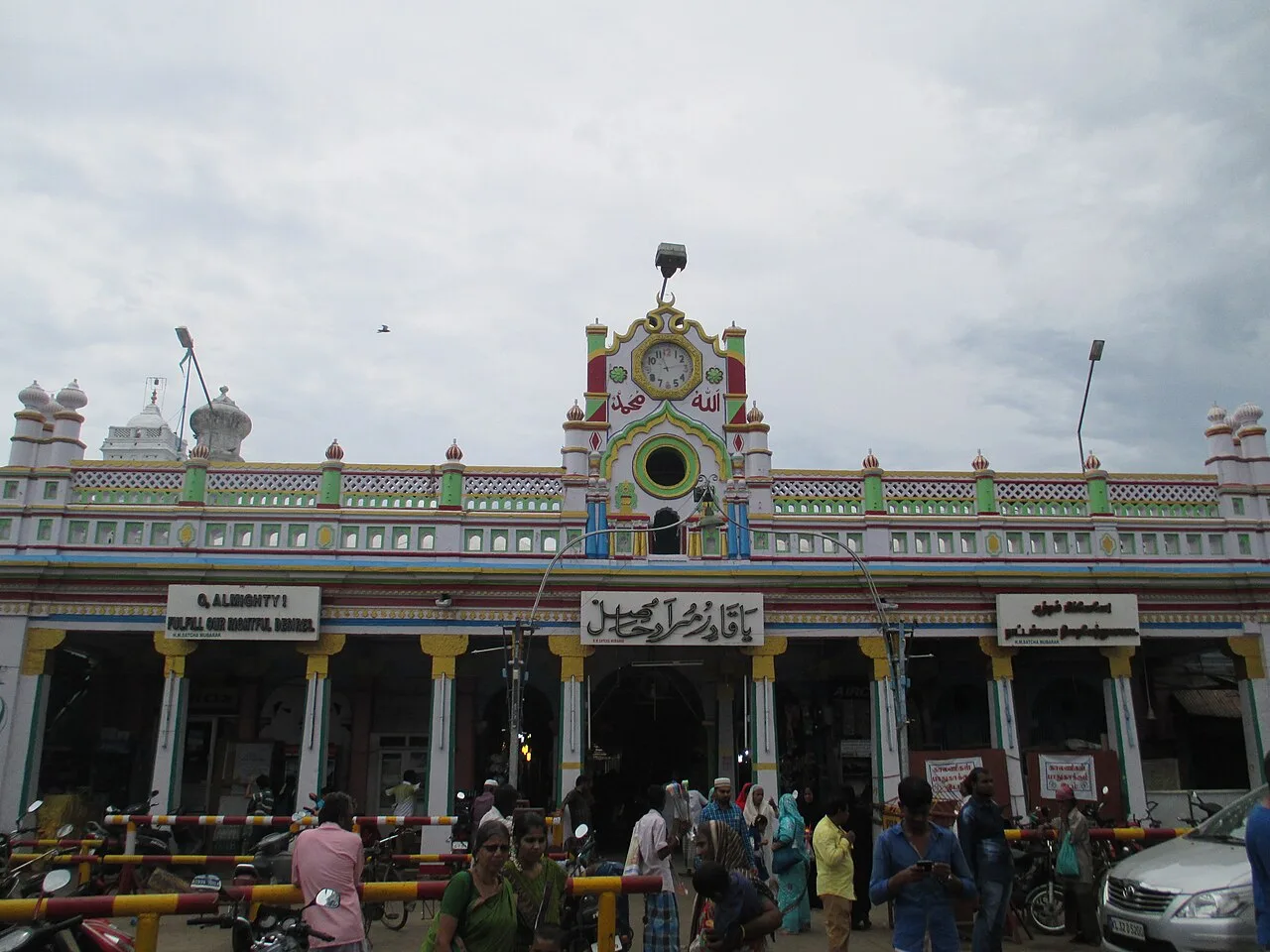
Nagore Dargah
Nagore Dargah is a shrine complex in Tamil Nadu built around the tomb of Sufi saint Shahul Hamid. Pilgrims from Muslim and Hindu communities visit, particularly for the annual Kanduri observance.
Key facts · verified by Ghumoopedia editors
- Type of place
- Temple / pilgrimage site
- Best time to visit
- November to February; April to June for the hill stations
- Nearest railway station
- Nagapattinam · about 6 km (straight line)
- Nearest airport
- Tiruchirappalli International Airport · about 126 km (straight line)
- Verified
- 21 Nov 2026
Plan a trip from Nagore Dargah — a day-by-day route through places nearby.
Known by several names, including Nagore Dargah Shareef, Syed Shahul Hamid Dargah and Nagore Andavar Dargah, the complex stands in Nagore, a seaside town in Tamil Nadu’s Nagapattinam district. Its buildings surround the tomb of the Sufi saint Nagore Syed Abdul Qadir Shahul Hamid. Local tradition holds that Shahul Hamid performed many miracles in Nagore, including curing Achuthappa Nayak, a Hindu ruler of Thanjavur in the sixteenth century. The saint is also called Nagore Andavar, a title whose meaning is ruler of Nagore. His followers are believed to have built the complex, with Hindus making a major contribution. Five minarets stand within the complex. The tallest was built by Pratap Singh, the Maratha ruler of Thanjavur from 1739 to 1763 CE. The shrine is a pilgrimage destination for Sufi Muslims and Hindus, and its following across both communities reflects their coexistence. The principal annual event is Kanduri, also known as Urus Mubarak: a fourteen-day observance commemorating Shahul Hamid’s death. Tamil Nadu is the land of great living temples — Madurai's Meenakshi, Thanjavur's Brihadeeswara, Srirangam, Chidambaram and Rameswaram — along with the Pallava shore monuments of Mamallapuram, the Chettinad mansions, the hill stations of Ooty and Kodaikanal and the meeting of three seas at Kanyakumari. The state is hot from March to June, gets light southwest-monsoon rain from June to September, and receives its main rainfall from the northeast monsoon between October and December. January to March is the most comfortable season; the Nilgiri and Kodaikanal hills are cool year-round. The usual best time to visit is November to February; April to June for the hill stations. Timings, fees and access arrangements must be confirmed locally. For official information, see Tamil Nadu Tourism at https://www.tamilnadutourism.tn.gov.in.
Why it matters
Nagore Dargah is a major Sufi pilgrimage centre in Nagore, in Tamil Nadu’s Nagapattinam district. It is built around the tomb of the 16th-century saint Shahul Hamid, also known locally as Nagore Andavar. The shrine is visited by Muslims and by people from other faiths, and its traditions are often described as expressing local religious coexistence. Its annual Kanduri, or Urs, draws pilgrims from the region and beyond. The complex is an important part of Nagore’s religious and community life. No UNESCO listing or specific national heritage designation is asserted here; visitors seeking current conservation or management information should check with the relevant local authority.
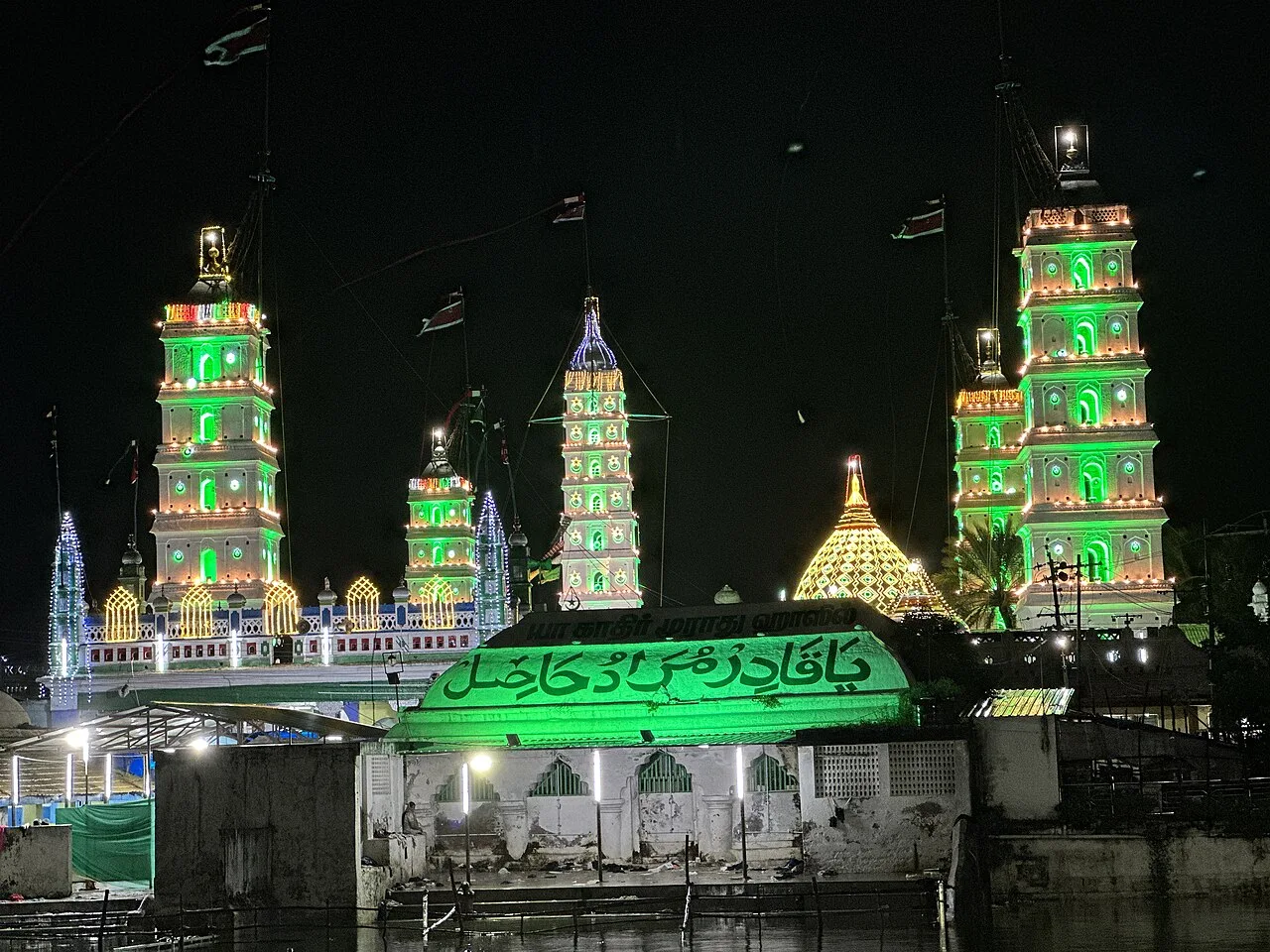
Nagore Dargah developed around the tomb of Sufi saint Syed Abdul Qadir Shahul Hamid, who is associated with Nagore in the 16th century. The shrine’s history is closely linked to the town and to the devotion of people from different religious communities. Local accounts say that the complex was built and enlarged by Shahul Hamid’s devotees, with significant contributions from Hindus as well as Muslims. Its present form reflects generations of additions rather than a single building campaign. The five minarets are among its best-known features; the tallest is traditionally credited to the Maratha ruler of Thanjavur, Pratap Singh, whose reign was in the 18th century. The dargah remains an active place of worship, and its buildings and practices continue to serve a living community. Details about individual construction phases and later repairs are not consistently documented in general visitor sources, so claims about particular restorations should be checked locally.
Origin stories & folklore
According to local tradition, Shahul Hamid performed miracles in Nagore and helped cure the physical affliction of Achuthappa Nayak, a 16th-century Hindu ruler of Thanjavur. Stories of this healing are central to the saint’s local reputation and help explain why devotees from different faiths visit the shrine. Shahul Hamid is affectionately called Nagore Andavar, commonly translated as “Ruler of Nagore.” Accounts of miracles belong to religious belief and oral tradition rather than independently verified history. Visitors may encounter these stories in conversations with worshippers or caretakers; they are best heard with respect for the varied ways devotees understand the saint and his legacy.
Architecture & design
The dargah is a compound of religious buildings centred on the tomb of Shahul Hamid. Its layout includes the tomb shrine and surrounding spaces used for prayer, visitation and gatherings; access to particular inner areas may be regulated. The complex is especially recognisable for its five minarets, which rise above the surrounding townscape. The tallest is associated with the 18th-century Maratha ruler Pratap Singh of Thanjavur. The buildings show the layered character of a shrine that grew through the contributions of devotees over time. Regional Islamic architectural elements sit within a locally developed complex, rather than a single uniform design. Plastered masonry and decorative details are visible in parts of the compound, though finishes and access can vary by area. As an active place of worship, its circulation and appearance also reflect ongoing religious use, not simply a preserved historic monument.
Important objects & sculptures
The principal sacred focus is the tomb of Shahul Hamid, approached by devotees according to the shrine’s customs and access rules. The five minarets are prominent features to observe from permitted areas, with the tallest traditionally linked to Pratap Singh of Thanjavur. Visitors may also notice architectural decoration, inscriptions or devotional fittings around the compound, but their interpretation and accessibility can vary. This is a living Muslim shrine, not a museum collection: objects and spaces may be used in worship, and displays should not be touched or photographed without permission. Ask a caretaker if you would like to understand the meaning of a feature, and avoid entering restricted areas to seek a closer view.
Religious significance
Nagore Dargah is a Sufi Muslim shrine built over the tomb of Shahul Hamid. Worshippers visit to pray, remember the saint and seek spiritual comfort; the forms of devotion may include quiet prayer and other practices guided by the shrine community. Shahul Hamid is also revered locally as Nagore Andavar. The dargah is visited by Muslims and by people of other faiths, a practice that has made it a notable shared pilgrimage place in the region. Visitors should not assume that every area or ritual is open to everyone. Follow signs and instructions from caretakers, maintain a quiet and respectful manner, and allow worshippers space for prayer.
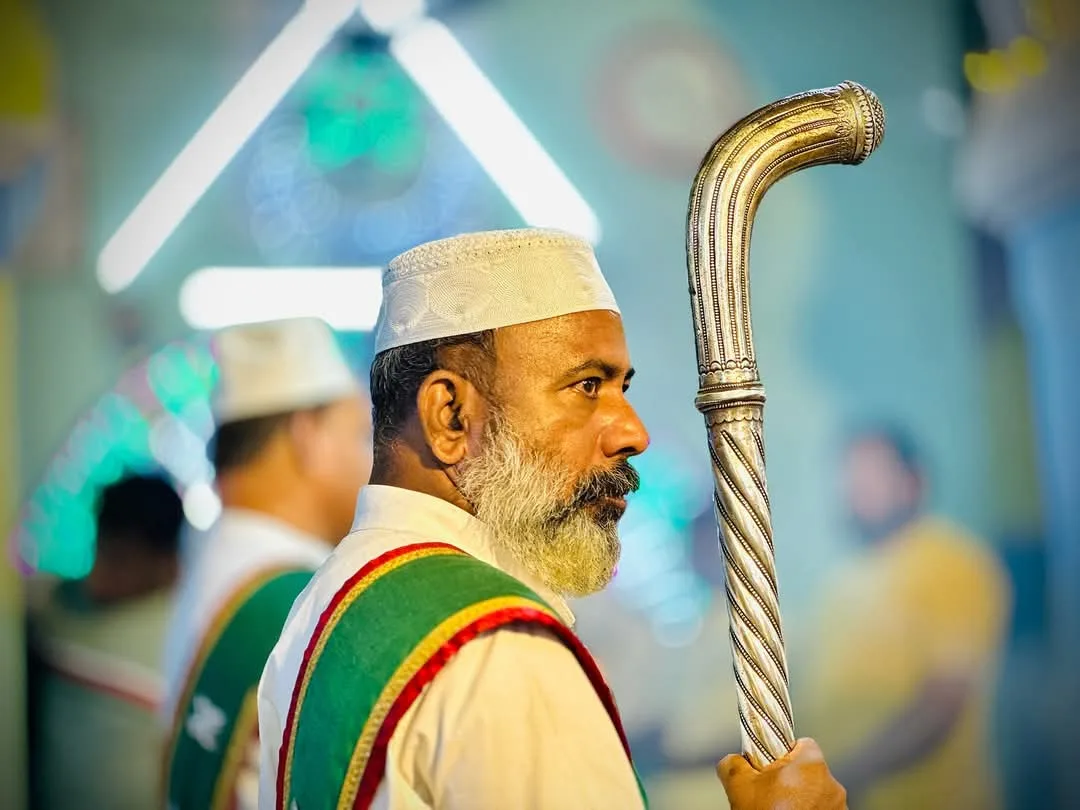
Visit Nagore Dargah with time to observe daily prayers and rituals respectfully. Follow the posted rules on footwear, photography, phones, head covering and dress — many major temples require modest clothing, prohibit leather items and phones inside, and have separate darshan queues; non-Hindus may not be admitted to some sanctums. Ask caretakers which areas are open to visitors, and beware of unofficial 'guides' or agents offering quick darshan for a fee. A comfortable itinerary is one main visit in the morning, a local meal at midday and a short nearby stop before an afternoon return. Use the district list on this site to find other places in Nagapattinam, but check the route and its condition before combining stops. If a festival is on — such as Pongal in January, the Madurai Chithirai festival, the Mahamaham at Kumbakonam or the Chennai music season in December — roads and stays can be busy, and the experience can be unforgettable. Leave no litter: many sites are protected by the communities around them.
Suggested itineraries
Half day: Allow about 2–3 hours for a respectful visit to the dargah, time in permitted areas for prayer or quiet observation, and a local meal or tea nearby. Full day: Spend the morning at the dargah, pause for lunch, then visit Nagapattinam town or continue to Velankanni if transport and conditions allow; leave time for the return journey. Gentler option: Arrange a vehicle close to the permitted entrance, focus on a shorter visit with seated rest breaks where available, and avoid combining multiple stops.
The shrine is part of everyday religious life in Nagore as well as a destination for pilgrims. Tamil is widely used locally, and visitors may also hear other languages from pilgrims arriving from elsewhere. The Kanduri season brings devotional activity, communal gatherings and a larger flow of visitors. Practices and clothing vary among individuals, so visitors should avoid treating any one custom as universal. Dress modestly, speak quietly in prayer areas and ask before joining or observing a ritual closely. Music or recitation may be part of religious occasions, but programmes and access can differ from year to year; check locally rather than relying on an assumed schedule.
Festivals & events
The main annual observance is Kanduri, also called Urs Mubarak, a fourteen-day commemoration of Shahul Hamid’s death anniversary. It is a major pilgrimage period, and the dargah and surrounding streets can be much busier than usual. Religious observances and associated gatherings follow the shrine’s calendar, so dates vary and should be confirmed locally. Nagapattinam district also has other pilgrimage events, including celebrations at Velankanni, but these are separate from the dargah’s festival. During major occasions, allow extra time for local movement and expect heavier demand for accommodation and services.
Local food in Tamil Nadu includes idli, dosa and filter coffee, Chettinad chicken and pepper curries, Madurai's kari dosa and jigarthanda, Thanjavur's banana-leaf vegetarian meals, Kanyakumari's seafood, and sweets such as Mysore pak, adhirasam and Tirunelveli halwa. Ask what is fresh that day; many small eateries cook a limited daily menu. Tamil Nadu is a paradise for vegetarian meals served on banana leaf; Chettinad and Madurai are the centres for meat and spice lovers. Filter coffee is a ritual — have it at a local 'hotel' (eatery). Remote sites may have no restaurant at all. Carry water and snacks, eat a proper breakfast before long drives, and ask your accommodation for a packed lunch if you are heading out early. If prasad is offered, accept it according to local custom. Choose busy, clean places, drink sealed or filtered water, and carry your packaging back with you.
Shopping & local experiences
Small shops around the dargah and in Nagore may sell devotional items, offerings, refreshments and everyday goods; stock changes, so ask locally rather than expecting a particular souvenir. Nagapattinam’s markets are a better place to browse for general household items and locally available products. The coastal district has food traditions worth exploring, including fresh seafood where offered, alongside familiar Tamil meals; choose eateries with clear food-handling practices. Dress and religious items should be purchased or used respectfully, and visitors should avoid buying anything presented as an official relic or guaranteed blessing without verifying its source.
November to February; April to June for the hill stations
The nearest principal railway station by straight-line distance is Nagapattinam, roughly 6 km away. The nearest operating airport by straight-line distance is Tiruchirappalli International Airport, roughly 126 km away. These figures are calculated from map coordinates — actual road distance is longer. Chennai is the main gateway; Coimbatore serves the west and Mettupalayam is the railhead for the Ooty toy train; Madurai and Tiruchirappalli serve the south and centre; Rameswaram and Kanniyakumari have their own rail termini. For the final leg, TNSTC and SETC buses reach nearly every town, with private sleeper coaches between cities and app cabs in Chennai, Coimbatore and Madurai link district towns. A private taxi gives more flexibility for remote sites such as hill stations, forest gates and coastal temples. When comparing train, bus and flight, count the complete door-to-door time: a flight saves the most time only if the onward road transfer is short, while an overnight train can save a hotel night. Book your return before you leave, because seats fill quickly on weekends, festivals and holidays. Current train numbers, timings, return services and fares are not listed here; check IRCTC and NTES for trains and the airline's own schedule for flights. No permit is needed to visit Tamil Nadu. The Nilgiri Mountain Railway toy train to Ooty must be booked well in advance on IRCTC — seats are few and sell out weeks ahead. Major temples such as Madurai Meenakshi and Srirangam have darshan queues and some enforce a dress code (dhoti or formal trousers for men, saree or salwar for women); phones and cameras are not allowed inside several temple sanctums. Boating to the Vivekananda Rock at Kanyakumari depends on sea conditions.
Confirm onward and return timings on IRCTC / NTES, the state bus operator or your airline before travel. A dash means current timings or fares have not been verified.
Getting around
Nagore is compact enough for some visitors to move between nearby points on foot, though heat, traffic and uneven surfaces can make walking tiring. Auto-rickshaws and local taxis are practical for the last leg from Nagapattinam and for trips around the area; confirm the destination before setting off. Local buses serve towns in the district, but routes and service frequency should be checked on arrival. If driving, ask locally about suitable parking near the dargah, especially during Kanduri, when streets may be crowded or access controlled. Keep walking routes clear around the shrine and follow any temporary traffic directions.
Hours, tickets & permissions
The dargah is an active place of worship, and entry arrangements may vary with prayer, festival activity and the areas being visited. Visitors should check current opening arrangements and any entry or access rules with the shrine’s managing authority before travelling. Do not assume that every part of the compound is open to visitors.
Facilities
Facilities within the compound may be limited or managed according to worship needs. Toilets, drinking water, small food shops and places to eat are usually easier to find in the surrounding town, but standards and availability can vary; check locally. Parking arrangements may be constrained near the shrine, particularly during festivals. ATMs and broader services are more likely in Nagapattinam than immediately beside the dargah. Caretakers can advise on visitor access and local customs; do not assume that an unofficial guide or service is authorised. Carry essential medicines and drinking water, especially in hot weather.
Accessibility
Expect walking through a busy religious compound, with possible thresholds, uneven paving, crowds and areas where footwear must be removed. Steps or narrow passages may limit access to some parts; do not assume that ramps, lifts or wheelchair-accessible facilities are available. The distance a visitor can walk depends on which areas are open and where vehicles may stop. Shade and places to rest may be limited or crowded, particularly during Kanduri. Wheelchair users, people with strollers and visitors with reduced mobility should contact the shrine or ask locally about the most accessible permitted route. Elderly visitors may find a short visit outside peak crowds more comfortable.
No permit is needed to visit Tamil Nadu. The Nilgiri Mountain Railway toy train to Ooty must be booked well in advance on IRCTC — seats are few and sell out weeks ahead. Major temples such as Madurai Meenakshi and Srirangam have darshan queues and some enforce a dress code (dhoti or formal trousers for men, saree or salwar for women); phones and cameras are not allowed inside several temple sanctums. Boating to the Vivekananda Rock at Kanyakumari depends on sea conditions. Carry a photo ID at all times and save the emergency number 112 and your accommodation's contact offline. Heat in summer and heavy rain in the monsoon are the main weather risks; carry water, avoid midday sun and allow extra time when roads flood. Watch your belongings in crowds and on public transport, and follow posted instructions.
Visitor rules
Dress modestly and follow any instructions about head covering and footwear at the entrance or prayer areas. Keep voices low, do not interrupt prayers, and respect boundaries around the tomb and other restricted spaces. Ask before handling devotional objects or joining a ritual. Photography, phone use and access rules can differ by area; obey signs and staff directions rather than assuming permission. Avoid littering, leave plastic and other waste in appropriate bins, and do not bring food into spaces where it is prohibited. During busy periods, follow crowd-control arrangements and give worshippers room.
Photography
The five minarets and exterior views are among the features visitors may wish to photograph, especially in softer morning or late-afternoon light. Permission is not guaranteed throughout the compound: ask staff before using a camera or phone, and follow any no-photography signs. Do not photograph worshippers, prayer or private devotional moments without consent. Avoid blocking entrances or lingering in crowded circulation areas for a shot. Drone use may be restricted by aviation rules and local authorities; do not fly one without confirming all required permissions. If unsure, put the camera away.
Choose a stay by the full journey to Nagore Dargah, not just the district name. Chennai, Coimbatore, Madurai and Tiruchirappalli offer the widest choice; Ooty and Kodaikanal have everything from heritage hotels to cottages — book far ahead for the April–June school holidays and the Pongal weekend. In summer, check air-conditioning; in the monsoon, check that the property is accessible if roads flood. Book in advance for weekends, festivals and the peak season (November to February; April to June for the hill stations). Confirm the exact location, meals included, check-in time and cancellation terms in writing. Avoid sending money to unverified contacts or touts at stations. Carry some cash, as card and digital payments can be unreliable in remote areas.
Nagapattinam town is a practical nearby stop for local services and a look at the district’s coastal setting. Velankanni, another well-known pilgrimage destination in Nagapattinam district, may be combined with Nagore if transport and time allow; it can be especially busy during its own religious celebrations. Sikkal is known for the Sikkal Singaravelan Temple and offers a different religious and architectural setting. These are separate sites with their own customs and access rules. Check road conditions and local transport before planning several stops in one day, and avoid trying to fit in too many destinations during festival periods.
For couples, Nagore Dargah rewards a slow pace: arrive early for soft light and fewer crowds, share a local meal and keep the evening free. Sunrise at Kanyakumari, a boat ride on Kodaikanal lake or an evening stroll through Mamallapuram's shore monuments makes the trip memorable. Public displays of affection can be frowned upon in conservative communities and at religious sites, so be discreet. Keep a buffer in your itinerary, because weather and road conditions can delay plans.
Q: How much time should I allow for a visit? A: A few hours is usually enough for a calm visit to the dargah; allow longer during Kanduri or if combining nearby destinations. Q: When is a comfortable season to visit? A: November to February is generally more comfortable in Tamil Nadu. The northeast monsoon can bring rain from October to December, so check the forecast and local conditions. Q: Is the dargah open to visitors of different faiths? A: People from different faiths visit, but access to particular areas and observance of shrine rules are determined locally. Ask caretakers and follow their guidance. Q: Can children and elderly visitors visit? A: Yes, but crowds, heat, walking and uneven surfaces can be tiring. Plan rest breaks and consider a shorter visit outside busy periods. Q: Where can I stay nearby? A: Visitors commonly look for accommodation in Nagapattinam or Velankanni. Availability may be limited during major pilgrimage events, so check and book ahead.
Be the first to share photos, stories, advice or a helpful contact for Nagore Dargah.
Loading…