
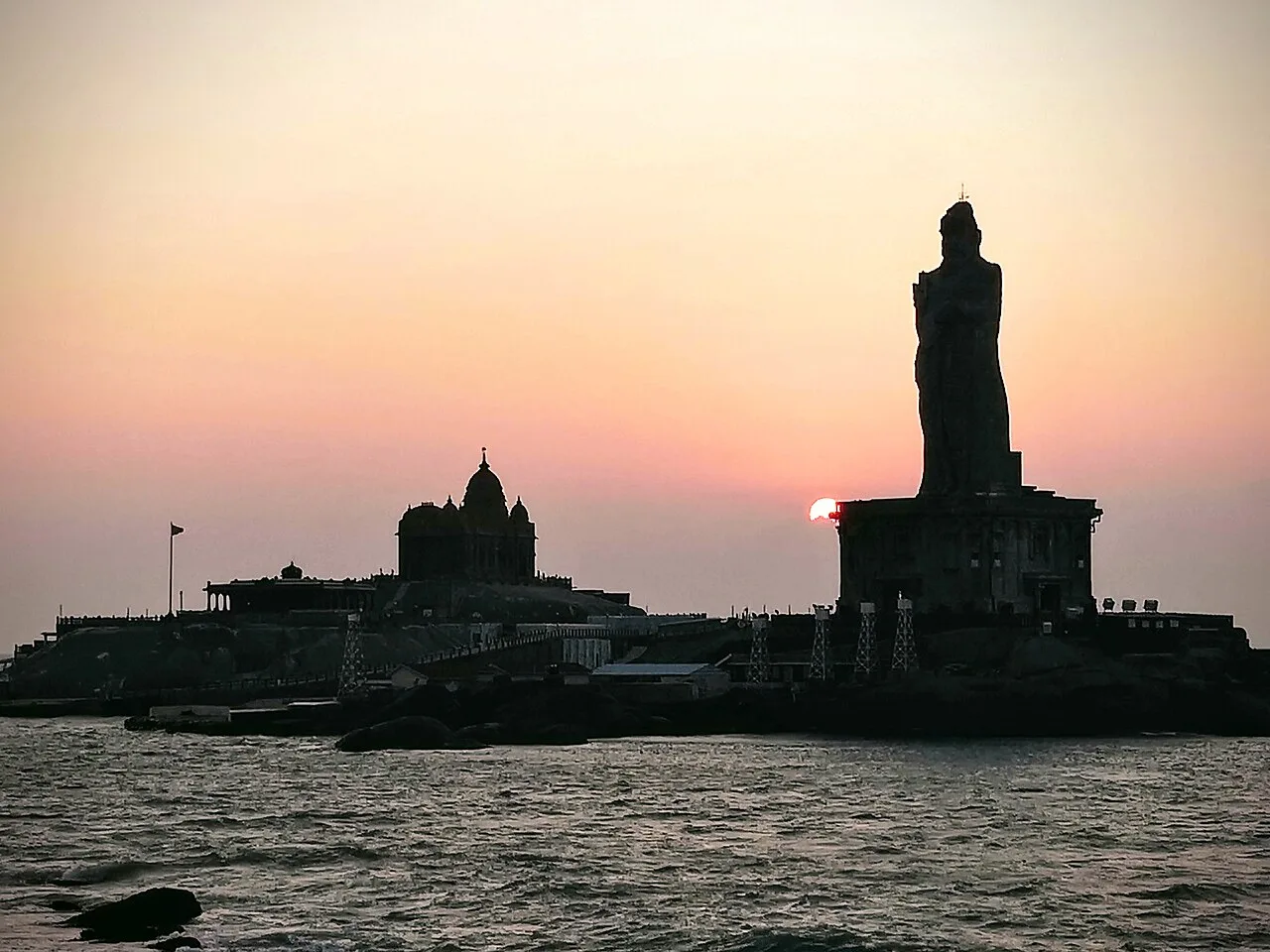
Thiruvalluvar Statue
The Thiruvalluvar Statue is a large stone likeness of the Tamil poet and philosopher who wrote the Thirukkural. Visitors come to see the monument near Kanniyakumari, where three seas meet.
Key facts · verified by Ghumoopedia editors
- Type of place
- Heritage monument
- Best time to visit
- November to February; April to June for the hill stations
- Nearest railway station
- Kanniyakumari · about 1 km (straight line)
- Nearest airport
- Thoothukudi (Tuticorin) Airport · about 89 km (straight line)
- Verified
- 21 Nov 2026
Plan a trip from Thiruvalluvar Statue — a day-by-day route through places nearby.
On a small island near Kanniyakumari in Tamil Nadu stands a stone monument depicting Thiruvalluvar, the Tamil poet and philosopher. Reaching 40.6 metres (133 feet), it honours the author of the Thirukkural, an ancient Tamil text on moral principles. The monument is also known as the Valluvar Statue. The island is close to Kanniyakumari town, at the southern tip of the Indian peninsula, where the Bay of Bengal, Arabian Sea and Indian Ocean converge. Indian sculptor V. Ganapati Sthapati created the statue; he also made the Iraivan Temple. M. Karunanidhi, then Chief Minister, unveiled it on 1 January 2000. By height, it ranks 25th among statues in India. During silver jubilee events on 1 January 2025, the Tamil Nadu government designated the monument the Statue of Wisdom. Tamil Nadu is the land of great living temples — Madurai's Meenakshi, Thanjavur's Brihadeeswara, Srirangam, Chidambaram and Rameswaram — along with the Pallava shore monuments of Mamallapuram, the Chettinad mansions, the hill stations of Ooty and Kodaikanal and the meeting of three seas at Kanyakumari. The state is hot from March to June, gets light southwest-monsoon rain from June to September, and receives its main rainfall from the northeast monsoon between October and December. January to March is the most comfortable season; the Nilgiri and Kodaikanal hills are cool year-round. The usual best time to visit is November to February; April to June for the hill stations. Timings, fees and access arrangements must be confirmed locally. For official information, see Tamil Nadu Tourism at https://www.tamilnadutourism.tn.gov.in.
Why it matters
The Thiruvalluvar Statue honours the Tamil poet and philosopher Thiruvalluvar, traditionally associated with the Thirukkural, a celebrated work of Tamil literature on virtue, public life and love. Set on a rocky islet off Kanniyakumari, it is a prominent landmark at the southern tip of mainland India, where the Bay of Bengal, Arabian Sea and Indian Ocean meet. Its scale and setting make it an important regional symbol of Tamil literary heritage as well as a major visitor attraction. The Government of Tamil Nadu declared it the “Statue of Wisdom” during its silver jubilee celebrations on 1 January 2025. It is not identified here as a UNESCO World Heritage Site or an ASI-protected monument; check current local information for its managing authority and status.
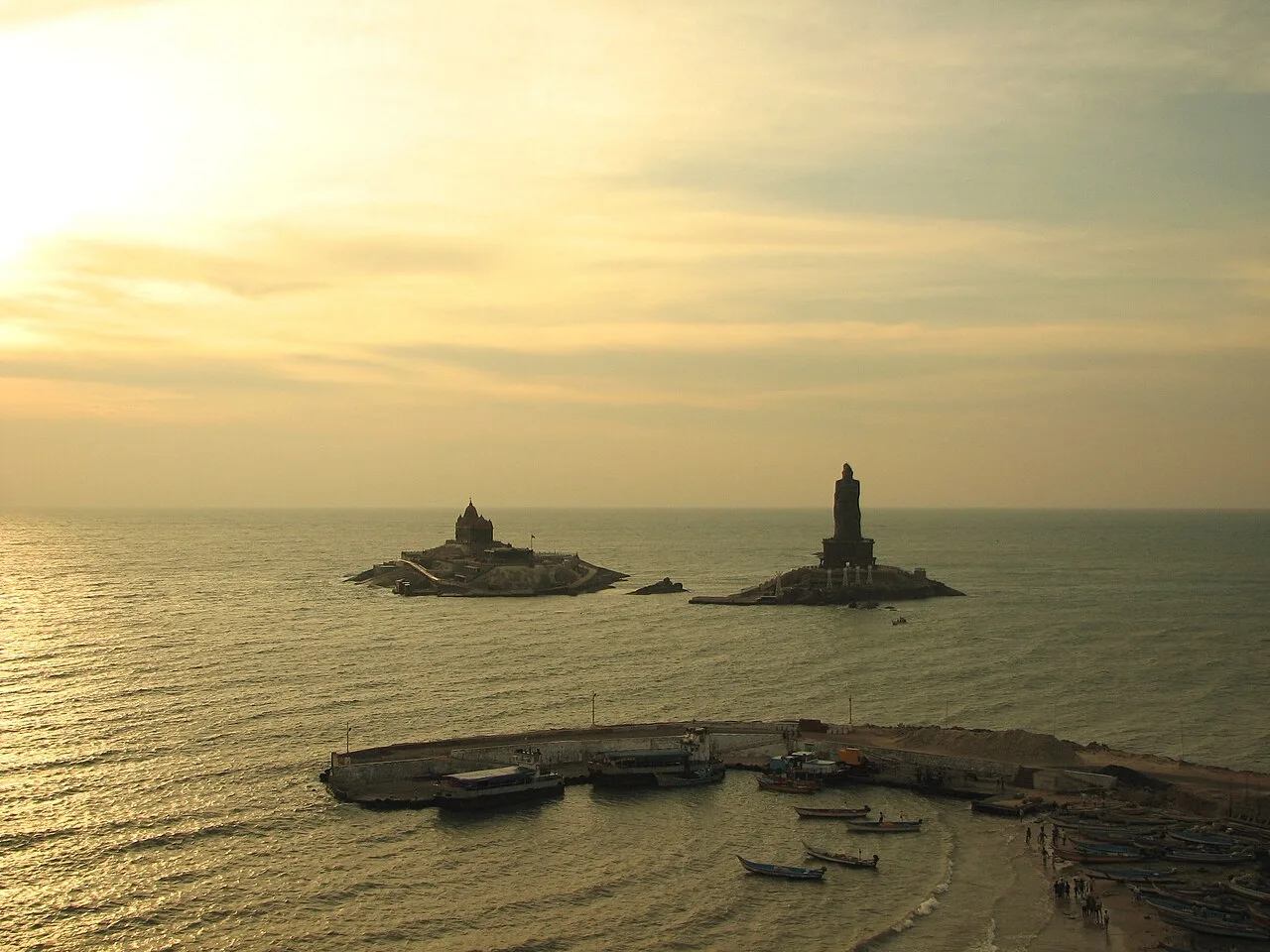
The statue was conceived as a public tribute to Thiruvalluvar, the author of the Thirukkural. Accounts of the project associate its development with the Tamil Nadu government under Chief Minister M. Karunanidhi and its sculptural design with V. Ganapati Sthapati, an Indian sculptor and temple architect who also created the Iraivan Temple. Work on the large stone monument took place in the late twentieth century, with the statue assembled on a rocky islet near Kanniyakumari. It was unveiled by Karunanidhi on 1 January 2000, at the start of the new millennium. The monument’s design gives symbolic significance to its dimensions: the 38-foot pedestal refers to the Thirukkural’s 38 chapters on virtue, while the 95-foot statue represents its remaining chapters on wealth and love, making 133 feet in total. The exposed marine location requires visitors to reach the site by boat, and access can be affected by sea and weather conditions. On 1 January 2025, Tamil Nadu marked the statue’s silver jubilee and declared it the “Statue of Wisdom.”
Origin stories & folklore
There is no widely established origin legend specifically about the Thiruvalluvar Statue; it is a modern monument. Local folklore around nearby Kanniyakumari is older and is often linked to the goddess Kanya Kumari. According to one popular tradition, the goddess was to marry Shiva, but the wedding did not take place. Rice and other provisions prepared for the ceremony were left behind and, in the story, became the coloured grains of sand found along parts of the coast. Versions differ, and this tale belongs to the region’s religious folklore rather than to the statue’s history. Visitors can encounter related traditions at the nearby Kanyakumari Bhagavathy Amman Temple.
Architecture & design
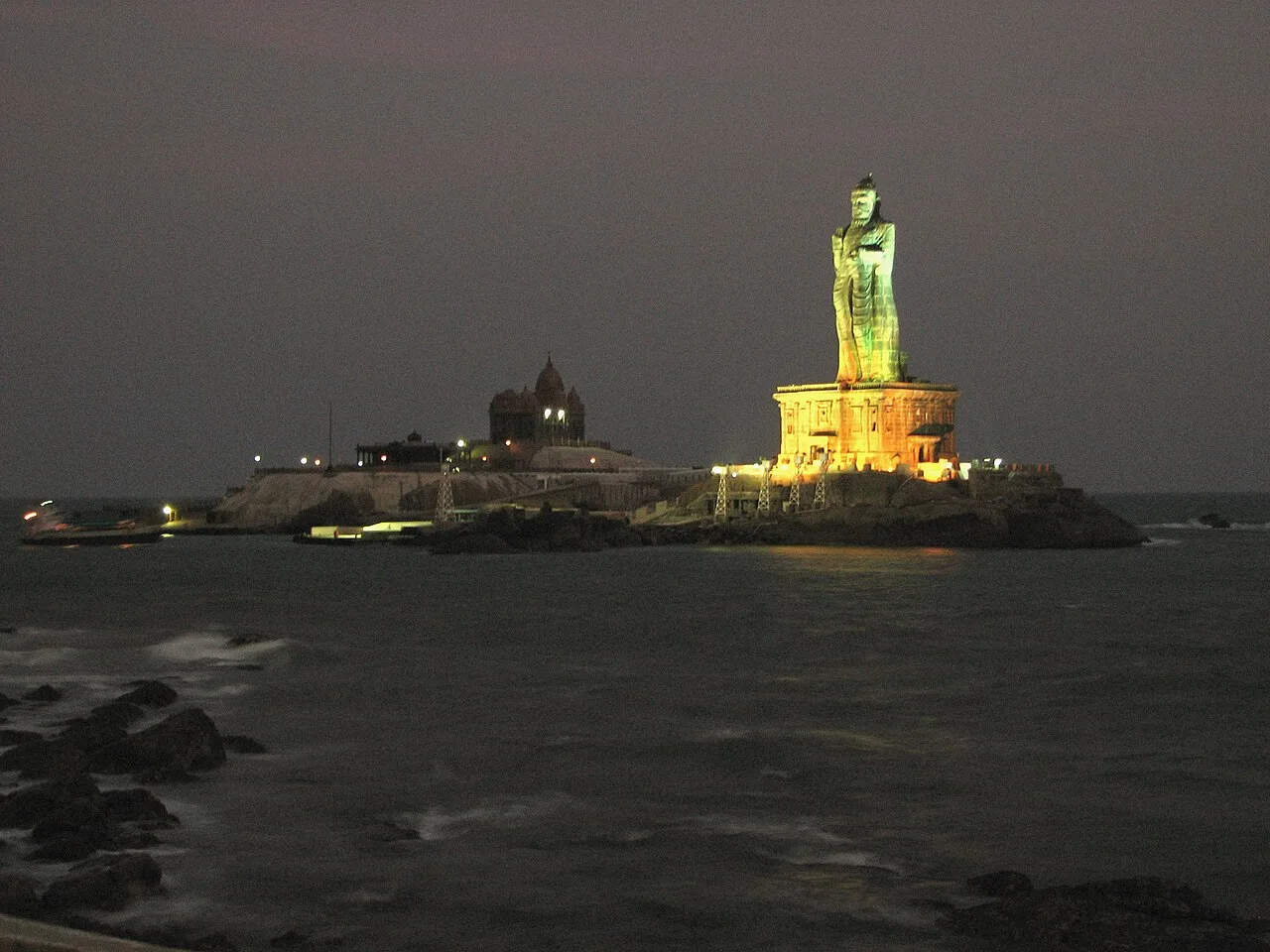
The monument stands on a rocky islet off the Kanniyakumari coast and is built from stone. Its overall height is 40.6 metres (133 feet), comprising a 38-foot pedestal and a 95-foot figure of Thiruvalluvar. The proportions are deliberately symbolic: the pedestal refers to the Thirukkural’s 38 chapters on virtue, and the figure to its other 95 chapters on wealth and love. The sculptor, V. Ganapati Sthapati, brought a traditional Indian sculptural approach to a large public monument in a highly exposed coastal setting. Thiruvalluvar is shown standing, with three fingers of one hand raised; the gesture is interpreted as referring to the three divisions of the Thirukkural. The statue and base form a single visual landmark against the sea, while the island setting makes the approach by boat part of the experience. Surfaces, access arrangements and any areas open to visitors can vary; follow current site instructions.
Important objects & sculptures
The main object to study is the monumental stone figure of Thiruvalluvar, especially its standing pose and the three raised fingers. These are commonly interpreted as representing the Thirukkural’s three divisions: virtue (aram), wealth or public life (porul), and love (inbam). Look also at the pedestal and consider its symbolic 38-foot height, linked to the work’s chapters on virtue. The statue is not a museum collection, and visitors should not expect extensive galleries or a large display of artefacts. Information boards or interpretive material may help explain the poet and the text; availability can change, so check locally. Observe the stonework from permitted visitor areas and do not touch or climb on restricted surfaces.
Explore Thiruvalluvar Statue slowly and read the interpretation boards, use the official audio guide where available or hire an authorised guide to understand its history. Check opening days, ticket counters and camera rules in advance; many monuments and museums close on one weekday and on some public holidays. Early morning gives softer light, cooler air and smaller crowds. A comfortable itinerary is one main visit in the morning, a local meal at midday and a short nearby stop before an afternoon return. Use the district list on this site to find other places in Kanniyakumari, but check the route and its condition before combining stops. If a festival is on — such as Pongal in January, the Madurai Chithirai festival, the Mahamaham at Kumbakonam or the Chennai music season in December — roads and stays can be busy, and the experience can be unforgettable. Leave no litter: many sites are protected by the communities around them.
Suggested itineraries
Half day: Reach the boat boarding area, visit the Thiruvalluvar Statue and take time to read available interpretation (about 2–3 hours, allowing for queues and the boat journey). Full day: Visit the statue in the morning, continue to Vivekananda Rock Memorial, have lunch in town, then see Gandhi Memorial Mandapam and the coast or Kanyakumari Bhagavathy Amman Temple (about 6–8 hours, depending on access and queues). Gentler option: View the statue from the mainland waterfront, then choose one nearby indoor or seated visit; avoid the boat transfer if sea conditions, steps or walking are a concern.
The statue represents a literary tradition that remains part of everyday Tamil cultural life. The Thirukkural is read, taught and quoted for its short verses on ethics, governance and human relationships, and visitors may hear the work discussed in Tamil and other languages. Tamil is the principal local language; English is also commonly useful in visitor-facing settings, though services vary. Kanniyakumari is a pilgrimage town as well as a coastal destination, so religious customs are visible around nearby temples and bathing areas. Dress is generally informal at the monument, but modest clothing is considerate, particularly when visiting places of worship. The statue itself is a civic and cultural landmark rather than an active temple or performance venue.
Festivals & events
The statue is not known primarily as a festival venue, but visitor numbers in Kanniyakumari can rise during religious and public celebrations. Pongal, the Tamil harvest festival, is observed in January; Navaratri is celebrated around September or October, with traditions centred on local temples; and Chaitra Purnima, usually in April or May, draws visitors to the coast. The town also holds local tourism and cultural events at different times of year, but programmes can change. During festivals and holiday periods, expect busier roads, accommodation and ferry queues. Confirm whether events affect boat access before planning a visit.
Local food in Tamil Nadu includes idli, dosa and filter coffee, Chettinad chicken and pepper curries, Madurai's kari dosa and jigarthanda, Thanjavur's banana-leaf vegetarian meals, Kanyakumari's seafood, and sweets such as Mysore pak, adhirasam and Tirunelveli halwa. Ask what is fresh that day; many small eateries cook a limited daily menu. Tamil Nadu is a paradise for vegetarian meals served on banana leaf; Chettinad and Madurai are the centres for meat and spice lovers. Filter coffee is a ritual — have it at a local 'hotel' (eatery). Remote sites may have no restaurant at all. Carry water and snacks, eat a proper breakfast before long drives, and ask your accommodation for a packed lunch if you are heading out early. Try a home-cooked or local thali meal when you can — it is often the best food on the route. Choose busy, clean places, drink sealed or filtered water, and carry your packaging back with you.
Shopping & local experiences
In Kanniyakumari town, look for locally made handicrafts, small devotional souvenirs and regional food products in shops around visitor areas. Tamil Nadu specialties and snacks can make more useful gifts than fragile coastal trinkets. Seafood and South Indian meals are widely associated with the coastal town; choose a clean, well-reviewed place and check what is available on the day. Avoid buying coral, products made from protected marine life or questionable shells. Shop responsibly, compare quality and packaging, and carry reusable bags where practical.
November to February; April to June for the hill stations
The nearest principal railway station by straight-line distance is Kanniyakumari, roughly 1 km away. The nearest operating airport by straight-line distance is Thoothukudi (Tuticorin) Airport, roughly 89 km away. These figures are calculated from map coordinates — actual road distance is longer. Chennai is the main gateway; Coimbatore serves the west and Mettupalayam is the railhead for the Ooty toy train; Madurai and Tiruchirappalli serve the south and centre; Rameswaram and Kanniyakumari have their own rail termini. For the final leg, TNSTC and SETC buses reach nearly every town, with private sleeper coaches between cities and app cabs in Chennai, Coimbatore and Madurai link district towns. A private taxi gives more flexibility for remote sites such as hill stations, forest gates and coastal temples. When comparing train, bus and flight, count the complete door-to-door time: a flight saves the most time only if the onward road transfer is short, while an overnight train can save a hotel night. Book your return before you leave, because seats fill quickly on weekends, festivals and holidays. Current train numbers, timings, return services and fares are not listed here; check IRCTC and NTES for trains and the airline's own schedule for flights. No permit is needed to visit Tamil Nadu. The Nilgiri Mountain Railway toy train to Ooty must be booked well in advance on IRCTC — seats are few and sell out weeks ahead. Major temples such as Madurai Meenakshi and Srirangam have darshan queues and some enforce a dress code (dhoti or formal trousers for men, saree or salwar for women); phones and cameras are not allowed inside several temple sanctums. Boating to the Vivekananda Rock at Kanyakumari depends on sea conditions.
Confirm onward and return timings on IRCTC / NTES, the state bus operator or your airline before travel. A dash means current timings or fares have not been verified.
Getting around
From Kanniyakumari town, visitors typically reach the boat boarding area on foot, by auto-rickshaw or by taxi, depending on their starting point and mobility. Boats provide the usual connection to the statue’s island; check locally for current boarding arrangements and weather-related interruptions. Local buses connect Kanniyakumari with towns in the district, while taxis can be useful for combining nearby sights. Parking is available in visitor areas but can be busy during holidays. The waterfront and town centre are walkable for many people, though surfaces, crowds and heat can make short distances tiring. Allow extra time for queues and transfers.
Hours, tickets & permissions
Access to the statue is generally linked to the passenger boat service from Kanniyakumari, so entry may be affected by sea conditions, maintenance or crowd management. Tickets, boarding arrangements, baggage rules and any camera restrictions are set by the relevant operator or managing authority and may change. There may be separate arrangements for visiting nearby attractions. Confirm current opening days, hours, fees and access notices with the managing authority before travelling. Follow staff instructions at the landing point and on the island; do not assume that a ticket for one attraction includes another.
Facilities
Facilities at the landing area and in Kanniyakumari town usually include public toilets, small shops and places to buy food or drinking water; provision on the island itself may be limited. Check locally for toilets, seating, shade and drinking-water availability before boarding. Restaurants and cafés are found in town, as are ATMs and basic visitor services. Parking is available near the waterfront, but spaces can fill during busy periods. Authorised guides or interpretive material may be available, though availability is not guaranteed. Carry essential medication and water, and take litter back to appropriate bins or off the island.
Accessibility
Reaching the statue requires a boat transfer, and the landing, island paths and visitor areas may include uneven surfaces, steps or exposed sections. The crossing can be difficult for anyone affected by motion, rough water or boarding gaps. Shade and seating may be limited, and sun, wind and heat can add to the effort. Wheelchair and stroller access should not be assumed; confirm current boat boarding and on-island arrangements with the operator before travelling. Older visitors or people with limited mobility may prefer viewing the statue from the mainland waterfront, or visiting only if sea conditions and assistance are suitable. Allow extra time and avoid rushing.
No permit is needed to visit Tamil Nadu. The Nilgiri Mountain Railway toy train to Ooty must be booked well in advance on IRCTC — seats are few and sell out weeks ahead. Major temples such as Madurai Meenakshi and Srirangam have darshan queues and some enforce a dress code (dhoti or formal trousers for men, saree or salwar for women); phones and cameras are not allowed inside several temple sanctums. Boating to the Vivekananda Rock at Kanyakumari depends on sea conditions. Carry a photo ID at all times and save the emergency number 112 and your accommodation's contact offline. Heat in summer and heavy rain in the monsoon are the main weather risks; carry water, avoid midday sun and allow extra time when roads flood. Watch your belongings in crowds and on public transport, and follow posted instructions.
Photography
The statue is striking against the sea, and softer morning light can help with contrast while avoiding some midday glare. The mainland waterfront offers a broad view; the island provides closer perspectives where visitors are permitted. Photography rules, including any restrictions or camera charges, can change, so check notices and ticket conditions. Do not use a drone without confirming current permissions from the relevant authorities; coastal and public sites may have restrictions. Be considerate around other visitors, local worshippers and ceremonies at nearby temples, and avoid blocking walkways while taking pictures.
Choose a stay by the full journey to Thiruvalluvar Statue, not just the district name. Chennai, Coimbatore, Madurai and Tiruchirappalli offer the widest choice; Ooty and Kodaikanal have everything from heritage hotels to cottages — book far ahead for the April–June school holidays and the Pongal weekend. In summer, check air-conditioning; in the monsoon, check that the property is accessible if roads flood. Book in advance for weekends, festivals and the peak season (November to February; April to June for the hill stations). Confirm the exact location, meals included, check-in time and cancellation terms in writing. Avoid sending money to unverified contacts or touts at stations. Carry some cash, as card and digital payments can be unreliable in remote areas.
Kanniyakumari’s best-known nearby landmark is the Vivekananda Rock Memorial, reached by boat from the same general waterfront area; check whether access is operating before combining visits. On the mainland, the Gandhi Memorial Mandapam and Kanyakumari Bhagavathy Amman Temple are established sights. The seafront and the meeting-of-the-seas viewpoint are also popular places to explore. For a wider district trip, consider Vattakottai Fort, Suchindram Thanumalayan Temple or Padmanabhapuram Palace near Thuckalay. These require additional travel, so check road conditions and opening arrangements rather than assuming they fit into a short visit.
For couples, Thiruvalluvar Statue rewards a slow pace: arrive early for soft light and fewer crowds, share a local meal and keep the evening free. Sunrise at Kanyakumari, a boat ride on Kodaikanal lake or an evening stroll through Mamallapuram's shore monuments makes the trip memorable. Public displays of affection can be frowned upon in conservative communities and at religious sites, so be discreet. Keep a buffer in your itinerary, because weather and road conditions can delay plans.
Q: How much time should I allow for the statue? A: Allow a few hours for the boat transfer, possible queues and time on the island; conditions and crowd levels affect the visit. Q: When is a good season to visit? A: November to February is generally comfortable in Tamil Nadu, but check sea and weather conditions before travelling by boat. Q: Is there an entry fee, and can I visit at any time? A: Entry and boat arrangements may involve tickets and rules. Confirm current fees, hours and access with the managing authority. Q: Is the visit suitable for children and older visitors? A: Many families visit, but the boat transfer, steps, uneven surfaces and exposure to sun may be challenging. Check access conditions and consider a mainland view if needed. Q: Where can I stay nearby? A: Kanniyakumari has visitor accommodation in and around town. Book ahead during holidays and festivals, and check the location’s distance from the waterfront.
Be the first to share photos, stories, advice or a helpful contact for Thiruvalluvar Statue.
Loading…