
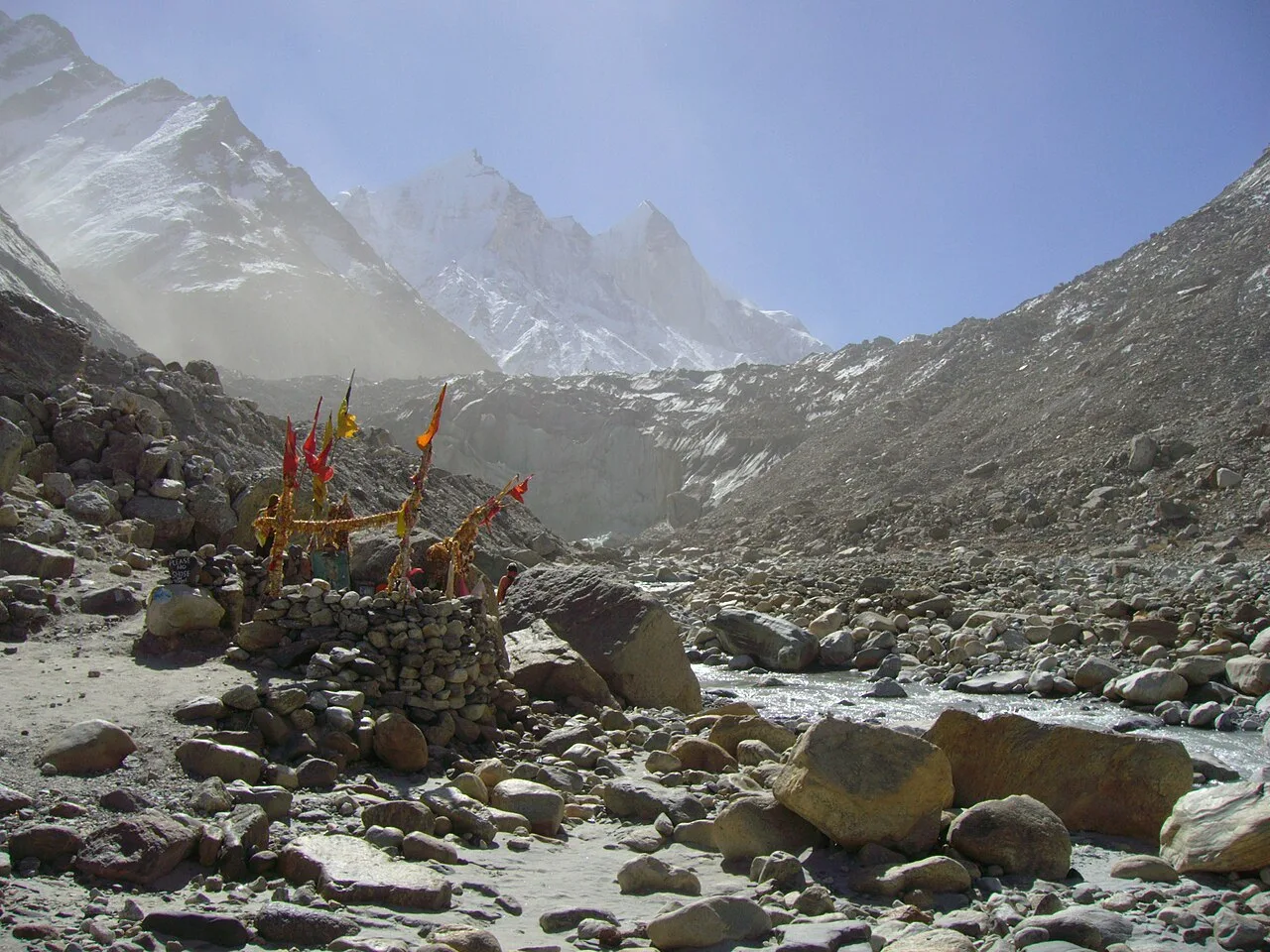
Gangotri Glacier
A large glacier in Uttarakhand, Gangotri Glacier is a source of the Bhagirathi, a major Ganges tributary. Hindu pilgrims and trekkers visit Gomukh, with some continuing to Tapovan.
Key facts · verified by Ghumoopedia editors
- Type of place
- Natural attraction
- Best time to visit
- March to June and September to November; December to February for snow in the hills; July to September only for the Valley of Flowers
- Nearest railway station
- Yog Nagari Rishikesh · about 118 km (straight line)
- Verified
- 21 Nov 2026
Plan a trip from Gangotri Glacier — a day-by-day route through places nearby.
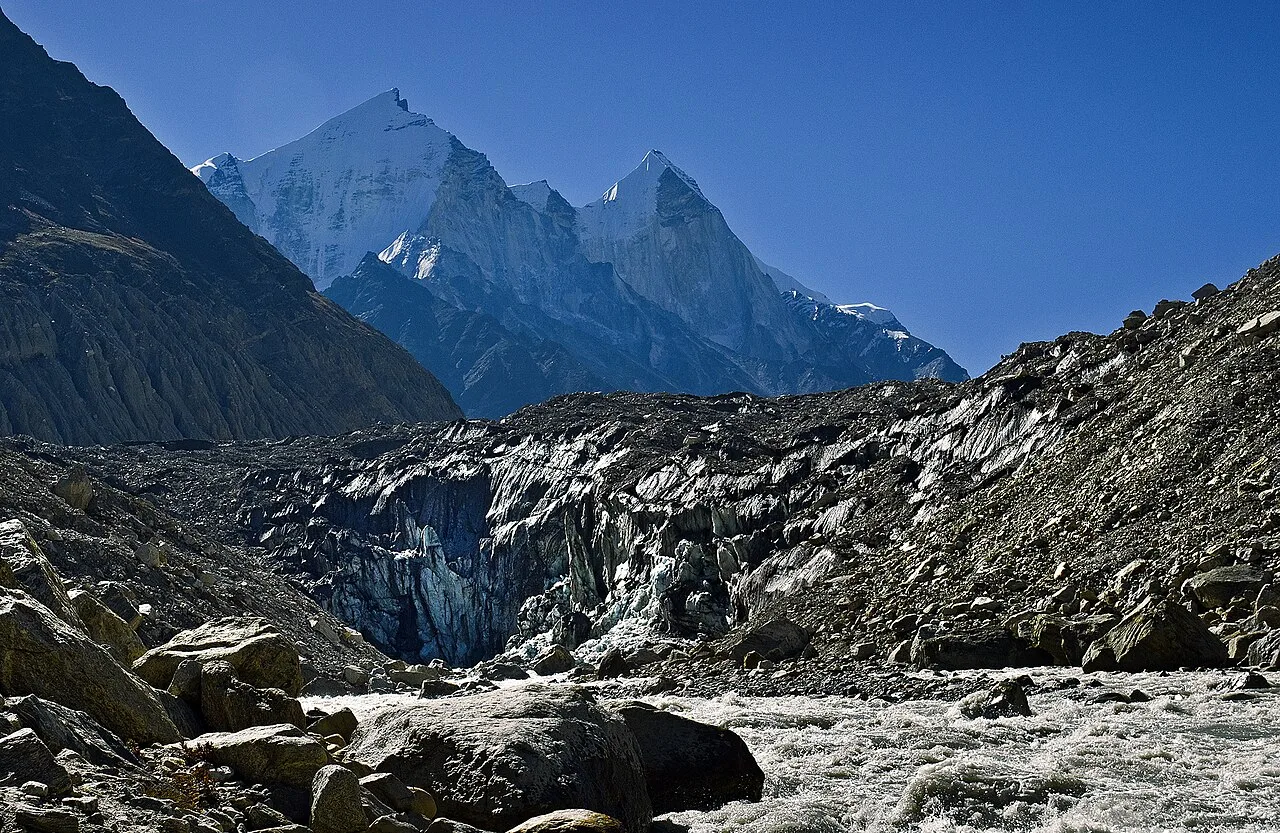
In Uttarakhand’s Uttarkashi district, near the boundary with Tibet, Gangotri Glacier is among the principal sources of the Ganges. Its volume exceeds 27 cubic kilometres. The ice body extends for roughly 30 kilometres and measures between two and four kilometres across. It runs generally northwest, beginning in a cirque beneath Chaukhamba, the highest summit in the Gangotri Group. Nearby peaks include Shivling, Thalay Sagar, Meru and Bhagirathi III, all known for exceptionally difficult climbing routes. At its lower end, the glacier forms an opening likened to a cow’s mouth, giving rise to the name Gomukh, also written Gaumukh. About 18 kilometres from Gangotri town, this point marks the precise origin of the Bhagirathi, a major tributary of the Ganges. Gomukh lies close to the foot of Shivling, with the Tapovan meadow between them. The area is a Hindu pilgrimage destination. Many Hindus regard bathing in the cold water near Gangotri town as a sacred observance. Pilgrims also walk to Gomukh, and some continue to Tapovan. The trek from Gangotri to Gaumukh passes Devgadh, Chirbhasa and Bhojwasa. Bhojwasa is the only place with accommodation, while forest check posts are located at Chirbhasa and Bhowasa. The 2013 North Indian floods destroyed much of the path. Beyond Chirbhasa, travel is more difficult because the trail has deteriorated and a rockfall area about two kilometres wide lies along the way. Uttarakhand, the Devbhumi or land of the gods, spans the Garhwal and Kumaon Himalaya: the Char Dham shrines and Panch Prayag confluences, Haridwar and Rishikesh on the Ganga, colonial hill stations such as Mussoorie, Nainital and Ranikhet, Corbett and Rajaji tiger reserves, the alpine Valley of Flowers, and Garhwali, Kumaoni, Jaunsari and Bhotiya communities with their folk songs, temple fairs and Aipan art. The plains around Haridwar and Udham Singh Nagar are hot from April to June; hill towns stay mild in summer and cold in winter, with snow above about 2,000 m from December to February. The monsoon (July to September) brings heavy rain, landslides and frequent road closures. High shrines such as Kedarnath and Badrinath open only from about late April or May until around Diwali. The usual best time to visit is March to June and September to November; December to February for snow in the hills; July to September only for the Valley of Flowers. Timings, fees and access arrangements must be confirmed locally. For official information, see Uttarakhand Tourism at https://uttarakhandtourism.gov.in.
Use Gangotri Glacier as a base to understand local life: walk through the market, look for local crafts such as Kumaoni Aipan art, ringaal bamboo craft, Pashmina and woollen shawls, copperware from Almora, Bal Mithai and local pulses and honey and ask your host about nearby viewpoints and short excursions. Always ask before photographing people, homes or ceremonies. A comfortable itinerary is one main visit in the morning, a local meal at midday and a short nearby stop before an afternoon return. In the mountains, mornings are clearest; clouds often roll in by noon, so start early for Himalayan views. Use the district list on this site to find other places in Uttarkashi, but check the route and its condition before combining stops. If a festival is on — such as the Kumbh and Ardh Kumbh at Haridwar, the Kanwar Yatra in July, Ganga Dussehra, the Nanda Devi Raj Jat, Phool Dei and Harela, or the Uttarayani fair at Bageshwar — roads and stays can be busy, and the experience can be unforgettable. Leave no litter: the Himalayan valleys have little waste collection, so carry a refillable bottle and bring your rubbish back down.
Local food in Uttarakhand includes kafuli (spinach curry), phaanu and chainsoo (lentil dishes), aloo ke gutke, bhatt ki churkani, mandua (finger-millet) rotis, jhangora kheer, singori and bal mithai from Almora, with rhododendron (buransh) squash in spring. Ask what is fresh that day; many small eateries cook a limited daily menu. Hill food is simple and warming, with plenty of vegetarian options; in pilgrim towns many eateries serve only vegetarian food without onion or garlic, and alcohol and meat are banned in places such as Haridwar, Rishikesh and the Char Dham towns. Remote sites may have no restaurant at all. Carry water and snacks, eat a proper breakfast before long drives, and ask your accommodation for a packed lunch if you are heading out early. Try a home-cooked or local thali meal when you can — it is often the best food on the route. Choose busy, clean places, drink sealed or filtered water, and carry your packaging back with you.
March to June and September to November; December to February for snow in the hills; July to September only for the Valley of Flowers
The nearest principal railway station by straight-line distance is Yog Nagari Rishikesh, roughly 118 km away. The nearest operating airport by straight-line distance is Jolly Grant Airport, Dehradun, roughly 119 km away. These figures are calculated from map coordinates — actual road distance is longer, and mountain roads mean even short distances can take hours. Haridwar, Rishikesh (Yog Nagari Rishikesh) and Dehradun stations and Dehradun's Jolly Grant Airport are the gateways to Garhwal; Kathgodam station and Pantnagar Airport serve Kumaon; Ramnagar station serves Corbett. Beyond these, travel is by road. Gangotri Glacier lies in a restricted or protected area: an Inner Line Permit (issued by the SDM office in Dharchula for the Adi Kailash–Om Parvat route) or a forest permit (for Gangotri National Park and the Nanda Devi area) is needed before you go, the number of visitors may be capped, and you must carry the original photo ID you applied with. Most travellers go with a registered operator. When comparing train, bus and flight, count the complete door-to-door time: a flight saves the most time only if the onward road transfer is short, while an overnight train can save a hotel night. For the Garhwal hills, an overnight train to Haridwar, Rishikesh or Dehradun (or a flight to Jolly Grant Airport, Dehradun) is the usual start; for Kumaon, trains run to Kathgodam and flights to Pantnagar. The road journey into the mountains takes most of a day, so do not plan sightseeing on arrival. Book your return before you leave, because seats fill quickly on weekends, festivals and holidays. Current train numbers, timings, return services and fares are not listed here; check IRCTC and NTES for trains and the airline's own schedule for flights. No permit is needed for most of Uttarakhand, but Char Dham pilgrims (Yamunotri, Gangotri, Kedarnath and Badrinath) and Hemkund Sahib pilgrims must register online with Uttarakhand Tourism before travelling, and areas near the Tibet border such as Adi Kailash, Om Parvat, Niti and Nelong valleys need an Inner Line Permit.
Confirm onward and return timings on IRCTC / NTES, the state bus operator or your airline before travel. A dash means current timings or fares have not been verified.
No permit is needed for most of Uttarakhand, but Char Dham pilgrims (Yamunotri, Gangotri, Kedarnath and Badrinath) and Hemkund Sahib pilgrims must register online with Uttarakhand Tourism before travelling, and areas near the Tibet border such as Adi Kailash, Om Parvat, Niti and Nelong valleys need an Inner Line Permit. Carry a photo ID at all times and save the emergency number 112 and your accommodation's contact offline. Altitude sickness is the main risk: spend a night acclimatising lower down before going higher, avoid alcohol, drink water, and descend immediately if you develop a severe headache, breathlessness or confusion. People with heart or lung conditions, young children and pregnant women should consult a doctor before going. Watch your belongings in crowds and on public transport, and follow posted instructions.
Choose a stay by the full journey to Gangotri Glacier, not just the district name. Permit-area trips usually rely on basic guesthouses or camps arranged by the operator; rooms are simple, heating is limited and power cuts are common, so carry warm layers and a torch. Nights are cold for much of the year — check heating, hot water and extra blankets. Book in advance for weekends, festivals and the peak season (March to June and September to November; December to February for snow in the hills; July to September only for the Valley of Flowers). Confirm the exact location, meals included, check-in time and cancellation terms in writing. Avoid sending money to unverified contacts or touts at stations. Carry some cash, as card and digital payments can be unreliable in remote areas.
For couples, Gangotri Glacier rewards a slow pace: arrive early for soft light and fewer crowds, share a local meal and keep the evening free. Sunrise over the Himalaya from a ridge-top homestay, a forest walk or an evening by a quiet lake makes the trip memorable. Public displays of affection can be frowned upon in conservative communities and at religious sites, so be discreet. Keep a buffer in your itinerary, because weather and road conditions can delay plans.
Be the first to share photos, stories, advice or a helpful contact for Gangotri Glacier.
Loading…