
Khimsar
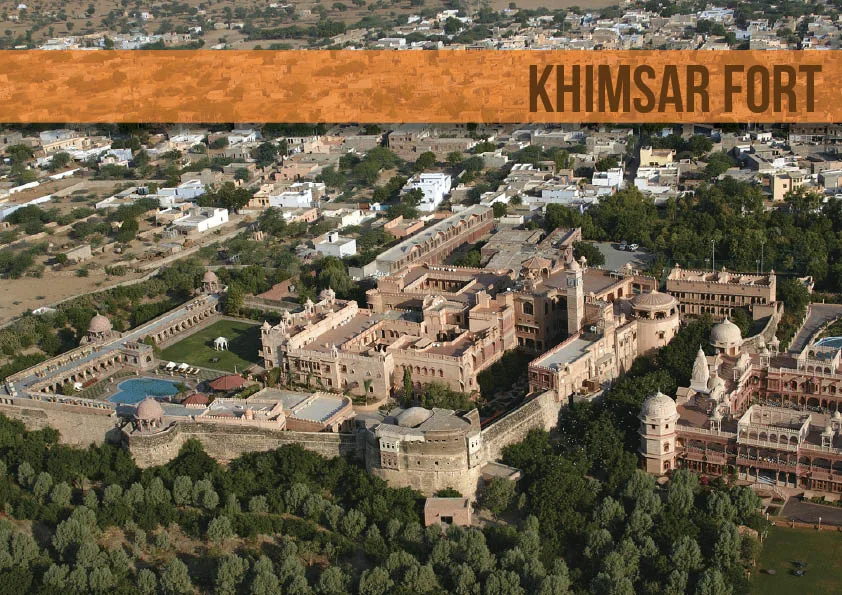
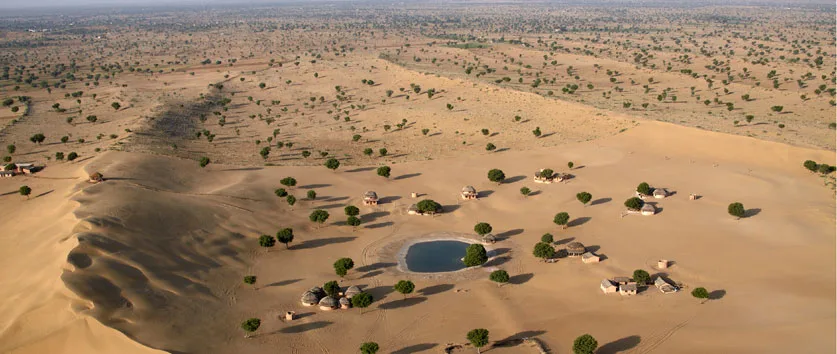
Khimsar, in Rajasthan’s Nagaur district, draws visitors for its historic fortress, converted into a heritage hotel, and the dunes close by.
Key facts · verified by Ghumoopedia editors
- Type of place
- Heritage monument
- Best time to visit
- October to March
- Verified
- 21 Nov 2026
Khimsar is a settlement in Nagaur district, Rajasthan, close to the desert boundary. Its principal historic landmark is a fort, now operated as a heritage hotel. Dunes in the vicinity provide a further reason to visit the village. The stronghold was built in 1523 by Rao Karamsji, the eighth son of Rao Jodha of Jodhpur. It lies halfway between Jodhpur and Nagaur, on the Thar Desert’s eastern side. Aurangzeb stayed at the fort during his time in Nagaur. The village’s desert setting is also reflected in the dunes nearby. Rajasthan is the land of Rajput forts and palaces, painted havelis, desert folk music, puppetry and colourful fairs such as the Pushkar camel fair. Rajasthan is very hot from April to June — often above 45 °C in the desert — with a short monsoon in July–September. Winter days are pleasant and nights are cold, especially in the Thar Desert. Mount Abu is the state's only hill station and stays cooler. The usual best time to visit is October to March. For official information, see Rajasthan Tourism at https://www.tourism.rajasthan.gov.in.
Why it matters
Khimsar is a village in Nagaur district on the eastern edge of the Thar Desert. Its best-known landmark, Khimsar Fort, connects the area with the history of the Jodhpur Rathore family and is now operated as a heritage hotel. The fort and nearby dunes also make Khimsar a point of interest for visitors exploring the desert landscape and historic settlements of western Rajasthan. Its importance is primarily regional and local, rather than that of a major public monument. Access to the fort may be limited because it is a functioning hotel.
Khimsar Fort is traditionally dated to 1523. It was built by Rao Karamsji, described in the local historical account as the eighth son of Rao Jodha, the Rathore ruler associated with the founding of Jodhpur. The fort’s position between Jodhpur and Nagaur placed it within a region shaped by Rajput rule, desert routes and changing political alliances. Accounts also associate the fort with the Mughal period: Aurangzeb is said to have stayed there when he was in Nagaur. Such references should be understood as historical tradition unless confirmed by a specific contemporary record. Like many Rajput strongholds, Khimsar Fort changed over time as successive generations adapted it for residence and defence. Its present character reflects this layered use rather than a single moment of construction. In modern times, parts of the complex were adapted for hospitality and it became a heritage hotel. This has helped preserve and maintain parts of the historic property, while also meaning that some areas are private or reserved for guests. Visitors should confirm access arrangements directly with the hotel or a local host.
Origin stories & folklore
No single, well-documented origin legend for Khimsar Fort can be confidently presented as established fact. Local accounts may link the fort’s beginnings to Rao Karamsji and the Rathore family, but such family histories and oral recollections are best treated as tradition rather than independently verified evidence. The fort’s association with Aurangzeb is also repeated in historical accounts, though it is not a supernatural tale. Ask a local guide or host whether they know village-specific stories, and distinguish oral tradition from documented history. Avoid assuming that a story told at another Rajasthani fort also belongs to Khimsar.
Architecture & design
Khimsar Fort is a fortified complex whose visible form reflects both defensive and residential use. Its construction is traditionally dated to the 16th century, with later generations adding to or adapting the property. The fort’s substantial outer walls and controlled entrances express its defensive purpose, while inner courtyards and residential spaces reflect life within the stronghold. Stone masonry, shaded passages and balconies or windowed openings are characteristic features visitors may notice where access is permitted. The complex is not simply a standalone ruin: sections have been adapted for use as a heritage hotel, and the layout may include private guest areas. The desert setting makes shade, thick walls and enclosed spaces practical features, but specific construction techniques should not be assumed without a specialist survey. Follow hotel guidance and do not enter closed rooms or residential areas.
Important objects & sculptures
The fort is primarily of interest as a historic building and lived-in heritage complex, rather than as a public museum with a guaranteed display collection. Where visitor access is allowed, look for details in the masonry, gateways, wall surfaces, balconies and interior architectural fittings. These can reveal changes made as the fort shifted from a defensive stronghold to a residence and later a hotel. Do not touch fragile surfaces or assume that furnishings and antiques are original to the fort; ask a guide or hotel representative about the history of any object on display.
Walk through Khimsar slowly to take in its old houses, streets and places of worship, ideally with a local guide or host who can explain the village's history and families. Many heritage houses are private homes — admire them from outside unless you are invited in or the house is open to visitors — and ask before photographing people. Look out for local food, crafts and festivals that are part of the village's living heritage, and combine your visit with nearby temples, forts or towns in Nagaur district.
Suggested itineraries
Half day: Ask about fort access; explore permitted fort areas (about 1–2 hours); walk through the village with a local host (about 1 hour); pause for a meal or tea. Full day: Visit the fort if access is arranged (about 2 hours); explore Khimsar village (about 1–2 hours); take a locally arranged trip to the nearby dunes (about 1–2 hours); return for a meal and rest. Gentler option: Arrange a vehicle close to the fort or village stops, limit walking to accessible areas, and take breaks in shaded or indoor spaces; confirm access and seating locally.
Khimsar remains a village as well as a heritage destination. Everyday life in the area reflects the wider Marwar region, where Hindi and Rajasthani speech, including Marwari, are commonly encountered. Family homes, places of worship and village streets are part of a living community, not simply a visitor attraction. Rajasthani clothing, local food and folk music may be encountered, but performances and craft demonstrations are not guaranteed in the village. Ask before photographing residents, entering a home or observing a private religious occasion. A local guide or host can help explain customs and the history of families without treating private spaces as public exhibits.
Festivals & events
Holi, Diwali, Teej and Gangaur are observed in Rajasthan, though the scale and arrangements in Khimsar vary from year to year. Nagaur is also known for its cattle fair, usually held in the winter season; dates and programme details change, so confirm locally before planning around it. Festival periods can bring more visitors, busier roads and accommodation pressure in the wider area. Do not assume that a fair or performance takes place inside the fort or in Khimsar village itself. Respect local customs and ask before photographing ceremonies or participants.
Village food in Rajasthan is home cooking: dal baati churma, gatte ki sabzi, ker sangri, laal maas, pyaaz kachori, mirchi vada, ghewar, mawa kachori and chaach (spiced buttermilk). Khimsar itself may have only tea stalls and small eateries, so ask your host or guide where to eat, or arrange a home-cooked meal in advance — it is often the highlight of a village visit. Carry water and a snack if you plan to spend the whole day, and eat your main meal in the nearest town if no local option is open.
Shopping & local experiences
Khimsar is a village, not a large shopping centre, so do not expect a broad range of dedicated souvenir shops. Ask locally about regional textiles, craftwork or small items made or sold in the area, and buy directly from makers where possible. Availability changes, and demonstrations or workshops should be arranged in advance rather than assumed. Local Rajasthani food can be part of the visit; ask your host or accommodation what is prepared nearby. Be respectful when browsing village homes or small businesses, and seek permission before photographing products or their makers.
October to March
These figures are calculated from map coordinates — actual road distance is longer. Jaipur, Ajmer, Jodhpur, Udaipur and Kota are the main rail hubs, and Jaipur, Udaipur and Jodhpur have the most flights; Delhi is the usual gateway for the north-east of the state. Khimsar is a village, so the last stretch is by road: Rajasthan State Road Transport Corporation (RSRTC) buses and private coaches reach the nearest town, and from there a shared auto, local bus or reserved taxi covers the final few kilometres. Village roads can be narrow and unpaved; a taxi hired for the day from the nearest town is the simplest way to combine Khimsar with nearby sights and get back before dark. When comparing train, bus and flight, count the complete door-to-door time: a flight saves the most time only if the onward road transfer is short, while an overnight train can save a hotel night. Book your return before you leave, because seats fill quickly on weekends, festivals and holidays. Current train numbers, timings, return services and fares are not listed here; check IRCTC and NTES for trains and the airline's own schedule for flights. No permit is needed to visit Rajasthan. Land close to the international border west of Jaisalmer and Barmer is restricted beyond certain points: places such as Tanot can be visited, but border outposts need Border Security Force permission. Forts and palaces charge entry and camera fees, and tiger-reserve safaris must be booked through the official forest department portal.
Getting around
Khimsar is best explored on foot within the village, though the fort and other stops may require a vehicle depending on where you are staying. For arrival and onward trips, arrange a taxi or local transport through your accommodation or a nearby town; do not assume autos or local buses will be available on demand. RSRTC services and private coaches serve towns in the region, but the final leg to the village may need separate planning. Ask locally about parking and whether a vehicle can reach your intended stop. Roads may be narrow or uneven, so allow extra time.
Hours, tickets & permissions
Khimsar Fort operates as a heritage hotel, so entry to the property or particular sections may depend on hotel policy, guest status or prior arrangement. It should not be assumed that the fort is freely open as a public monument. Tickets, permits, camera rules, dress expectations and identification requirements may vary or be introduced by the manager. Confirm current visiting arrangements, hours and fees with the hotel or managing authority before travelling. Village streets and public places have separate access, but homes and active places of worship are not automatically open to visitors.
Facilities
Facilities depend on whether you are visiting as a hotel guest or have arranged separate access. The heritage hotel may provide toilets, drinking water, food and visitor assistance for its guests; check in advance what is available to non-guests. In the village, facilities may be limited and opening arrangements can vary. Do not count on a public visitor centre, ATM, accessible toilet or guide being available on site. Ask your accommodation about parking, meals and a local guide, and carry drinking water for the journey. Confirm food and water arrangements before setting out for the dunes.
Accessibility
The fort and village are historic environments, so surfaces may be uneven and routes may include steps, narrow passages or thresholds. A heritage hotel adaptation does not guarantee step-free access to historic rooms or all visitor areas. Shade and seating may be available in some places, but should be checked in advance, particularly in hot weather. Wheelchair and stroller access cannot be assumed, and some sections may be difficult for visitors with limited mobility. Older visitors may prefer a vehicle-assisted visit, short walks and frequent rests. Contact the hotel or local host before arrival to discuss specific access needs.
No permit is needed to visit Rajasthan. Land close to the international border west of Jaisalmer and Barmer is restricted beyond certain points: places such as Tanot can be visited, but border outposts need Border Security Force permission. Forts and palaces charge entry and camera fees, and tiger-reserve safaris must be booked through the official forest department portal. Carry a photo ID, some cash (card and UPI acceptance varies in villages) and a charged phone with offline maps; save the emergency number 112 and your host's contact. Heat in summer and heavy rain in the monsoon are the main weather risks; carry water, avoid midday sun and allow extra time when village roads flood. Respect local customs: dress modestly, remove footwear where asked, and always ask before photographing people, homes or rituals.
Photography
Soft morning or late-afternoon light can bring out the fort’s stonework and the desert setting; check that the viewpoint you choose is publicly accessible. Photography rules inside the hotel or fort may depend on management, so ask before taking pictures and confirm whether any camera restrictions apply. Drone use may require permissions and can be restricted near private property or populated areas; do not fly without checking current rules. Ask residents before photographing them, and avoid interrupting worship, ceremonies or hotel guests. Do not enter closed areas to obtain a photograph.
Most visitors see Khimsar on a day trip from the nearest town, which has the widest choice of hotels. A few villages have homestays or heritage stays; otherwise base yourself in the district town and hire a taxi for the day. Confirm the booking and the exact location before you travel, because village addresses can be hard to find.
Within the wider region, Nagaur Fort, also known as Ahhichatragarh, is a major historic site in Nagaur town and can be considered alongside Khimsar. Kuchaman Fort is another fort in Nagaur district. The temples and historic settlement at Osian are a possible regional excursion, though they are outside Nagaur district and require separate travel planning. Jodhpur offers additional forts and urban heritage for a longer trip. Khimsar’s nearby dunes are a natural landscape attraction rather than a monument. Check road conditions, opening arrangements and access before combining multiple stops.
For couples, Khimsar is a chance to slow down: walk the lanes in the soft morning light, share a home-cooked meal and keep the afternoon free. Stay in a nearby homestay or heritage property to make it a quiet overnight escape.
Q: How much time should I allow for Khimsar? A: A half day can cover an arranged fort visit and a village walk; allow a full day if adding the dunes or a nearby excursion. Q: When is the best season to visit? A: October to March is generally the most comfortable season. Desert summers can be extremely hot, so check conditions before travelling. Q: Can anyone enter Khimsar Fort? A: The fort is a heritage hotel, and access may be limited to guests or visitors with prior permission. Confirm current arrangements with management. Q: Is Khimsar suitable for children or elderly visitors? A: It can be, but historic surfaces may be uneven and some areas may have steps. Plan shorter walks, supervision and rest breaks. Q: Where can I stay nearby? A: Khimsar has heritage-hotel accommodation, and nearby towns offer other options. Confirm availability and access arrangements before setting out.
Be the first to share photos, stories, advice or a helpful contact for Khimsar.
Loading…