
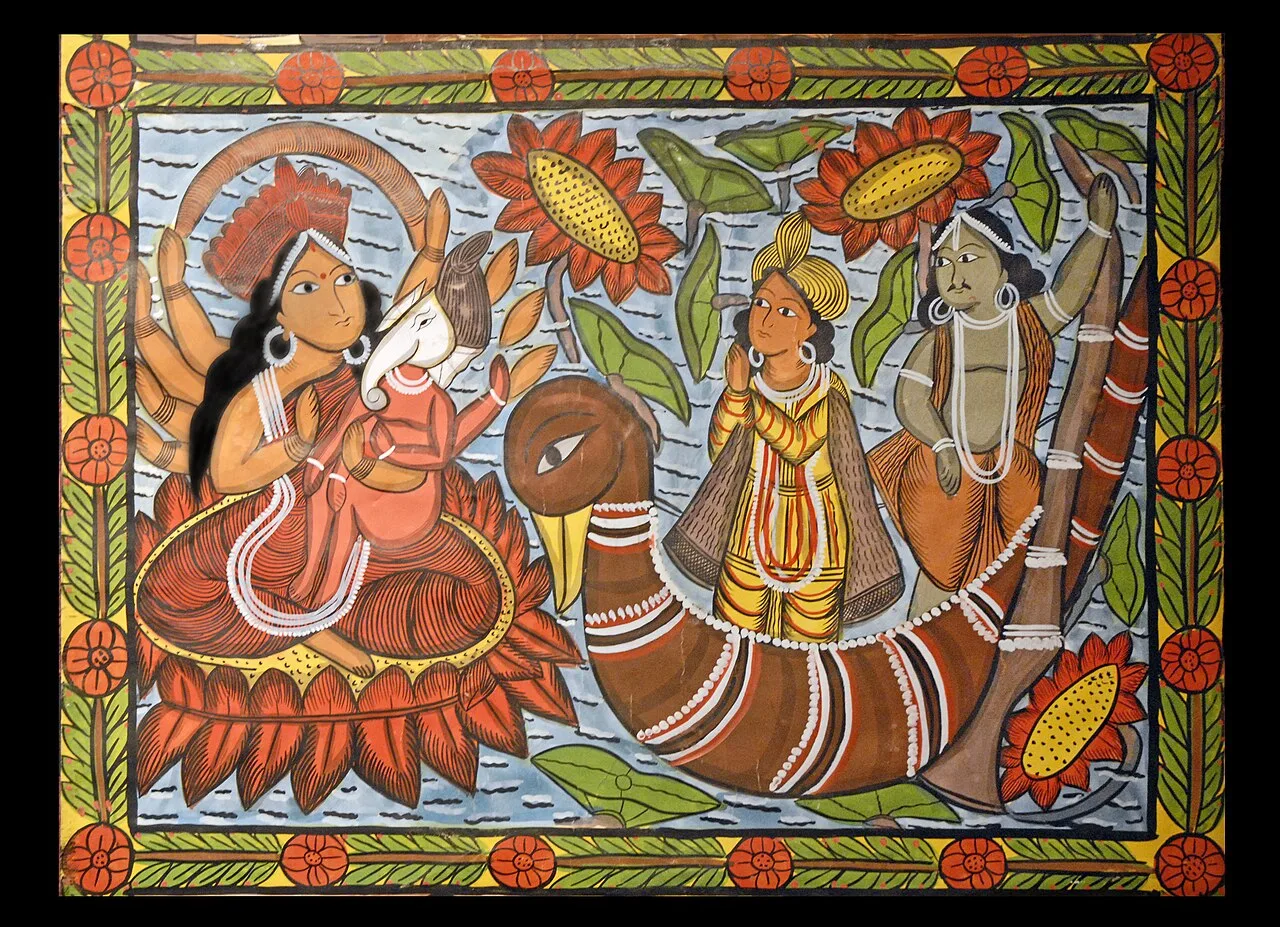
Naya (Pingla Patachitra Village)
Naya, in West Bengal’s Paschim Medinipur district, is known for Patua (Chitrakar) artists who paint story scrolls and sing their narratives; visitors also come for the yearly patachitra fair.
Key facts · verified by Ghumoopedia editors
- Type of place
- Community & living culture
- Best time to visit
- October to March for the plains and coast; March to May and October to December for the Darjeeling hills
- Verified
- 21 Nov 2026
Naya lies within Pingla block, in West Bengal’s Paschim Medinipur district. It is associated with families of Patua, or Chitrakar, artists. They create scroll paintings that tell stories, then sing the narratives represented in the images. The painting and performance are closely connected: the scroll provides a visual account, while song carries its story. Visitors come to the village to encounter this practice and attend its annual patachitra fair. Naya’s art is not limited to painted scenes; the artists also present the stories aloud. The yearly fair is devoted to patachitra, the scroll-painting tradition practised by the village’s Patua families. West Bengal stretches from the Himalayan tea gardens of Darjeeling to the mangrove delta of the Sundarbans, with Kolkata's colonial architecture, the terracotta temples of Bishnupur, Tagore's Santiniketan and the Nawabi heritage of Murshidabad. The plains are hot and humid from March to June, receive heavy monsoon rain from June to September and are pleasant from November to February; the Darjeeling hills are cool year-round and cold in winter, and the coast and Sundarbans can be hit by cyclones in May and October–November. The usual best time to visit is October to March for the plains and coast; March to May and October to December for the Darjeeling hills. For official information, see West Bengal Tourism at https://wbtourism.gov.in.
Why it matters
Naya is a village in the Pingla block of Paschim Medinipur district, known for its Patua (Chitrakar) artists. Its importance lies in a living tradition: artists paint stories on scrolls and perform them by singing as they unroll the pictures. The village offers a chance to encounter this work in the homes and small workshops where it is made, rather than only in a gallery or shop. Naya also hosts an annual patachitra fair, which brings makers and visitors together. The village itself is not known as an ASI-protected monument or a UNESCO World Heritage site. Ask sellers about any applicable craft certification; it should not be assumed that every item carries one.
Patachitra is a long-standing storytelling art associated with Patua communities in parts of Bengal. Traditionally, a Patua could paint a sequence of scenes on a scroll and sing its narrative while displaying it. Stories have drawn on religious epics and folk traditions, as well as social themes. The practice combines image-making with performance, and its subjects and audiences have changed over time. Naya is now a recognised centre of this living craft, with Patua (Chitrakar) families making and performing scrolls in the village. The available information does not establish a precise founding date for Naya’s artisan settlement, nor a single builder or institution responsible for its development. As interest in the craft has grown, visitors, fairs, cooperative activity and direct sales have become part of some artists’ livelihoods alongside making and performing. Artists may also adapt themes, formats and products for new audiences. These changes do not mean the tradition is identical in every household: materials, subjects and working methods can vary. Naya’s history is therefore best encountered through the makers themselves, while respecting that each family has its own practice and story.
Origin stories & folklore
The village’s best-known stories are those artists paint and sing, rather than a fixed origin tale about the settlement. Patua scroll narratives may draw on religious epics, folk beliefs and events in contemporary life; the subjects differ between artists and works. A visitor may hear a story performed while a scroll is unrolled, but should not assume that every version is the same or that a performance represents a community-wide belief. Ask the artist about the particular work and how they wish its story to be understood.
The heart of a visit to Naya is meeting the artisans at work. Ask to see each stage of the work, from raw material to finishing; most families work at home or in small courtyard workshops, and a single piece can take hours or days. Many households and cooperative societies welcome visitors who show genuine interest, but this is a working village, not a museum: ask before entering a home or workshop, keep visits short during busy hours, and accept that some families may be away at fairs or markets. Buying directly from the maker or a registered cooperative is the best way to support the craft. Where a product carries a Geographical Indication (GI) tag or a handloom mark, ask for it; prices for handmade work reflect the time and skill involved, so bargain gently, if at all. Some workshops offer short hands-on sessions — ask locally rather than expecting a fixed schedule.
Suggested itineraries
Half day: Arrive and orient yourself in the village; spend time with an artist who has agreed to host visitors; see stages of scroll-making or hear a story performance if offered; browse work for sale. Full day: Begin with an unhurried village walk; visit one or more workshops by invitation; take a break for a local meal; meet another maker or cooperative if available; finish with a performance or shopping visit, depending on the day. Gentler option: Arrange one nearby workshop visit, stay seated while speaking with the artist or viewing work, and limit walking between stops.
Naya’s cultural life centres on patachitra: painting narrative scenes on scrolls and singing the accompanying story as the images are revealed. Patua artists may work at home or in small courtyard workshops, and visitors may be able to see parts of the process when invited. Subjects range from familiar epic and folk narratives to contemporary themes. Bengali is widely used in the region; artists may also communicate with visitors in other languages, depending on the household. Customs vary, so ask before entering a home, observing a work session or beginning a conversation during busy work. The annual village fair adds a public setting for the craft.
Local communities
Patua (Chitrakar) families are central to Naya’s identity and livelihoods. Residents make scroll paintings and related works, perform songs, teach or demonstrate aspects of the craft, and sell directly or through cooperative and fair settings. Some households may combine craft work with other sources of income; livelihoods and working arrangements are not the same for everyone. The village is also a lived-in community, not solely a visitor attraction. Meet artists as individuals, ask before visiting private workspaces and avoid treating any one person as a spokesperson for all families. Buying directly, without pressuring makers to lower handmade prices, can support their work.
Festivals & events
Naya hosts an annual patachitra fair, commonly known as Pot Maya. It is generally associated with the cooler-season cultural calendar, often around November, but the programme and dates can vary; confirm locally before planning around it. The fair can bring more visitors, activity and sales to the village than an ordinary day, and some artists may be busy with performances or stalls. Durga Puja is widely observed across West Bengal in autumn, though local arrangements vary. For a quieter visit to meet artists, avoid assuming that every household will be available during a fair or festival; ask locally and be flexible.
Village food in West Bengal is home cooking: macher jhol (fish curry), shorshe ilish (hilsa in mustard), kosha mangsho, luchi with alur dom, kathi rolls and phuchka in Kolkata, mishti doi, rosogolla and sandesh; in the Darjeeling hills, momos, thukpa, shaphaley and first-flush Darjeeling tea. Naya itself may have only tea stalls and small eateries, so ask your host or guide where to eat, or arrange a home-cooked meal in advance — it is often the highlight of a village visit. Carry water and a snack if you plan to spend the whole day, and eat your main meal in the nearest town if no local option is open.
Shopping & local experiences
Look for handmade narrative scrolls, smaller painted panels and other works made by Patua artists. Buying directly from the maker or a registered cooperative is a practical way to support the craft; ask about the artist, materials and care of the piece. Handmade work takes time, so bargain gently, if at all. If a seller says an item carries a Geographical Indication or other mark, ask to see the relevant label or documentation rather than assuming all work is certified. Some artists may offer demonstrations or short hands-on sessions, but availability varies. Ask locally about simple food or tea nearby.
Naya is a rural village in the plains of Paschim Medinipur, rather than a designated nature reserve or wildlife-viewing destination. The surrounding landscape is shaped by settlement and agriculture, with open fields and village greenery that change in appearance with the seasons. Small water bodies may be encountered in the wider rural area, but visitors should not assume that a particular pond or wetland is open or suitable for access. Common village birds may be seen, though sightings vary and are not guaranteed. The monsoon brings heavy rain to the region, while the hotter months can make outdoor walking uncomfortable. Stay on public paths and avoid entering fields or water edges without permission.
October to March for the plains and coast; March to May and October to December for the Darjeeling hills
These figures are calculated from map coordinates — actual road distance is longer. Howrah, Sealdah and Kolkata stations and Kolkata airport serve the south; New Jalpaiguri station and Bagdogra airport near Siliguri are the gateways to the Darjeeling hills and the Dooars. Naya is a village, so the last stretch is by road: West Bengal Transport Corporation, North Bengal State Transport and South Bengal State Transport buses, private buses and shared jeeps in the hills reach the nearest town, and from there a shared auto, local bus or reserved taxi covers the final few kilometres. Village roads can be narrow and unpaved; a taxi hired for the day from the nearest town is the simplest way to combine Naya with nearby sights and get back before dark. When comparing train, bus and flight, count the complete door-to-door time: a flight saves the most time only if the onward road transfer is short, while an overnight train can save a hotel night. Book your return before you leave, because seats fill quickly on weekends, festivals and holidays. Current train numbers, timings, return services and fares are not listed here; check IRCTC and NTES for trains and the airline's own schedule for flights. No permit is needed for Indian citizens to visit West Bengal. Entry to the Sundarbans Tiger Reserve needs a forest permit, usually arranged through a registered boat operator or the forest office at Sajnekhali or Canning; trekking in Singalila National Park (Sandakphu) needs an entry permit and a registered guide from Maneybhanjan. Durga Puja in October brings huge crowds to Kolkata, so book transport and stays well ahead.
Getting around
On arrival in the area, local autos, shared vehicles or a reserved taxi may be options for reaching Naya, depending on where you start and what is operating that day. Confirm the last stretch with local residents or your accommodation, as services and road conditions can vary. There is no need to expect a regular visitor shuttle within the village. Walking between accessible public areas and invited workshops is often the practical way to explore, but village lanes may be narrow. Ask before parking near homes or workshop entrances, and arrange a return ride in advance if local transport is limited.
Hours, tickets & permissions
Naya is a working village rather than a ticketed attraction with one assured entry schedule. There may be no formal gate or standard admission process for walking through public areas, but homes and workshops are private spaces and require the residents’ permission. Fairs, cooperative spaces and individual workshops may have their own arrangements. Camera rules, any entry requirements and the availability of demonstrations can differ by household or event. Confirm current access, hours and any fees with the relevant organiser or artist before visiting; do not assume that a workshop will be open simply because you have arrived in the village.
Facilities
Naya is a village, so visitor facilities may be modest and dispersed rather than grouped at a visitor centre. Toilets, drinking water and food options should be checked locally; do not assume every workshop has facilities for guests. Tea or a simple meal may be available nearby, but availability can vary. Parking, if needed, is informal and should not obstruct residents or narrow lanes. Guides are not guaranteed, though an artist or local contact may help arrange a visit. ATMs and broader services are more likely to be found in larger nearby towns; carry essentials and confirm arrangements before setting out.
Accessibility
Expect village lanes and workshop approaches that may be uneven, narrow or unpaved, with conditions affected by rain. Walking distances between homes can vary, and shade or places to sit are not guaranteed. A wheelchair or stroller may be difficult to manoeuvre on some paths and inside small domestic workshops; ramps and accessible toilets should not be assumed. Older visitors or anyone with limited mobility may find a pre-arranged visit to one accessible workshop more comfortable than a broad village walk. Ask the host about the route, seating and step-free access before travelling, and allow time to move at an easy pace.
No permit is needed for Indian citizens to visit West Bengal. Entry to the Sundarbans Tiger Reserve needs a forest permit, usually arranged through a registered boat operator or the forest office at Sajnekhali or Canning; trekking in Singalila National Park (Sandakphu) needs an entry permit and a registered guide from Maneybhanjan. Durga Puja in October brings huge crowds to Kolkata, so book transport and stays well ahead. Carry a photo ID, some cash (card and UPI acceptance varies in villages) and a charged phone with offline maps; save the emergency number 112 and your host's contact. Heat in summer and heavy rain in the monsoon are the main weather risks; carry water, avoid midday sun and allow extra time when village roads flood. Respect local customs: dress modestly, remove footwear where asked, and always ask before photographing people, homes or rituals.
Visitor rules
Treat Naya as a residential and working village. Ask permission before entering homes, courtyards or workshops, and follow the host’s directions about where to stand and what may be handled. Dress comfortably and respectfully for a village visit; practical footwear is useful on uneven lanes. Do not touch unfinished work, tools or materials without invitation, and avoid interrupting artists during busy periods. Carry rubbish out and avoid single-use plastic where possible. Keep noise low, do not block lanes or doorways, and respect any areas a household asks visitors not to enter.
Photography
Soft morning or late-afternoon light can suit village scenes and painted scrolls, but the best conditions depend on weather and where an artist is working. Ask before photographing people, homes, workshops, performances or artwork, and check whether an image may be shared online. Some artists may prefer that visitors do not photograph particular stages or works. Avoid flash if it could disturb a performance or distract a maker. Drone use can raise privacy, safety and regulatory concerns in a residential area; do not fly one without the required permissions and the community’s consent.
Most visitors see Naya on a day trip from the nearest town, which has the widest choice of hotels. A few villages have homestays or heritage stays; otherwise base yourself in the district town and hire a taxi for the day. Confirm the booking and the exact location before you travel, because village addresses can be hard to find.
Midnapore and Kharagpur are useful larger towns in Paschim Medinipur for transport connections and broader services; they can be considered as separate stops rather than assumed to be an easy walk from Naya. Kurumbera Fort, at Gaganeswar in the district, is a notable historic site that can be combined with a wider regional journey if road arrangements suit. Distances and travel times depend on the route and starting point, so check a current map and local transport before planning. Naya itself is the main reason to visit this area for patachitra, and a visit should leave time for an unhurried encounter with its artists.
For couples, Naya is a chance to slow down: spend an unhurried morning with the makers, choose a piece together directly from the family that made it, share a home-cooked meal and keep the afternoon free. Stay in a nearby homestay or heritage property to make it a quiet overnight escape.
Q: How much time should I allow for Naya? A: A half day can allow for one workshop visit and browsing; a full day gives more time to meet artists without rushing. Q: When is a good season to visit? A: The cooler months are generally more comfortable in the plains. The annual fair is often held around November, but confirm its schedule locally. Q: Is there an entry ticket, and can I visit a workshop? A: Village access may not involve a formal ticket, but workshops are private spaces. Ask permission and confirm any event or workshop arrangements before visiting. Q: Is Naya suitable for children and older visitors? A: It can be a rewarding visit, but lanes and workshop entrances may be uneven. Arrange a short visit and suitable seating in advance if needed. Q: Can I stay in Naya? A: Do not assume accommodation is available in the village. Check locally for homestays and consider staying in a larger nearby town if none can be confirmed.
Be the first to share photos, stories, advice or a helpful contact for Naya (Pingla Patachitra Village).
Loading…