
Samode
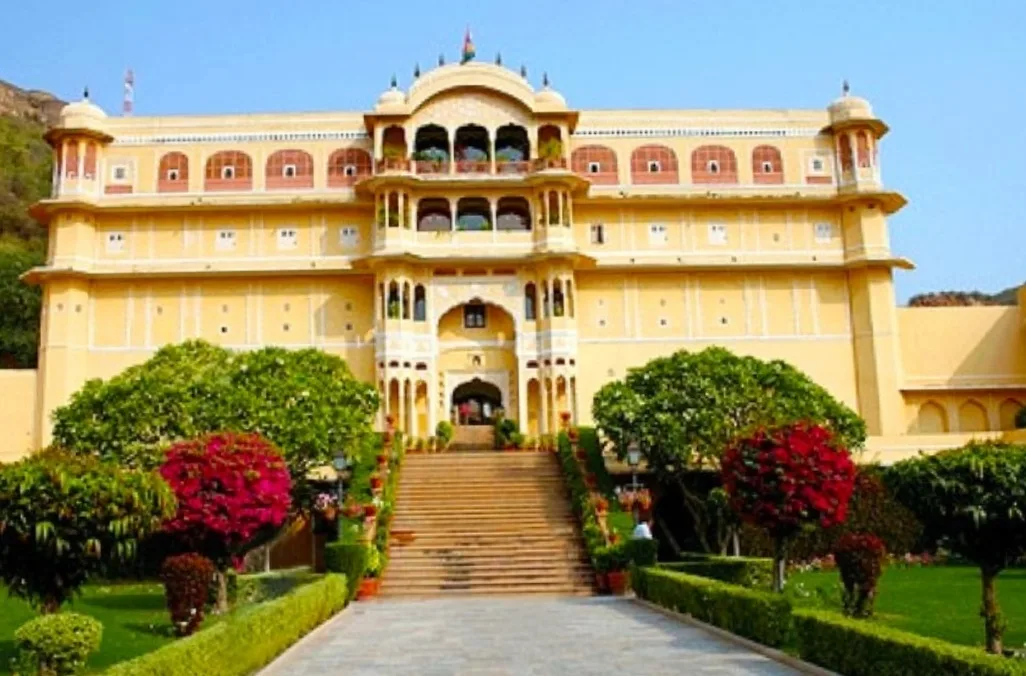
Samode is a village in Rajasthan’s Aravalli hills, north-west of Jaipur. Visitors come for its palace, haveli and garden, historic properties now operated as heritage hotels.
Key facts · verified by Ghumoopedia editors
- Type of place
- Heritage monument
- Best time to visit
- October to March
- Nearest railway station
- Jaipur Junction · about 30 km (straight line)
- Nearest airport
- Jaipur International Airport · about 40 km (straight line)
- Verified
- 21 Nov 2026
Plan a trip from Samode — a day-by-day route through places nearby.
Samode is a settlement in Jaipur district, in Rajasthan’s Aravalli range to the north-west of Jaipur. Its best-known landmarks are Samode Palace, Samode Haveli and Samode Bagh, a garden. These buildings, dating back several centuries, were created by a noble family holding the inherited rank of Maha Rawal or Maha Saheb under the Amber and Jaipur principality. Their design brings together Mughal and Rajasthani artistic and architectural traditions. The three properties now operate as heritage hotels under the Samode name, managed by their hereditary owners. Samode Palace stands 40 kilometres north of Jaipur; Samode Haveli is within Jaipur’s central city area, around 6 kilometres from the railway station. Samode Bagh lies 4 kilometres from the palace and is also operated as a luxury hotel. Samode Haveli is the one of these three properties located within Jaipur city. The palace’s interiors and grounds have served as settings for Hindi feature films. In 1984, its precincts provided filming locations for an American HBO television serial based on the Raj-romance novel The Far Pavilions. The production featured Ben Cross, Amy Irving, Omar Sharif and Christopher Lee. Rajasthan is the land of Rajput forts and palaces, painted havelis, desert folk music, puppetry and colourful fairs such as the Pushkar camel fair. Rajasthan is very hot from April to June — often above 45 °C in the desert — with a short monsoon in July–September. Winter days are pleasant and nights are cold, especially in the Thar Desert. Mount Abu is the state's only hill station and stays cooler. The usual best time to visit is October to March. For official information, see Rajasthan Tourism at https://www.tourism.rajasthan.gov.in.
Why it matters
Samode is a village in Jaipur district, north-west of Jaipur, best known for the Samode Palace and its associated heritage properties. The palace, Samode Haveli and Samode Bagh are linked to the hereditary noble family whose title is described as Maha Rawal or Maha Saheb under the Amber and Jaipur principality. Together, the properties illustrate the region’s courtly and domestic heritage and a blend of Mughal and Rajasthani design. The palace is also known as a film location, including for the 1984 television adaptation of The Far Pavilions. The available guide does not identify these properties as UNESCO-listed or ASI-protected; visitors should check official records rather than assume a designation.
Samode’s heritage is associated with a noble feudatory family holding the hereditary title of Maha Rawal or Maha Saheb in the Amber and Jaipur principality. The Palace, Haveli and Bagh are described as having histories extending over several hundred years, but a precise founding date is not established in the available account. Their development reflects the family’s standing and the changing needs of its residence and estate. As with many long-used residences, the buildings and decorative schemes were shaped over time rather than necessarily completed in a single campaign. In the modern period, the three properties became part of the Samode heritage-hotel group, operated by the hereditary owners; hotel use has brought continued attention to their conservation, while access to individual areas can depend on current management arrangements. The Palace’s interiors and grounds have also served as film settings. Hindi feature films have been shot there, and the 1984 American HBO television adaptation of The Far Pavilions, starring Ben Cross, Amy Irving, Omar Sharif and Christopher Lee, filmed in the palace precincts. For specific construction phases, restorations or family history, seek information from the owners or a reliable local guide.
Origin stories & folklore
No single, well-documented origin legend for Samode Palace is established in the available guide. Local accounts may connect the palace and its surrounding estate with the fortunes, service and status of the family that held the title of Maha Rawal or Maha Saheb. Such stories are best understood as family or village tradition, not as independently verified dates or events. Visitors may hear anecdotes about particular rooms, patrons or former residents from guides and hosts; versions can differ, so it is worth asking who told the story and whether it is recorded history or oral memory. The village’s older houses and places of worship may also have their own local associations, which are best discussed respectfully with residents.
Architecture & design
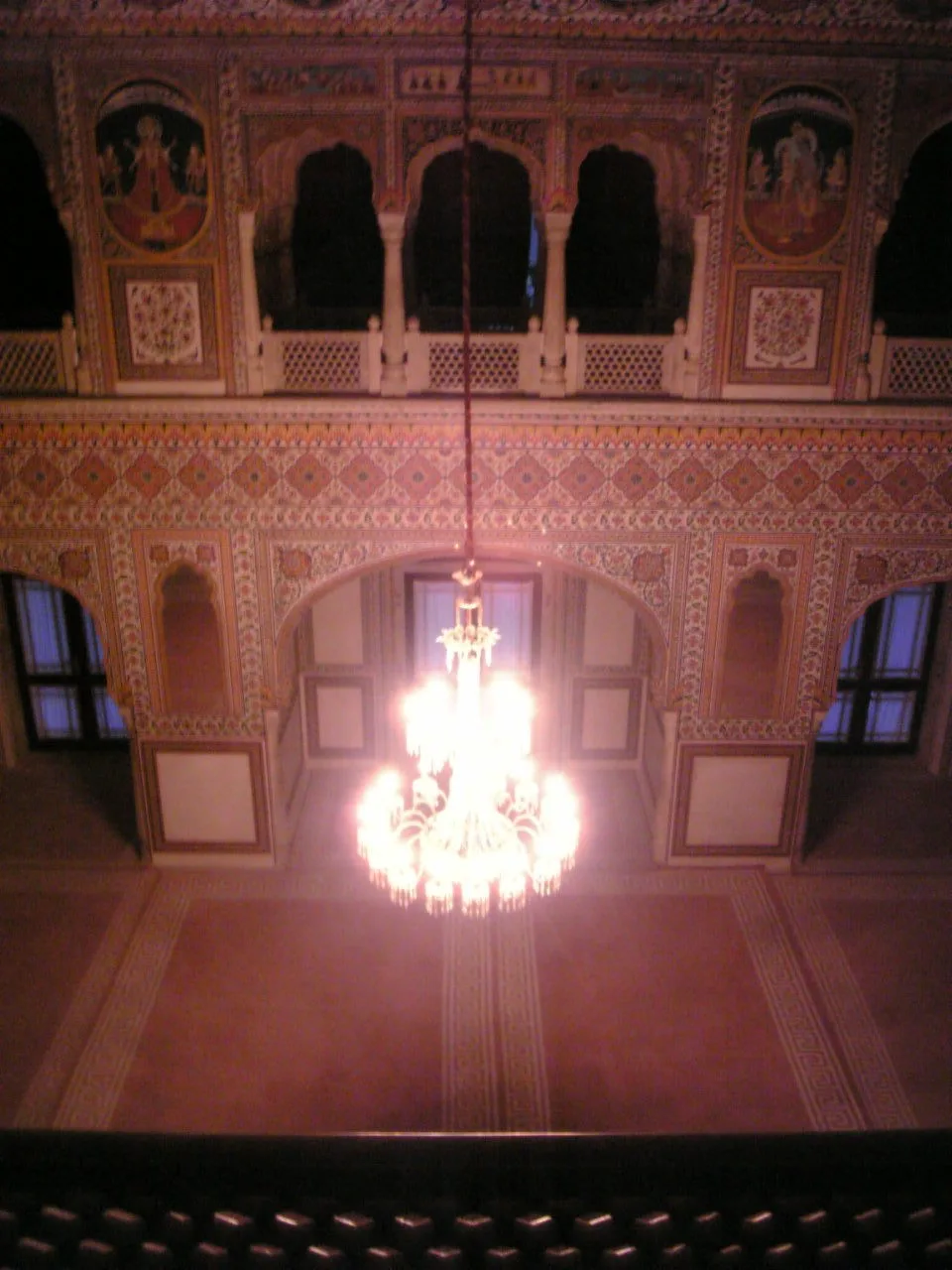
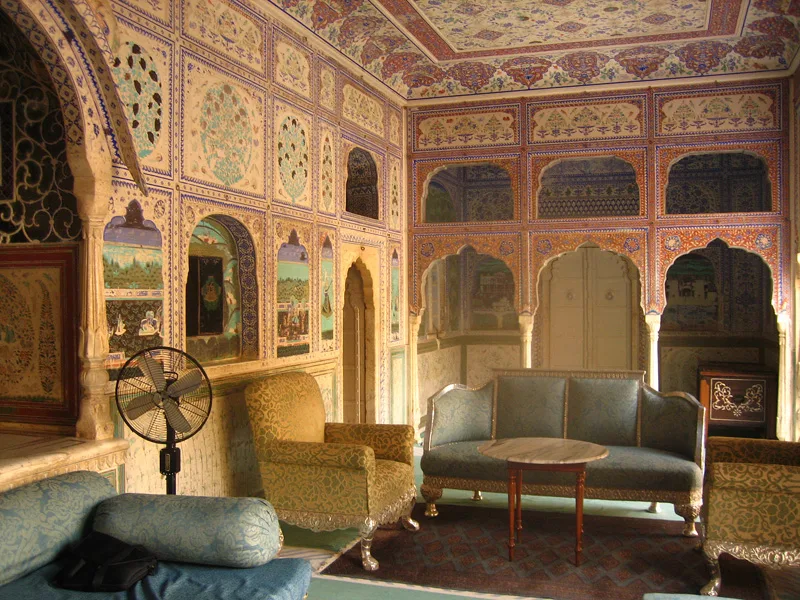
Samode’s heritage properties bring together Rajasthani forms and Mughal-influenced decoration. The Palace is a substantial historic residence set within a village landscape; the Haveli is a separate property within Jaipur city, while the Bagh is a garden property near the Palace. The Palace is noted for richly decorated interiors, including painted surfaces and mirror work, and for courtyards and rooms arranged around the needs of a noble household. Arched openings, balconies and screened windows are characteristic features to look for where present, but access to particular areas may be restricted. The architecture uses traditional masonry and plastered, ornamented surfaces; visitors should avoid touching fragile finishes. The garden setting at Samode Bagh offers a contrast to the more enclosed palace spaces. The complex grew over generations, so details and arrangements can vary between buildings rather than follow a single uniform plan.
Important objects & sculptures
Look for the Palace’s painted decoration and mirror-work interiors, which are among its best-known features. Depending on which areas are open, visitors may also notice ornamental doorways, carved details, balconies, patterned surfaces and the way decorative work frames rooms and views. These are architectural features rather than necessarily movable museum objects, and some may be behind barriers or in guest-only spaces. The available guide does not identify a particular sculpture collection, inscription or set of idols as a principal attraction. Do not touch mirrors, paintings, carvings or other finishes, and ask before photographing objects in private or religious spaces. A local guide or the property’s staff may be able to explain the meaning and period of individual details without relying on guesswork.
Walk through Samode slowly to take in its old houses, streets and places of worship, ideally with a local guide or host who can explain the village's history and families. Many heritage houses are private homes — admire them from outside unless you are invited in or the house is open to visitors — and ask before photographing people. Look out for local food, crafts and festivals that are part of the village's living heritage, and combine your visit with nearby temples, forts or towns in Jaipur district.
Suggested itineraries
Half day: Arrive by road; spend about 1–2 hours exploring Samode village with a local host; visit the Palace if access is available; allow time for a meal or tea. Full day: Travel from Jaipur; explore the village and Palace in the morning; pause for lunch; visit Samode Bagh if open to visitors; return by road, allowing extra time for local stops. Gentler option: Arrange a vehicle close to the places you are visiting, limit walking to one accessible area at a time, and take seated breaks; confirm access and steps with the property beforehand.
Samode is a living village as well as a heritage destination. Its streets, homes and places of worship are part of everyday community life, not simply a visitor attraction. Rajasthani languages and Hindi are used in the region; the language spoken by a particular household may vary. Local food, crafts, family histories and religious customs offer context for the built heritage, though experiences depend on what residents choose to share. Walk with a local guide or host where possible, dress respectfully near places of worship, and ask permission before photographing people or entering private courtyards. Music, dance and traditional dress are part of wider Rajasthani culture, but performances should not be assumed to take place in the village on an ordinary visit.
Festivals & events
Rajasthan’s major festivals, including Diwali and Holi, are observed across the region, while local religious occasions may be marked by village communities. The exact programme in Samode can vary from year to year, and visitors should not assume that a public performance or fair is scheduled. Jaipur’s larger cultural events and fairs may offer additional experiences when travelling through the district, but they can bring heavier traffic and accommodation demand in the city. Ask locally about village events before planning around one, and observe worship or community celebrations from an appropriate distance. During busy festival periods, allow extra time for road travel and be considerate of residents’ privacy.
Village food in Rajasthan is home cooking: dal baati churma, gatte ki sabzi, ker sangri, laal maas, pyaaz kachori, mirchi vada, ghewar, mawa kachori and chaach (spiced buttermilk). Samode itself may have only tea stalls and small eateries, so ask your host or guide where to eat, or arrange a home-cooked meal in advance — it is often the highlight of a village visit. Carry water and a snack if you plan to spend the whole day, and eat your main meal in the nearest town if no local option is open.
Shopping & local experiences
A visit is an opportunity to look for locally made crafts, textiles, embroidered goods and small Rajasthani souvenirs, but availability in Samode itself may be limited. Jaipur has a broader choice of craft and textile markets if shopping is a priority. Ask sellers about the origin and materials of handmade items, and avoid assuming that a product is made locally simply because it is sold in a heritage setting. Try regional food at an open local eatery or hotel dining space where access is permitted. Seek permission before entering workshops or photographing artisans, and buy directly from makers when possible.
October to March
The nearest principal railway station by straight-line distance is Jaipur Junction, roughly 30 km away. The nearest operating airport by straight-line distance is Jaipur International Airport, roughly 40 km away. These figures are calculated from map coordinates — actual road distance is longer. Jaipur, Ajmer, Jodhpur, Udaipur and Kota are the main rail hubs, and Jaipur, Udaipur and Jodhpur have the most flights; Delhi is the usual gateway for the north-east of the state. Samode is a village, so the last stretch is by road: Rajasthan State Road Transport Corporation (RSRTC) buses and private coaches reach the nearest town, and from there a shared auto, local bus or reserved taxi covers the final few kilometres. Village roads can be narrow and unpaved; a taxi hired for the day from the nearest town is the simplest way to combine Samode with nearby sights and get back before dark. When comparing train, bus and flight, count the complete door-to-door time: a flight saves the most time only if the onward road transfer is short, while an overnight train can save a hotel night. Book your return before you leave, because seats fill quickly on weekends, festivals and holidays. Current train numbers, timings, return services and fares are not listed here; check IRCTC and NTES for trains and the airline's own schedule for flights. No permit is needed to visit Rajasthan. Land close to the international border west of Jaisalmer and Barmer is restricted beyond certain points: places such as Tanot can be visited, but border outposts need Border Security Force permission. Forts and palaces charge entry and camera fees, and tiger-reserve safaris must be booked through the official forest department portal.
Confirm onward and return timings on IRCTC / NTES, the state bus operator or your airline before travel. A dash means current timings or fares have not been verified.
Getting around
Samode is best explored on foot once you reach the village, though uneven lanes and the distance between points may make a vehicle useful. Local buses or coaches may serve the nearest town, with a taxi, shared auto or other local connection needed for the final stretch; confirm availability locally. A reserved taxi from Jaipur is a practical option, especially if combining the Palace with nearby stops. Village roads can be narrow, and parking may be limited near older lanes, so ask the driver where to stop. Autos and taxis are more readily arranged in larger towns than within the village itself.
Hours, tickets & permissions
Samode village streets are public spaces, but the Palace, Haveli and Bagh are managed heritage properties and parts may be accessible only to hotel guests or by arrangement. Entry rules can differ between properties and may change with private events or hotel operations. Tickets, advance permission, identity checks, camera restrictions or limits on access to guest areas may apply; confirm these directly with the managing authority before setting out. Check current opening arrangements and any applicable fees locally. Do not enter private homes or hotel-only spaces without permission.
Facilities
Facilities depend on whether you are visiting the village, the Palace or another managed property. The heritage hotels may provide dining, restrooms and guest services, but these should not be assumed available to day visitors; check access in advance. In the village, food and drinking water options may be limited or vary by day, so carry water and plan meals ahead. Parking, public toilets, ATMs and formal guiding services are not guaranteed at every site. Jaipur offers a wider range of services. Ask locally about a guide and confirm facilities before travelling, particularly for visitors needing accessible toilets or a place to rest.
Accessibility
Samode’s older lanes and heritage buildings may have uneven, narrow or unpaved surfaces, steps and thresholds. Palace interiors can include stairs, and access between floors or courtyards may be difficult for wheelchair users and people with limited mobility. Wheelchair and stroller access should not be assumed; confirm the route, entrances and available assistance with the managing property before visiting. Walking distances depend on which village sites are open and how they are reached. Shade and seating may be intermittent outdoors, so plan breaks and carry water, especially in warm weather. Older visitors may find a vehicle drop-off and a shorter, guided visit more comfortable.
No permit is needed to visit Rajasthan. Land close to the international border west of Jaisalmer and Barmer is restricted beyond certain points: places such as Tanot can be visited, but border outposts need Border Security Force permission. Forts and palaces charge entry and camera fees, and tiger-reserve safaris must be booked through the official forest department portal. Carry a photo ID, some cash (card and UPI acceptance varies in villages) and a charged phone with offline maps; save the emergency number 112 and your host's contact. Heat in summer and heavy rain in the monsoon are the main weather risks; carry water, avoid midday sun and allow extra time when village roads flood. Respect local customs: dress modestly, remove footwear where asked, and always ask before photographing people, homes or rituals.
Photography
Soft morning or late-afternoon light can bring out the village’s façades and the Palace’s exterior details; interior lighting and access vary. Ask the property or site staff before photographing inside, as hotel operations, private areas or displayed objects may have restrictions. Avoid photographing residents, worshippers or ceremonies without permission, and never treat private homes as public subjects. Drone use may be restricted by aviation rules, property policy or local security requirements; obtain all necessary permissions and do not fly over people or buildings without approval. Be mindful of other visitors and fragile surfaces when framing photographs.
Most visitors see Samode on a day trip from the nearest town, which has the widest choice of hotels. A few villages have homestays or heritage stays; otherwise base yourself in the district town and hire a taxi for the day. Confirm the booking and the exact location before you travel, because village addresses can be hard to find.
Within the Samode area, the Palace, village and Samode Bagh are the principal related heritage stops, though access arrangements differ. Samode Haveli is another property in Jaipur city and should not be confused with the village Palace. Jaipur offers major heritage attractions including Amber Fort, Jaigarh Fort, Nahargarh Fort and the historic walled city. These can be combined with Samode as a longer trip, but road time and traffic should be considered. Ask locally about nearby temples or other village sites before adding them to a route, as access and visitor facilities may not be formalised.
For couples, Samode is a chance to slow down: walk the lanes in the soft morning light, share a home-cooked meal and keep the afternoon free. Stay in a nearby homestay or heritage property to make it a quiet overnight escape.
Q: How much time should I allow for Samode? A: Allow at least half a day for the village and a visit to the Palace if entry is available; a full day gives more time for the garden property and travel. Q: When is the best season to visit? A: October to March is generally the most comfortable period in Rajasthan. Summer can be very hot, so plan carefully and check local conditions. Q: Can I enter Samode Palace as a day visitor? A: Access depends on current hotel and property arrangements. Confirm entry rules and any fees with the managing authority before travelling. Q: Is Samode suitable for children and elderly visitors? A: It can be, but uneven lanes, steps and heat may be challenging. Keep the visit flexible, take breaks and check accessibility in advance. Q: Can I stay near Samode? A: The Samode heritage properties include hotel accommodation, subject to availability and booking conditions. Jaipur also offers a wide range of places to stay.
Be the first to share photos, stories, advice or a helpful contact for Samode.
Loading…