
Bodhi tree
The Bodhi tree is a sacred fig at the Mahabodhi Temple in Bodh Gaya, Bihar. Buddhists visit this revered site because tradition links it to the Buddha’s enlightenment.
Key facts · verified by Ghumoopedia editors
- Type of place
- Heritage monument
- Best time to visit
- October to March
- Nearest railway station
- Gaya Junction · about 10 km (straight line)
- Nearest airport
- Gaya Airport · about 5 km (straight line)
- Verified
- 21 Nov 2026
Plan a trip from Bodhi tree — a day-by-day route through places nearby.
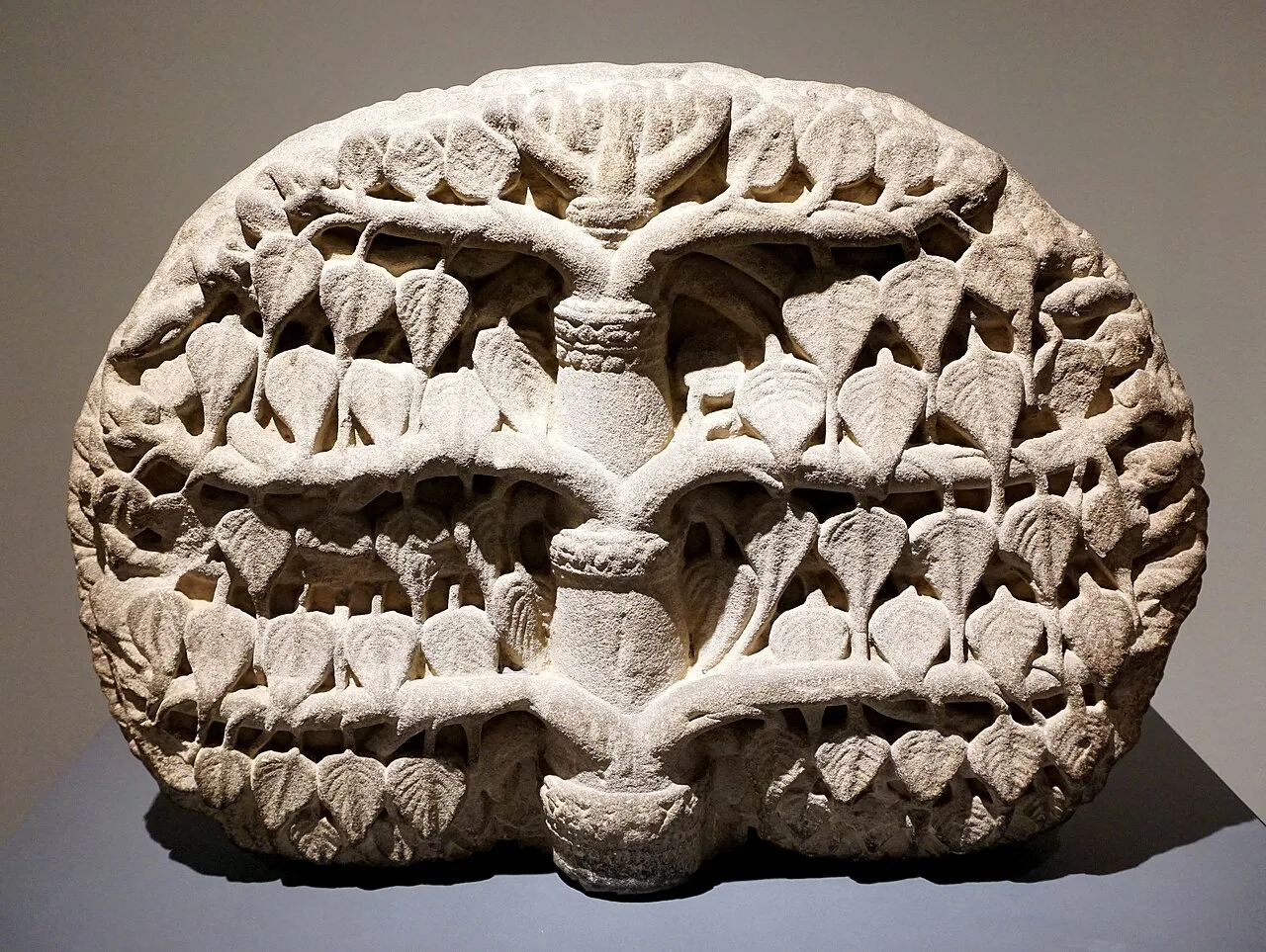
At the Mahabodhi Temple in Bodh Gaya, Bihar, stands the tree known as the Bodhi tree. It is a sacred fig (Ficus religiosa) within a complex recognised as a UNESCO World Heritage Site. Buddhist tradition identifies this location as the place beneath a Bo tree where Siddhartha Gautama attained enlightenment, or Buddhahood, around the fifth century BCE. It remains an important focus of Buddhist devotion and pilgrimage. Buddhist art often shows the tree with the heart-shaped leaves of Ficus religiosa, which have come to represent wisdom and awakening. The original tree is gone, but later generations descended from it have been revered for more than two millennia. The lineage has faced repeated loss and renewal. Accounts record its felling during Emperor Aśoka’s rule (c. 268–232 BCE), followed by its destruction by Queen Tissarakkhā around 254 BCE. It was damaged or destroyed during the persecution of Buddhism under King Puṣyamitra Śuṅga in the second century BCE. Around 600 CE, King Śaśāṅka of Gauda cut it down. After each episode, surviving saplings were used to establish a new tree. In 288 BCE, Emperor Aśoka sent a sapling descended from the original tree to Sri Lanka with his daughter, Sanghamittā Therī. Planted at Anuradhapura, it survives as Jaya Sri Maha Bodhi and is regarded as the oldest living tree planted by people with a known date. The present tree at Bodh Gaya was planted in 1881 by British archaeologist Alexander Cunningham, using a cutting from the Sri Lankan tree. It remains one of Buddhism’s most revered pilgrimage places. Bihar is the heart of ancient Magadha — the land of the Buddha's enlightenment, the Mahavihara of Nalanda, the Mauryan capital Pataliputra, Jain tirthankara Mahavira and the Maithili and Bhojpuri cultures. Bihar has very hot summers from April to June, a monsoon from June to September that can flood low-lying areas, and cool, pleasant winters from November to February with foggy mornings in December and January. The usual best time to visit is October to March. Timings, fees and access arrangements must be confirmed locally. For official information, see Bihar Tourism at https://tourism.bihar.gov.in.
Why it matters
The Bodhi tree at Bodh Gaya is revered in Buddhist tradition as the tree beneath which Siddhartha Gautama attained enlightenment and became the Buddha. It is a living focus of pilgrimage, prayer and reflection for Buddhists from India and across the world. The tree stands within the Mahabodhi Temple complex, in Gaya district, Bihar. UNESCO inscribed the Mahabodhi Temple Complex at Bodh Gaya on the World Heritage List in 2002; the recognition applies to the complex, not to the tree as a separate property. The tree is a sacred fig (Ficus religiosa), whose heart-shaped leaves are widely used in Buddhist art as a symbol associated with wisdom and awakening. Its descendants connect the site with a long history of Buddhist devotion.
Buddhist tradition places the Buddha’s enlightenment beneath a Bo tree at this site, an event generally dated to around the 5th century BCE. The original tree has not survived. Accounts describe repeated destruction and replanting, although details and dates differ across historical and religious sources. The main source tradition records episodes associated with Emperor Aśoka, Queen Tissarakkhā, the Śuṅga period and King Śaśāṅka of Gauda. Saplings or surviving descendants were used to renew the tree after these losses. A sapling said to have come from the original tree was taken to Sri Lanka by Sanghamittā, Aśoka’s daughter, and planted at Anuradhapura; the tree there is known as Jaya Sri Maha Bodhi. In the late 19th century, British archaeologist Alexander Cunningham planted the present Bodh Gaya tree in 1881, using a cutting from the Sri Lankan tree. The Mahabodhi Temple complex also reflects many centuries of construction, repair and pilgrimage. Its restoration and archaeological study intensified under British administration, and the complex was later inscribed as a UNESCO World Heritage Site in 2002. The tree remains a living successor rather than the original specimen.
Origin stories & folklore
According to Buddhist tradition, Siddhartha Gautama sat in meditation beneath a Bo tree at Bodh Gaya and attained enlightenment there. The tree is consequently called the Bodhi, or “awakening,” tree. Buddhist belief treats its descendants as connected to that sacred event, even though the original tree no longer survives. A well-known lineage story tells that a sapling from the Bodh Gaya tree was carried to Sri Lanka by Sanghamittā, where it was planted at Anuradhapura; a later cutting from that tree was used to establish the present tree at Bodh Gaya. These accounts are central to the site’s religious meaning, but visitors should understand them as Buddhist tradition rather than a continuous botanical record verified in every detail.
Architecture & design
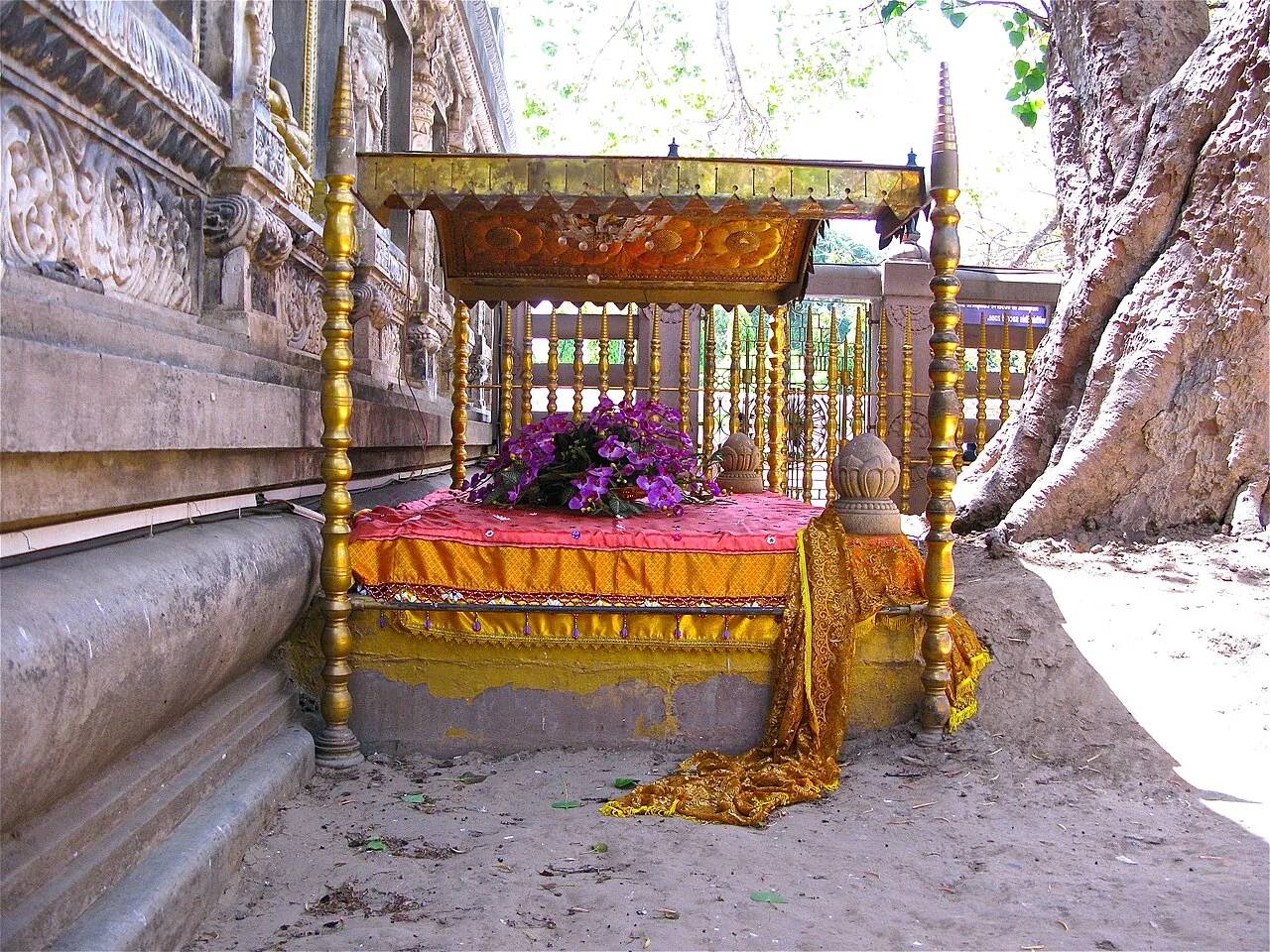
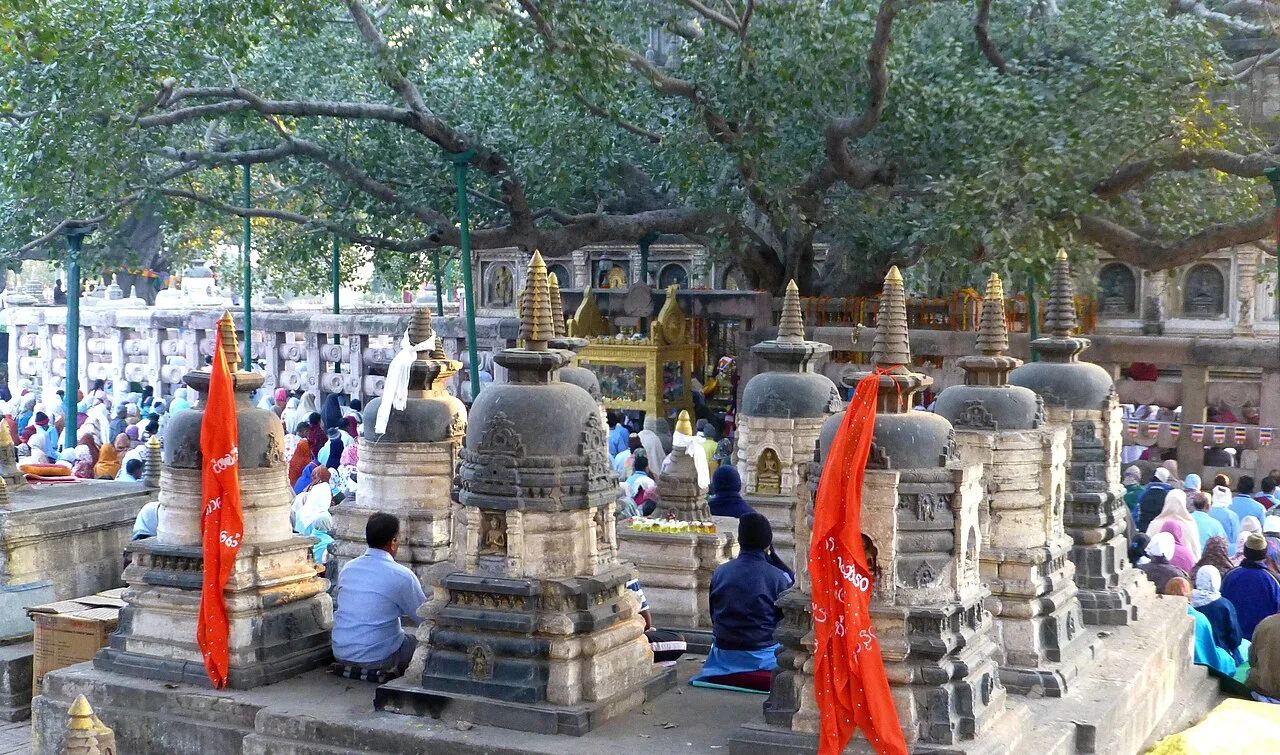
The Bodhi tree is a living landmark within the Mahabodhi Temple complex, rather than a freestanding architectural monument. It stands behind the principal temple, in a precinct arranged for worship, meditation and circumambulation. The complex’s dominant structure is the brick Mahabodhi Temple, whose tall, tapering profile rises above the surrounding shrines. Its surface includes niches and sculptural details, while smaller votive stupas and shrines occupy parts of the grounds. Near the tree is the Vajrasana, or Diamond Throne, a stone seat traditionally associated with the Buddha’s meditation. Stone railings around the sacred area include ancient sculptural traditions as well as later work and restorations. The layout brings the tree, throne and temple into a connected devotional setting; paths allow pilgrims to move around the sacred points, though circulation can become crowded. The complex has been modified and repaired over many centuries, so its present appearance combines historical fabric, restoration and active religious use. Visitors should follow barriers and signs rather than entering restricted areas.
Important objects & sculptures
Look for the Vajrasana, the stone seat traditionally identified as the Buddha’s place of meditation, near the Bodhi tree. The tree’s heart-shaped leaves are themselves a significant focus for pilgrims, who may pause, pray or make offerings nearby. Within the wider Mahabodhi Temple complex, visitors can see the central Buddha image in the main shrine, smaller devotional images, votive stupas and carved stone features. The railings and sculptural details reflect different periods of the site’s history; some elements have been repaired or reconstructed. Inscriptions and archaeological remains may be visible in the complex, but interpretation and access vary. Do not touch, collect or move leaves, offerings or fragments, and observe any restrictions around images and sacred objects.
Visit Bodhi tree with time to observe daily prayers and rituals respectfully. Follow the posted rules on footwear, photography, head covering and dress, and avoid interrupting worshippers. Ask caretakers which areas are open to visitors, and beware of unofficial 'guides' asking for donations. A comfortable itinerary is one main visit in the morning, a local meal at midday and a short nearby stop before an afternoon return. Use the district list on this site to find other places in Gaya, but check the route and its condition before combining stops. If a festival or fair is on — such as Chhath or the Sonepur fair — roads and stays can be busy, and the experience can be unforgettable. Leave no litter: many sites are protected by the communities around them.
Suggested itineraries
Half day: Mahabodhi Temple complex and Bodhi tree (2–3 hours), allowing quiet time for prayer and observation; pause for a local meal or tea nearby. Full day: Mahabodhi Temple complex and Bodhi tree (2–3 hours), lunch in Bodh Gaya, then visit Sujata Stupa and the Dungeshwari cave temples (allow several hours for travel and visits); check road conditions first. Gentler option: Use a taxi for drop-off near the temple, focus on the accessible parts of the complex with rest breaks, and skip additional sites if walking or crowds become tiring.
The Bodhi tree remains part of an active international pilgrimage landscape. Visitors may encounter Buddhist monks, nuns and lay pilgrims praying, chanting, meditating or walking clockwise around sacred points. Practices and forms of worship vary among Buddhist traditions and national communities; quiet observation is appropriate, and worshippers should not be interrupted for photographs. Hindi and Magahi are widely heard locally, alongside English and languages brought by pilgrims from across Asia and elsewhere. Modest clothing and respectful conduct are valued in the temple precinct. The tree is also important to local residents and guides, whose work is connected to the steady flow of visitors. This is a place of worship as well as heritage, so routines may change during ceremonies or crowded pilgrimage periods.
Festivals & events
Buddha Purnima, usually observed in April or May, is an important occasion at Bodh Gaya and can bring larger crowds, devotional gatherings and special ceremonies. Buddhist communities also hold prayer meetings and observances at different points in the year; dates and scale vary by tradition and local programme. Major international Buddhist events, including teachings or prayer gatherings, are held periodically rather than on a fixed annual schedule. Chhath, usually observed in the autumn, is a major festival across Bihar, though it is not specifically a Bodhi tree festival. During large religious events, expect busier roads, fuller accommodation and more activity around the temple; confirm event arrangements locally before planning.
Local food in Bihar includes litti chokha, sattu paratha, khaja (a layered sweet from Silao), tilkut and anarsa from Gaya, makhana (fox nuts) from the Mithila region, chana ghugni, malpua and thekua. Ask what is fresh that day; many small eateries cook a limited daily menu. Vegetarian travellers eat very well across this region, and most towns also have non-vegetarian options. Remote sites may have no restaurant at all. Carry water and snacks, eat a proper breakfast before long drives, and ask your accommodation for a packed lunch if you are heading out early. If prasad or langar is offered, accept it according to local custom. Choose busy, clean places, drink sealed or filtered water, and carry your packaging back with you.
Shopping & local experiences
Bodh Gaya’s shops and market streets commonly offer Buddhist prayer items, beads, small images, books, incense, textiles and souvenirs linked to the pilgrimage. Compare workmanship and ask what an object is made from, especially for items described as antique or sacred. Local food stalls and restaurants provide a chance to try Bihar-style meals and snacks, alongside food catering to international visitors. Choose packaged drinking water or confirm safe refill points, and carry reusable bags where practical. Avoid buying leaves or other material claimed to have been taken from the Bodhi tree; the tree and its surroundings should be treated with care.
October to March
The nearest principal railway station by straight-line distance is Gaya Junction, roughly 10 km away. The nearest operating airport by straight-line distance is Gaya Airport, roughly 5 km away. These figures are calculated from map coordinates — actual road distance is longer. Patna Junction, Rajendra Nagar Terminal and Gaya Junction are the main rail gateways, and Patna and Gaya have airports; Varanasi airport serves the west of the state. For the final leg, Bihar State Road Transport Corporation (BSRTC) buses, private coaches and shared jeeps and autos link district towns; shared jeeps usually leave early in the morning. A private taxi gives more flexibility for remote sites. When comparing train, bus and flight, count the complete door-to-door time: a flight saves the most time only if the onward road transfer is short, while an overnight train can save a hotel night. Book your return before you leave, because seats fill quickly on weekends, festivals and holidays. Current train numbers, timings, return services and fares are not listed here; check IRCTC and NTES for trains and the airline's own schedule for flights. No permit is needed to visit Bihar. Buddhist circuit sites such as Bodh Gaya, Rajgir, Nalanda and Vaishali welcome visitors of all backgrounds; dress modestly at temples, monasteries and dargahs. The Sonepur fair, Chhath Puja and the Rajgir Mahotsav draw very large crowds, so book transport and stays well ahead.
Confirm onward and return timings on IRCTC / NTES, the state bus operator or your airline before travel. A dash means current timings or fares have not been verified.
Getting around
Bodh Gaya is served by autos, taxis and local vehicles from Gaya and nearby transport points; availability may vary with season and visitor numbers. Within the temple precinct, walking is the usual way to move between the tree, main shrine and other sacred features. Ask the driver to use an authorised drop-off or parking area and check local restrictions, especially during busy events. Local buses and shared vehicles connect towns in the district, while a taxi can make a visit to nearby sites more flexible. Gaya Junction is the principal rail gateway, and Gaya Airport is a nearby air gateway; road journeys take longer than straight-line map distances suggest.
Hours, tickets & permissions
Entry conditions can vary with temple management, religious events, security measures and conservation work. Visitors may encounter screening, limits on bags or belongings, footwear rules, restricted areas, and separate conditions for photography or camera equipment. Dress modestly and follow posted instructions about head covering and conduct; requirements can differ by area. Do not assume that all parts of the precinct are open at all times. Confirm current opening arrangements, entry rules and any applicable fees with the Mahabodhi Temple managing authority before travelling.
Facilities
Facilities in and around the Mahabodhi Temple precinct usually include security screening, footwear storage arrangements, toilets and places to buy refreshments nearby, but provision and access can change. Food, guesthouses, shops and basic services are available in Bodh Gaya; options are more limited inside the sacred precinct. Parking and vehicle access may be controlled, particularly during busy periods. ATMs and pharmacies are generally easier to find in town than at the temple itself. Licensed or locally recognised guides may be available; agree the scope of a visit clearly and be cautious about unsolicited donation requests. Check locally for drinking water and current facility access.
Accessibility
Expect walking on paved paths that may be uneven or crowded, with changes in level and steps around some parts of the temple complex. The route between the entrance, main shrine and tree can involve standing and slow movement, especially during ceremonies. Shade and places to rest may be limited in some areas, so take breaks and carry water where permitted. Wheelchair and stroller access may be difficult or incomplete; confirm current arrangements with the site authority rather than assuming step-free access. Older visitors or anyone with limited mobility may find a shorter visit, an accompanying helper and a taxi drop-off useful. Crowds, security checks and footwear rules can add to the physical effort.
No permit is needed to visit Bihar. Buddhist circuit sites such as Bodh Gaya, Rajgir, Nalanda and Vaishali welcome visitors of all backgrounds; dress modestly at temples, monasteries and dargahs. The Sonepur fair, Chhath Puja and the Rajgir Mahotsav draw very large crowds, so book transport and stays well ahead. Carry a photo ID at all times and save the emergency number 112 and your accommodation's contact offline. Heat in summer and fog in winter are the main weather risks; carry water and allow extra travel time on foggy December–January mornings. Respect community rules, private property and posted instructions. Follow local guidance if access changes.
Photography
Soft morning light can suit the temple and tree, while quieter periods may offer more room to observe; conditions and crowds vary. Follow all posted rules on cameras, mobile phones and photography, since permissions may differ between the complex and particular sacred areas. Do not photograph worshippers, monks or ceremonies without their consent, and avoid interrupting prayer for a viewpoint. Drones should not be flown unless the relevant authorities explicitly permit them; do not assume they are allowed near this religious and heritage site. Keep equipment out of the way and never touch the tree, railings or offerings for a photograph.
Choose a stay by the full journey to Bodhi tree, not just the district name. Patna, Gaya and Bodh Gaya offer the widest choice, from pilgrim dharamshalas to international hotels; monastery guesthouses in Bodh Gaya are good value. In summer, check air-conditioning or coolers; in December and January, check hot water. Book in advance for weekends, festivals and the peak season (October to March). Confirm the exact location, meals included, check-in time and cancellation terms in writing. Avoid sending money to unverified contacts or touts at stations. Carry some cash, as card and digital payments can be unreliable in remote areas.
Within Bodh Gaya, visitors can explore the wider Mahabodhi Temple complex and the international Buddhist monasteries established by different Buddhist communities. Sujata Stupa, associated in Buddhist tradition with Sujata’s offering to the Buddha, is another nearby pilgrimage stop. The Dungeshwari cave temples, also known as the Mahakala caves, are linked with accounts of the Buddha’s austerities before enlightenment. Gaya city is home to Vishnupad Temple, an important Hindu pilgrimage site; check its entry rules separately. These visits can be combined by road, but allow for traffic and local conditions. Nalanda is a major heritage destination in Bihar, though it is a longer excursion and is better planned separately.
For couples, Bodhi tree rewards a slow pace: arrive early for soft light and fewer crowds, share a local meal and keep the evening free. Sunset on the Ganga at a Patna ghat or an evening under the Bodhi tree's descendant at Bodh Gaya is quietly memorable. Public displays of affection can be frowned upon in conservative communities and at religious sites, so be discreet. Keep a buffer in your itinerary, because weather and road conditions can delay plans.
Q: How much time should I allow for the Bodhi tree? A: Allow a few hours to visit the tree and the main Mahabodhi Temple complex without rushing; crowds and ceremonies can affect the visit. Q: When is the best season to visit? A: October to March is generally the most comfortable season in Bihar. Summers are very hot, and monsoon rain may affect travel. Q: Is there an entry fee or special permission? A: Rules and any applicable fees can change. Confirm current entry and camera requirements with the temple managing authority. Q: Can children and elderly visitors visit? A: Yes, but expect security checks, walking and possible steps or crowds. Plan rests and assistance for anyone with limited mobility. Q: Is there somewhere to stay nearby? A: Bodh Gaya has guesthouses and hotels in town, including options used by pilgrims. Check current availability and location before booking.
Be the first to share photos, stories, advice or a helpful contact for Bodhi tree.
Loading…