
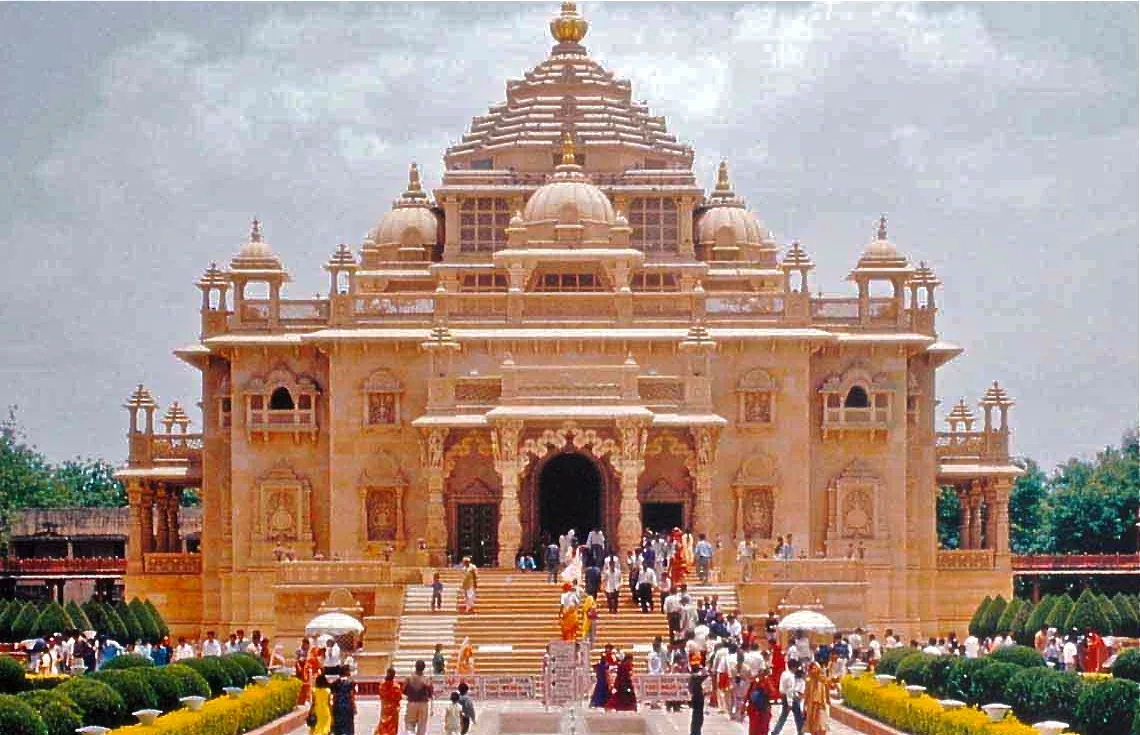
Swaminarayan Akshardham
This Hindu temple complex in Gandhinagar, Gujarat, draws visitors interested in Swaminarayan’s teachings, BAPS traditions and its central shrine built from pink sandstone.
Key facts · verified by Ghumoopedia editors
- Type of place
- Heritage monument
- Best time to visit
- November to February
- Nearest railway station
- Gandhinagar Capital · about 5 km (straight line)
- Verified
- 21 Nov 2026
Plan a trip from Swaminarayan Akshardham — a day-by-day route through places nearby.
In Gandhinagar district, Gujarat, Swaminarayan Akshardham is a Hindu religious complex linked to BAPS Swaminarayan Hinduism. Yogiji Maharaj (1892–1971), considered Swaminarayan’s fourth spiritual successor, inspired the project. Pramukh Swami Maharaj (1921–2016), the fifth successor, oversaw its creation. Work on the complex took 13 years. Its 23-acre grounds centre on Akshardham temple, built using 6,000 metric tonnes of pink sandstone from Rajasthan. The site honours Swaminarayan and commemorates his life and teachings. In BAPS belief, Akshardham is Swaminarayan’s divine abode. Followers believe a jiva, or soul, reaches it after attaining moksha, meaning liberation. On 24 September 2002, two Lashkar-e-Taiba terrorists attacked the temple, killing 33 worshippers and injuring 70. Gujarat combines Harappan cities at Dholavira and Lothal, the stepwells and Sultanate mosques of Ahmedabad and Patan, the Jain hills of Palitana and Girnar, Gandhi's Sabarmati Ashram, the Asiatic lions of Gir and the white salt desert and craft villages of Kutch. Gujarat is very hot from March to June (Kutch and north Gujarat often exceed 42°C), receives monsoon rain from late June to September, heaviest in the south and the Dangs, and is pleasant and dry from November to February with cold desert nights in Kutch. The usual best time to visit is November to February. Timings, fees and access arrangements must be confirmed locally. For official information, see Gujarat Tourism at https://www.gujarattourism.com.
Why it matters
Swaminarayan Akshardham is a major Hindu temple and cultural complex in Gandhinagar, Gujarat. It was inspired by Yogiji Maharaj and created under the direction of Pramukh Swami Maharaj, spiritual leaders in the BAPS denomination of Swaminarayan Hinduism. For BAPS followers, Akshardham represents the divine abode of Swaminarayan and has religious significance beyond its role as a place of worship. Its exhibitions and gardens also make it a prominent visitor attraction in the state capital. The complex is not identified here as a UNESCO World Heritage Site or an ASI-protected monument; visitors seeking formal heritage designations should consult the relevant authorities.
The complex was conceived as a tribute to Swaminarayan and his life and teachings. Its inspiration is attributed to Yogiji Maharaj (1892–1971), the fourth spiritual successor of Swaminarayan in the BAPS tradition. The project was developed and brought to completion under Pramukh Swami Maharaj (1921–2016), the fifth spiritual successor according to BAPS. Construction took 13 years, and the temple complex opened to visitors in 1992. It was built on a 23-acre site in Gandhinagar, with the central temple made from pink sandstone brought from Rajasthan. The broader complex combines worship with displays and cultural interpretation of Swaminarayan’s teachings and Hindu traditions. On September 24, 2002, two armed attackers entered the site and killed 33 people and wounded 70. The attack led to a major security response and remains an important part of the complex’s recent history. The temple continues to be managed as a living religious institution; changes to visitor access and security arrangements are made by its management, so current conditions should be checked before a visit.
Origin stories & folklore
For BAPS followers, Akshardham is not simply a name for a temple complex: it refers to the divine abode of Swaminarayan. According to this religious belief, a jiva, or soul, reaches Akshardham after attaining moksha, or liberation. The complex’s name and its devotional displays express this understanding of the relationship between the divine, spiritual discipline and liberation. Swaminarayan’s life and teachings are also recounted through the temple’s exhibitions and worship traditions. These are matters of faith and religious teaching rather than independently verifiable local folklore. Visitors can learn about them through the displays and published explanations while respecting the beliefs of worshippers.
Architecture & design
The complex covers about 23 acres, with the main temple at its centre. Its construction uses approximately 6,000 metric tons of pink sandstone from Rajasthan. The stonework is associated with Hindu temple architecture, including carved surfaces and sculptural detail; the monument is designed as a devotional focus as well as a setting for visitors to encounter BAPS teachings. The wider site includes exhibition spaces, landscaped gardens and areas for gathering, making the experience larger than the central shrine alone. The temple complex was built over 13 years. Its layout directs attention toward the main monument while accommodating worship, interpretation and public circulation. Sandstone gives the building its warm colour, but visitors should follow site rules about touching, entering or photographing particular areas. The architecture and exhibitions work together to present religious narratives and cultural themes.
Important objects & sculptures
Look for the central devotional image of Swaminarayan and the carved stonework that gives the main temple its detailed surface. Sculptural figures and decorative motifs across the monument reward close observation, though access to individual areas can depend on worship schedules and management rules. The exhibition galleries interpret Swaminarayan’s life, teachings and Hindu traditions through displays and audiovisual presentation; their contents and availability may change. Visitors should distinguish objects intended for worship from museum-style displays: do not touch sacred images or interrupt rituals. Ask staff which areas are open and whether any gallery is temporarily unavailable.
Visit Swaminarayan Akshardham with time to observe daily prayers and rituals respectfully. Follow the posted rules on footwear, photography, phones, head covering and dress, and avoid interrupting worshippers; popular temples may have separate queues, dress codes or mobile-phone deposit counters. Ask caretakers which areas are open to visitors, and beware of unofficial 'guides' or agents offering quick darshan for a fee. A comfortable itinerary is one main visit in the morning, a local meal at midday and a short nearby stop before an afternoon return. Use the district list on this site to find other places in Gandhinagar, but check the route and its condition before combining stops. If a festival is on — such as Navratri garba, the Rann Utsav or Uttarayan kite flying — roads and stays can be busy, and the experience can be unforgettable. Leave no litter: many sites are protected by the communities around them.
Suggested itineraries
Half day: Allow roughly 3–4 hours for security and entry, the main temple, time for respectful observation of worship, and selected exhibitions or gardens. Full day: Spend the morning at Akshardham, take a midday meal, then visit Indroda Nature Park or Gandhinagar’s planned-city landmarks, allowing time for travel and breaks. Gentler option: Focus on the main temple and one nearby seating or garden area, take rests as needed, and ask staff about the least strenuous visitor route.
Akshardham is an active place of worship as well as a visitor attraction. BAPS devotees gather for prayer, devotional singing and religious observances, and the complex’s exhibitions introduce visitors to Swaminarayan’s teachings. Gujarati is widely used in the region, while Hindi and English may also be encountered among visitors and staff. Customs include removing footwear where instructed, dressing modestly and observing quiet or restricted areas. Devotees may wear everyday Indian clothing or other modest attire; visitors are not expected to imitate religious dress, but should follow posted guidance. The temple is maintained by its religious community, so respectful conduct and consideration for worshippers are central to a visit.
Festivals & events
Religious observances at the complex may include Janmashtami, Diwali and Annakut, as well as celebrations connected with Swaminarayan and the BAPS tradition. Dates follow religious calendars and vary from year to year; celebrations are commonly associated with the relevant season rather than a fixed civil date. Navratri is widely celebrated across Gujarat, especially in autumn, and can bring busy roads and accommodation in the region. Festival days at a major temple may involve larger crowds, security procedures and changes to visitor access. Check with the temple management before planning around a celebration, and allow extra time for travel and entry.
Local food in Gujarat includes dhokla, khandvi, thepla, fafda-jalebi, undhiyu in winter, the Gujarati thali, Kutchi dabeli, Surti locho and ponk, kadhi-khichdi, and sweets such as mohanthal and shrikhand; much of Gujarat's food is vegetarian and lightly sweet. Ask what is fresh that day; many small eateries cook a limited daily menu. Vegetarian travellers eat superbly here; non-vegetarian food is available in cities but limited in pilgrimage towns such as Palitana, Dwarka and Ambaji, where it may be banned. Remote sites may have no restaurant at all. Carry water and snacks, eat a proper breakfast before long drives, and ask your accommodation for a packed lunch if you are heading out early. If prasad or langar is offered, accept it according to local custom. Choose busy, clean places, drink sealed or filtered water, and carry your packaging back with you.
Shopping & local experiences
The complex may have devotional or souvenir items connected with Swaminarayan and BAPS, subject to what is available on the day. In Gandhinagar and Ahmedabad, look for Gujarati textiles, embroidery, handicrafts and regional snacks from established shops or markets. Choose items with clear provenance, and ask before photographing artisans or stalls. Food experiences can include Gujarati thali, farsan and sweets; options are broader in nearby city centres than at the temple itself. Avoid buying from unofficial agents who promise special access or quick darshan.
November to February
The nearest principal railway station by straight-line distance is Gandhinagar Capital, roughly 5 km away. The nearest operating airport by straight-line distance is Sardar Vallabhbhai Patel International Airport, Ahmedabad, roughly 15 km away. These figures are calculated from map coordinates — actual road distance is longer. Ahmedabad, Vadodara, Surat and Rajkot are the main rail and air gateways; Bhuj serves Kutch, and Veraval, Junagadh, Dwarka and Porbandar serve Saurashtra. For the final leg, Gujarat State Road Transport Corporation (GSRTC) buses, private sleeper coaches and shared chhakdas and autos in rural areas link district towns. A private taxi gives more flexibility for remote sites. When comparing train, bus and flight, count the complete door-to-door time: a flight saves the most time only if the onward road transfer is short, while an overnight train can save a hotel night. Book your return before you leave, because seats fill quickly on weekends, festivals and holidays. Current train numbers, timings, return services and fares are not listed here; check IRCTC and NTES for trains and the airline's own schedule for flights. No permit is needed to visit Gujarat. Gujarat is a dry state: alcohol sale and consumption are prohibited except with a liquor permit, which visitors from outside the state can apply for at authorised hotel liquor shops with ID — never carry alcohol across the state border without one. Lion safaris in Gir and entry to parts of the Rann of Kutch near the border need advance online booking or a permit, and the White Rann around Dhordo is busiest during the Rann Utsav (roughly November to February).
Confirm onward and return timings on IRCTC / NTES, the state bus operator or your airline before travel. A dash means current timings or fares have not been verified.
Getting around
Gandhinagar Capital railway station and Ahmedabad’s Sardar Vallabhbhai Patel International Airport are the principal gateways noted in the existing guide; road journeys from either may take longer than map distance suggests. On arrival, taxis and app-based car services can offer a direct trip, while local buses and autos may serve parts of Gandhinagar. Availability and routes can vary, so check locally. Walking is practical within the complex but less suitable for reaching it from distant parts of the city. Visitors arriving by car should follow on-site directions for parking and security checks. Allow extra time during festivals or busy periods.
Hours, tickets & permissions
Entry arrangements can vary between the worship areas, exhibitions and other parts of the complex. Visitors may encounter security screening, restrictions on bags or electronic devices, footwear rules, dress guidance, and separate entry procedures for particular attractions. Ticketing or other charges may apply to some visitor experiences, while access rules for worship areas can differ. Carry identification if requested by the managing authority, and do not assume every part of the site is open on the same day. Confirm current hours, fees and access arrangements directly with the complex before travelling.
Facilities
The complex usually provides visitor facilities such as toilets, drinking-water access, food or refreshments, and managed parking, though availability and access can vary. Exhibition entry, worship areas and other attractions may have separate arrangements. Security screening and rules about phones, bags or footwear can affect how visitors move through the site. Guides or interpretive material may be available, but confirm locally rather than relying on unsolicited offers. ATMs and a wider choice of food and services are more likely in Gandhinagar or Ahmedabad than within the complex. Check current facilities with the managing authority before travelling, especially if you have specific needs.
Accessibility
Expect a substantial complex with outdoor walking between the entrance, temple, exhibition areas and gardens. Surfaces, steps and access arrangements can differ by area; do not assume that every shrine or gallery is step-free. The sandstone and open grounds may feel hot in sunny weather, and shade or seating may not be continuous along every route. Wheelchair, stroller and mobility-aid access should be confirmed with the management in advance, including any security or storage requirements. Older visitors may prefer to limit the number of galleries, pause often and visit in cooler weather. Ask staff about current routes and facilities before starting.
No permit is needed to visit Gujarat. Gujarat is a dry state: alcohol sale and consumption are prohibited except with a liquor permit, which visitors from outside the state can apply for at authorised hotel liquor shops with ID — never carry alcohol across the state border without one. Lion safaris in Gir and entry to parts of the Rann of Kutch near the border need advance online booking or a permit, and the White Rann around Dhordo is busiest during the Rann Utsav (roughly November to February). Carry a photo ID at all times and save the emergency number 112 and your accommodation's contact offline. Heat in summer and heavy rain in the monsoon are the main weather risks; carry water, avoid midday sun and allow extra time when roads flood. Watch your belongings in crowds and on public transport, and follow posted instructions.
Photography
Photography rules may differ between the grounds, temple interiors and exhibitions, and phones or cameras may be restricted or required to be deposited in designated areas. Check posted notices and ask staff before taking pictures; do not photograph worshippers, ceremonies or security arrangements without permission. Outdoor views of the sandstone monument can be attractive in softer morning or late-afternoon light, subject to access rules. Drone use should not be assumed to be permitted; follow aviation rules and the complex’s restrictions. Avoid blocking pathways or interrupting prayer for a photograph.
Choose a stay by the full journey to Swaminarayan Akshardham, not just the district name. Ahmedabad, Vadodara, Rajkot and Bhuj offer the widest choice; pilgrim towns have dharamshalas and trust guesthouses, and Gir has resorts near Sasan Gir. In summer, check air-conditioning; in the monsoon, check that the property is accessible if roads flood. Book in advance for weekends, festivals and the peak season (November to February). Confirm the exact location, meals included, check-in time and cancellation terms in writing. Avoid sending money to unverified contacts or touts at stations. Carry some cash, as card and digital payments can be unreliable in remote areas.
Within Gandhinagar, Indroda Nature Park offers a contrasting nature-focused visit, while the city’s planned avenues and government district provide context for Gujarat’s capital. Adalaj Stepwell, a notable historic stepwell near Gandhinagar, is another possible stop; check access and route conditions before combining it with the temple. Ahmedabad can be added for places such as Sabarmati Ashram and its historic urban sites, but allow for the road journey and traffic. These visits are best planned as separate stops rather than rushed additions, particularly during festivals or peak travel periods.
For couples, Swaminarayan Akshardham rewards a slow pace: arrive early for soft light and fewer crowds, share a local meal and keep the evening free. A full-moon night on the White Rann, sunset at Shivrajpur or an evening on the Sabarmati Riverfront makes the trip memorable. Public displays of affection can be frowned upon in conservative communities and at religious sites, so be discreet. Keep a buffer in your itinerary, because weather and road conditions can delay plans.
Q: How much time should I allow for a visit? A: Allow several hours for security, the main temple and any exhibitions or gardens you plan to see; a longer visit may be needed for a fuller experience. Q: When is the best season to visit? A: November to February is generally the most comfortable period in Gujarat. Midday heat can be intense in warmer months. Q: Is entry free, and do I need to book? A: Entry rules and any charges vary by area and visitor experience. Check current arrangements with the temple management before going. Q: Is the complex suitable for children and elderly visitors? A: Families can visit, but expect security procedures and walking across a large site. Older visitors or anyone with limited mobility should confirm routes and facilities in advance. Q: Where can I stay nearby? A: Gandhinagar and Ahmedabad offer accommodation options. Choose based on your onward transport and confirm travel time to the complex.
Be the first to share photos, stories, advice or a helpful contact for Swaminarayan Akshardham.
Loading…