
Jaganmohan Palace
Jaganmohan Palace in Mysuru is a former royal residence that now houses the Sri Jayachamarajendra Art Gallery, attracting visitors interested in art and royal history.
Key facts · verified by Ghumoopedia editors
- Type of place
- Heritage monument
- Best time to visit
- October to February; June to September for monsoon greenery in the Western Ghats
- Nearest railway station
- Mysuru Junction · about 1 km (straight line)
- Nearest airport
- Mysuru Airport · about 0 km (straight line)
- Verified
- 21 Nov 2026
Plan a trip from Jaganmohan Palace — a day-by-day route through places nearby.
In Mysuru district, Karnataka, Jaganmohan Palace stands about 200 metres west of Mysore Palace. It is now home to the Sri Jayachamarajendra Art Gallery and has also been known as Jaganmohana Palace. The building has served as a royal residence, an art museum and an auditorium. Work on the palace began in 1856 and ended in 1861. It ranks among Mysore’s earliest modern buildings. The royal household lived there when construction or renovation at Mysore Palace made it necessary to leave their usual residence. The family’s last stay in the palace was in 1897, following a fire that destroyed the old Mysore Palace. Krishnaraja Wadiyar IV was the reigning maharaja at that time. Karnataka holds the boulder-strewn ruins of Hampi, the Hoysala temple jewels of Belur and Halebidu, the Chalukyan monuments of Badami, Aihole and Pattadakal, the palaces of Mysuru, the coffee hills of Coorg and Chikkamagaluru, the temple-and-beach town of Gokarna and the tiger forests of Bandipur and Nagarhole. Bengaluru and the plateau are mild most of the year; the coast is hot and humid; the Malnad hills (Coorg, Chikkamagaluru, Agumbe) get very heavy monsoon rain from June to September. October to February is pleasant almost everywhere. The usual best time to visit is October to February; June to September for monsoon greenery in the Western Ghats. Timings, fees and access arrangements must be confirmed locally. For official information, see Karnataka Tourism at https://karnatakatourism.org.
Why it matters
Jaganmohan Palace is an important part of Mysuru’s royal and artistic heritage. Built as a royal residence, it later became the Sri Jayachamarajendra Art Gallery, bringing together the palace’s history and a substantial collection of Indian and international art. Its location close to Mysore Palace makes it a useful stop for understanding how the Wadiyar court shaped the city’s cultural life beyond its best-known royal residence. The gallery is particularly valued for its paintings, including works by Raja Ravi Varma and the Mysore artist S. L. Haldankar.
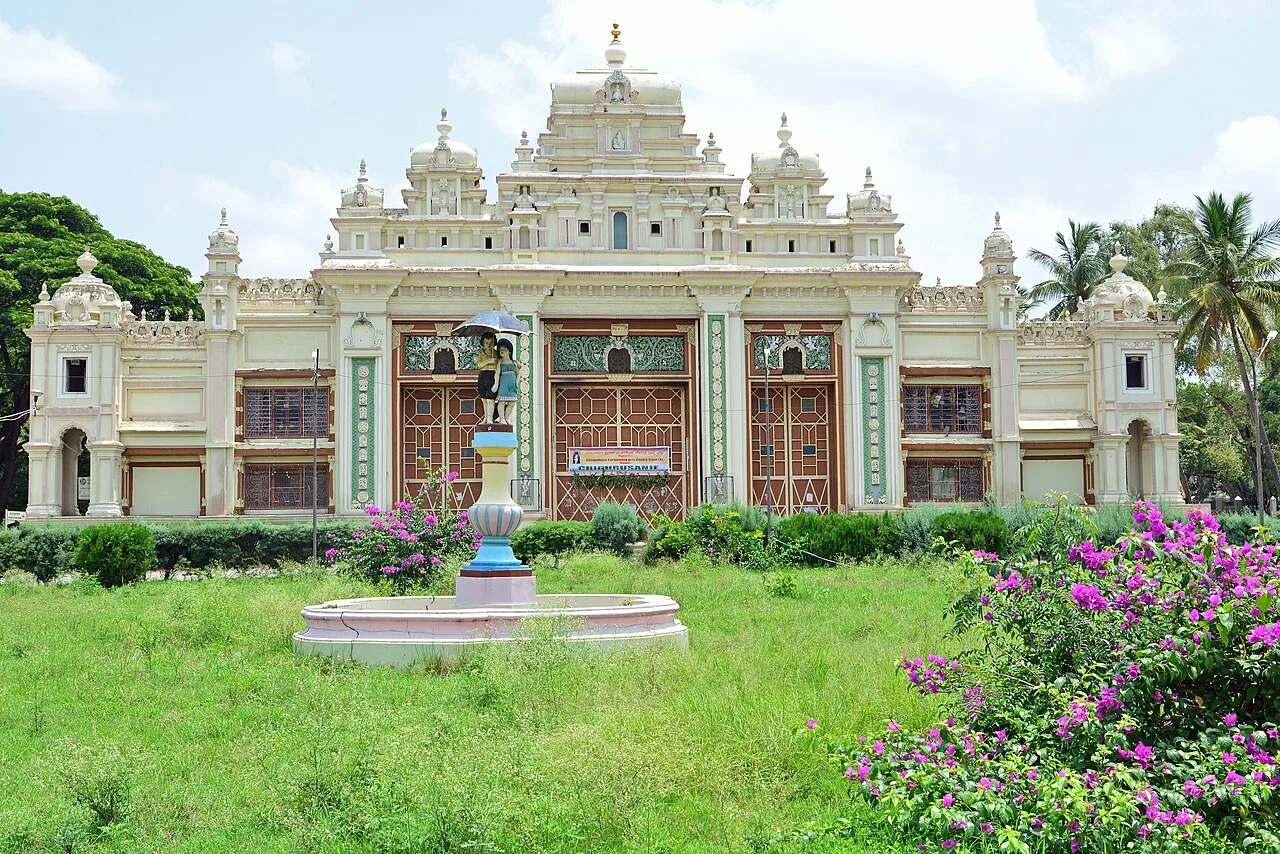
Jaganmohan Palace was built between 1856 and 1861 under the Mysore royal family, during the reign of Krishnaraja Wadiyar III. It served as an alternative royal residence when work was under way at Mysore Palace. In 1897, a fire destroyed the old Mysore Palace, and the royal family again used Jaganmohan Palace while a replacement palace was planned and built. The family’s residence there was temporary, and the building’s role subsequently shifted from royal home to a venue for court and public functions. The Sri Jayachamarajendra Art Gallery was established in the palace in the early twentieth century; it is commonly cited as having opened in 1915. Its collection grew through works assembled or acquired by the Mysore royal family and later additions. The gallery was named for Jayachamarajendra Wadiyar in the twentieth century. Today, the former palace is principally visited as an art museum, preserving both its royal associations and an important collection of paintings and other objects. Visitors should check current gallery information for details of exhibits and access.
Origin stories & folklore
No single, well-documented origin legend is widely associated with Jaganmohan Palace. Its best-known stories are grounded in Mysuru’s royal history: local accounts recall that the Wadiyar family used the building when Mysore Palace was undergoing work, and again after the 1897 fire there. The name Jaganmohana is commonly understood as a Sanskrit-derived courtly expression meaning “one who enchants the world”; this interpretation should not be mistaken for a supernatural origin tale. The palace’s atmosphere and royal connections may invite imaginative stories, but visitors are best served by distinguishing such personal impressions from documented history. Gallery interpretation and local guides can provide context for the building’s changing uses.
Architecture & design
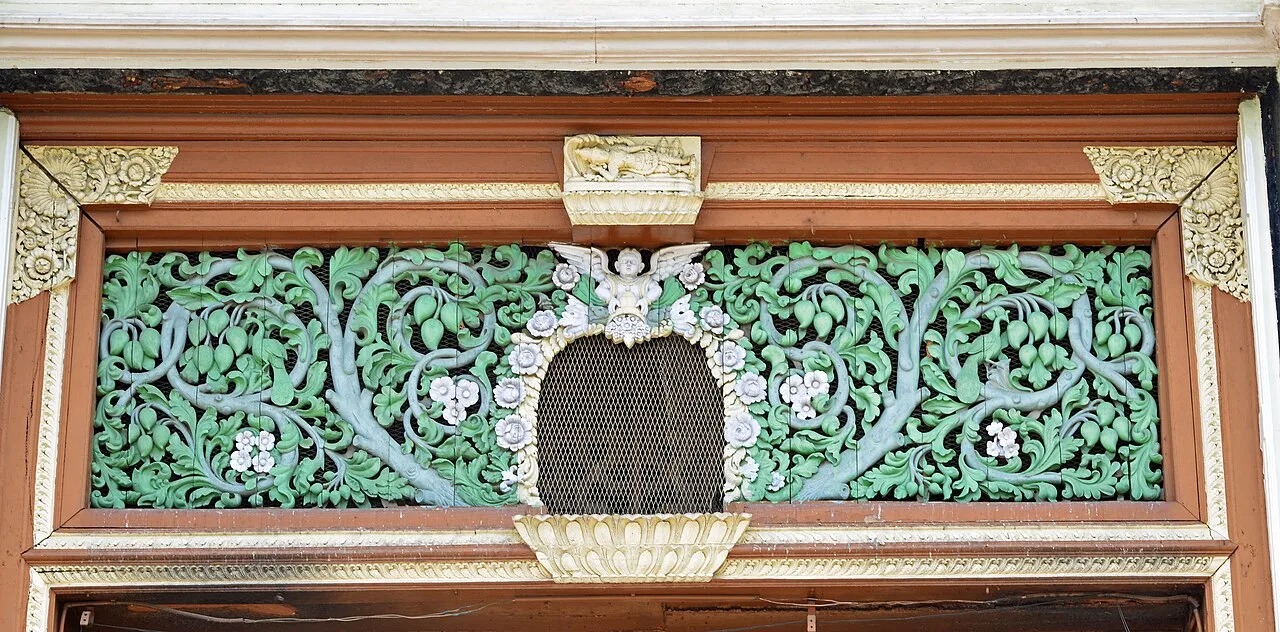
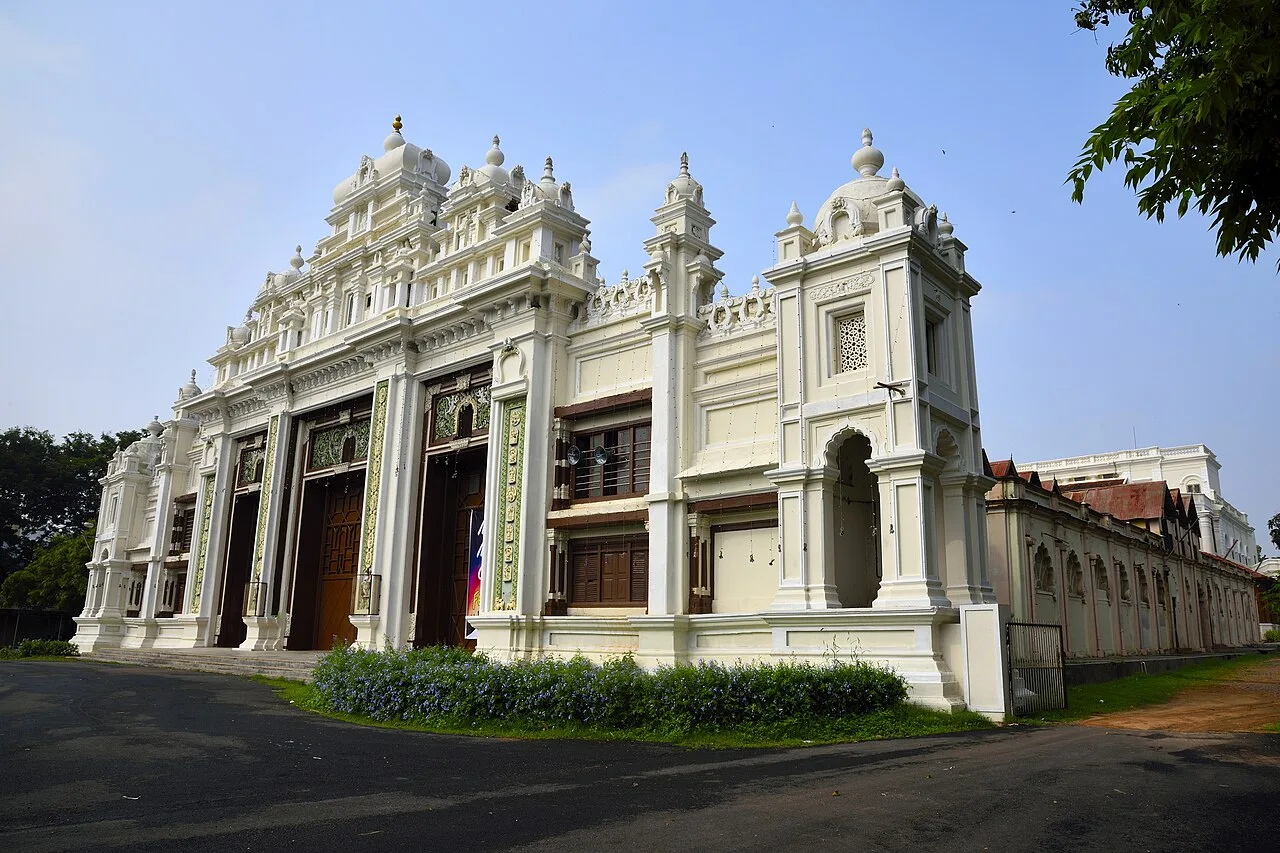
The palace is a substantial, three-storey royal building whose exterior and interior reflect the courtly architecture of Mysuru. Its formal façade is arranged around prominent entrances and decorative details, giving the building a ceremonial presence on the city street. Carved wooden doors are among the features visitors may notice, while the interior rooms now serve the needs of the art gallery. The building’s layout has been adapted over time for royal residence, public functions and museum display, so its rooms are encountered as both historic spaces and exhibition galleries. Rather than treating it as a single, untouched period design, visitors can read it as a palace with later uses and changes. Look closely at the entrance details and the relationship between the building’s ornamental exterior and its quieter gallery rooms. Follow any staff instructions about which areas are open.
Important objects & sculptures
The gallery’s paintings are its principal draw. Look for works by Raja Ravi Varma and S. L. Haldankar, whose painting commonly known as “Glow of Hope” is a notable attraction. The collection also includes Mysore-style painting and works from other Indian artistic traditions, alongside examples of international art. Depending on what is on display, visitors may encounter sculptures and other historic objects associated with the collection. The exhibits and their arrangement can change, so not every object will necessarily be visible on every visit. Give paintings time: observing their subjects, details and techniques is more rewarding than moving quickly from room to room. Read the labels where available, and ask staff before photographing any artwork.
Explore Jaganmohan Palace slowly and read the interpretation boards, use the official audio guide where available or hire an authorised guide to understand its history. Check opening days, ticket counters and camera rules in advance; many monuments and museums close on one weekday and on some public holidays. Early morning gives softer light, cooler air and smaller crowds. A comfortable itinerary is one main visit in the morning, a local meal at midday and a short nearby stop before an afternoon return. Use the district list on this site to find other places in Mysuru, but check the route and its condition before combining stops. If a festival is on — such as Mysuru Dasara, the Hampi Utsav, the Kambala buffalo races on the coast or the Karaga in Bengaluru — roads and stays can be busy, and the experience can be unforgettable. Leave no litter: many sites are protected by the communities around them.
Suggested itineraries
Half day: Spend 1.5–2 hours at the gallery, then walk or ride to Mysore Palace for an exterior visit and a meal nearby. Full day: Allow 2 hours for Jaganmohan Palace, visit Mysore Palace, pause for lunch, then choose Devaraja Market or St. Philomena’s Church before returning. Gentler option: Focus on the gallery’s main rooms, take seated breaks where available, and use an autorickshaw or taxi for the next stop rather than adding several walks.
Jaganmohan Palace sits within a city where royal history remains part of everyday civic identity. Kannada is the principal local language, while visitors may also encounter English and other languages in the tourism and hospitality sector. The gallery offers a quieter way to engage with Mysuru’s artistic heritage, including courtly painting traditions, alongside the city’s better-known palace and festival culture. Around the site, visitors will find a mix of local residents, students and tourists; modest, considerate behaviour suits the museum setting. Mysuru is also known for classical music, dance and crafts, though performances are not guaranteed at the palace. During festival periods, traditional dress, decorated streets and public celebrations may be visible elsewhere in the city.
Festivals & events
Mysuru Dasara, usually celebrated in September or October, is the city’s major festival season. Its processions and public events are centred on Mysuru and may affect movement, accommodation and crowd levels around the palace district; check the year’s programme rather than assuming events take place at Jaganmohan Palace itself. Deepavali and Ugadi are also observed locally, though they are not necessarily accompanied by special gallery programming. The palace is primarily an art gallery, not a festival ground. If visiting during a major celebration, allow extra time for city traffic and be prepared for busy public spaces. Confirm whether the gallery is open during public holidays or festival days.
Local food in Karnataka includes bisi bele bath, Mysore masala dosa, ragi mudde with sambar, Coorg's pandi (pork) curry, Mangalorean fish curry with neer dosa, Davangere benne dosa, Dharwad pedha and filter coffee everywhere. Ask what is fresh that day; many small eateries cook a limited daily menu. Vegetarian travellers eat very well across the state; the coast is the place for seafood, and Coorg has its own distinctive cuisine. Don't miss a tiffin breakfast of idli, vada and filter coffee. Remote sites may have no restaurant at all. Carry water and snacks, eat a proper breakfast before long drives, and ask your accommodation for a packed lunch if you are heading out early. Try a home-cooked or local thali meal when you can — it is often the best food on the route. Choose busy, clean places, drink sealed or filtered water, and carry your packaging back with you.
Shopping & local experiences
For locally made souvenirs, look for Mysuru silk, sandalwood products, rosewood work, incense and paintings or prints inspired by regional art. Buy from reputable shops and check product labelling, especially for goods made from protected materials. Devaraja Market is a lively place to browse flowers, fruit, spices and everyday wares, rather than a dedicated museum shop. Mysuru is also associated with its distinctive masala dosa and Mysore pak; try them at a local eatery and ask about ingredients if you have dietary needs. Availability and authenticity vary between sellers.
October to February; June to September for monsoon greenery in the Western Ghats
The nearest principal railway station by straight-line distance is Mysuru Junction, roughly 1 km away. The nearest operating airport by straight-line distance is Mysuru Airport, roughly 0 km away. These figures are calculated from map coordinates — actual road distance is longer. Bengaluru is the hub for the south and centre; Hubballi and Belagavi serve the north; Mangaluru serves the coast; Mysuru is the gateway to Coorg, and Hosapete is the railhead for Hampi. KSRTC buses connect the district towns, and the coast is served by the Konkan Railway with frequent buses from Mangaluru and Udupi. For Hampi, take a train or bus to Hosapete and an autorickshaw for the last 13 km. When comparing train, bus and flight, count the complete door-to-door time: a flight saves the most time only if the onward road transfer is short, while an overnight train can save a hotel night. Book your return before you leave, because seats fill quickly on weekends, festivals and holidays. Current train numbers, timings, return services and fares are not listed here; check IRCTC and NTES for trains and the airline's own schedule for flights. No permit is needed to visit Karnataka. Tiger safaris in Bandipur, Nagarhole and the Kali Tiger Reserve must be booked in advance through the forest department or authorised lodges — weekend slots sell out. Treks in Kudremukh National Park and some Western Ghat peaks need forest entry permission. Hampi's monuments have ASI entry tickets; the core zone is best seen with a bicycle, moped or autorickshaw for the day.
Confirm onward and return timings on IRCTC / NTES, the state bus operator or your airline before travel. A dash means current timings or fares have not been verified.
Getting around
Mysuru Junction is the city’s principal railway station, and autorickshaws and taxis are practical options for reaching the palace area. City buses serve Mysuru, but routes and stops should be checked locally. If staying nearby, walking may be convenient, although street crossings and traffic can make the final approach less relaxed. App-based cab availability can vary. Ask the driver to use the palace’s commonly known name or the Sri Jayachamarajendra Art Gallery name. Parking conditions around central Mysuru can be busy, especially during Dasara and weekends, so check locally and allow time to find a suitable place.
Hours, tickets & permissions
Entry is subject to the gallery’s current operating schedule and admission arrangements. Tickets may be required, and rules for cameras, bags, guided visits or access to particular rooms can vary. Carry identification only if requested by the managing authority, and follow notices and staff directions on dress and visitor conduct. Do not assume that all sections are open on every visit. Before travelling, confirm current hours, fees, weekly closures and holiday arrangements directly with the gallery or its managing authority.
Facilities
Gallery facilities may include visitor assistance and basic amenities, but availability can change; check locally for toilets, drinking water, seating and cloakroom arrangements. Food and refreshments are easier to find in the surrounding city than to rely on inside the museum. Guides or interpretive material may be available, but do not assume a guide or audio guide is operating on the day. ATMs, shops and a wider choice of meals are found around central Mysuru. Parking near the building may be limited or subject to local arrangements, particularly at busy times.
Accessibility
Expect a heritage building with indoor galleries and possible steps, thresholds or uneven transitions between spaces. The extent of step-free access, accessible toilets and any assistance available should be confirmed with the gallery before visiting; do not assume that a lift or ramp is provided. Strollers and wheelchairs may find some rooms or doorways difficult to navigate. The visit involves standing and walking through exhibits, so elderly visitors may prefer a slower pace and rest breaks. The surrounding streets can be busy, and shade on the approach is not guaranteed. A companion can help with transitions, and an autorickshaw or taxi can reduce walking from other city sights.
No permit is needed to visit Karnataka. Tiger safaris in Bandipur, Nagarhole and the Kali Tiger Reserve must be booked in advance through the forest department or authorised lodges — weekend slots sell out. Treks in Kudremukh National Park and some Western Ghat peaks need forest entry permission. Hampi's monuments have ASI entry tickets; the core zone is best seen with a bicycle, moped or autorickshaw for the day. Carry a photo ID at all times and save the emergency number 112 and your accommodation's contact offline. Heat in summer and heavy rain in the monsoon are the main weather risks; carry water, avoid midday sun and allow extra time when roads flood. Watch your belongings in crowds and on public transport, and follow posted instructions.
Photography
The exterior can be pleasant to photograph in the softer light of morning or late afternoon. Inside the gallery, photography rules may differ by room or artwork, so check signs and ask staff before taking pictures; flash may be restricted to protect exhibits. Avoid blocking doorways or other visitors while composing a shot. Drone use should not be assumed to be permitted: check applicable permissions and local restrictions before bringing one. Be considerate when photographing people, staff and any cultural activity, and do not touch artworks or decorative surfaces for a photograph.
Choose a stay by the full journey to Jaganmohan Palace, not just the district name. Bengaluru, Mysuru and Mangaluru offer the widest choice; Hampi has guesthouses on both banks of the Tungabhadra, Coorg has plantation homestays and resorts, and the forest lodges at Bandipur and Nagarhole book out early. In summer, check air-conditioning; in the monsoon, check that the property is accessible if roads flood. Book in advance for weekends, festivals and the peak season (October to February; June to September for monsoon greenery in the Western Ghats). Confirm the exact location, meals included, check-in time and cancellation terms in writing. Avoid sending money to unverified contacts or touts at stations. Carry some cash, as card and digital payments can be unreliable in remote areas.
Mysore Palace is the natural companion visit and helps place Jaganmohan Palace in the wider royal history of the city. Devaraja Market offers a glimpse of everyday trade and local produce. St. Philomena’s Church and Mysuru Zoo are other established city attractions; Chamundi Hill is a further option if time and transport allow. These stops have different access needs and may require separate entry arrangements. Festival traffic can lengthen journeys across Mysuru, so check routes before combining several attractions in one day.
For couples, Jaganmohan Palace rewards a slow pace: arrive early for soft light and fewer crowds, share a local meal and keep the evening free. A sunset over Hampi's boulders, a coffee-estate walk in Coorg or a quiet evening on a Gokarna beach makes the trip memorable. Public displays of affection can be frowned upon in conservative communities and at religious sites, so be discreet. Keep a buffer in your itinerary, because weather and road conditions can delay plans.
Q: How much time should I allow for Jaganmohan Palace? A: Around one to two hours is a reasonable starting point for the gallery, with more time if you enjoy studying the artworks. Q: When is a comfortable season to visit? A: October to February is generally pleasant in Mysuru; festival periods can be especially busy. Q: Is entry free, and do I need to book? A: Admission and booking arrangements can change. Confirm current requirements and fees with the managing authority before travelling. Q: Is it suitable for children and elderly visitors? A: The gallery can suit both, but it involves indoor walking and may have steps or access constraints. Take breaks and check accessibility in advance. Q: Where should I stay nearby? A: Mysuru has accommodation across a range of budgets, including options in the central city. Choose based on transport needs and confirm location and availability directly.
Be the first to share photos, stories, advice or a helpful contact for Jaganmohan Palace.
Loading…