
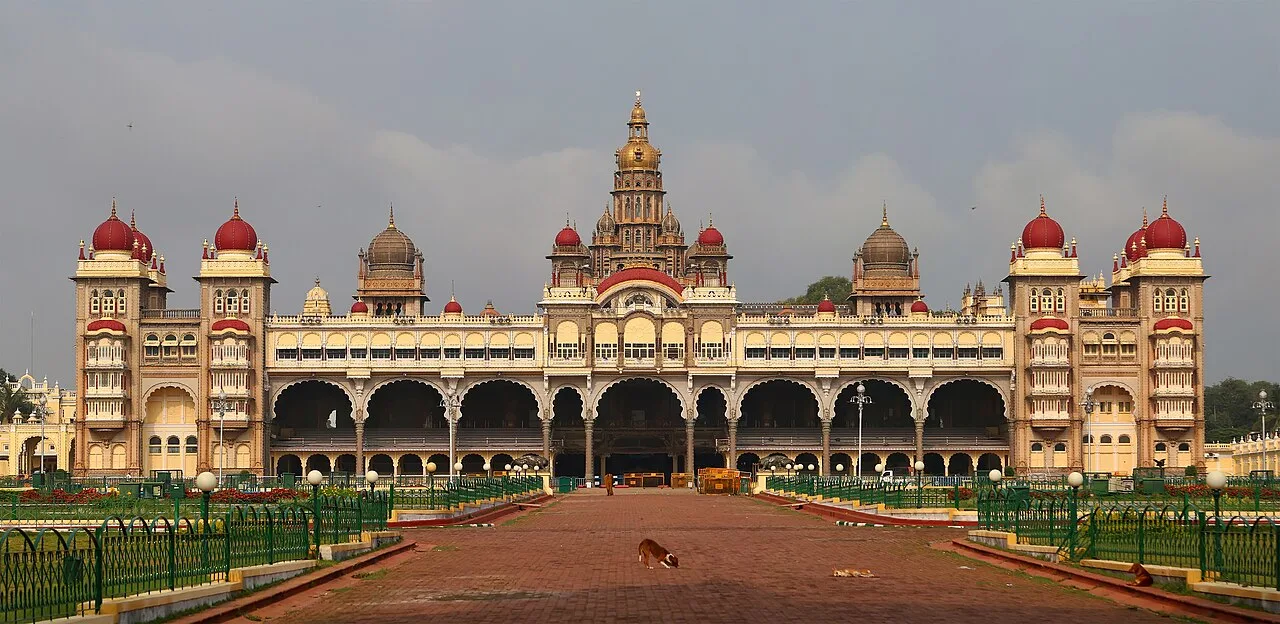
Mysore Palace
Mysore Palace, also called Amba Vilas Palace, is a former Wadiyar royal residence in Karnataka. Visitors come to see its architecture, museum and connection with the Mysore Dasara festival.
Key facts · verified by Ghumoopedia editors
- Type of place
- Heritage monument
- Best time to visit
- October to February; June to September for monsoon greenery in the Western Ghats
- Nearest railway station
- Mysuru Junction · about 2 km (straight line)
- Nearest airport
- Mysuru Airport · about 1 km (straight line)
- Verified
- 21 Nov 2026
Plan a trip from Mysore Palace — a day-by-day route through places nearby.
Located in Mysuru district, Karnataka, the palace served as the Wadiyar dynasty’s home and as the seat of the Kingdom of Mysore. A fire destroyed the earlier building in August 1897, after which Krishnaraja Wodeyar IV ordered a replacement. Building work began in 1897 and was finished in 1912. The design is attributed to British architect Henry Irwin, who had designed the Madras High Court, and Edwin Wolleston Fritchley, who later designed Lalitha Mahal. The palace ranks among India’s largest and is an example of Indo-Saracenic design. Its features draw on Indo-Islamic, Rajput, Hoysala and Gothic styles. The site’s recorded history reaches back to the late 14th century, when a small fort stood there. A palace was first built on the grounds in the 17th century, during Kanthirava Narasaraja I’s reign. It was later destroyed and rebuilt more than once. Mysore Dasara has taken place on the palace grounds each year since the early 19th century. The festival concludes on Vijayadashami with a procession featuring elephants. In 1998, Karnataka’s government enacted a law to take ownership of the palace from the Wadiyar family. The family challenged the measure in court, and the dispute remains unresolved. The main building contains a public museum as well as the living quarters of Yaduveer Krishnadatta Chamaraja Wadiyar, the dynasty’s present ceremonial head. The wider grounds include gardens and Hindu temples, some dating from before the present palace. Karnataka holds the boulder-strewn ruins of Hampi, the Hoysala temple jewels of Belur and Halebidu, the Chalukyan monuments of Badami, Aihole and Pattadakal, the palaces of Mysuru, the coffee hills of Coorg and Chikkamagaluru, the temple-and-beach town of Gokarna and the tiger forests of Bandipur and Nagarhole. Bengaluru and the plateau are mild most of the year; the coast is hot and humid; the Malnad hills (Coorg, Chikkamagaluru, Agumbe) get very heavy monsoon rain from June to September. October to February is pleasant almost everywhere. The usual best time to visit is October to February; June to September for monsoon greenery in the Western Ghats. Timings, fees and access arrangements must be confirmed locally. For official information, see Karnataka Tourism at https://karnatakatourism.org.
Why it matters
Mysore Palace, also called Amba Vilas Palace, is a major heritage landmark in Mysuru and a former royal residence of the Wadiyar dynasty. It was the seat of the Kingdom of Mysore, whose influence shaped the region’s political and cultural history. The palace remains closely associated with the city’s identity and with Mysuru Dasara, celebrated on its grounds. Its Indo-Saracenic design brings together influences associated with several Indian and European architectural traditions. The palace is open to the public as a museum, while parts of the complex retain a royal connection. Published accounts describe a continuing legal dispute over ownership following the Karnataka government’s 1998 acquisition legislation; visitors should not assume that the building is a UNESCO-listed site.
The land beneath the palace is recorded as the site of a small fort in the late 14th century. A palace was built there during the 17th century, in the reign of Kanthirava Narasaraja I. That earlier building was damaged, destroyed and rebuilt over time. In 1897, a fire destroyed the previous palace, prompting the commissioning of the present structure. Construction began that year and was completed in 1912. The design is attributed to British architect Henry Irwin, with Edwin Wolleston Fritchley also associated with the project. The palace served as the official residence of the Wadiyar dynasty and the seat of the Kingdom of Mysore. Since the early 19th century, the grounds have been central to Mysuru Dasara celebrations. In 1998, the Karnataka government enacted legislation to acquire the palace from the Wadiyar family. The act was challenged in court, and the ownership question has remained the subject of legal proceedings. Today, the main palace contains a public museum as well as living quarters connected with Yaduveer Krishnadatta Chamaraja Wadiyar, the dynasty’s ceremonial head.
Origin stories & folklore
According to local tradition, the name Mysore is linked to Mahishasura, a demon said to have ruled the area. In the story, the goddess Chamundeshwari defeated him on Chamundi Hill, and the settlement came to be associated with the name Mahishuru, later rendered as Mysuru. This legend belongs to the wider sacred landscape of the city rather than to the palace’s construction history. The Wadiyar dynasty also has traditions connecting its early rule to divine blessing and the goddess Chamundeshwari. Such stories are important to local identity and festival observances, but they should be understood as religious and dynastic traditions, not as documented accounts of the palace’s origins.
Architecture & design
The present palace is a prominent example of Indo-Saracenic architecture, combining elements associated with Indo-Islamic, Rajput, Hoysala and Gothic traditions. Its design is attributed to Henry Irwin, with Edwin Wolleston Fritchley also associated with the work. The large complex is organised around courtyards and ceremonial interiors, with towers, arches and domed roof forms shaping its exterior. Grey granite is used in the main structure, while pink marble appears in decorative details. Inside, visitors can look for richly ornamented halls, carved doors, painted surfaces and the Kalyana Mantapa, or marriage pavilion, known for its decorated ceiling and stained glass. The palace’s scale and arrangement reflect both royal residence and public ceremony: spaces for courtly display sit alongside routes through galleries and courtyards. Its architecture is best appreciated by noticing how the different motifs and materials are brought together rather than treating it as a single-style building.
Important objects & sculptures
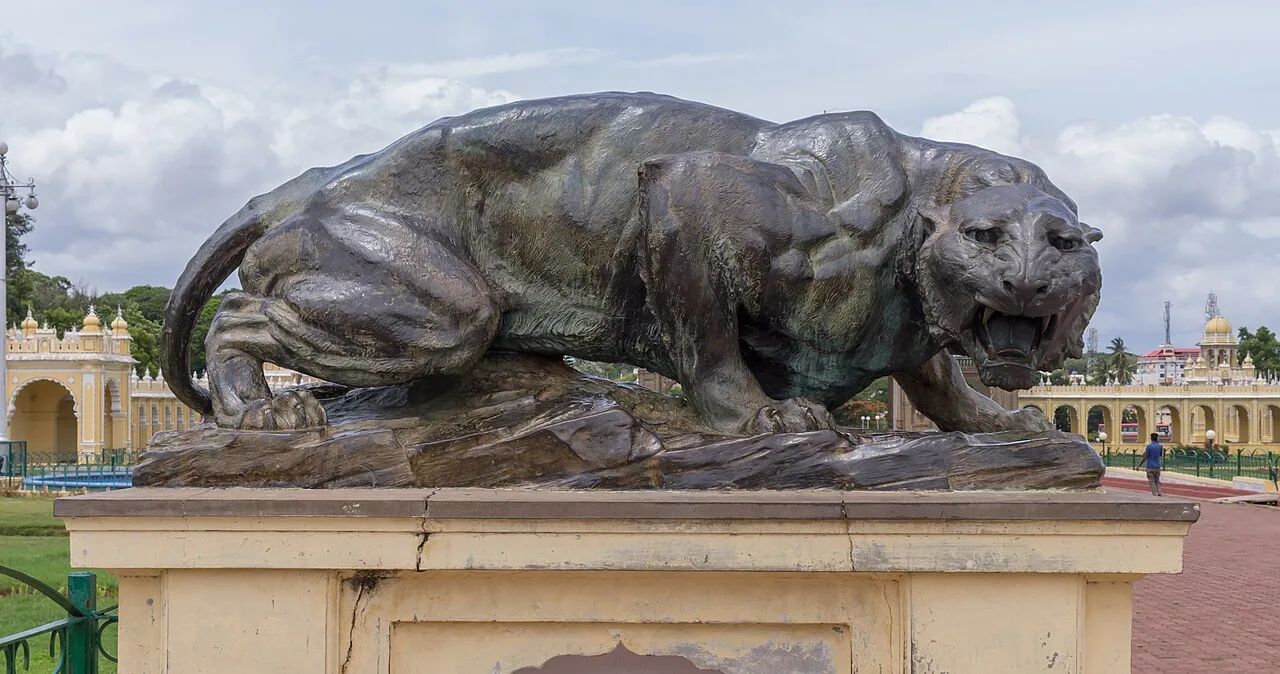
Inside the public museum, look for royal-era paintings, furnishings, arms, ceremonial objects and displays relating to the Wadiyar court; the selection and arrangement may change. The Gombe Thotti, or doll pavilion, reflects the court’s ceremonial and festive world. The palace is also known for its richly decorated doors, painted interiors and sculptural details, which reward a slower visit. In the wider complex, several Hindu temples have histories that predate the present palace. Their icons and architectural features belong to active places of worship, so observe respectfully and follow local guidance. Do not assume that every object on display is original to the current building or that photography is permitted in galleries.
Explore Mysore Palace slowly and read the interpretation boards, use the official audio guide where available or hire an authorised guide to understand its history. Check opening days, ticket counters and camera rules in advance; many monuments and museums close on one weekday and on some public holidays. Early morning gives softer light, cooler air and smaller crowds. A comfortable itinerary is one main visit in the morning, a local meal at midday and a short nearby stop before an afternoon return. Use the district list on this site to find other places in Mysuru, but check the route and its condition before combining stops. If a festival is on — such as Mysuru Dasara, the Hampi Utsav, the Kambala buffalo races on the coast or the Karaga in Bengaluru — roads and stays can be busy, and the experience can be unforgettable. Leave no litter: many sites are protected by the communities around them.
Suggested itineraries
Half day: Allow about 2–3 hours for the palace museum and grounds, then take a relaxed meal nearby. Full day: Spend about 2–3 hours at the palace, have lunch, then visit Jaganmohan Palace or Devaraja Market and finish with a stop at St Philomena’s Church or Mysuru Zoo. Gentler option: Focus on the main palace visit, take seated breaks where permitted, and choose one nearby stop reachable by vehicle rather than trying to cover the full complex and several city attractions.
The palace remains a setting for public heritage visits and for ceremonies connected with Mysuru’s royal and civic traditions. Kannada is the principal local language; visitors will also commonly encounter English and other Indian languages. Classical music, dance and ceremonial performance are part of the wider cultural life of Mysuru, especially during festival periods. Dasara brings together processions, devotional observances and cultural programmes, with the palace as a prominent backdrop. Visitors may see people wearing traditional Indian clothing for worship or celebrations, though everyday dress in the city is varied. Several temples within the complex are active religious spaces: keep voices low, follow posted instructions and ask before photographing worshippers or rituals.
Festivals & events
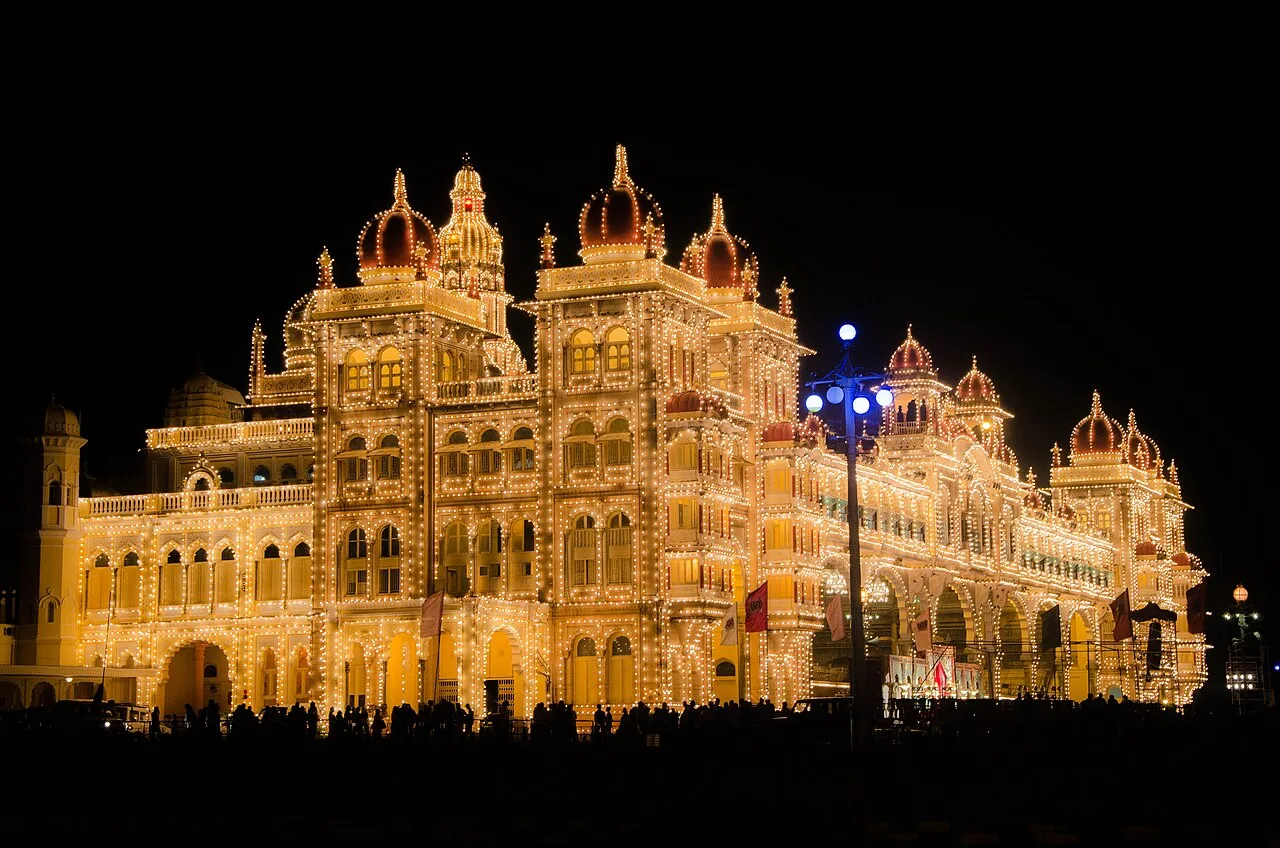
Mysuru Dasara, usually celebrated in September or October according to the lunar calendar, is the palace’s most prominent festival association. Celebrations include cultural events and a Vijayadashami procession, and the palace is often illuminated during the festival period. Crowds, traffic restrictions and pressure on accommodation can increase substantially, so plan ahead and check current public-access arrangements. Navaratri observances are also important in the city. Festival programmes and access to particular areas can change from year to year; confirm details locally rather than relying on past schedules.
Local food in Karnataka includes bisi bele bath, Mysore masala dosa, ragi mudde with sambar, Coorg's pandi (pork) curry, Mangalorean fish curry with neer dosa, Davangere benne dosa, Dharwad pedha and filter coffee everywhere. Ask what is fresh that day; many small eateries cook a limited daily menu. Vegetarian travellers eat very well across the state; the coast is the place for seafood, and Coorg has its own distinctive cuisine. Don't miss a tiffin breakfast of idli, vada and filter coffee. Remote sites may have no restaurant at all. Carry water and snacks, eat a proper breakfast before long drives, and ask your accommodation for a packed lunch if you are heading out early. Try a home-cooked or local thali meal when you can — it is often the best food on the route. Choose busy, clean places, drink sealed or filtered water, and carry your packaging back with you.
Shopping & local experiences
Mysuru is known for silk, sandalwood products, rosewood inlay work and Mysore paintings; Devaraja Market and established city shops are places to browse. Check product labels and buy from reputable sellers, particularly for items marketed as genuine silk or sandalwood. Avoid products made from protected wildlife materials. Mysore Pak and other local sweets make popular food souvenirs, while market visits offer a chance to sample regional snacks. Ask about packaging and travel suitability if carrying food or fragile handicrafts.
October to February; June to September for monsoon greenery in the Western Ghats
The nearest principal railway station by straight-line distance is Mysuru Junction, roughly 2 km away. The nearest operating airport by straight-line distance is Mysuru Airport, roughly 1 km away. These figures are calculated from map coordinates — actual road distance is longer. Bengaluru is the hub for the south and centre; Hubballi and Belagavi serve the north; Mangaluru serves the coast; Mysuru is the gateway to Coorg, and Hosapete is the railhead for Hampi. KSRTC buses connect the district towns, and the coast is served by the Konkan Railway with frequent buses from Mangaluru and Udupi. For Hampi, take a train or bus to Hosapete and an autorickshaw for the last 13 km. When comparing train, bus and flight, count the complete door-to-door time: a flight saves the most time only if the onward road transfer is short, while an overnight train can save a hotel night. Book your return before you leave, because seats fill quickly on weekends, festivals and holidays. Current train numbers, timings, return services and fares are not listed here; check IRCTC and NTES for trains and the airline's own schedule for flights. No permit is needed to visit Karnataka. Tiger safaris in Bandipur, Nagarhole and the Kali Tiger Reserve must be booked in advance through the forest department or authorised lodges — weekend slots sell out. Treks in Kudremukh National Park and some Western Ghat peaks need forest entry permission. Hampi's monuments have ASI entry tickets; the core zone is best seen with a bicycle, moped or autorickshaw for the day.
Confirm onward and return timings on IRCTC / NTES, the state bus operator or your airline before travel. A dash means current timings or fares have not been verified.
Getting around
Mysuru is straightforward to explore by autorickshaw, taxi or local bus, and the palace is also reachable on foot from parts of the central city. For trips between the palace, markets and nearby attractions, agree the destination clearly with your driver or use a taxi service you trust. Walking can be pleasant but the complex itself involves substantial ground to cover. Check locally where vehicles may park and whether roads are restricted during festivals or events. If arriving at Mysuru Junction or the airport, arrange onward transport at the station or terminal rather than assuming the straight-line distance reflects the road journey.
Hours, tickets & permissions
Entry to the public areas is ticket-controlled, and visitors should expect security procedures and rules about belongings. Camera use may be restricted indoors or subject to separate conditions; policies can differ between exterior grounds and palace interiors. Some areas may have specific footwear or visitor instructions. No general dress or identification rule should be assumed without checking current guidance. Confirm opening days, current hours, fees, camera rules and any festival-related access changes with the palace’s managing authority before setting out.
Facilities
Visitor facilities usually include ticketing and basic amenities near the entrance, with toilets and drinking-water access available in or around the visitor area; check locally for current locations and conditions. Food and refreshments are easier to find outside the palace grounds, and the city centre has restaurants and shops. Parking arrangements can vary with events and crowd control. Authorised guides or audio interpretation may be available, but availability can change. ATMs and other services are found around central Mysuru rather than necessarily inside the complex.
Accessibility
A visit can involve considerable walking across the palace grounds and through interior galleries. Expect steps in some areas and surfaces that may be uneven outdoors; shade is not continuous, particularly while crossing open spaces. Wheelchair and stroller access can vary by entrance and section, and not every interior route should be assumed step-free. Contact the managing authority in advance to ask about current accessible routes and assistance. Older visitors or anyone with limited stamina may prefer to focus on selected halls, take breaks and avoid combining the palace with several distant attractions in one outing.
No permit is needed to visit Karnataka. Tiger safaris in Bandipur, Nagarhole and the Kali Tiger Reserve must be booked in advance through the forest department or authorised lodges — weekend slots sell out. Treks in Kudremukh National Park and some Western Ghat peaks need forest entry permission. Hampi's monuments have ASI entry tickets; the core zone is best seen with a bicycle, moped or autorickshaw for the day. Carry a photo ID at all times and save the emergency number 112 and your accommodation's contact offline. Heat in summer and heavy rain in the monsoon are the main weather risks; carry water, avoid midday sun and allow extra time when roads flood. Watch your belongings in crowds and on public transport, and follow posted instructions.
Photography
Early morning often provides softer light and can mean fewer visitors in exterior areas; the palace façade and grounds offer broad viewpoints. Photography rules differ between outdoor spaces and interiors, so check signs and staff instructions before taking pictures. Flash, tripods or other equipment may be restricted, and camera permissions can change. Do not fly a drone without all required approvals and confirmation that local rules permit it. Ask before photographing worshippers, staff or other visitors, and avoid blocking circulation routes while taking pictures.
Choose a stay by the full journey to Mysore Palace, not just the district name. Bengaluru, Mysuru and Mangaluru offer the widest choice; Hampi has guesthouses on both banks of the Tungabhadra, Coorg has plantation homestays and resorts, and the forest lodges at Bandipur and Nagarhole book out early. In summer, check air-conditioning; in the monsoon, check that the property is accessible if roads flood. Book in advance for weekends, festivals and the peak season (October to February; June to September for monsoon greenery in the Western Ghats). Confirm the exact location, meals included, check-in time and cancellation terms in writing. Avoid sending money to unverified contacts or touts at stations. Carry some cash, as card and digital payments can be unreliable in remote areas.
Within Mysuru, visitors can combine the palace with Jaganmohan Palace, Devaraja Market, St Philomena’s Church and Mysuru Zoo. Chamundi Hill and the Sri Chamundeshwari Temple offer a different view of the city’s religious and cultural landscape; allow for road travel and possible crowds. Karanji Lake is another city stop for a quieter outdoor visit. Choose a small number of nearby places rather than trying to fit them all around the palace, especially on festival days. Check each attraction’s current access arrangements before combining visits.
For couples, Mysore Palace rewards a slow pace: arrive early for soft light and fewer crowds, share a local meal and keep the evening free. A sunset over Hampi's boulders, a coffee-estate walk in Coorg or a quiet evening on a Gokarna beach makes the trip memorable. Public displays of affection can be frowned upon in conservative communities and at religious sites, so be discreet. Keep a buffer in your itinerary, because weather and road conditions can delay plans.
Q: How much time should I allow for Mysore Palace? A: Allow a few hours for the palace and grounds; add more time if you want to read displays carefully or visit nearby attractions. Q: When is a good season to visit? A: October to February is generally pleasant in Karnataka. Dasara is culturally significant but can bring heavier crowds and busy roads. Q: Do visitors need a ticket, and can they take photographs? A: Public access is ticket-controlled. Photography rules may differ between outdoor areas and interiors, so check current instructions before visiting. Q: Is the palace suitable for children and older visitors? A: It can suit families, but expect walking and some steps. Older visitors or anyone with limited mobility may prefer a shorter route and regular breaks. Q: Where can I stay nearby? A: Mysuru has accommodation across the city, including options in and around the centre. Compare location and transport needs, and book ahead during major festivals.
Be the first to share photos, stories, advice or a helpful contact for Mysore Palace.
Loading…