
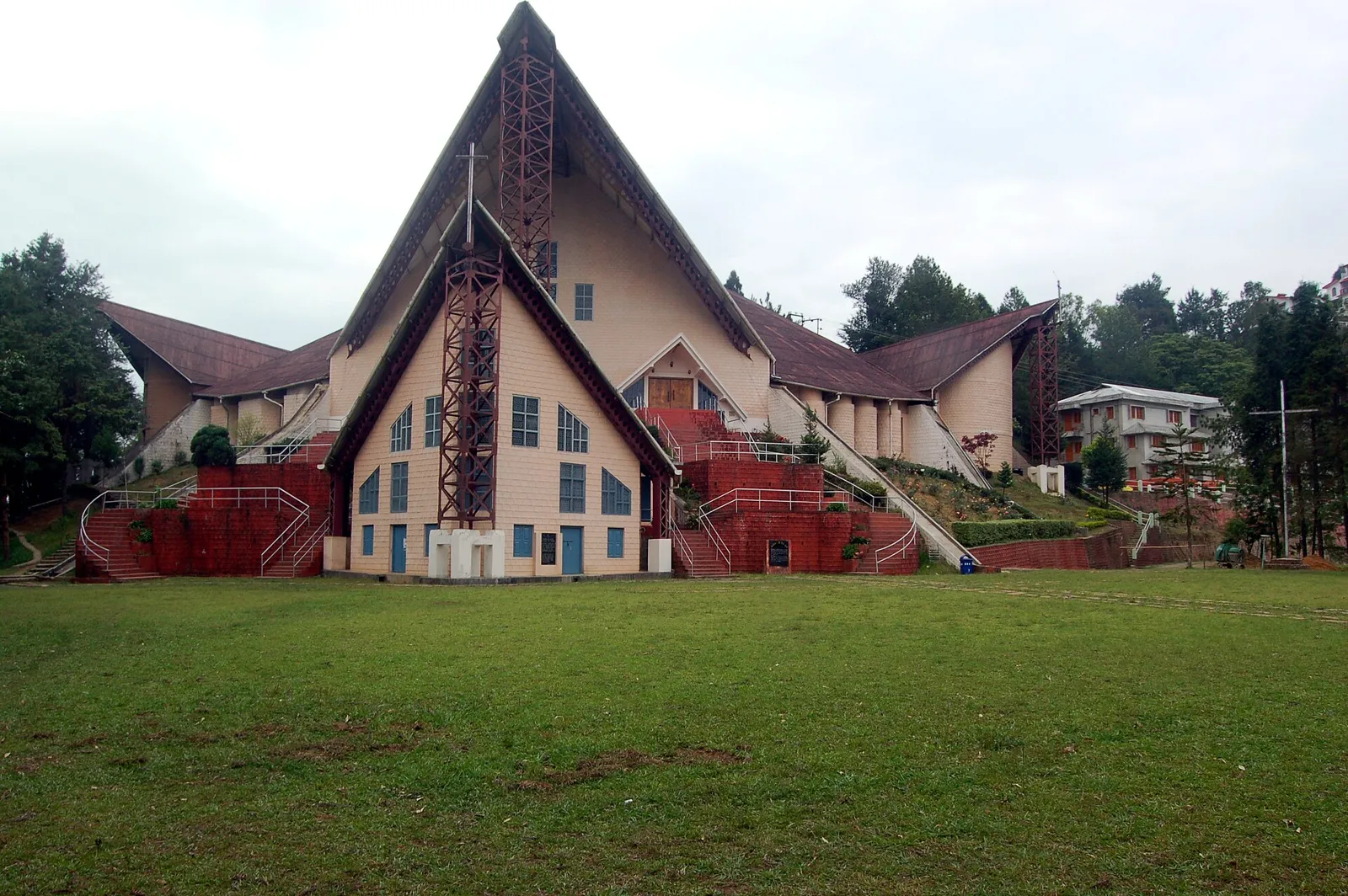
Mary Help of Christians Cathedral
This Catholic cathedral is the principal church of Kohima’s diocese in Nagaland. Visitors come to see its Naga-inspired architecture and carved cross, and to reflect on its memorial links to the Battle of Kohima.
Key facts · verified by Ghumoopedia editors
- Type of place
- Temple / pilgrimage site
- Best time to visit
- October to May; early December for the Hornbill Festival
- Nearest railway station
- Dimapur · about 45 km (straight line)
- Nearest airport
- Dimapur Airport · about 40 km (straight line)
- Verified
- 21 Nov 2026
Plan a trip from Mary Help of Christians Cathedral — a day-by-day route through places nearby.
Mary Help of Christians Cathedral is the bishop’s church and the main Catholic place of worship for Kohima’s diocese in Nagaland. Its design incorporates features of traditional Naga homes, including a façade reminiscent of a dwelling. The structure is shaped to sit within the hillside on which it stands. A wooden crucifix, carved to a height of 16 feet, is counted among Asia’s largest crosses. The cathedral was conceived by Abraham Alangimattathil, Kohima’s first bishop, whose tomb is within the grounds. Building work began in 1986, and the church was consecrated in January 1991. The project cost three crore, most of which was provided by Japanese contributors. Their support was intended to create a memorial to Japanese soldiers killed in the Second World War at Kohima. An inscription on the grounds expresses gratitude for the cathedral and for Masses held each morning in remembrance of the fallen. Another message near the entrance asks people to remember those who have given their lives, and those prepared to give everything, for Nagaland’s safety and well-being. The cathedral has also hosted reconciliation meetings between Japanese and British veterans who fought on opposing sides during the war. Its Naga-influenced design, memorial purpose and role in bringing former opponents together help explain its significance to visitors. Nagaland’s many Naga tribes each have their own language, festivals and village councils. The Hornbill Festival at Kisama is held in early December, and the state enforces liquor prohibition. Kohima and the hill districts are cool, with cold winter nights; Dimapur in the plains is warmer and humid. The monsoon brings heavy rain from June to September. The usual best time to visit is October to May; early December for the Hornbill Festival. Days are short in Northeast India: the sun can set before 5 pm in winter, so plan to reach and leave Mary Help of Christians Cathedral in daylight. Timings, fees and access arrangements must be confirmed locally. For official information, see Nagaland Tourism at https://tourism.nagaland.gov.in.
Why it matters
Mary Help of Christians Cathedral is the principal Catholic church of the Diocese of Kohima and the seat of its bishop, giving it an important role in the religious life of Kohima and Nagaland. Its design draws on Naga architectural forms, making it a notable meeting point of Catholic worship and local visual identity. The cathedral is also associated with remembrance of the Battle of Kohima: Japanese people contributed substantially to its construction as a memorial to Japanese soldiers who died in the Second World War. Its use for reconciliation gatherings between Japanese and British veterans adds to that role. These are its established regional and historical significances; no formal UNESCO or national heritage designation is asserted here.
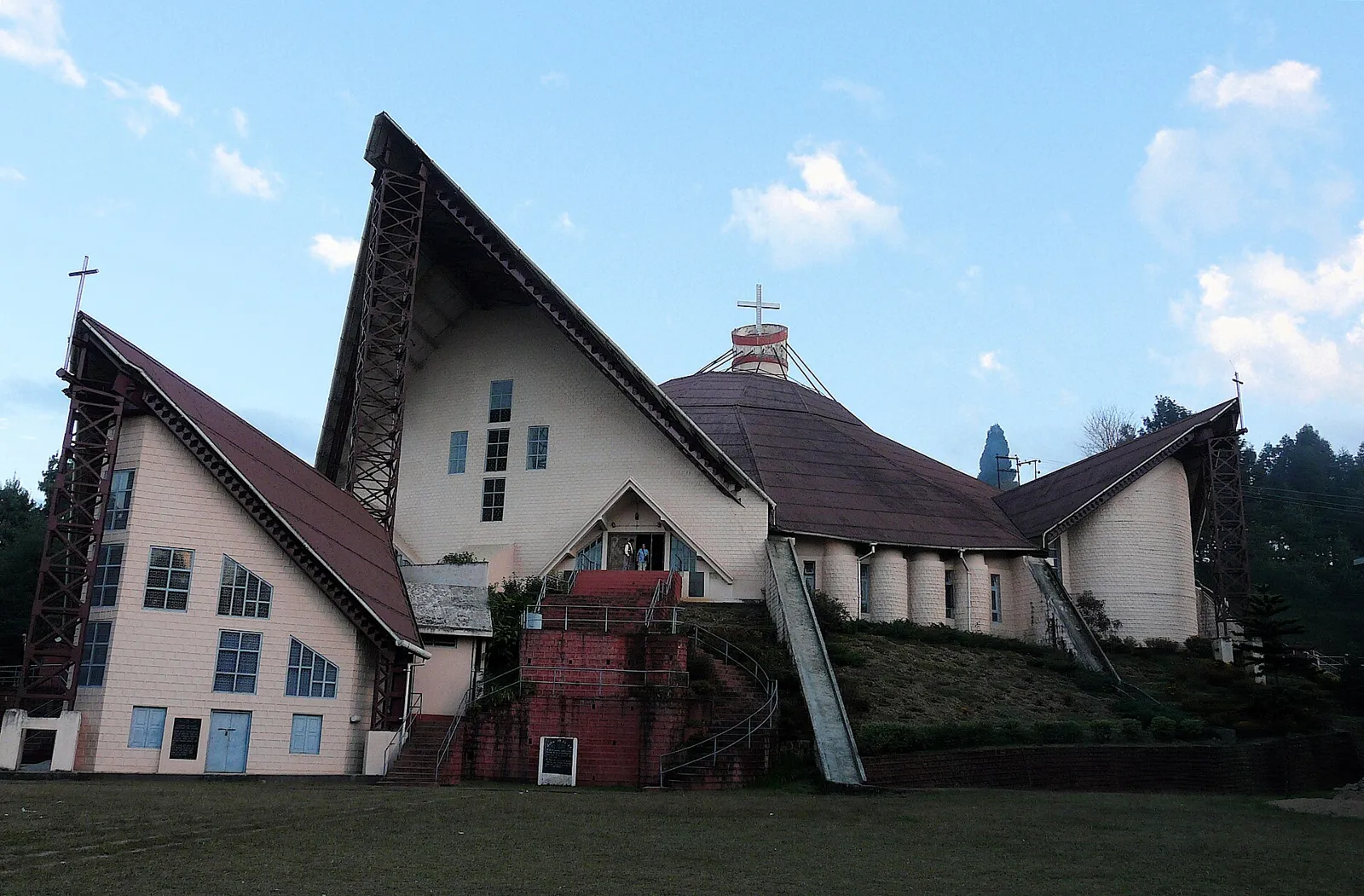
The cathedral was conceptualised by Abraham Alangimattathil, the first bishop of Kohima. Construction began in 1986, and the church was consecrated in January 1991. It became the principal church of the Diocese of Kohima, serving as the bishop’s church and a centre for Catholic worship in the diocese. The reported construction cost was three crore rupees, with much of the funding provided by Japanese people wishing to honour Japanese soldiers killed in the Battle of Kohima during the Second World War. An inscription at the site recalls their hope that Mass would be offered for the fallen. Another message near the entrance asks visitors to remember those who gave their lives for Nagaland’s safety and future. The cathedral complex also contains Bishop Alangimattathil’s tomb. In later years, the church was used as a venue for reconciliation meetings between Japanese and British veterans who had fought on opposing sides in the war. No specific restoration history is established in the available account.
Origin stories & folklore
No well-documented local origin legend is associated with the cathedral, so visitors should distinguish its recorded history from folklore rather than attach an invented story to the site. Its name refers to Mary, Help of Christians, a title within Catholic devotion to the Virgin Mary. The cathedral’s stronger documented story is its connection to remembrance and reconciliation after the Battle of Kohima. Inscriptions invite prayer for those who died and for Nagaland’s future, expressing a devotional hope rather than a legend. Visitors interested in oral histories can ask local church representatives whether community accounts or veterans’ memories are shared during their visit.
Architecture & design
The cathedral stands on a hillside in Kohima district, and its design is described as blending into the slope rather than sitting apart from it. Its exterior incorporates references to traditional Naga houses, especially in a facade shaped to evoke a Naga dwelling. The result combines a Catholic church form with regional architectural imagery. The church forms the central worship space within a complex that also includes the tomb of Bishop Abraham Alangimattathil. Visitors can observe how the building’s profile relates to the hill and how its Naga-inspired facade differs from more conventional church designs. Detailed information on the building’s structural system and material specifications is not established here.
Important objects & sculptures
Look for the 16-foot carved wooden crucifix, a major devotional feature of the cathedral. The site’s inscriptions are also important: one remembers Japanese soldiers who died in the Battle of Kohima and expresses gratitude that Mass would be offered for the fallen; another, near the entrance, asks visitors to remember those who gave their lives for a safer and better Nagaland. The wording connects prayer, local aspirations and wartime memory. Bishop Abraham Alangimattathil’s tomb is within the cathedral complex. Treat these features as devotional and commemorative objects: avoid touching them or entering marked areas, and ask before photographing any object inside the church.
Religious significance
Mary Help of Christians Cathedral belongs to the Roman Catholic tradition and is the church of the bishop of the Diocese of Kohima. Its title honours the Virgin Mary under the Catholic devotional name Mary, Help of Christians. Mass and other Catholic services are central to its purpose; worshippers may gather for prayer, sacraments and community observances. The cathedral’s inscriptions also invite prayer for people killed in war and for Nagaland’s well-being, giving remembrance a visible place alongside worship. Visitors who are not attending a service are welcome to approach the building respectfully where access is permitted, but should avoid interrupting prayer. Ask church staff or caretakers about service arrangements and visitor access rather than assuming every area is open.
Visit Mary Help of Christians Cathedral with time to observe daily rituals respectfully. Follow the posted rules on footwear, photography and dress, walk clockwise around Buddhist shrines and prayer wheels, and avoid interrupting worshippers. Ask caretakers which areas are open to visitors. A comfortable itinerary is one main visit in the morning, a local meal at midday and a short nearby stop before an afternoon return. Use the district list on this site to find other places in Kohima, but check the actual road route and its condition before combining stops. If a festival is on, local roads and stays can be busy — and the experience can be unforgettable. Leave no litter: many sites in Nagaland are protected by the communities who own them.
Suggested itineraries
Half day: Allow about 1–2 hours for the cathedral, its inscriptions and the complex; take a short rest or meal in Kohima before returning. Full day: Spend about 1–2 hours at the cathedral, have lunch in Kohima, then allow 1–2 hours for Kohima War Cemetery and additional time for the State Museum or another local stop; verify routes and opening arrangements before combining visits. Gentler option: Arrange a taxi drop-off as close as permitted, sit and observe the exterior and grounds at an unhurried pace, and skip steep walks or extra stops.
The cathedral stands in a state shaped by many Naga communities, whose languages, festivals and customs are distinct rather than uniform. Its Naga-inspired facade reflects an architectural engagement with local forms, while Catholic worship brings together congregations within the Diocese of Kohima. Depending on the day, visitors may hear church singing or encounter community gatherings, but these should not be treated as performances for tourists. Dress and conduct should respect both the church setting and local community expectations. Nagamese, English and local Naga languages may be heard in the wider area; which language is used at a service or by an individual varies.
Festivals & events
Christmas is an important season in Catholic churches, and the cathedral may host special worship and community observances; confirm arrangements locally. Easter is another significant period in the Catholic calendar and can bring increased attendance. In Kohima district, the Hornbill Festival is held in early December at Kisama Heritage Village, outside the cathedral. It showcases traditions from Nagaland’s communities and can make accommodation and roads busier across the area. The festival is not a cathedral event. During major religious services or local festivals, allow extra time, follow any crowd guidance and avoid treating worship as a sightseeing spectacle.
Local food in Nagaland includes smoked pork with bamboo shoot, axone (fermented soybean), galho rice porridge, king chilli (raja mircha) relishes and seasonal greens. Ask what is fresh that day; many small eateries cook a limited daily menu. Pork, beef, fish and fermented ingredients are common in tribal cuisines, so vegetarian travellers should explain their needs clearly — rice, dal, vegetables and eggs are usually possible in towns. Remote sites may have no restaurant at all. Carry water and snacks, eat a proper breakfast before long drives, and ask your accommodation for a packed lunch if you are heading out early. If food or prasad is offered at the shrine, accept it according to local custom. Choose busy, clean places and carry your packaging back to town.
Shopping & local experiences
Kohima’s markets and local shops are places to look for Naga textiles, woven items, locally made crafts and practical travel supplies. Availability and the communities represented vary, so ask sellers about an item’s maker and origin rather than assuming a single style represents all Naga people. Local food can be sampled at eateries in town; dishes and ingredients differ by community and establishment. The cathedral is a place of worship, not a souvenir market, so do not expect sales on site. Buy respectfully, avoid products made from protected wildlife and carry purchases without leaving packaging or litter behind.
October to May; early December for the Hornbill Festival
The nearest principal railway station by straight-line distance is Dimapur, roughly 45 km away. The nearest operating airport by straight-line distance is Dimapur Airport, roughly 40 km away. These figures are calculated from map coordinates — hill roads in Nagaland wind a lot, so actual road distance and travel time are usually much longer. Guwahati is the main rail and air hub for the region, and most long-distance journeys connect through it. For the final leg, Nagaland State Transport (NST) and shared taxis from Dimapur and Kohima link district towns; shared taxis usually leave early in the morning and depart only when full. A private taxi gives more flexibility for remote sites. When comparing train, bus and flight, count the complete door-to-door time: a flight saves the most time only if the onward road transfer is short, while an overnight train to Guwahati plus a road journey can save a hotel night. Book your return before you leave, because seats on shared vehicles and the few daily flights fill quickly. Current train numbers, timings, return services and fares are not listed here; check IRCTC and NTES for trains and the airline’s own schedule for flights. Indian visitors who are not residents of Nagaland need an Inner Line Permit, available online through Nagaland’s official ILP portal. Foreign nationals must check the current Protected Area Permit and registration requirements.
Confirm onward and return timings on IRCTC / NTES, the state bus operator or your airline before travel. A dash means current timings or fares have not been verified.
Getting around
Kohima is reached by road, with shared taxis and private taxis serving connections with Dimapur and other towns; hill journeys can take longer than map distances suggest. Within Kohima, a local taxi is a practical way to reach the cathedral, particularly on steep roads or when travelling with limited time. Walking is possible for nearby stops, but the hillside setting and uneven slopes can make routes demanding. Ask your driver to confirm the exact drop-off point and return arrangements, especially if you plan to leave later in the day. Check local road conditions and transport availability before combining distant stops.
Hours, tickets & permissions
Entry arrangements can vary depending on worship, church activities and whether particular areas of the complex are open. A visitor may be asked to wait during a service or to seek permission before entering certain spaces. Do not assume that the church interior, tomb area or other parts of the grounds are accessible at all times. Confirm current visiting hours, entry conditions and any fees with the cathedral’s managing authority before setting out. Follow notices at the entrance and ask a caretaker if guidance is not clear.
Facilities
Facilities within the cathedral complex may be limited and can depend on church activities. Toilets, drinking water, seating and visitor assistance should be checked locally rather than assumed. Kohima town has food options and general services, but it is sensible to carry water and any personal supplies needed for a hillside visit. Parking availability near the church may vary, especially during services or events; confirm with the driver or caretaker. Do not expect a dedicated guide, ATM or shop at the cathedral itself. Ask before using church facilities or entering non-public areas.
Accessibility
The cathedral is on a hillside, so the approach and surrounding ground may include slopes, uneven surfaces or steps. The amount of walking depends on the vehicle drop-off point and which parts of the complex are open. Shade and places to rest may be limited outdoors, so plan breaks and carry water. Wheelchair and stroller access cannot be confirmed; contact the church in advance and ask about the approach, thresholds and accessible facilities. Older visitors or anyone with reduced mobility may find a taxi drop-off and a short, unhurried visit more manageable than combining the cathedral with steep walks around Kohima.
Indian visitors who are not residents of Nagaland need an Inner Line Permit, available online through Nagaland’s official ILP portal. Foreign nationals must check the current Protected Area Permit and registration requirements. Carry a printed and digital copy of your permit and a photo ID at all times; checkpoints are common. Save the emergency number 112 and your accommodation’s contact offline. Heat, humidity and sudden downpours are the main weather risks; carry water and rain protection. Respect community rules, private property and posted instructions. Avoid hill road travel after dark and during heavy rain, when landslides are more likely. Check official advisories for the region before travel, and follow local guidance if access changes.
Visitor rules
This is an active place of worship. Wear modest clothing, keep voices low and give worshippers space, especially during services. Follow posted guidance on footwear and ask whether shoes should be removed before entering any area. Do not enter rooms, offices or sections marked as restricted, and seek permission before approaching the tomb or handling objects. Avoid littering and reduce single-use plastic. Do not block entrances or congregation movement. Rules may change for services or events, so follow notices and instructions from church staff and caretakers.
Photography
The hillside setting and Naga-inspired facade are good subjects in soft morning or late-afternoon light, while daylight is useful for viewing the building’s details. Photography may be restricted inside the church, during worship or near particular objects; ask before taking pictures and follow posted notices. Do not photograph worshippers, clergy or private gatherings without consent. The inscriptions and crucifix deserve respectful, non-intrusive framing. Drone use may be subject to aviation rules and local restrictions; do not fly one without the required permissions and the church’s approval.
Choose a stay by the full journey to Mary Help of Christians Cathedral, not just the district name. Main towns in Kohima usually offer hotels, state tourism lodges and homestays with better transport, meals and medical access, while village homestays offer a closer connection to local life. In the plains and valleys, check fans or air-conditioning and mosquito nets in summer. Book in advance for weekends, festival dates and the peak season (October to May; early December for the Hornbill Festival). Confirm the exact location, meals included, check-in time and cancellation terms in writing. Many homestays accept payment on arrival; avoid sending money to unverified contacts. Mobile network and digital payments can be unreliable in remote areas, so carry some cash.
Kohima War Cemetery is a meaningful nearby stop for understanding the Battle of Kohima and its remembrance. The Nagaland State Museum in Kohima offers context on the state’s communities and material culture; check its current visitor arrangements before going. Kisama Heritage Village, outside Kohima, is associated with the Hornbill Festival and Naga cultural presentations, especially in early December. These places can be combined with a cathedral visit only after checking road conditions, opening arrangements and travel time. Avoid planning a tight schedule: Kohima’s hillside roads and event traffic can slow journeys.
For couples, Mary Help of Christians Cathedral rewards a slow pace: arrive early for soft light and fewer crowds, share a local meal and keep the evening free. Public displays of affection can be frowned upon in conservative communities and at religious sites, so be discreet. A homestay can make the trip memorable — confirm privacy, hot water and transport back. Keep a buffer day in your itinerary, because weather and road closures can delay plans in Nagaland.
Q: How much time should I allow for a visit? A: Around one to two hours is a comfortable allowance for the church, its inscriptions and the complex, depending on access and whether a service is taking place. Q: When is a good season to visit? A: October to May is generally the more comfortable travel season in Nagaland. The monsoon, usually June to September, brings heavy rain; early December can be busy around the Hornbill Festival. Q: Is there an entry fee or do I need permission? A: Current entry conditions and any fees are not established here. Confirm with the cathedral’s managing authority and follow notices at the site. Q: Is the cathedral suitable for children and elderly visitors? A: Families can visit respectfully, but the hillside approach may involve slopes or steps. Older visitors and anyone with limited mobility should check access and arrange a suitable drop-off in advance. Q: Where can I stay nearby? A: Kohima has accommodation options. Choose a place based on your route and confirm availability, especially during the Hornbill Festival or other busy periods.
Be the first to share photos, stories, advice or a helpful contact for Mary Help of Christians Cathedral.
Loading…