
City Palace, Jaipur
A historic royal complex in Jaipur, the City Palace served the city’s rulers and remains the royal family’s home. Visitors come to see its architecture and explore the museum.
Key facts · verified by Ghumoopedia editors
- Type of place
- Heritage monument
- Best time to visit
- October to March
- Nearest railway station
- Jaipur Junction · about 5 km (straight line)
- Nearest airport
- Jaipur International Airport · about 10 km (straight line)
- Verified
- 21 Nov 2026
Plan a trip from City Palace, Jaipur — a day-by-day route through places nearby.
Building began in 1727, following Jaipur’s founding under Maharaja Sawai Jai Singh II. He transferred his court from Amber to the new city, and work was completed in 1732. Jaipur served as the kingdom’s capital until 1949, when it became the capital of Rajasthan. The palace was the Maharaja’s ceremonial centre and a base for government. It also hosted religious observances and cultural gatherings, and supported activity in the arts, trade and industry. The site lies in Jaipur district, Rajasthan. As the ruling family’s urban base, it combined household life with official duties connected to governing the kingdom. Planned according to Vastu principles, the complex blends Rajput and Mughal influences. Its grounds include several buildings and courtyards, as well as galleries, restaurants and offices used by the museum trust. The site houses the Maharaja Sawai Man Singh II Museum and remains the Jaipur royal family’s home. Around 500 people serve the household as personal staff. The MSMS II Museum Trust is chaired by Rajamata Padmini Devi, who is from Sirmour in Himachal Pradesh. Princess Diya Kumari serves as its secretary and trustee, and oversees The Palace School and Maharaja Sawai Bhawani Singh School in Jaipur. She established and leads the Princess Diya Kumari Foundation, which works to support women in Rajasthan facing economic disadvantage or limited employment. She is also a businesswoman. In 2013, she was elected to the Rajasthan Legislative Assembly for the Sawai Madhopur constituency. Rajasthan is the land of Rajput forts and palaces, painted havelis, desert folk music, puppetry and colourful fairs such as the Pushkar camel fair. Rajasthan is very hot from April to June — often above 45 °C in the desert — with a short monsoon in July–September. Winter days are pleasant and nights are cold, especially in the Thar Desert. Mount Abu is the state's only hill station and stays cooler. The usual best time to visit is October to March. Timings, fees and access arrangements must be confirmed locally. For official information, see Rajasthan Tourism at https://www.tourism.rajasthan.gov.in.
Why it matters
City Palace is important to Jaipur’s political and cultural history: it served as a royal residence and the administrative and ceremonial seat of the rulers of Jaipur State. Its establishment followed Maharaja Sawai Jai Singh II’s move from Amber and the founding of Jaipur in 1727. The complex remains partly a royal residence and also houses the Maharaja Sawai Man Singh II Museum, preserving collections associated with the Jaipur court. It is a major heritage site in Rajasthan’s capital. Jaipur’s historic walled city is on UNESCO’s World Heritage List, but that designation should not be taken to mean that City Palace itself is a separately inscribed UNESCO property.
Construction began in 1727 under Maharaja Sawai Jai Singh II, who shifted his court from Amber as he established Jaipur. The palace was planned as both a residence and a centre of government for the Jaipur State. The main construction is traditionally dated to completion in 1732, though the complex developed over time as successive rulers added or altered buildings and courtyards. Its design drew on Rajput and Mughal traditions and was shaped by the planning principles associated with the new city. For generations, the palace hosted courtly, religious and cultural occasions as well as administrative work. Jaipur remained the kingdom’s capital until 1949, when it became the capital of Rajasthan after the state’s formation. The palace continued as a seat of royal ceremony and remains the home of the Jaipur royal family. Parts of the complex now operate as the Maharaja Sawai Man Singh II Museum, with the Museum Trust overseeing its collections and visitor areas. As a living palace and museum, access to different sections can change; consult the managing authority for current arrangements.
Origin stories & folklore
There is no single, widely documented founding legend for City Palace that should be presented as established history. Local accounts often celebrate Sawai Jai Singh II’s decision to move his court from Amber and build a planned capital, while stories about the city’s auspicious layout draw on traditions of vastu and astrology. These beliefs are part of the broader cultural memory of Jaipur, rather than proof of supernatural events at the palace. Visitors may hear additional family or neighbourhood stories from guides; treat them as oral tradition and ask how they relate to documented history. The palace’s long association with the Jaipur royal family also sustains stories of court life and ceremony.
Architecture & design
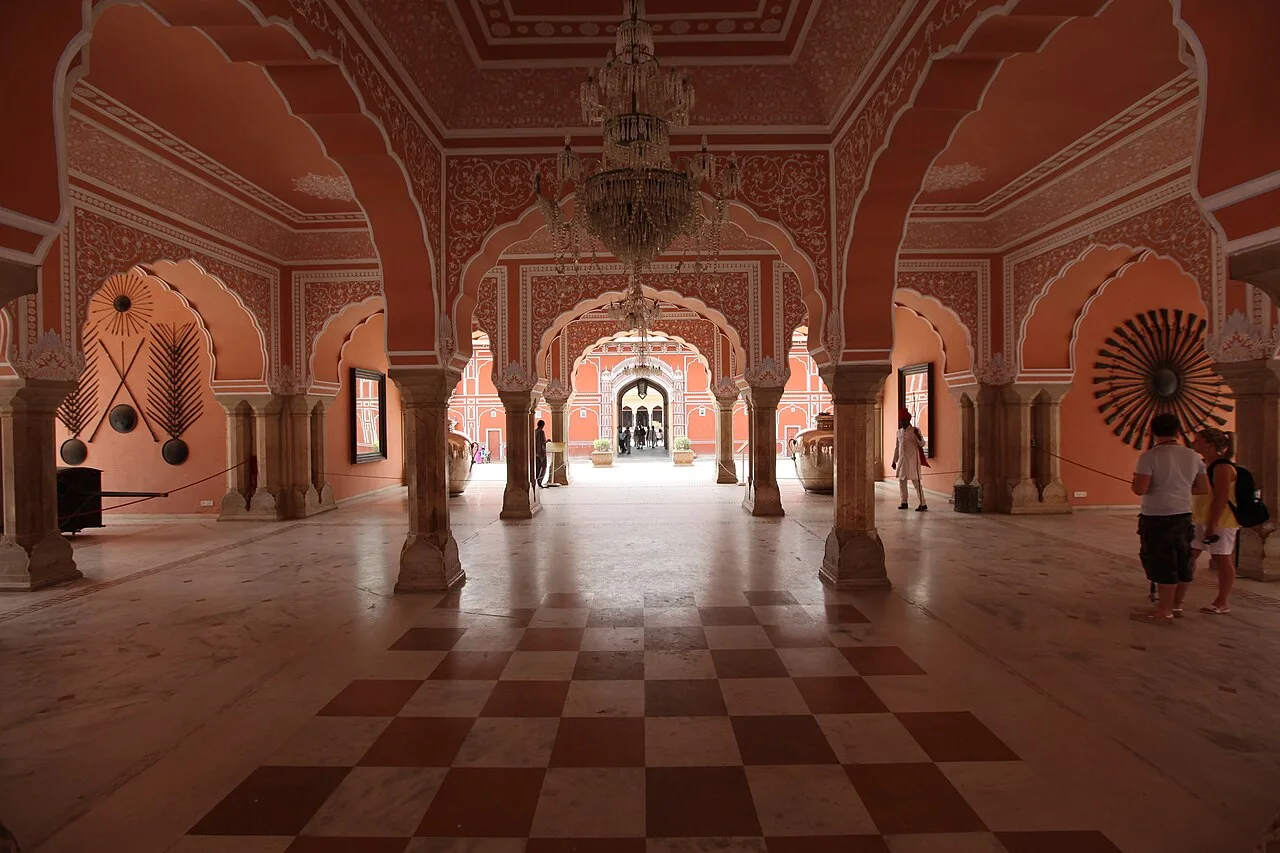
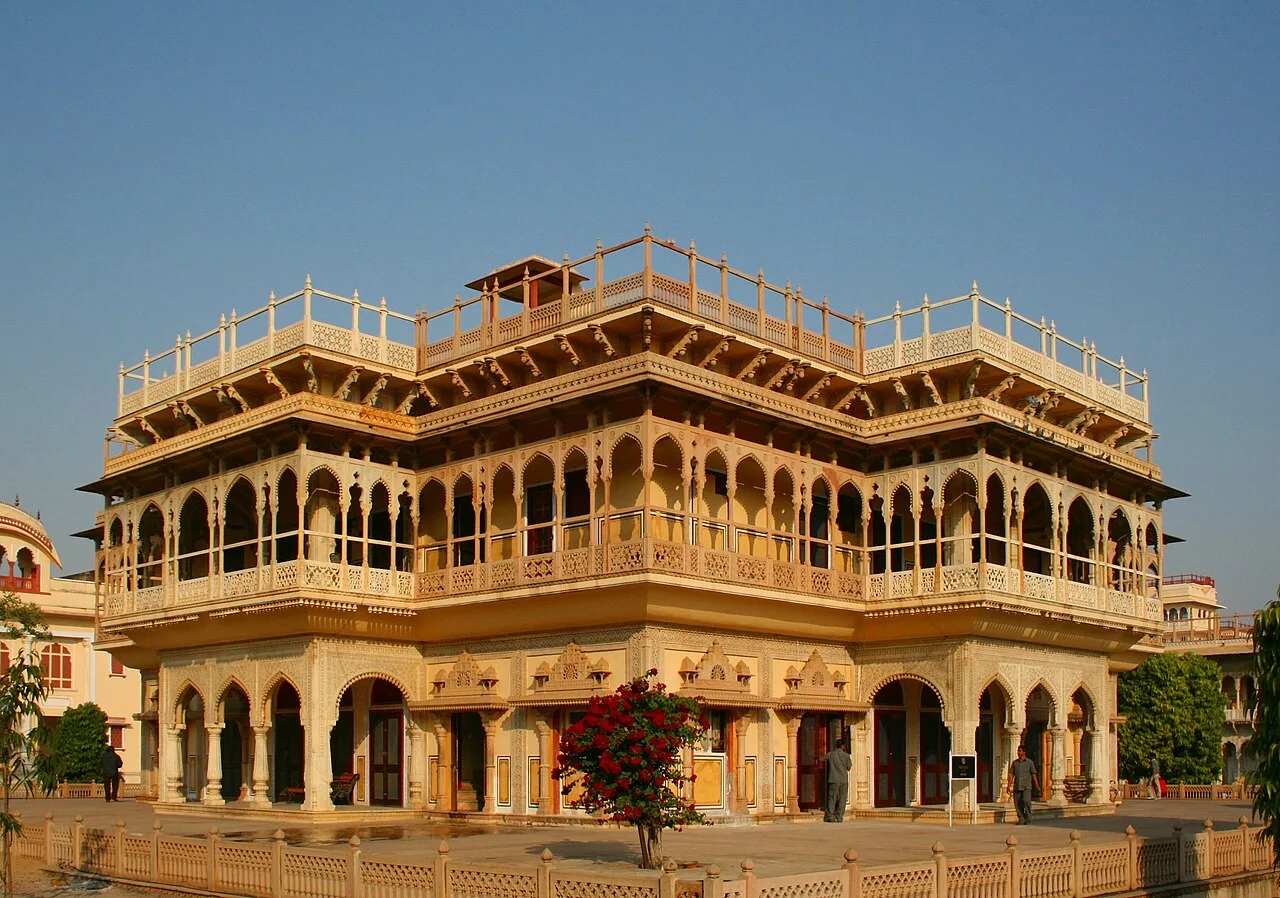
The complex combines Rajput and Mughal architectural influences, with later additions reflecting changing tastes. It is organised around courtyards, gateways and connected buildings rather than a single palace block. Notable parts include the Chandra Mahal, still associated with the royal residence; Mubarak Mahal; the public audience halls known as Diwan-i-Aam and Diwan-i-Khas; and the courtyards of Pritam Niwas Chowk. The four decorated gateways at Pritam Niwas Chowk are especially admired for their painted and sculpted motifs. Red and pink sandstone, marble, painted plaster and decorative stonework appear across the complex. Arched openings, columns, carved details, balconies and jali screens provide visual variety and, in some spaces, filtered light and air. The courtyards help organise movement between public, ceremonial and private areas. The palace was built in keeping with principles associated with vastu shastra, alongside courtly design conventions of its period.
Important objects & sculptures
The Maharaja Sawai Man Singh II Museum presents objects connected with Jaipur’s rulers and court. Depending on the galleries open, visitors may see royal textiles and costumes, arms and armour, paintings, manuscripts, photographs and decorative arts. Look for fine embroidery, formal garments and details in the court paintings that reveal changing styles of dress and ceremony. The palace is also known for its large silver vessels, traditionally associated with Maharaja Sawai Madho Singh II and his journey to England; check which objects are currently on display. Gallery contents and access can change, so use the museum’s interpretation material and follow any restrictions on handling or photography.
Explore City Palace slowly and read the interpretation boards, use the official audio guide where available or hire an authorised guide to understand its history. Check opening days, ticket counters and camera rules in advance; many monuments and museums close on one weekday and on some public holidays. Early morning gives softer light, cooler air and smaller crowds. A comfortable itinerary is one main visit in the morning, a local meal at midday and a short nearby stop before an afternoon return. Use the district list on this site to find other places in Jaipur, but check the route and its condition before combining stops. If a festival or fair is on, roads and stays can be busy — and the experience can be unforgettable. Leave no litter: many sites are protected by the communities around them.
Suggested itineraries
Half day: Allow about 2–3 hours for the museum and palace courtyards; take a meal break, then walk to Hawa Mahal or Jantar Mantar if energy and access allow. Full day: Spend about 3 hours at City Palace, pause for lunch, visit Jantar Mantar, then explore Hawa Mahal and the nearby old-city markets at an unhurried pace. Gentler option: Focus on the most accessible open galleries and one courtyard, take seated breaks, and use a taxi between nearby stops rather than adding a long walking route.
City Palace remains connected to the Jaipur royal family, while its museum and public spaces bring visitors into contact with the city’s heritage. Courtly customs are interpreted through collections, architecture and ceremonial objects; the palace should not be mistaken for a venue where traditional performances take place every day. Jaipur’s wider cultural life includes folk music, dance, craft traditions and festivals, with Hindi and Rajasthani widely heard alongside other languages. Visitors can encounter local customs in nearby markets and temples. Dress respectfully, particularly when visiting religious spaces, and ask before photographing staff, worshippers or private ceremonies.
Festivals & events
Jaipur’s major celebrations include Teej, usually during the monsoon season, and the spring festival of Gangaur. Diwali brings illuminations and busy shopping streets, while Holi is widely celebrated in the city. These are citywide observances, not a guarantee of events inside City Palace; check with the palace or museum for any special programme. Festival periods can bring heavier traffic, crowded markets and increased demand for accommodation. Jaipur Literature Festival, generally held in winter, is another major city event, though its venue is separate from the palace.
Local food in Rajasthan includes dal baati churma, gatte ki sabzi, ker sangri, laal maas, pyaaz kachori, mirchi vada, ghewar, mawa kachori and chaach (spiced buttermilk). Ask what is fresh that day; many small eateries cook a limited daily menu. Vegetarian travellers eat very well across this region, and most towns also have non-vegetarian options. Remote sites may have no restaurant at all. Carry water and snacks, eat a proper breakfast before long drives, and ask your accommodation for a packed lunch if you are heading out early. Try a home-cooked or dhaba meal when you can — it is often the best food on the route. Choose busy, clean places and carry your packaging back with you.
Shopping & local experiences
Nearby old-city bazaars offer textiles, block-printed fabrics, jewellery, blue pottery, leather goods and other crafts associated with Jaipur and Rajasthan. Johari Bazaar is known for jewellery, while Bapu Bazaar and the surrounding market streets have a mix of clothing, crafts and souvenirs. Product quality and origin vary, so ask about materials and compare items before buying. Look for local snacks and Rajasthani dishes at established eateries nearby. Bargaining may be customary in some shops; be courteous, and avoid buying objects presented as antiques or protected heritage without reliable provenance.
October to March
The nearest principal railway station by straight-line distance is Jaipur Junction, roughly 5 km away. The nearest operating airport by straight-line distance is Jaipur International Airport, roughly 10 km away. These figures are calculated from map coordinates — actual road distance is longer. Jaipur, Ajmer, Jodhpur, Udaipur and Kota are the main rail hubs, and Jaipur, Udaipur and Jodhpur have the most flights; Delhi is the usual gateway for the north-east of the state. For the final leg, Rajasthan State Road Transport Corporation (RSRTC) buses and private coaches link district towns; shared taxis usually leave early in the morning. A private taxi gives more flexibility for remote sites. When comparing train, bus and flight, count the complete door-to-door time: a flight saves the most time only if the onward road transfer is short, while an overnight train can save a hotel night. Book your return before you leave, because seats fill quickly on weekends, festivals and holidays. Current train numbers, timings, return services and fares are not listed here; check IRCTC and NTES for trains and the airline's own schedule for flights. No permit is needed to visit Rajasthan. Land close to the international border west of Jaisalmer and Barmer is restricted beyond certain points: places such as Tanot can be visited, but border outposts need Border Security Force permission. Forts and palaces charge entry and camera fees, and tiger-reserve safaris must be booked through the official forest department portal.
Confirm onward and return timings on IRCTC / NTES, the state bus operator or your airline before travel. A dash means current timings or fares have not been verified.
Getting around
Autos, app-based cabs and hired taxis can bring visitors to the old city, but traffic and limited space near the palace may mean a short walk to the entrance. Jaipur city buses serve parts of the wider area; check locally for a convenient stop and route. Walking is practical for nearby sights, though pavements can be uneven and streets busy. Ask your driver about an agreed drop-off and pickup point rather than assuming vehicles can wait at the entrance. Parking availability around the old city is limited or may require a walk, so check before driving.
Hours, tickets & permissions
Entry is ticketed, and access may differ between the museum, palace sections and any special exhibits. Rules can apply to bags, photography, video recording and entry to areas that remain private or are used for ceremonies. Carry identification if requested and follow posted instructions; do not assume that every courtyard or building is included on one ticket. Confirm current opening days, hours, fees, camera rules and permitted areas with City Palace or the Maharaja Sawai Man Singh II Museum before travelling.
Facilities
Museum and visitor facilities may include toilets, drinking-water points, seating, information desks or guides; availability and access can vary by section, so check locally. Food and refreshments are available in the surrounding old city, and some facilities may operate within the wider complex. ATMs, pharmacies and additional dining options can be found around central Jaipur. Parking near the entrance may be limited. If you need a particular service, such as a guided visit or step-free access, contact the managing authority before arrival rather than relying on it being available on the day.
Accessibility
Expect walking between buildings and courtyards, with uneven paving, thresholds and stairs in parts of the complex. Shade and seating are not continuous, and the old-city approach can be crowded or exposed to heat. Some galleries or upper levels may be difficult to reach for wheelchair users or visitors with limited mobility; do not assume ramps or lifts are available throughout. Strollers may be awkward on steps and uneven surfaces. Older visitors may find a slower visit with frequent rests more comfortable. Contact the palace or museum in advance to ask which areas are accessible during your visit.
No permit is needed to visit Rajasthan. Land close to the international border west of Jaisalmer and Barmer is restricted beyond certain points: places such as Tanot can be visited, but border outposts need Border Security Force permission. Forts and palaces charge entry and camera fees, and tiger-reserve safaris must be booked through the official forest department portal. Carry a photo ID at all times and save the emergency number 112 and your accommodation's contact offline. Heat in summer and fog in winter are the main weather risks; carry water and allow extra travel time on foggy December–January mornings. Respect community rules, private property and posted instructions. Follow local guidance if access changes.
Photography
Morning light is often softer for exterior details and courtyards, while the painted gateways at Pritam Niwas Chowk offer colourful compositions when accessible. Photography rules vary by gallery and may distinguish between personal cameras, flash and video; follow signs and staff instructions rather than assuming all areas allow photography. Do not use a drone without the required permissions and confirmation of local restrictions. Ask before photographing people, especially staff, worshippers or ceremonies, and avoid blocking passages while taking pictures.
Choose a stay by the full journey to City Palace, not just the district name. Heritage havelis, fort hotels, state tourism (RTDC) hotels and desert camps offer distinctive stays; check that a desert camp is licensed and has proper toilets. In summer, check air-conditioning or coolers; in December and January, check heating and hot water. Book in advance for weekends, festivals and the peak season (October to March). Confirm the exact location, meals included, check-in time and cancellation terms in writing. Avoid sending money to unverified contacts or touts at stations. Carry some cash, as card and digital payments can be unreliable in remote areas.
Within Jaipur’s historic centre, Hawa Mahal and Jantar Mantar are natural additions; Jantar Mantar is a UNESCO World Heritage property. Govind Dev Ji Temple is an important nearby place of worship, so dress respectfully and check local visitor practices. Albert Hall Museum offers another perspective on Rajasthan’s collections and history. For a longer outing within Jaipur district, Amber Fort and Jaigarh Fort can be combined with planning for road time and walking. Choose fewer stops if visiting during a festival or when traffic is heavy.
For couples, City Palace rewards a slow pace: arrive early for soft light and fewer crowds, share a local meal and keep the evening free. A heritage hotel or a lakeside sunset makes the trip memorable. Public displays of affection can be frowned upon in conservative communities and at religious sites, so be discreet. Keep a buffer in your itinerary, because weather and traffic can delay plans.
Q: How much time should I allow for City Palace? A: Allow a few hours to explore the museum and accessible palace areas without rushing; add time for queues or a guided visit. Q: When is a comfortable season to visit? A: October to March is generally more comfortable for Jaipur. Summer can be very hot, so plan for heat and check seasonal conditions. Q: Do I need a ticket, and can I enter every building? A: Entry is ticketed, and access can vary by section. Confirm current fees, inclusions and rules with the palace or museum. Q: Is the visit suitable for children and elderly visitors? A: Many visitors can enjoy it, but expect walking, uneven surfaces and steps. Plan breaks and check accessibility needs in advance. Q: Where should I stay nearby? A: Jaipur has accommodation across the city, including options around the historic centre. Choose based on transport, noise and mobility needs, and confirm the route to the entrance.
Be the first to share photos, stories, advice or a helpful contact for City Palace, Jaipur.
Loading…