
Galtaji
Galtaji is an ancient Hindu pilgrimage complex in Jaipur district, around 10 km east of Jaipur. Pilgrims visit its temples and bathe in tanks fed by a hillside spring.
Key facts · verified by Ghumoopedia editors
- Type of place
- Heritage monument
- Best time to visit
- October to March
- Nearest railway station
- Dausa · about 20 km (straight line)
- Nearest airport
- Jaipur International Airport · about 30 km (straight line)
- Verified
- 21 Nov 2026
Plan a trip from Galtaji — a day-by-day route through places nearby.
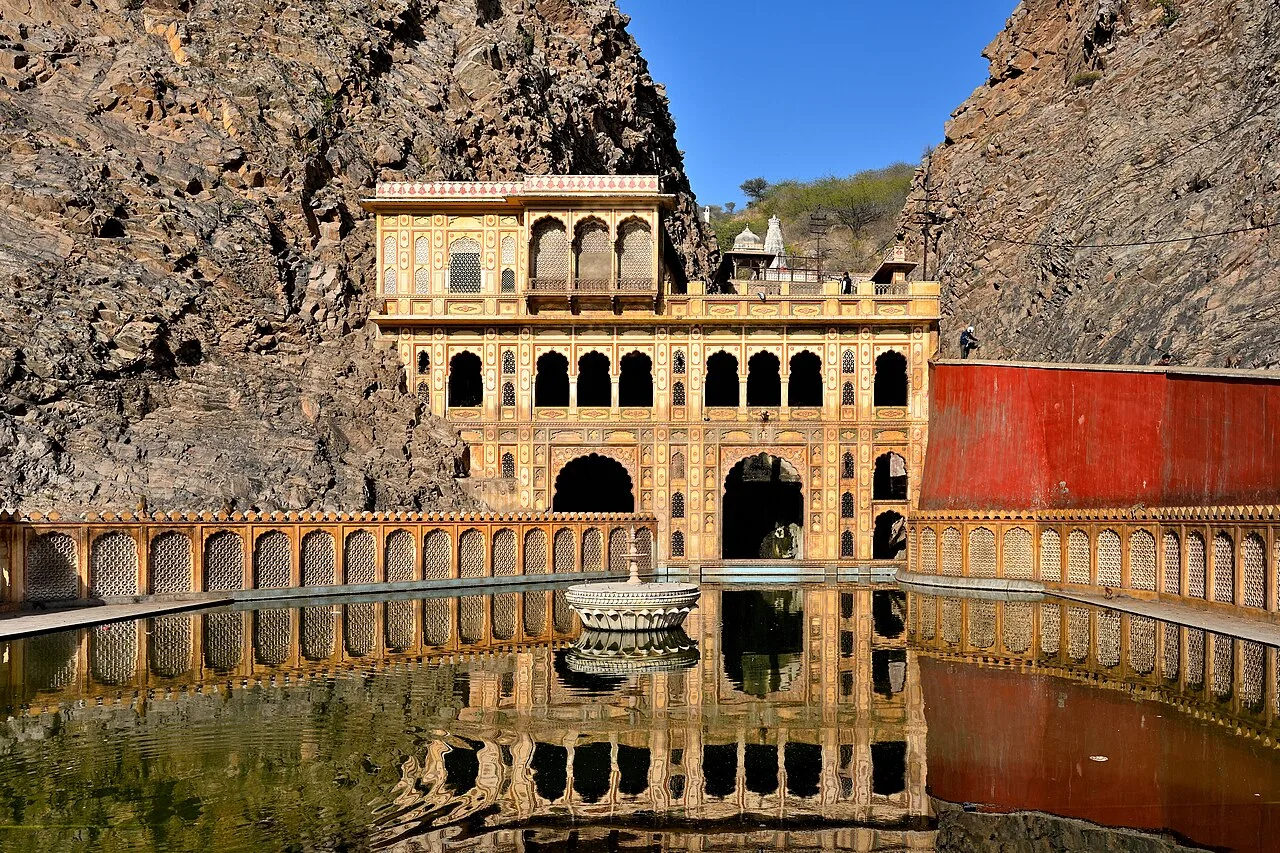
Set among the hills around Jaipur, Galtaji has several temples built within a narrow cleft. The site is in Rajasthan’s Jaipur district, roughly 10 km east of the city, and is regarded as an ancient Hindu pilgrimage place. A spring rises on the hillside and flows down through the complex, supplying a succession of sacred kunds, or bathing tanks. Pilgrims bathe in these waters. The path climbs beyond the highest pool to a hilltop temple, with views across Jaipur and its fortifications. Belief holds that the sage Galav lived at Galtaji, meditated there and undertook tapasya, or penance. Rajasthan is the land of Rajput forts and palaces, painted havelis, desert folk music, puppetry and colourful fairs such as the Pushkar camel fair. Rajasthan is very hot from April to June — often above 45 °C in the desert — with a short monsoon in July–September. Winter days are pleasant and nights are cold, especially in the Thar Desert. Mount Abu is the state's only hill station and stays cooler. The usual best time to visit is October to March. Timings, fees and access arrangements must be confirmed locally. For official information, see Rajasthan Tourism at https://www.tourism.rajasthan.gov.in.
Why it matters
Galtaji is an important Hindu pilgrimage site in Jaipur district, about 10 km east of Jaipur. Its temples, natural spring and sacred kunds (water tanks) draw pilgrims as well as visitors interested in Rajasthan’s religious heritage. The complex is traditionally associated with the sage Galav, and its setting in a narrow hill cleft gives it a distinctive place in Jaipur’s landscape. Its importance is primarily regional and devotional, with connections to living worship and pilgrimage rather than only to monumental architecture. Visitors can observe prayers and rituals, provided they do so respectfully. No UNESCO or Archaeological Survey of India designation is asserted here; check with the relevant authority for current information on heritage status and access.
Galtaji’s religious history is linked by tradition to the sage Galav, who is said to have meditated and performed penance here. That association gives the site its name and has sustained pilgrimage over generations, though the precise date of the earliest shrine is not firmly established in this account. The complex developed over time, with temples and water structures arranged along a narrow valley in the hills east of Jaipur. The present temple buildings are commonly attributed to Diwan Rao Kriparam, a court official during the period of Sawai Jai Singh II, the founder of Jaipur. They are generally associated with the eighteenth century, when Jaipur’s rulers and courtly households supported religious buildings and public works. The structures combine devotional use with features of the region’s palace and haveli architecture. The spring-fed kunds have remained central to worship and ritual bathing. Galtaji continues to serve as a place of pilgrimage, while also receiving day visitors from Jaipur. The complex is used and cared for as a living religious site, not simply as a historic ruin. Details of individual repairs or restoration campaigns should be confirmed with the temple caretakers or relevant heritage authority.
Origin stories & folklore
According to local tradition, the sage Galav lived in this hill valley, meditated and performed tapasya (penance). The name Galtaji is associated with him, and pilgrims regard the place as sacred because of this connection. Stories also describe the spring that feeds the kunds as a blessed or divinely provided source of water. Bathing in the tanks is a devotional act for some pilgrims and is believed by them to bring spiritual merit; such beliefs are part of living faith, not claims that can be independently verified. The many monkeys seen around the complex add to its familiar popular image, but visitors should not assume they are tame or feed them.
Architecture & design
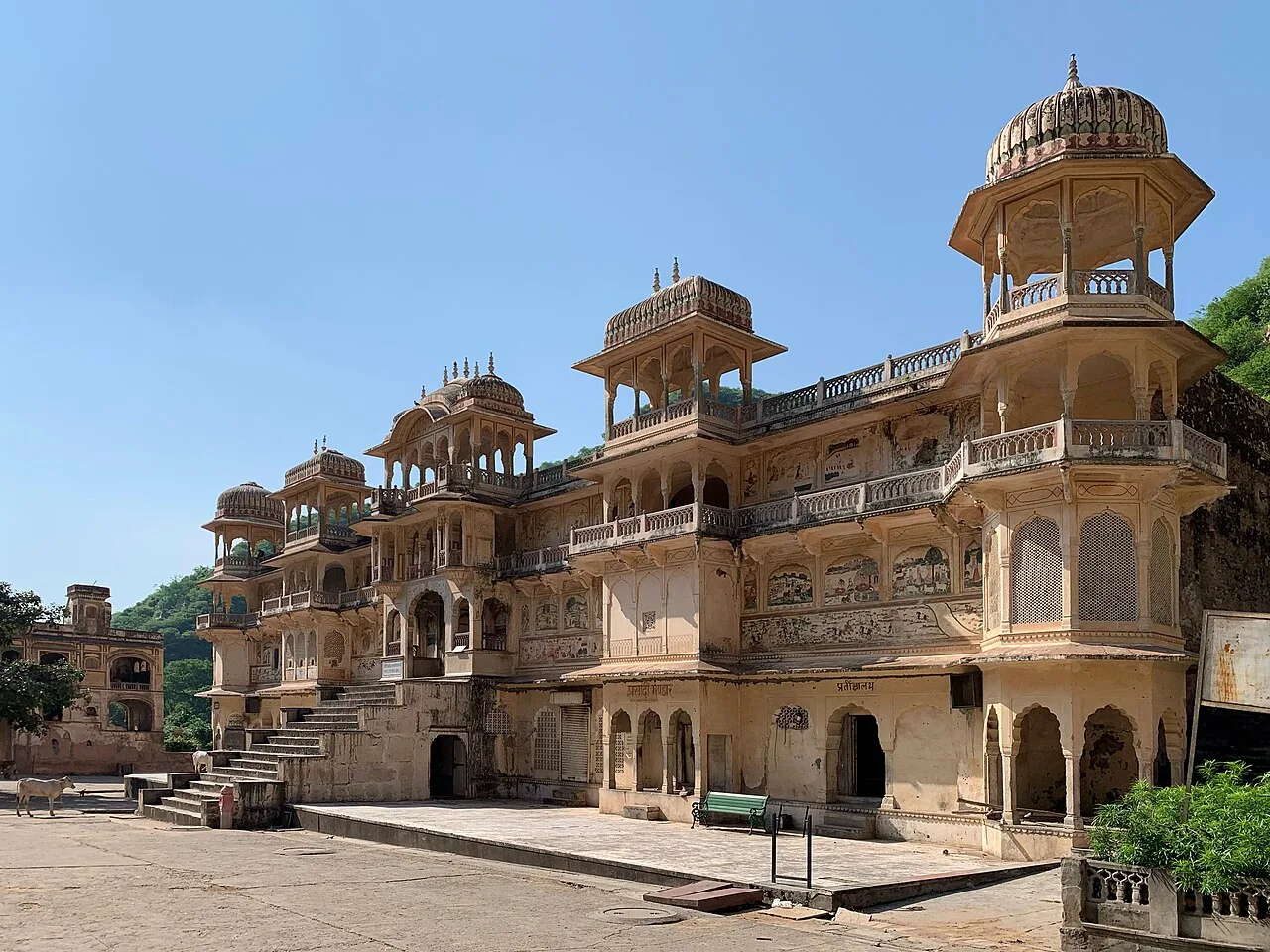
Galtaji’s buildings occupy a narrow cleft in the hills, following the contours of the valley rather than a single formal axis. The complex includes temples, pavilions, courtyards and a sequence of kunds fed by a natural spring that emerges higher on the hillside. Water moves down through channels and pools, making the landscape itself part of the sacred design. The tanks’ stepped edges provide access to the water, though conditions and access can vary. The temples are commonly described as having a haveli-like character, with arcades, balconies, domed or pavilion-like roof features and elaborately framed openings. Pink-toned stone and plastered surfaces are prominent, with painted decoration and carved details in places. The design reflects the devotional architecture of Rajasthan and the courtly building culture associated with Jaipur. Paths and steps continue uphill beyond the main pools toward shrines on the ridge, including a hilltop temple from which visitors can see Jaipur and its fortifications. The steep, confined setting makes circulation and views central features of the experience.
Important objects & sculptures
Visitors may notice shrine images and devotional fittings in the temples, but the principal focus is worship rather than a museum collection. Look for carved or painted details around doorways, pillars and niches, along with the domed pavilions and decorated surfaces. The spring outlet and the connected kunds are among the most significant features to observe: they show how water is gathered and directed through the complex and remain part of its religious use. Individual shrines and images may have access restrictions or be in active use, so follow posted instructions and ask caretakers before approaching, touching or photographing sacred objects. Do not treat offerings or ritual items as display objects.
Visit Galtaji with time to observe daily prayers and rituals respectfully. Follow the posted rules on footwear, photography, head covering and dress, and avoid interrupting worshippers. Ask caretakers which areas are open to visitors, and beware of unofficial 'guides' asking for donations. A comfortable itinerary is one main visit in the morning, a local meal at midday and a short nearby stop before an afternoon return. Use the district list on this site to find other places in Jaipur, but check the route and its condition before combining stops. If a festival or fair is on, roads and stays can be busy — and the experience can be unforgettable. Leave no litter: many sites are protected by the communities around them.
Suggested itineraries
Half day: Allow about 2–3 hours to reach Galtaji, explore the main temples and kunds, pause respectfully for worship, and walk to an accessible viewpoint before returning. Full day: Spend about 2–3 hours at Galtaji, have a meal back in Jaipur, then visit Sisodia Rani Garden and Vidyadhar Garden, allowing time for travel between stops. Gentler option: Stay near the lower temple area and main kunds, take frequent rests, and skip the uphill steps to the ridge if they feel strenuous.
Galtaji remains a working pilgrimage place. Visitors may encounter prayers, offerings, ritual bathing and other acts of worship, especially around the temples and kunds. The complex is associated with Vaishnav devotional traditions, although practices may vary between shrines and occasions. Hindi and Rajasthani are commonly heard in the Jaipur area. Modest clothing and quiet conduct are appropriate; follow local directions about footwear, head covering and entry to sanctums. Monkeys are a visible part of the surroundings, but they are wild animals and should not be fed or approached. Ask permission before photographing worshippers, and give people space during prayers and bathing rituals.
Festivals & events
Makar Sankranti, usually in January, is an important period for ritual bathing and pilgrimage at Galtaji, and the site may be particularly crowded. Some visitors also come for observances around Kartik Purnima, generally in October or November, though the scale and arrangements can vary. Festival dates shift with the lunar calendar, so confirm locally before planning around a specific observance. Jaipur’s wider calendar includes events such as Teej and Gangaur, but these are city-wide celebrations rather than festivals exclusive to Galtaji. During busy religious days, expect more people around the approach, temples and water tanks, and allow extra time.
Local food in Rajasthan includes dal baati churma, gatte ki sabzi, ker sangri, laal maas, pyaaz kachori, mirchi vada, ghewar, mawa kachori and chaach (spiced buttermilk). Ask what is fresh that day; many small eateries cook a limited daily menu. Vegetarian travellers eat very well across this region, and most towns also have non-vegetarian options. Remote sites may have no restaurant at all. Carry water and snacks, eat a proper breakfast before long drives, and ask your accommodation for a packed lunch if you are heading out early. If prasad or langar is offered, accept it according to local custom. Choose busy, clean places and carry your packaging back with you.
Shopping & local experiences
Galtaji itself is primarily a place of worship, so do not expect a large or dependable shopping area within the complex. In Jaipur, visitors can look for block-printed textiles, blue pottery, lac bangles, leather mojari footwear and other regional crafts. Johari Bazaar, Bapu Bazaar and Tripolia Bazaar are well-known city markets, though stock and opening arrangements vary. Ask about materials and workmanship, and compare items before buying. A meal in Jaipur is a good way to explore local food, including Rajasthani dishes; choose a clean, established restaurant and check ingredients if you have dietary needs.
October to March
The nearest principal railway station by straight-line distance is Dausa, roughly 20 km away. The nearest operating airport by straight-line distance is Jaipur International Airport, roughly 30 km away. These figures are calculated from map coordinates — actual road distance is longer. Jaipur, Ajmer, Jodhpur, Udaipur and Kota are the main rail hubs, and Jaipur, Udaipur and Jodhpur have the most flights; Delhi is the usual gateway for the north-east of the state. For the final leg, Rajasthan State Road Transport Corporation (RSRTC) buses and private coaches link district towns; shared taxis usually leave early in the morning. A private taxi gives more flexibility for remote sites. When comparing train, bus and flight, count the complete door-to-door time: a flight saves the most time only if the onward road transfer is short, while an overnight train can save a hotel night. Book your return before you leave, because seats fill quickly on weekends, festivals and holidays. Current train numbers, timings, return services and fares are not listed here; check IRCTC and NTES for trains and the airline's own schedule for flights. No permit is needed to visit Rajasthan. Land close to the international border west of Jaisalmer and Barmer is restricted beyond certain points: places such as Tanot can be visited, but border outposts need Border Security Force permission. Forts and palaces charge entry and camera fees, and tiger-reserve safaris must be booked through the official forest department portal.
Confirm onward and return timings on IRCTC / NTES, the state bus operator or your airline before travel. A dash means current timings or fares have not been verified.
Getting around
From Jaipur, visitors commonly reach Galtaji by auto-rickshaw or taxi; a private car offers more flexibility for combining nearby stops. Local buses may serve parts of the area, but routes and the final approach should be checked locally. Parking and vehicle access near the complex can be limited or affected by crowds, so ask the driver where to wait and agree on a pickup point. Expect to walk from the approach into the temple complex, with steps and uneven paths within it. Carry water for the walk, but avoid leaving bottles or other litter behind.
Hours, tickets & permissions
Entry arrangements can differ between the temple areas and individual shrines. Some spaces may be restricted during worship or closed to visitors, and rules may apply to footwear, photography, dress and access to the kunds. Do not assume that every part of the complex is open or that a single ticket covers all areas. Ask caretakers about current entry requirements and any permitted offerings or visitor conduct. Confirm current opening hours, fees and other rules with the managing authority before setting out; arrangements can change on festival days.
Facilities
Facilities within the complex may be basic and can vary. Toilets, drinking water, food stalls and seating should not be assumed to be available or open; check locally and carry water. Jaipur has a wider choice of restaurants, shops, ATMs and visitor services, so plan to use those before or after the visit. Parking may be available near the approach, but space can be limited, particularly when the site is busy. Guides may offer services, but ask temple caretakers for reliable information and clarify any arrangements before proceeding. Keep personal belongings secure around monkeys.
Accessibility
The approach and temple complex include uneven surfaces, steps and sloping paths. Continuing uphill beyond the main pools involves a steeper walk, and reaching the ridge or hilltop shrine may be difficult for visitors with limited mobility. Wheelchair and stroller access should not be assumed; there may be no continuous step-free route through the complex. Shade and places to rest can be intermittent, especially on exposed sections. Older visitors and anyone with balance, heart or mobility concerns may prefer to remain near the lower temples, go with a companion and take breaks. Check conditions locally, particularly after rain.
No permit is needed to visit Rajasthan. Land close to the international border west of Jaisalmer and Barmer is restricted beyond certain points: places such as Tanot can be visited, but border outposts need Border Security Force permission. Forts and palaces charge entry and camera fees, and tiger-reserve safaris must be booked through the official forest department portal. Carry a photo ID at all times and save the emergency number 112 and your accommodation's contact offline. Heat in summer and fog in winter are the main weather risks; carry water and allow extra travel time on foggy December–January mornings. Respect community rules, private property and posted instructions. Follow local guidance if access changes.
Photography
Morning or late-afternoon light can bring out the hill setting and the warm tones of the buildings; views from higher paths include Jaipur and its fortifications. Photography rules may differ between courtyards, shrines and active worship areas, so look for notices and ask caretakers before taking pictures indoors. Do not photograph people bathing or praying without permission, and avoid interrupting rituals to get a view. Drone use may require permissions and can be restricted around religious sites and the city; do not fly one without confirming current rules with the relevant authorities.
Choose a stay by the full journey to Galtaji, not just the district name. Heritage havelis, fort hotels, state tourism (RTDC) hotels and desert camps offer distinctive stays; check that a desert camp is licensed and has proper toilets. In summer, check air-conditioning or coolers; in December and January, check heating and hot water. Book in advance for weekends, festivals and the peak season (October to March). Confirm the exact location, meals included, check-in time and cancellation terms in writing. Avoid sending money to unverified contacts or touts at stations. Carry some cash, as card and digital payments can be unreliable in remote areas.
Within the Galtaji setting, visitors may continue uphill to a temple on the ridge for views over Jaipur, if the route is open and manageable. In the same eastern Jaipur area, Sisodia Rani Garden and Vidyadhar Garden are possible additions for visitors interested in historic gardens and architecture. Jaipur’s central attractions include the City Palace, Jantar Mantar and Hawa Mahal; they are better treated as separate city stops rather than assumed to be within walking distance. Amber Fort is another major Jaipur-area sight, but combining it with Galtaji requires planning for road travel. Check routes and access conditions before linking several sites in one day.
For couples, Galtaji rewards a slow pace: arrive early for soft light and fewer crowds, share a local meal and keep the evening free. A heritage hotel or a lakeside sunset makes the trip memorable. Public displays of affection can be frowned upon in conservative communities and at religious sites, so be discreet. Keep a buffer in your itinerary, because weather and traffic can delay plans.
Q: How much time should I allow for Galtaji? A: A few hours is usually enough for the main temples and kunds; allow longer if you plan to walk uphill or visit during a busy observance. Q: When is a good season to visit? A: October to March is generally more comfortable than the hot summer. Check conditions locally, especially during the monsoon. Q: Is entry free, and do I need a permit? A: Entry rules and any fees can change or differ by area. Confirm current requirements with the temple caretakers or managing authority. Q: Is Galtaji suitable for children and elderly visitors? A: Families can visit, but watch children near water and monkeys. Steps and uneven paths may make the uphill sections difficult for older visitors or anyone with limited mobility. Q: Where should I stay nearby? A: Jaipur offers the broadest choice of accommodation. Choose a place based on your onward route and confirm transport arrangements for the visit.
Be the first to share photos, stories, advice or a helpful contact for Galtaji.
Loading…