
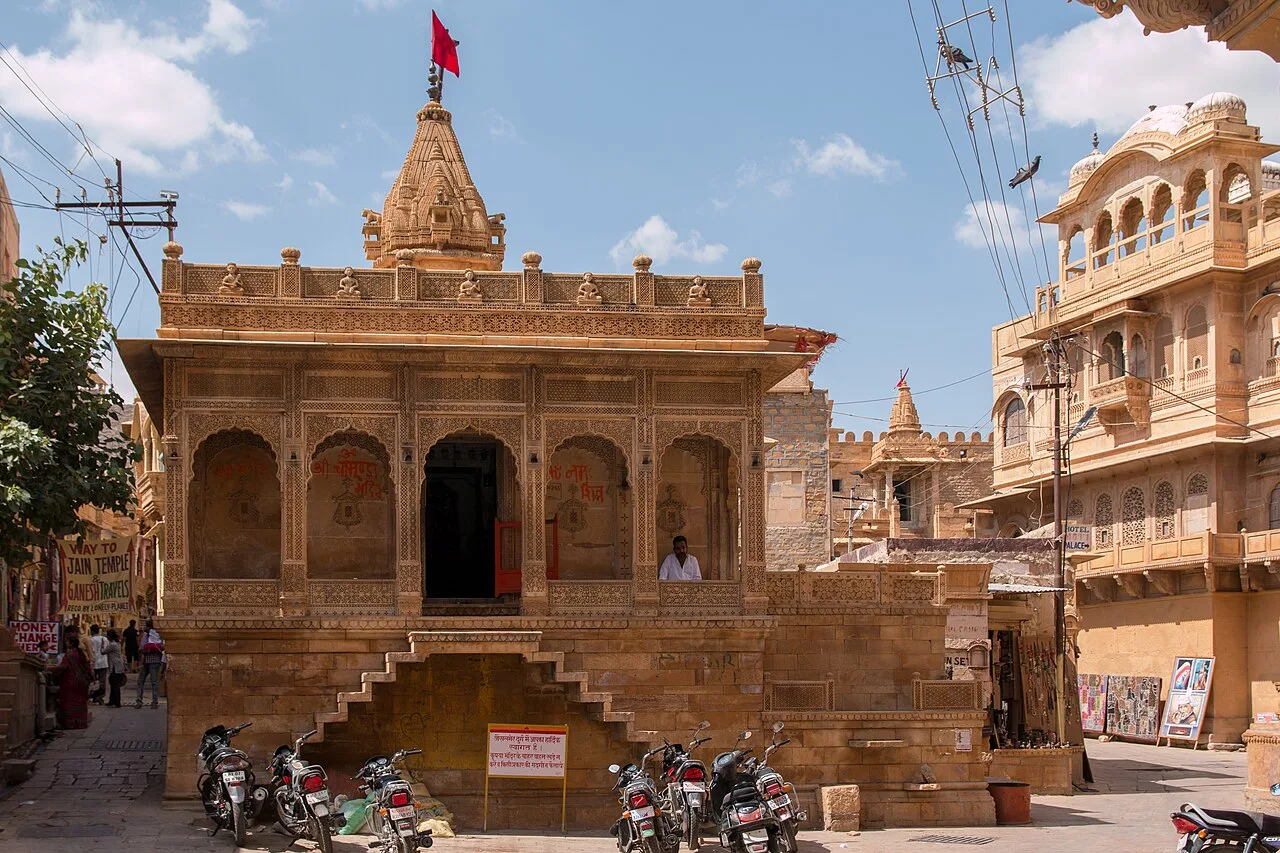
Jaisalmer Fort
Jaisalmer Fort is a historic sandstone stronghold in Rajasthan, known for its resident community, desert-coloured walls and location on old trade routes. Visitors come to explore its distinctive setting and history.
Key facts · verified by Ghumoopedia editors
- Type of place
- Heritage monument
- Best time to visit
- October to March
- Nearest railway station
- Jaisalmer · about 5 km (straight line)
- Nearest airport
- Jaisalmer Airport (seasonal flights) · about 5 km (straight line)
- Verified
- 21 Nov 2026
Plan a trip from Jaisalmer Fort — a day-by-day route through places nearby.
Jaisalmer Fort rises on Trikuta Hill amid the sandy Thar Desert, in Jaisalmer district, Rajasthan. Also known as Trikutgarh, it occupies high ground on the southern edge of the city that shares its name; its towers and defences can be seen from many miles away. Rawal Jaisal, the ruler who gave the fort its name, had it built in 1156 AD. It is Rajasthan’s second-oldest fort and developed at the meeting point of important trade routes, including the ancient Silk Road. The fort’s yellow sandstone changes appearance with the light. In daytime its walls have a tawny, lion-like tone; as the sun sets, they take on a honey-gold colour, blending with the yellow desert. This has earned the stronghold the names Swarn Durg, Sonar Quila and Golden Fort. Sonar Kella, Bengali for Golden Fortress, became familiar to visitors after a Bengali film of that title was shot inside the fort by eminent filmmaker Satyajit Ray. Jaisalmer Fort is a living fort: nearly one quarter of the old city’s population still resides inside its walls. For much of its 860-year history, the fort was Jaisalmer itself, with the settlement and its defences forming a single urban centre. As the population grew, the first neighbourhoods beyond the walls are said to have appeared in the seventeenth century. In 2013, the 37th session of the World Heritage Committee in Phnom Penh, Cambodia, recognised Jaisalmer Fort alongside five other Rajasthan forts as part of the UNESCO World Heritage listing Hill Forts of Rajasthan. Rajasthan is the land of Rajput forts and palaces, painted havelis, desert folk music, puppetry and colourful fairs such as the Pushkar camel fair. Rajasthan is very hot from April to June — often above 45 °C in the desert — with a short monsoon in July–September. Winter days are pleasant and nights are cold, especially in the Thar Desert. Mount Abu is the state's only hill station and stays cooler. The usual best time to visit is October to March. Timings, fees and access arrangements must be confirmed locally. For official information, see Rajasthan Tourism at https://www.tourism.rajasthan.gov.in.
Why it matters
Jaisalmer Fort is a major heritage landmark in Jaisalmer, Rajasthan, and an enduring reminder of the city’s role in desert trade. Traditionally dated to 1156, it grew into a fortified urban centre at the meeting point of important routes, including routes associated with the historic Silk Road. Unlike many forts preserved mainly as monuments, it remains inhabited: the existing guide estimates that nearly one quarter of the old city’s population lives within its walls, though the number may change. In 2013, the UNESCO World Heritage Committee included it in the Hill Forts of Rajasthan listing, alongside five other forts. Its golden sandstone profile has also made it a defining feature of Jaisalmer’s identity.
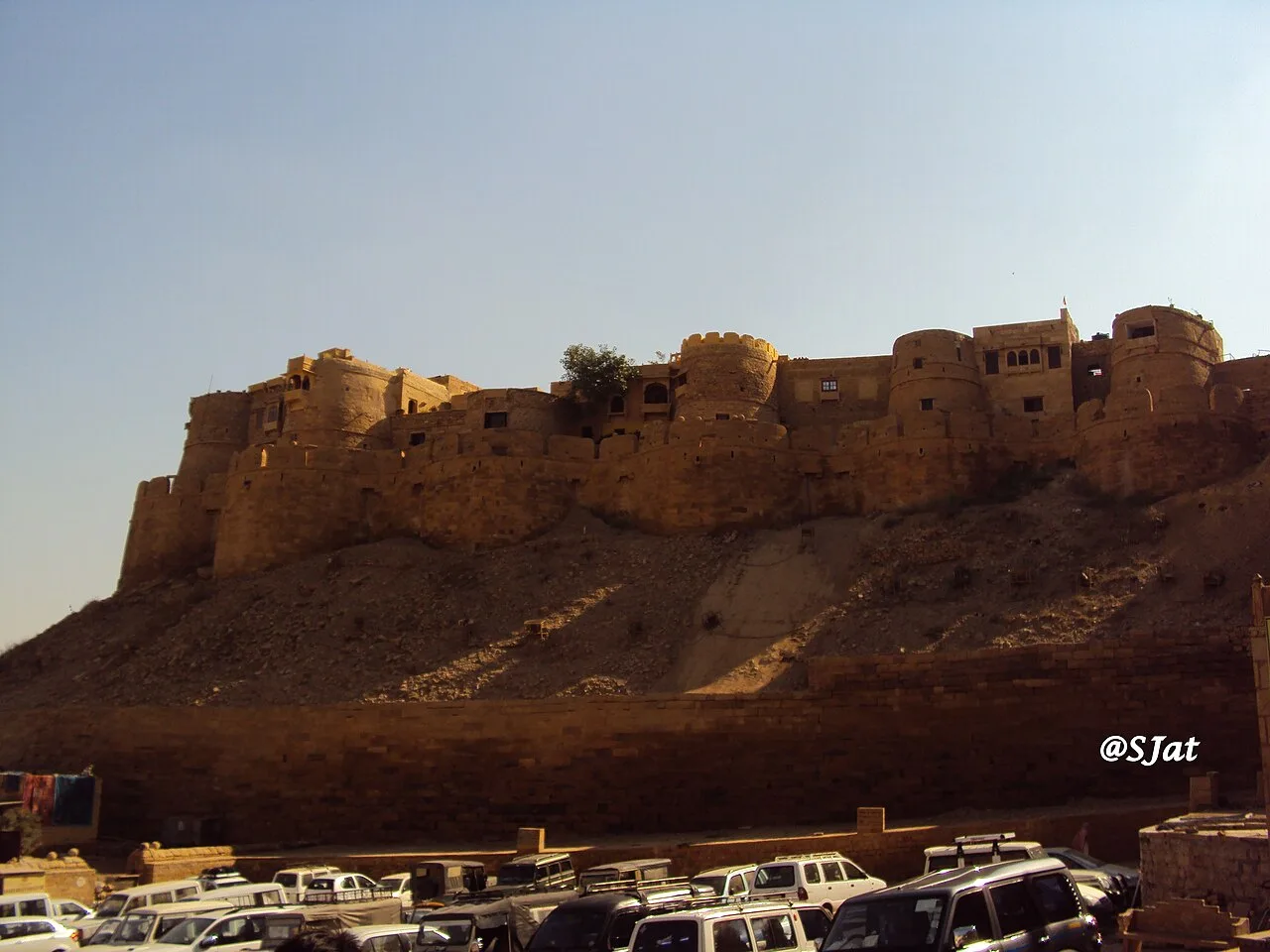
Jaisalmer Fort was founded in 1156 by Rawal Jaisal, the ruler from whom the city and fort take their names. Its position on Trikuta Hill gave it a commanding view over the surrounding desert and helped protect a settlement connected to long-distance trade routes. For centuries, the fort was effectively the city itself. As the population grew, settlements are said to have begun spreading beyond its walls in the 17th century. The fort developed over successive periods of Rajput rule and changing trade and political conditions. Its palaces, places of worship, homes and lanes reflect a town that continued to evolve rather than a single, completed building project. Jaisalmer’s trade connections brought wealth to some local families, visible in the carved residences and religious buildings within the fort. The fort is often described as Rajasthan’s second-oldest, after Chittorgarh. It remains a living neighbourhood, with homes and businesses alongside heritage sites. This continued use brings conservation challenges, including pressure on old buildings and infrastructure. In 2013, UNESCO inscribed Jaisalmer Fort as part of the serial World Heritage property Hill Forts of Rajasthan. Visitors should follow local guidance and avoid treating residential lanes as vacant museum spaces.
Origin stories & folklore
According to local tradition, Rawal Jaisal chose Trikuta Hill for his new stronghold after receiving guidance from a sage. Stories linked to the hill also connect it with ancient Hindu traditions and the idea that a fort would one day rise there. These accounts are part of the place’s remembered history, not independently verified records of the fort’s construction. The fort’s golden appearance has inspired another enduring description: as the sun lowers, its sandstone seems to blend with the desert light. This visual effect helped give it names such as Sonar Quila and Swarn Durg, meaning Golden Fort. The name Sonar Kella became familiar to many visitors through Satyajit Ray’s Bengali film of that name, filmed at the fort. Such stories and names enrich the site, but do not replace its documented history.
Architecture & design
The fort crowns Trikuta Hill and is built chiefly of locally sourced yellow sandstone. Its colour shifts from tawny in strong daylight to honey-gold in softer evening light, helping explain its popular name, the Golden Fort. Fortification walls and bastions follow the hill’s contours, while narrow, winding lanes fit a dense settlement shaped by the steep site. Within the walls, the built environment combines defensive works with palaces, temples, homes and small shops. The Rajput-era palace complex and the Jain temples are among the best-known historic buildings. Sandstone façades, carved details, balconies and screens show the skill of local stoneworkers. The fort is not simply a uniform military structure: it is a layered urban landscape that developed over many generations. Its elevated position offered visibility across the surrounding terrain, while compact lanes and closely grouped buildings made efficient use of limited space. The fort remains inhabited, so visitors should remember that many lanes and buildings are part of a functioning neighbourhood, not solely a monument.
Important objects & sculptures
Look for the carved sandstone details on historic façades, including decorative balconies, doorways and screens. The Jain temples within the fort are notable for their sculptural work and religious imagery; visitors should follow posted rules and observe respectfully, especially where worship is taking place. The royal palace complex offers a sense of the courtly life once centred within the fort, though access to rooms or displays can vary. Interpretation boards, where available, can help explain the fort’s history and individual structures. Inscriptions and other historic details may be present, but visibility and access differ by site. Do not touch carvings, idols or fragile surfaces, and check locally which buildings are open during your visit.
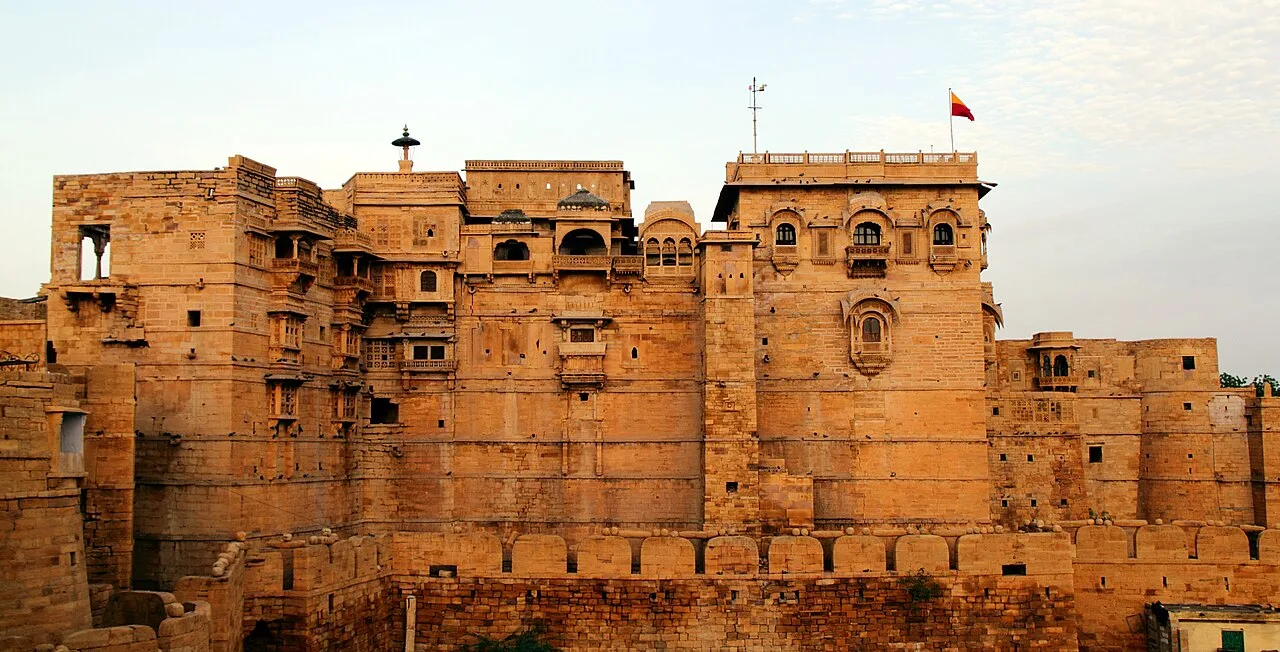
Explore Jaisalmer Fort slowly and read the interpretation boards, use the official audio guide where available or hire an authorised guide to understand its history. Check opening days, ticket counters and camera rules in advance; many monuments and museums close on one weekday and on some public holidays. Early morning gives softer light, cooler air and smaller crowds. A comfortable itinerary is one main visit in the morning, a local meal at midday and a short nearby stop before an afternoon return. Use the district list on this site to find other places in Jaisalmer, but check the route and its condition before combining stops. If a festival or fair is on, roads and stays can be busy — and the experience can be unforgettable. Leave no litter: many sites are protected by the communities around them.
Suggested itineraries
Half day: Enter the fort in the morning, walk its lanes and read interpretation boards (1–2 hours); visit an accessible palace or temple open to visitors (about 1 hour); pause for a local meal nearby. Full day: Explore the fort and its monuments in the morning (2–3 hours); take a relaxed midday meal and rest; visit Patwon ki Haveli and Gadisar Lake in the afternoon, allowing time for travel between stops. Gentler option: Choose a short, unhurried walk on the more manageable lanes, pause often, and visit one open monument; arrange a nearby vehicle drop-off and avoid trying to cover the whole fort.
Jaisalmer Fort is a lived-in neighbourhood as well as a heritage site. Residents, shopkeepers and worshippers use its lanes and buildings in everyday life, so visitors should be considerate around homes, temples and local businesses. Hindi and Rajasthani languages are widely heard in the city; visitors may also encounter other languages through tourism and trade. Jaisalmer’s wider cultural life is associated with desert folk music, dance, puppetry and colourful textiles. These traditions are presented at cultural events and venues around the city, though performances are not guaranteed inside the fort. Local customs vary by household and religious setting. Ask before photographing people, dress respectfully when entering places of worship, and keep noise low in residential lanes.
Festivals & events
The Jaisalmer Desert Festival is usually held in winter, commonly around January or February, with cultural programmes and activities staged at locations in and around the city. The programme and venues vary by year; check current local announcements before planning a visit. Festival periods can bring larger crowds, busier roads and increased demand for accommodation. Diwali and other religious festivals are observed by local communities, and temple activity may be especially significant on festival days. These occasions can affect access to particular buildings or lanes. Be respectful around ceremonies, follow local instructions and avoid assuming that a public event is taking place inside the fort itself.
Local food in Rajasthan includes dal baati churma, gatte ki sabzi, ker sangri, laal maas, pyaaz kachori, mirchi vada, ghewar, mawa kachori and chaach (spiced buttermilk). Ask what is fresh that day; many small eateries cook a limited daily menu. Vegetarian travellers eat very well across this region, and most towns also have non-vegetarian options. Remote sites may have no restaurant at all. Carry water and snacks, eat a proper breakfast before long drives, and ask your accommodation for a packed lunch if you are heading out early. Try a home-cooked or dhaba meal when you can — it is often the best food on the route. Choose busy, clean places and carry your packaging back with you.
Shopping & local experiences
The fort’s lanes and nearby Jaisalmer markets have shops selling textiles, embroidered goods, leather items, jewellery, puppets and small sandstone or camel-leather souvenirs. Look for locally made work, ask about materials and craftsmanship, and compare items before buying. Food shops and restaurants offer opportunities to try Rajasthani dishes and snacks, though menus and availability vary. Ask permission before photographing artisans or stalls, and avoid buying objects presented as antiquities unless their provenance and legality are clear.
October to March
The nearest principal railway station by straight-line distance is Jaisalmer, roughly 5 km away. The nearest operating airport by straight-line distance is Jaisalmer Airport (seasonal flights), roughly 5 km away. These figures are calculated from map coordinates — actual road distance is longer. Jaipur, Ajmer, Jodhpur, Udaipur and Kota are the main rail hubs, and Jaipur, Udaipur and Jodhpur have the most flights; Delhi is the usual gateway for the north-east of the state. For the final leg, Rajasthan State Road Transport Corporation (RSRTC) buses and private coaches link district towns; shared taxis usually leave early in the morning. A private taxi gives more flexibility for remote sites. When comparing train, bus and flight, count the complete door-to-door time: a flight saves the most time only if the onward road transfer is short, while an overnight train can save a hotel night. Book your return before you leave, because seats fill quickly on weekends, festivals and holidays. Current train numbers, timings, return services and fares are not listed here; check IRCTC and NTES for trains and the airline's own schedule for flights. No permit is needed to visit Rajasthan. Land close to the international border west of Jaisalmer and Barmer is restricted beyond certain points: places such as Tanot can be visited, but border outposts need Border Security Force permission. Forts and palaces charge entry and camera fees, and tiger-reserve safaris must be booked through the official forest department portal.
Confirm onward and return timings on IRCTC / NTES, the state bus operator or your airline before travel. A dash means current timings or fares have not been verified.
Getting around
The fort is within Jaisalmer city. Auto-rickshaws and taxis can bring visitors to an appropriate drop-off point, but narrow lanes inside the fort are best explored on foot. Confirm where vehicles are allowed to stop and use designated parking where available; congestion can affect access near busy entrances. Local buses may serve parts of the city, but routes and suitability for a particular visit should be checked locally. Wear shoes suited to uneven lanes, carry water and allow extra time for walking between the fort and other city sights.
Hours, tickets & permissions
Entry arrangements differ between the fort’s public lanes and individual ticketed monuments, museums or temples. Tickets, separate entry rules, camera restrictions and closures may apply at particular sites; some attractions may close on a weekday or public holiday. Dress or identification requirements can also depend on the place visited, especially at religious sites. Confirm current opening hours, fees, ticket arrangements and camera rules with the relevant managing authority or locally before setting out.
Facilities
Facilities vary between the fort’s public lanes and individual attractions. Food, drinks and small shops are usually available in or near the fort, while toilets and drinking-water points may be limited or located away from particular monuments; check locally and carry water. Guides may be available, but confirm their authorisation and agree on the scope of a visit before starting. ATMs and broader services are easier to find in the city. Parking is generally outside or near access points rather than within narrow lanes; follow local signs and advice.
Accessibility
The fort’s hilltop setting, uneven stone surfaces, narrow lanes and changes in level can make a visit physically demanding. Some routes include steps, slopes or tight passages, and shade is intermittent. Wheelchair and stroller access may be difficult; do not assume that ramps, lifts or step-free routes are available. Older visitors or anyone with limited mobility may prefer a short visit, frequent rests and a companion, while avoiding steep or crowded lanes. Ask locally about the condition of the intended route and access to individual monuments before entering.
No permit is needed to visit Rajasthan. Land close to the international border west of Jaisalmer and Barmer is restricted beyond certain points: places such as Tanot can be visited, but border outposts need Border Security Force permission. Forts and palaces charge entry and camera fees, and tiger-reserve safaris must be booked through the official forest department portal. Carry a photo ID at all times and save the emergency number 112 and your accommodation's contact offline. Desert heat is dangerous from April to September: travel early or late, wear a hat, carry plenty of water and watch for heat exhaustion. Desert nights in winter are cold, so pack a warm layer. Respect community rules, private property and posted instructions. Follow local guidance if access changes.
Photography
Early morning usually offers softer light, cooler conditions and fewer visitors; late-day light brings out the sandstone’s golden tones. Public lanes and exterior views are popular subjects, but rules can differ inside ticketed monuments, museums and religious buildings, so check signs and ask before photographing. Seek consent before taking close-up photographs of residents, worshippers or workers. Drone use may be restricted by aviation rules, local security conditions or site regulations; do not fly without confirming permission. Avoid blocking lanes or disrupting rituals for a photograph.
Choose a stay by the full journey to Jaisalmer Fort, not just the district name. Heritage havelis, fort hotels, state tourism (RTDC) hotels and desert camps offer distinctive stays; check that a desert camp is licensed and has proper toilets. In summer, check air-conditioning or coolers; in December and January, check heating and hot water. Book in advance for weekends, festivals and the peak season (October to March). Confirm the exact location, meals included, check-in time and cancellation terms in writing. Avoid sending money to unverified contacts or touts at stations. Carry some cash, as card and digital payments can be unreliable in remote areas.
Within Jaisalmer, Patwon ki Haveli, Nathmal ki Haveli and Salim Singh ki Haveli offer further examples of the city’s historic architecture. Gadisar Lake is another well-known city stop. Bada Bagh, a historic memorial complex, lies outside the central city, while Sam Sand Dunes are a popular desert excursion farther afield. These places can require separate transport and time; check road conditions, access and current local arrangements before combining them with a fort visit. The district list can help identify additional stops in Jaisalmer district.
For couples, Jaisalmer Fort rewards a slow pace: arrive early for soft light and fewer crowds, share a local meal and keep the evening free. A sunset on the dunes and a night under desert stars are memorable. Public displays of affection can be frowned upon in conservative communities and at religious sites, so be discreet. Keep a buffer in your itinerary, because weather and traffic can delay plans.
Q: How much time should I allow for Jaisalmer Fort? A: Allow at least a few hours for a relaxed walk and one or more open monuments; a broader city itinerary needs longer. Q: What is the best season to visit? A: October to March is generally the most comfortable period. Summer can be very hot, so check conditions and plan carefully. Q: Is there an entry ticket? A: The fort is a living neighbourhood, while individual monuments and museums may have separate tickets or rules. Confirm current arrangements locally. Q: Is the fort suitable for children and older visitors? A: Families can visit, but uneven lanes, steps and crowds require care. Visitors with limited mobility may prefer a short, gentle route. Q: Where can I stay nearby? A: Jaisalmer city has accommodation options, including in and around the fort area. Check location, access and current facilities before booking.
Be the first to share photos, stories, advice or a helpful contact for Jaisalmer Fort.
Loading…