
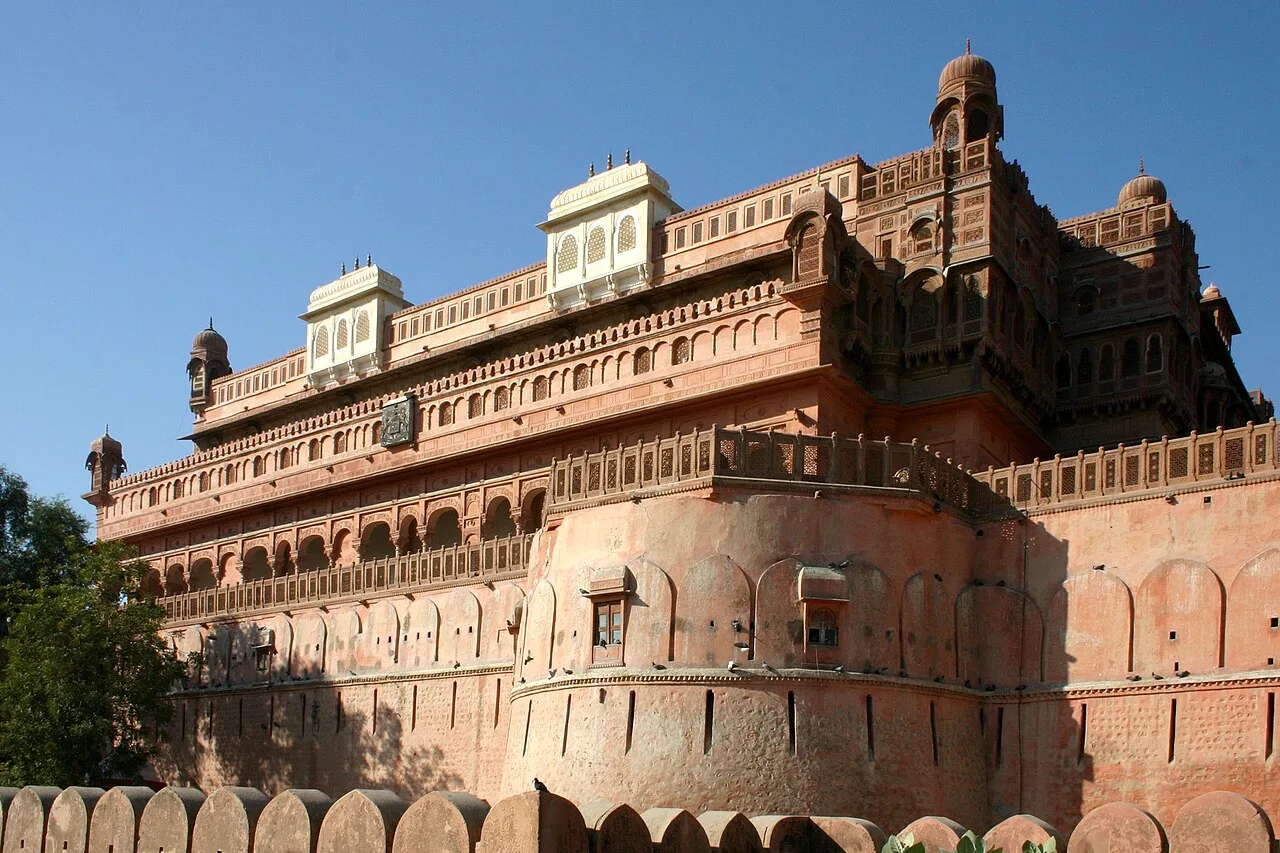
Junagarh Fort
Junagarh Fort is a historic complex in Bikaner, Rajasthan, known for its palaces, temples and pavilions. Visitors can explore its layered history and blend of architectural traditions.
Key facts · verified by Ghumoopedia editors
- Type of place
- Heritage monument
- Best time to visit
- October to March
- Nearest railway station
- Bikaner Junction · about 5 km (straight line)
- Nearest airport
- Bikaner (Nal) Airport · about 10 km (straight line)
- Verified
- 21 Nov 2026
Plan a trip from Junagarh Fort — a day-by-day route through places nearby.
Located in Bikaner district, Junagarh Fort was first known as Chintamani. In the early 20th century, the royal household shifted to Lalgarh Palace beyond the fort, after which the complex took the name Junagarh, meaning Old Fort. Members of a junior branch of the family continued to live within its walls. Unlike many prominent forts in Rajasthan, it does not stand on a hill. Bikaner’s built-up area grew around it. Raja Rai Singh, Bikaner’s sixth ruler, reigned from 1571 to 1611. His prime minister, Karan Chand, oversaw the fort’s construction. Work on the ramparts and surrounding moat began in 1589 and finished in 1594. The site was established beyond the city’s earlier stronghold, founded by Rao Bikaji, and lies about 1.5 kilometres from the city centre. Remains of that first fort can be seen close to Lakshmi Narayan temple. Although attackers made repeated attempts to seize Junagarh, it was captured only once, for a single day. The brief occupation came in 1534, when Kamran Mirza, Babur’s second son, attacked Bikaner during the rule of Rao Jait Singh. Covering 5.28 hectares, the fort precinct contains palaces, shrines and pavilions. Their varied styles reflect a meeting of architectural traditions and cultures. Rajasthan is the land of Rajput forts and palaces, painted havelis, desert folk music, puppetry and colourful fairs such as the Pushkar camel fair. Rajasthan is very hot from April to June — often above 45 °C in the desert — with a short monsoon in July–September. Winter days are pleasant and nights are cold, especially in the Thar Desert. Mount Abu is the state's only hill station and stays cooler. The usual best time to visit is October to March. Timings, fees and access arrangements must be confirmed locally. For official information, see Rajasthan Tourism at https://www.tourism.rajasthan.gov.in.
Why it matters
Junagarh Fort is a major historic landmark in Bikaner and an important record of the former Bikaner princely state. Its palaces, temples and courtyards show how royal buildings developed over several centuries and combine Rajput forms with influences from other architectural traditions. Unlike many well-known forts in Rajasthan, it stands on relatively level ground rather than a hilltop, with the modern city growing around it. The fort’s museum and historic interiors make it a key place for understanding the region’s courtly life, craftsmanship and history. This account does not claim a UNESCO designation or a specific official protection status; visitors should check current information from the fort’s management or relevant heritage authority.
The fort was built for Raja Rai Singh, the sixth ruler of Bikaner, whose reign lasted from 1571 to 1611. Historical accounts identify Karan Chand, Rai Singh’s prime minister, as supervising the project. Construction of the walls and moat began in 1589 and was completed in 1594. The fort stood beyond the earlier city fort founded by Rao Bika; some remains of that older fort are preserved near the Lakshmi Narayan temple. In 1534, before Junagarh Fort was built, Kamran Mirza, son of Babur, attacked Bikaner. Accounts describe a brief occupation of the city’s fort by Kamran, often noted as the exception to the later fort’s record of resisting capture. Junagarh was originally called Chintamani. In the early twentieth century, after the ruling family moved to Lalgarh Palace outside its walls, it became known as Junagarh, meaning “Old Fort.” Members of a cadet branch of the royal family continued to live within the complex. Successive rulers added palaces and other buildings, creating a layered ensemble rather than a single-period structure. The site now includes a museum, and its historic buildings and collections are maintained for visitors; check locally for current conservation and access arrangements.
Origin stories & folklore
Local accounts often describe Junagarh as a fort that enemies could not capture, while historical narratives note the brief occupation associated with Kamran Mirza in 1534. Because that event preceded the construction of the present fort, it should not be confused with an attack on its completed walls. Stories of the fort’s resilience form part of Bikaner’s historical memory, but details can vary in retelling. The complex also contains a royal temple where worship and courtly ceremonies were observed; visitors may hear local explanations of these customs. Treat such stories as tradition unless supported by historical records, and follow any posted rules around active places of worship.
Architecture & design
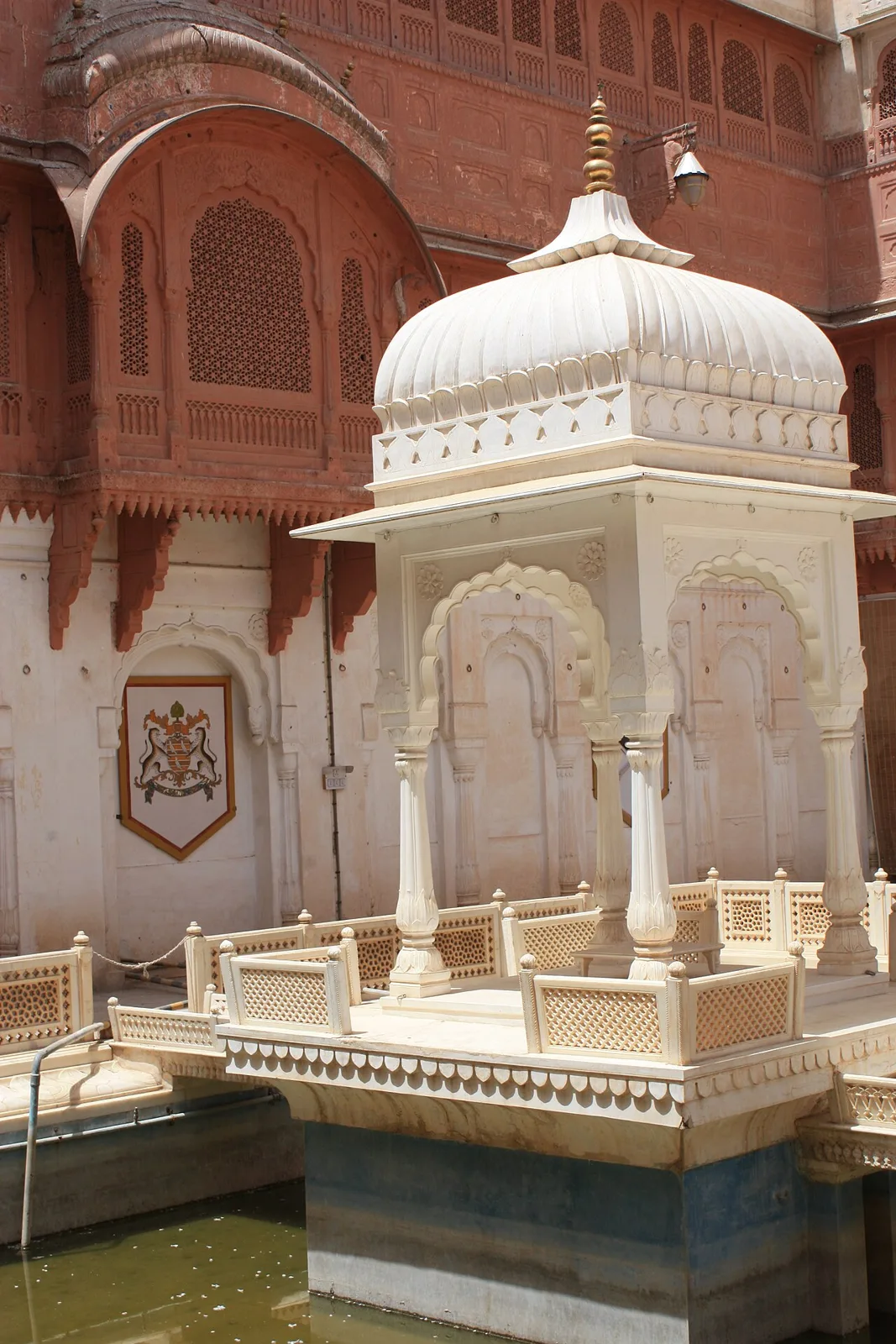
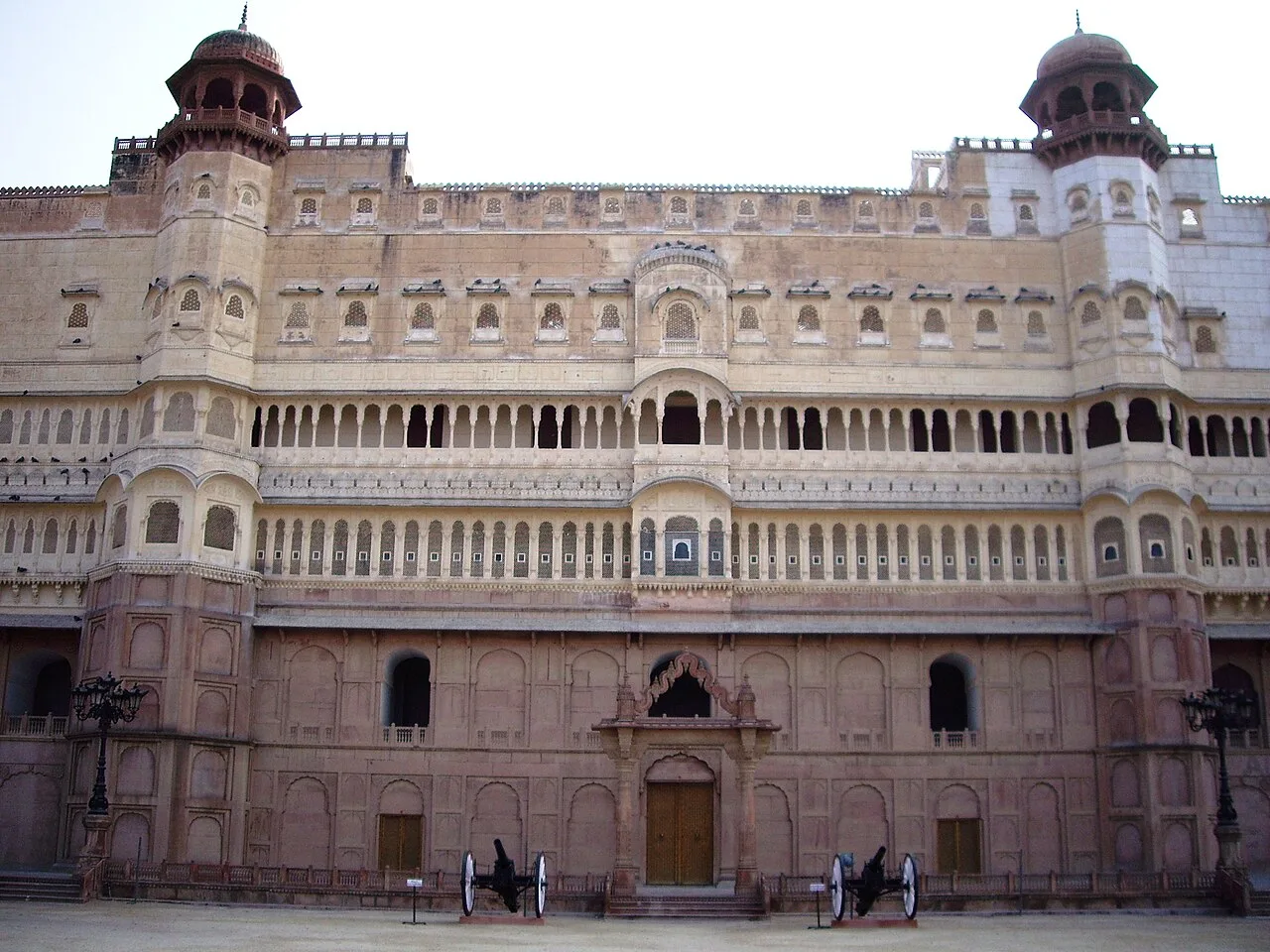
Junagarh occupies a roughly 5.28-hectare precinct on level ground, enclosed by defensive walls and an associated moat. Its red sandstone exterior contrasts with interiors that use marble, painted surfaces, mirror work, carved stone and decorative plaster. The complex grew over time and contains courtyards, audience spaces, residential apartments, temples and pavilions, rather than one uniform palace plan. Suraj Pol is a prominent entrance, while Karan Pol is another named gate. Notable palace areas include Anup Mahal, Phool Mahal and Badal Mahal, each with its own decorative treatment. The architecture draws principally on Rajput court traditions while showing Mughal and other regional influences in its ornament and planning. Painted rooms, patterned ceilings, jali screens and richly worked doorways reward a slow visit. The enclosed layout links public and private spaces and combines royal display with defensive construction.
Important objects & sculptures
Look for the fort’s painted and decorated interiors as well as the objects displayed in its museum. Collections have included arms, manuscripts, paintings, royal clothing, furnishings, palanquins and ceremonial equipment; which items are on view may change. The palace rooms contain details such as mirror work, carved doors, patterned ceilings and painted wall decoration. Har Mandir, the royal temple within the complex, is associated with Hindu worship and court ceremonies; observe any restrictions around its images and ritual spaces. Inscriptions and labels can help identify objects and their period, but displays may be rearranged, so follow current museum interpretation rather than relying on assumptions about an individual object.
Explore Junagarh Fort slowly and read the interpretation boards, use the official audio guide where available or hire an authorised guide to understand its history. Check opening days, ticket counters and camera rules in advance; many monuments and museums close on one weekday and on some public holidays. Early morning gives softer light, cooler air and smaller crowds. A comfortable itinerary is one main visit in the morning, a local meal at midday and a short nearby stop before an afternoon return. Use the district list on this site to find other places in Bikaner, but check the route and its condition before combining stops. If a festival or fair is on, roads and stays can be busy — and the experience can be unforgettable. Leave no litter: many sites are protected by the communities around them.
Suggested itineraries
Half day: Allow about 2–3 hours to explore the gates, courtyards, palace rooms, temple areas and museum at an unhurried pace; take a local meal afterward. Full day: Spend about 3 hours at the fort in the morning, have lunch in Bikaner, then visit a nearby city attraction such as Rampuria Havelis or Lalgarh Palace; check routes and access before setting out. Gentler option: Focus on the most accessible open areas and a small selection of palace rooms, take seated breaks, and arrange a taxi to avoid extra walking between stops.
Bikaner’s present-day culture reflects its desert setting and its history as a regional court and trading centre. Hindi and Rajasthani varieties, including Marwari, are commonly heard; visitors may also encounter other languages in the city. Folk music, devotional singing, puppetry and dance are part of the wider cultural life of Rajasthan, though performances are not guaranteed at the fort. Traditional dress, craft skills and local food remain visible in markets and festivals. The fort’s temples and ceremonial rooms recall the religious and court customs of former rulers, while the surrounding city is an active community rather than a museum setting. Ask before photographing people, and dress and behave respectfully in worship spaces.
Festivals & events
The Bikaner Camel Festival, generally held in January, features camel-related events and cultural programmes around the city; it can bring extra visitors and busier roads and accommodation. Diwali, Dussehra and Gangaur are observed in Bikaner and the wider region, with dates varying by the calendar. The Karni Mata fair at Deshnok, in Bikaner district, is another important nearby religious event and can attract large crowds. These celebrations are not necessarily held inside Junagarh Fort, and the fort’s access arrangements may differ during public events or holidays. Check local notices before planning a visit, especially if combining the fort with a festival outing.
Local food in Rajasthan includes dal baati churma, gatte ki sabzi, ker sangri, laal maas, pyaaz kachori, mirchi vada, ghewar, mawa kachori and chaach (spiced buttermilk). Ask what is fresh that day; many small eateries cook a limited daily menu. Vegetarian travellers eat very well across this region, and most towns also have non-vegetarian options. Remote sites may have no restaurant at all. Carry water and snacks, eat a proper breakfast before long drives, and ask your accommodation for a packed lunch if you are heading out early. Try a home-cooked or dhaba meal when you can — it is often the best food on the route. Choose busy, clean places and carry your packaging back with you.
Shopping & local experiences
Bikaner is known for its savoury snacks, including Bikaneri bhujia, papad and other namkeen; buy food from established shops and check packaging if carrying it home. In city markets, look for Usta-style decorative work, lacquer items, textiles, pottery and locally made footwear. Craft availability and materials vary, so ask sellers about the making process and provenance. Market visits can be combined with a local meal or a taste of regional sweets. Bargaining customs differ by shop, and respectful discussion is preferable to assuming a fixed price or an item’s authenticity.
October to March
The nearest principal railway station by straight-line distance is Bikaner Junction, roughly 5 km away. The nearest operating airport by straight-line distance is Bikaner (Nal) Airport, roughly 10 km away. These figures are calculated from map coordinates — actual road distance is longer. Jaipur, Ajmer, Jodhpur, Udaipur and Kota are the main rail hubs, and Jaipur, Udaipur and Jodhpur have the most flights; Delhi is the usual gateway for the north-east of the state. For the final leg, Rajasthan State Road Transport Corporation (RSRTC) buses and private coaches link district towns; shared taxis usually leave early in the morning. A private taxi gives more flexibility for remote sites. When comparing train, bus and flight, count the complete door-to-door time: a flight saves the most time only if the onward road transfer is short, while an overnight train can save a hotel night. Book your return before you leave, because seats fill quickly on weekends, festivals and holidays. Current train numbers, timings, return services and fares are not listed here; check IRCTC and NTES for trains and the airline's own schedule for flights. No permit is needed to visit Rajasthan. Land close to the international border west of Jaisalmer and Barmer is restricted beyond certain points: places such as Tanot can be visited, but border outposts need Border Security Force permission. Forts and palaces charge entry and camera fees, and tiger-reserve safaris must be booked through the official forest department portal.
Confirm onward and return timings on IRCTC / NTES, the state bus operator or your airline before travel. A dash means current timings or fares have not been verified.
Getting around
Bikaner Junction is the principal rail arrival point listed in the guide, with the fort roughly 5 km away in a straight line; road routes may be longer. Auto-rickshaws and taxis are practical for reaching the entrance, and private vehicles can be useful for combining sites around the city. Local buses serve parts of Bikaner, but check routes locally for the most convenient stop. The surrounding old city can be busy, so walking the final stretch may be easier than driving right to the entrance. Ask locally about designated parking and allow time for traffic and pedestrian areas.
Hours, tickets & permissions
Entry is generally subject to a ticket, and rules may differ between the fort grounds, museum areas and any special exhibits. Camera use, video recording, tripods or commercial photography may require permission or a separate fee; do not assume all equipment is allowed. Follow notices about restricted rooms, places of worship and photography. Carry identification if requested by the managing authority, and check whether any areas are closed for conservation or events. Confirm current opening days, hours, tickets, fees and access rules with the fort’s management before travelling.
Facilities
Facilities within the complex can vary by season and operating arrangements. Toilets are usually available on or near visitor routes, but check their location on arrival. Carry drinking water, particularly in hot weather, and confirm whether food or refreshments are sold inside; Bikaner has more options nearby. Guides may be available, and audio-guide availability should be checked locally. Parking and nearby cash or ATM services depend on current arrangements and location. Ask at the entrance about museum access, seating, assistance and any temporary closures before beginning the visit.
Accessibility
A visit involves walking across a large historic complex, with uneven surfaces, thresholds and steps in some areas. Palace interiors may have narrow passages and stairways, and not every room is likely to be accessible to visitors with limited mobility. Shade and places to rest can be limited in exposed courtyards, so plan breaks and carry water. Wheelchair and stroller access should not be assumed; contact the fort’s management before visiting to ask about usable routes and assistance. Older visitors or anyone who tires easily may prefer a shorter route, a companion, and a taxi close to the entrance where permitted.
No permit is needed to visit Rajasthan. Land close to the international border west of Jaisalmer and Barmer is restricted beyond certain points: places such as Tanot can be visited, but border outposts need Border Security Force permission. Forts and palaces charge entry and camera fees, and tiger-reserve safaris must be booked through the official forest department portal. Carry a photo ID at all times and save the emergency number 112 and your accommodation's contact offline. Desert heat is dangerous from April to September: travel early or late, wear a hat, carry plenty of water and watch for heat exhaustion. Desert nights in winter are cold, so pack a warm layer. Respect community rules, private property and posted instructions. Follow local guidance if access changes.
Photography
Early morning usually offers softer light and can mean cooler conditions and fewer visitors; courtyards and exterior walls provide varied compositions. Photography rules can differ by room, museum display and event, so check signs and ask staff before using a camera, flash or tripod. Do not photograph restricted objects or worshippers without permission. Drone use may be restricted by heritage-site rules and aviation regulations; obtain all required permissions rather than flying on assumption. Be considerate of other visitors and avoid blocking narrow passages while taking pictures.
Choose a stay by the full journey to Junagarh Fort, not just the district name. Heritage havelis, fort hotels, state tourism (RTDC) hotels and desert camps offer distinctive stays; check that a desert camp is licensed and has proper toilets. In summer, check air-conditioning or coolers; in December and January, check heating and hot water. Book in advance for weekends, festivals and the peak season (October to March). Confirm the exact location, meals included, check-in time and cancellation terms in writing. Avoid sending money to unverified contacts or touts at stations. Carry some cash, as card and digital payments can be unreliable in remote areas.
Within Bikaner, visitors can consider Lalgarh Palace, the Rampuria Havelis and the Lakshmi Narayan temple, whose area also preserves remnants associated with the earlier city fort. Devi Kund Sagar is a historic cenotaph complex outside the central city. Gajner Palace and Gajner Wildlife Sanctuary offer a different setting beyond the city; check access and road conditions before combining them with a fort visit. In Bikaner district, the Karni Mata Temple at Deshnok is a notable religious destination. These sites have separate opening and visitor arrangements, so confirm locally and avoid trying to fit too many distant stops into one day.
For couples, Junagarh Fort rewards a slow pace: arrive early for soft light and fewer crowds, share a local meal and keep the evening free. A sunset on the dunes and a night under desert stars are memorable. Public displays of affection can be frowned upon in conservative communities and at religious sites, so be discreet. Keep a buffer in your itinerary, because weather and traffic can delay plans.
Q: How much time should I allow for Junagarh Fort? A: Allow around two to three hours for a considered visit to the main areas and museum; add time if you want to read displays slowly. Q: When is a good season to visit? A: October to March is generally the more comfortable season in Rajasthan. Summer can be very hot, so check conditions and plan carefully. Q: Do I need a ticket, and can I take photographs? A: Entry is generally ticketed. Camera rules can vary by area, so confirm current fees and restrictions with the fort’s management. Q: Is the fort suitable for children and elderly visitors? A: Families can visit, but expect substantial walking and some uneven surfaces or steps. Older visitors may prefer a shorter route and rest breaks. Q: Where can I stay nearby? A: Bikaner has hotels and guesthouses in and around the city. Choose accommodation based on your transport needs and confirm current availability directly.
Be the first to share photos, stories, advice or a helpful contact for Junagarh Fort.
Loading…