
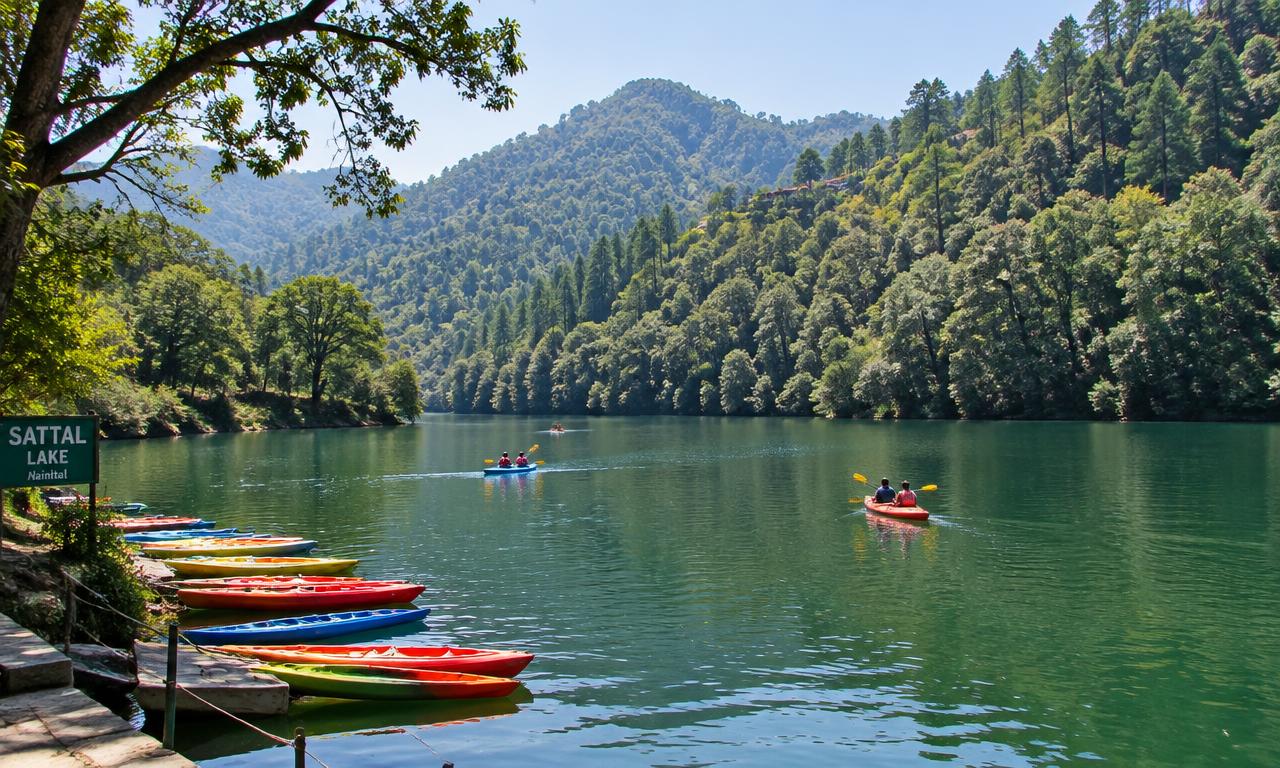
Sattal
Sattal is a lake destination in Kumaon, set among woodland. Visitors come to kayak, watch birds and enjoy a peaceful stay near Bhimtal and Nainital.
Key facts · verified by Ghumoopedia editors
- Type of place
- Natural attraction
- Best time to visit
- March–June, September–November
- Altitude
- 1,370 m
- Verified
- 21 Nov 2026
Plan a trip from Sattal — a day-by-day route through places nearby.
In Kumaon, Uttarakhand, Sattal, also known as Sat Tal, lies close to Bhimtal and Nainital. Its name translates as seven lakes, referring to a group of freshwater lakes and smaller water bodies among oak and pine trees. The seven do not appear as equally clear or reachable attractions from the main visitor area. Sattal is better approached as a wider natural setting to explore than as a fixed sequence of separate lake stops. Oak and pine woods surround the waters. Kayaking, birding and quiet places to stay are among the reasons people visit. At roughly 1,370 metres above sea level, Sattal suits travellers seeking birdwatching, boating, photography and quiet walks. The main lakeside activity zone can become busy on weekends, but accommodation away from it often feels considerably quieter. Allow two nights if you want an unhurried stay; a day trip works for boating and a short walk, but misses the early-morning atmosphere. March to June generally brings pleasant sightseeing weather, while October and November often offer clearer conditions after the rains. Winter mornings and evenings are cold. The monsoon makes the forest lush but can disrupt roads and outdoor plans. Check the forecast before travelling, and remember that lakeside paths may be uneven rather than promenade-style.
Why it matters
Sattal, also written Sat Tal, is a cluster of freshwater lakes in the Kumaon region of Uttarakhand, set among oak and pine woodland near Bhimtal and Nainital. Its name means “seven lakes,” though the smaller water bodies are not all equally visible or accessible from the main visitor area. The lakes and surrounding forest make it a regional destination for boating, birdwatching, nature walks and quieter stays. Its appeal lies in the connected lake-and-woodland landscape rather than in a single monument or built attraction. Sattal is not known as a UNESCO World Heritage Site or an ASI-protected monument; check with local authorities for any current site-specific conservation or access rules.
Sattal’s lakes are natural water bodies, not a complex built by a known ruler or architect. The name, meaning “seven lakes,” reflects the traditional description of a group of lakes and smaller waters within the forested landscape; their number and visibility can depend on how the cluster is understood and approached. There is no widely established written account assigning the lakes a single founding date or builder. Sattal forms part of the wider Kumaon lake country, whose settlements and travel routes developed over a long period. Hill travel and tourism in the Nainital region expanded during the colonial era, and later road access made nearby lakes more reachable for visitors. In more recent decades, Sattal has become known for nature-based tourism, including birdwatching, boating and stays in forest surroundings. Accommodation and activity options have grown, but development is not uniform across the area: the main lakeside zone is more active, while properties farther from it may feel quieter. The lakes and woodland remain the central attraction. For a detailed account of land-use or conservation changes, consult local forest and district sources rather than assuming a single restoration history.
Origin stories & folklore
There is no single, consistently documented origin legend for Sattal that can be confidently presented as local fact. The best-known traditional explanation is the name itself: “Sat Tal” means “seven lakes,” and local descriptions treat the waters as a connected group within the forest. The exact lakes included in that count may vary, and some are less obvious or accessible than others. Visitors may hear local stories about individual lakes or the surrounding hills, but these should be understood as oral tradition rather than verified history. Ask residents respectfully if they wish to share a story, and avoid presenting folklore as a scientific explanation for how the lakes formed.
- Take a boat ride from the main lakeside area when operations and weather permit. Ask about duration, total cost, permitted passenger numbers and life jackets before paying; verify current operating hours locally. - Book an early-morning birdwatching walk with a knowledgeable local naturalist. Sattal is well known for woodland birds, and a guide can help locate productive trails without disturbing habitat. Carry binoculars and avoid call playback. - Walk quieter forest paths with local advice about route conditions and access. Do not assume every track shown online is public, maintained or suitable after rain. - Try kayaking or other advertised outdoor activities only with a reputable operator, proper safety equipment and clear supervision. Availability changes seasonally. - Photograph reflections and forest scenery in softer morning light. Ask permission before photographing residents. - Add Bhimtal or Naukuchiatal as a separate half-day outing. Combining several lake towns with Nainital in one day can become mostly driving.
Suggested itineraries
Half day: Main lakeside area and orientation walk (about 30–45 minutes); boat ride if operating (allow about 1–2 hours); relaxed lakeside break (about 30 minutes). Full day: Early guided birdwatching walk (about 2–3 hours); breakfast and rest; main lake area and boating or photography (about 2 hours); choose either a quiet forest walk or a separate outing to Bhimtal (about 2–3 hours). Gentler option: Spend 1–2 hours near the accessible main lakeside area, take breaks at a nearby café or accommodation, and skip uneven forest paths and boat activities if they are uncomfortable.
Sattal is part of Kumaon, where Kumaoni and Hindi are commonly heard, alongside other languages used by residents and visitors. Everyday life here is shaped by the forested setting, nearby lake towns and seasonal tourism. Local customs are not staged performances: visitors may encounter regional food, hospitality and ordinary community life through homestays, shops or guided walks. There is no regular large-scale music or dance programme at the lakes themselves. Traditional dress may be worn for family, religious or festival occasions, but visitors should not treat residents as subjects for photographs without asking. Keep noise low around homes and woodland trails.
Local communities
The lakes are connected to residents of the Sattal area and the wider Kumaon region. Local livelihoods include tourism-related work such as accommodation, food service, transport, boating and guiding, alongside other work and small-scale businesses in nearby settlements. Naturalists and guides may help visitors explore birdlife and forest paths while sharing local knowledge. The area also has communities whose lives are not centred on tourism; ask before entering private land or photographing people. Use locally run services where practical, follow guidance about trail access, and do not assume that every forest track or lakeside property is open to the public.
Festivals & events
Sattal is not known for a major annual festival held at the lakes. Visitors may encounter Kumaoni celebrations in nearby towns and villages, including Harela, commonly observed in the monsoon season, and events associated with Nanda Devi in the wider Nainital region, often held in autumn. Dates and programmes vary by community and year, so check locally before making plans. Festival periods can bring extra activity and visitors to nearby town centres, while the lakeside may remain comparatively calm or become busier depending on local events and weekends. Be respectful around processions, shrines and private celebrations.
Expect simple North Indian meals, tea, snacks and seasonal menus at lakeside stalls, cafés and guesthouses. For Kumaoni cooking, ask your host in advance about bhatt ki churkani, dubke, mandua roti or seasonal greens; these are not guaranteed on every menu. Bal mithai is a regional sweet worth trying from a busy, reputable shop. Carry drinking water and snacks for early birding trips. Check kitchen closing times, and explain allergies clearly rather than relying only on menu descriptions.
Shopping & local experiences
Shopping at Sattal itself is limited compared with nearby towns. Visitors may find small refreshment stalls or basic local goods around the activity area, but should not expect a large craft market. Bhimtal and Nainital offer a broader choice of shops, where Kumaoni foods, locally made items and regional souvenirs may be available; check the origin and materials of products before buying. Try regional dishes at local eateries or accommodation, and ask about ingredients if you have dietary needs. Choose reusable packaging where possible and avoid purchasing products made from wildlife or other protected natural materials.
Sattal lies at roughly 1,370 metres above sea level in a wooded landscape of interconnected freshwater lakes and smaller water bodies. Oak and pine are characteristic of the surrounding forest, with other vegetation varying by slope and season. The woodland and water edges support a range of birdlife, making the area popular with birdwatchers; sightings vary, and quiet observation is more reliable than expecting any particular species. The setting also offers reflections, forest paths and seasonal changes in foliage. The monsoon brings lush growth but may affect trails and roads. Stay on routes confirmed as accessible, avoid disturbing nests or wildlife, and do not feed birds or play recorded calls.
March–June, September–November
Kathgodam is the usual railhead, roughly 30–35 kilometres away by road. Prebook a taxi or arrange pickup through your accommodation; hill-road travel commonly takes around an hour or longer, depending on traffic and your property's location. Confirm the full fare, luggage allowance and waiting charges beforehand. Pantnagar is the nearest airport with scheduled services, approximately 60–70 kilometres away by road; verify current flights before planning around it. Delhi arrivals face a much longer onward journey. From Nainital, Sattal is roughly 20–25 kilometres by road; Bhimtal is closer. Local buses and shared vehicles may not reach your property's doorstep. Confirm last-mile transport, especially for evening arrivals. Download offline maps and request a precise location pin.
Getting around
Most visitors arrive by road and use a prearranged taxi or accommodation pickup to reach their stay. Once in Sattal, the main lakeside area can be explored on foot, but paths may be uneven and properties can lie away from the visitor zone. Taxis may be useful for moving between scattered stays and nearby lake towns; confirm pickup arrangements in advance, particularly for evenings. Local buses or shared vehicles may not serve every property or provide convenient last-mile access. Parking is generally relevant near the main activity area, but availability can vary when it is busy. Boat services operate only when available and conditions permit.
Hours, tickets & permissions
Access arrangements can differ between the lakeside, private properties, activity areas and forest paths. Some services may require a ticket, permit or operator booking; camera or activity rules can also vary. Do not assume that access to one area covers the whole lake cluster, or that every trail is public. Ask locally about restrictions, closures and any applicable entry, camera or activity charges before setting out. Confirm current hours and fees with the managing authority or relevant local operator, as arrangements may change with season, weather or conservation needs.
Facilities
The main lakeside visitor area usually has small food and refreshment options, and boating or other activities may be available seasonally. Toilets, drinking water, parking and seating can be limited or unevenly distributed, so check locally and carry water. Accommodation ranges from stays near the activity zone to quieter properties farther away; facilities depend on the property. Guides and naturalists can often be arranged through local operators or accommodation, but book or confirm availability ahead. ATMs and a wider range of shops and services are more likely in nearby towns such as Bhimtal or Nainital than at the lakes themselves.
Accessibility
Sattal is not a fully level, promenade-style attraction. The main lakeside area has walking surfaces that may be uneven, and forest paths can include slopes, loose ground or muddy sections after rain. Distances between a visitor’s accommodation, the lakeside and quieter trails vary. Shade is available under woodland, but lakeside exposure and weather can change through the day. Wheelchair and stroller access should not be assumed, and boats may require stepping on or off at a dock. Older visitors or anyone with limited mobility may prefer a short visit near the main activity area, with a companion and frequent rests. Check the exact route and conditions before arrival.
Wear a properly fastened life jacket for every boat or kayak outing; avoid swimming unless a specifically managed activity provides qualified supervision. Forest paths can be slippery, isolated or poorly marked, so finish walks before dark and tell your host your route. Keep food away from monkeys and do not approach wildlife. Carry regular medicines, basic first aid and a charged phone. Ask where the nearest functioning clinic is; more comprehensive treatment may require travel toward Haldwani. During heavy rain, check road conditions locally before departure. India's emergency number is 112.
Photography
Soft morning light is often useful for lake reflections, woodland detail and birdwatching, though mist and weather vary by season. The main lakeside and public paths offer general views; quieter viewpoints may require walking on uneven ground, so confirm access locally. Ask permission before photographing residents, guides or private property, and be especially considerate around religious observances. Avoid approaching birds or nesting areas for a closer image. Drone use may be restricted by local rules, landowners or aviation regulations; check permissions before flying and do not assume it is allowed.
Choose between lakeside lodges, forest-edge homestays, cottages and activity-oriented camps. For quiet, ask how far the property is from the main boating area and whether it hosts groups or amplified music. Confirm road access, parking, stairs, hot water, heating charges, mobile reception and meal availability. Some scenic properties involve steep approaches or walks with luggage. Seniors should request recent entrance photographs. Book ahead for holiday weekends, and verify cancellation terms, especially during monsoon weather. Compare total costs including meals and transfers.
Bhimtal is a close-by lake town and can be visited as a separate outing; its lakeside setting and local services differ from Sattal’s quieter wooded atmosphere. Naukuchiatal is another nearby lake destination, while Nainital offers a larger town centre, lakefront and established visitor services. These places are better treated as separate stops rather than rushed into one day with a full Sattal visit. Kathgodam is the usual railhead for the region, not a sightseeing stop for most itineraries. Road conditions and travel time vary, so plan around your accommodation’s location and avoid overloading a day with several hill-road transfers.
Plan two nights with one early lakeside outing and plenty of unscheduled time. A quiet cottage or small homestay usually suits a relaxed trip better than accommodation beside the busiest activity stalls. Ask specifically about privacy, neighbouring rooms and evening noise. Reserve transport for dinner outside your property rather than expecting taxis on demand. Choose a daytime forest walk or boat ride for shared time outdoors; avoid secluded trails after sunset.
Q: How much time should I allow for Sattal? A: A half day can cover the main lakeside area and a boat ride if available. Two nights suit a slower visit with early birdwatching and quiet walks. Q: When is a good season to visit? A: March to June is generally pleasant for sightseeing, while October and November often bring clearer conditions. Winter is cold, and monsoon weather can disrupt outdoor plans. Q: Is there an entry fee for Sattal? A: Entry and activity arrangements can vary by area and operator. Confirm current rules and any fees locally before visiting. Q: Is Sattal suitable for children and elderly visitors? A: Families can enjoy the lakeside, but supervise children near water. Uneven paths and slopes may challenge older visitors or anyone with limited mobility. Q: Can I stay near Sattal? A: Yes. Accommodation is available in and around the area, including quieter stays away from the main lakeside zone. Confirm the exact location and last-mile transport before booking.
Be the first to share photos, stories, advice or a helpful contact for Sattal.
Loading…