
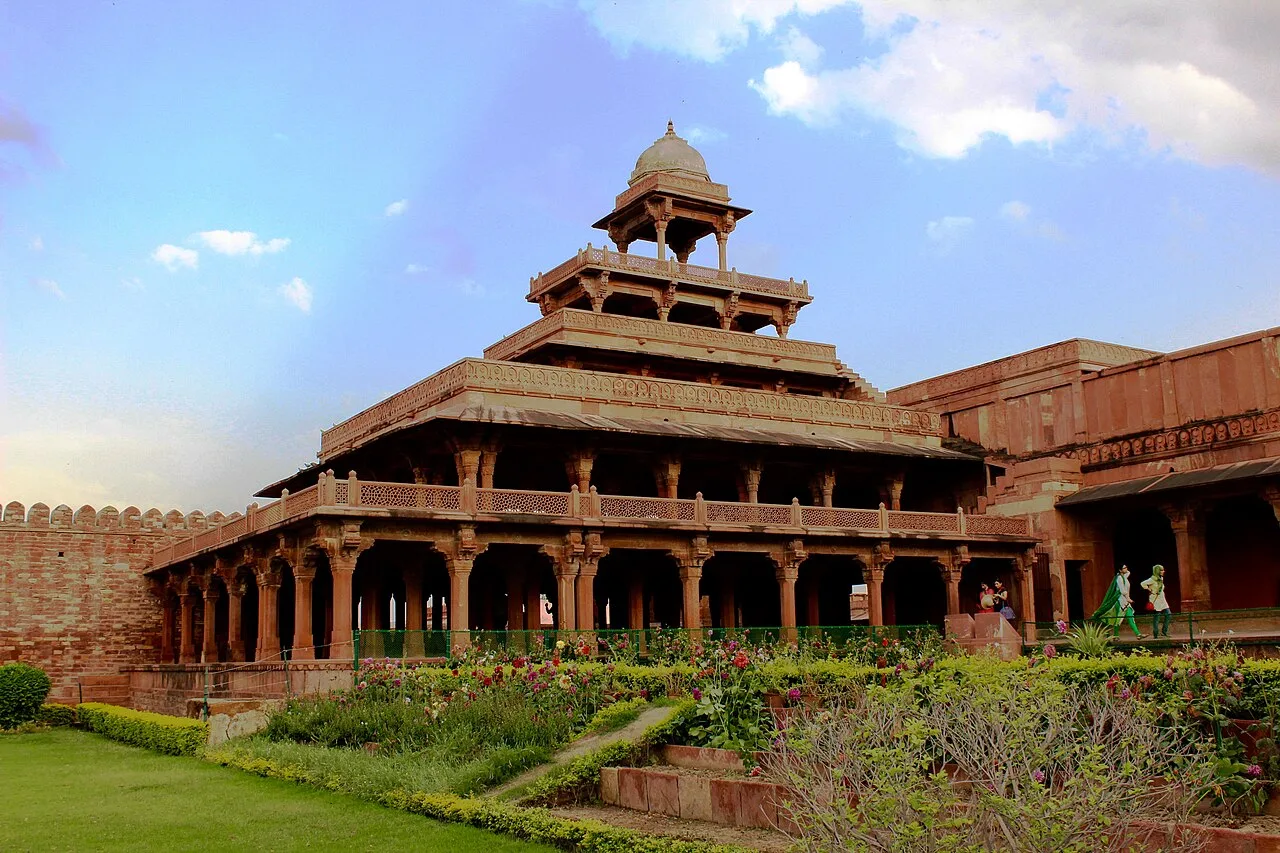
Panch Mahal, Fatehpur Sikri
Panch Mahal is a five-level palace at Fatehpur Sikri, commissioned by Akbar. Visitors see its tiered, carved architecture and learn about its possible role in royal recreation beside the Anoop Talab.
Key facts · verified by Ghumoopedia editors
- Type of place
- Heritage monument
- Best time to visit
- October to March
- Nearest railway station
- Agra Cantt · about 33 km (straight line)
- Nearest airport
- Agra Airport (Kheria) · about 30 km (straight line)
- Verified
- 21 Nov 2026
Plan a trip from Panch Mahal, Fatehpur Sikri — a day-by-day route through places nearby.
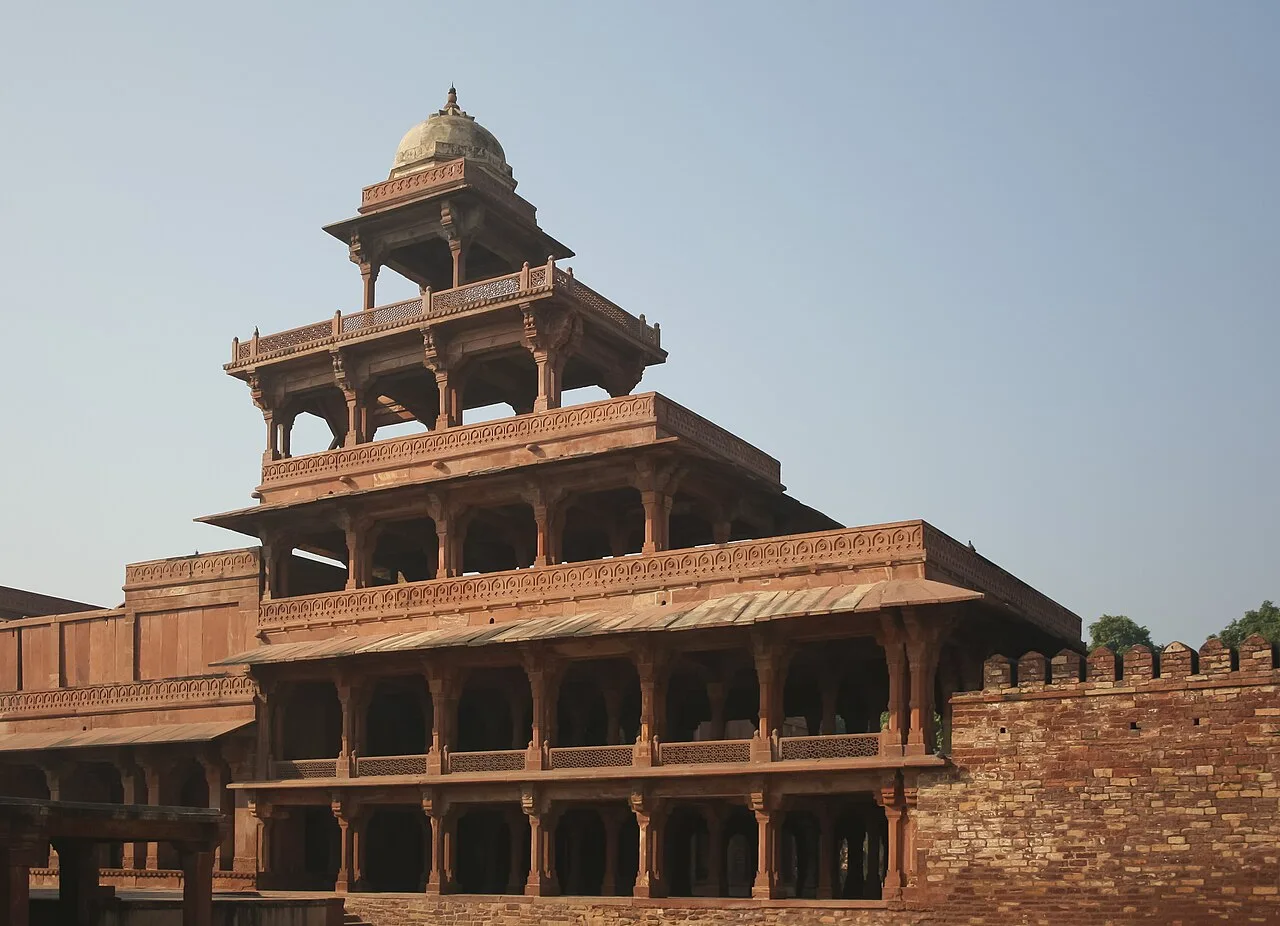
Commissioned by Akbar, Panch Mahal stands in Fatehpur Sikri, in Agra district of Uttar Pradesh. Its name means Five-Level Palace. Set beside the Zenana, or harem, its position has prompted the view that it may have served as a place for recreation and amusement. It is among Fatehpur Sikri’s notable buildings. The pavilion recalls the form of a Buddhist temple and consists of open, column-supported tiers, each reduced in size from the level below. Their layout is asymmetrical. The lowest tier has 84 pillars; the next has 56, followed by levels with 20 and 12. At the summit, four pillars hold up a chhattri. In all, the five levels contain 176 pillars, each bearing its own carved design. Jaalis once placed between the supports gave queens and princesses purdah on the upper terraces, while they enjoyed the cool air and views over the fortifications of Sikri and the town at the ridge’s foot. The successive tiers create the building’s stepped outline, with the carved columns carrying the structure throughout. The screens offered cover without closing off the outlook. The fort can be seen to the palace’s left. Anoop Talab is set in front of the building. It would have been filled with water, apart from the bridge, and used as a venue for musical concerts and other entertainment. Uttar Pradesh is India's great heritage heartland: the Taj Mahal, Agra Fort and Fatehpur Sikri of the Mughals; Varanasi's ghats on the Ganga; the Krishna towns of Mathura and Vrindavan; Ayodhya, Prayagraj's Triveni Sangam; the Buddhist circuit of Sarnath, Kushinagar and Shravasti; Lucknow's Nawabi monuments and food; and the terai forests of Dudhwa and Pilibhit. Summers from April to June are very hot (often 43–47°C), the monsoon from July to September is humid with heavy showers, and winter from December to January is cold, with dense morning fog that regularly delays trains and flights by hours. The usual best time to visit is October to March. Timings, fees and access arrangements must be confirmed locally. For official information, see Uttar Pradesh Tourism at https://uptourism.gov.in.
Why it matters
Panch Mahal is an important palace within Fatehpur Sikri, the Mughal city commissioned by Emperor Akbar in the 16th century. Its open, tiered design makes it a distinctive part of the city’s architectural ensemble and offers views across the historic ridge and nearby buildings. Fatehpur Sikri is inscribed on UNESCO’s World Heritage List; the recognition applies to the historic city, including its monuments, rather than conferring a separate designation on Panch Mahal. The site is also protected and managed as part of the archaeological complex by the Archaeological Survey of India (ASI). For visitors, it helps explain the courtly life and architectural experimentation associated with Akbar’s capital.
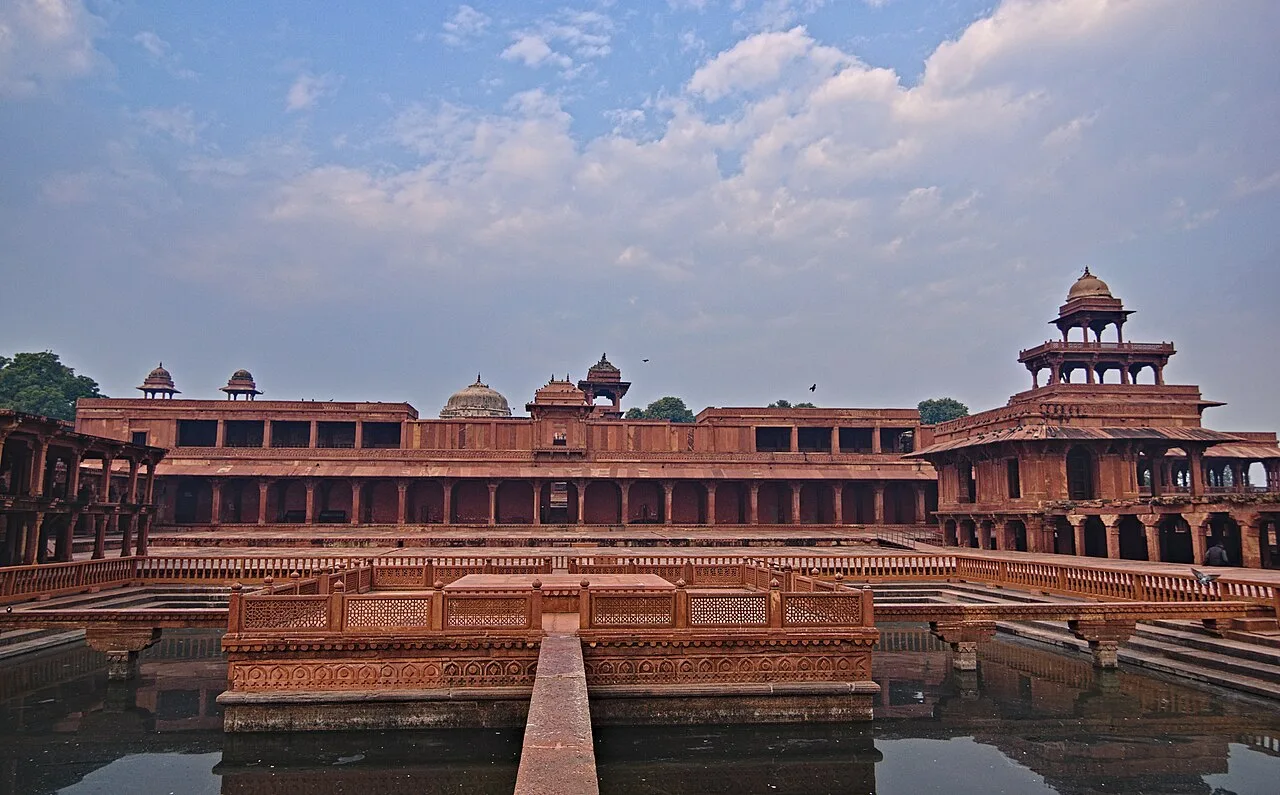
Panch Mahal was commissioned by Akbar as part of Fatehpur Sikri, the imperial city developed during the Mughal period. The city’s major construction belongs to the later 16th century, when Akbar established his court there; Fatehpur Sikri served as the Mughal capital for a relatively brief period before the court moved away. The palace’s name means “five-level palace,” referring to its rising sequence of storeys and upper pavilion. Its position near the Zenana, or women’s quarters, has led historians and guides to suggest that it may have been used for relaxation and entertainment, though its precise function is not firmly documented. Its open structure would have allowed air to circulate and provided views over the city. The nearby Anoop Talab is associated with musical performances and courtly gatherings, although the details of particular events are not certain. The building forms part of the protected Fatehpur Sikri monument complex. Its stonework and carved columns have been maintained through conservation work over time; visitors should consult ASI information on site for current conservation or access arrangements. The palace remains a key example of the city’s Mughal-era architecture.
Origin stories & folklore
According to a well-known tradition about Fatehpur Sikri, Akbar visited the Sufi saint Sheikh Salim Chishti at Sikri while seeking an heir. The story says the saint foretold the birth of a son, and that Akbar later named the child Salim, who became Emperor Jahangir. This tradition is often told in connection with Akbar’s decision to develop the city, but it is a story about the wider Fatehpur Sikri complex, not a documented origin tale for Panch Mahal itself. The palace’s closeness to the Zenana has also encouraged speculation about its use as a place for royal women to enjoy breezes and views; that interpretation should be treated as a possibility rather than established fact.
Architecture & design
Panch Mahal is a red sandstone, columnar pavilion whose five levels diminish in size as they rise. The lower storeys are open rather than enclosed rooms, and their asymmetrical arrangement gives the structure a light, stepped profile. The ground floor has 84 columns; the levels above have 56, 20 and 12, while four columns support the small top pavilion, or chhattri. The account of the monument records 176 columns in total. Their carved capitals and shafts vary in design, so looking closely at the supports is rewarding. The airy form has been compared with Buddhist viharas or temple pavilions, though this is a stylistic comparison rather than proof of direct derivation. Screens, or jaalis, once stood between columns and are associated with providing privacy while allowing air and views through. The upper levels offer changing perspectives over the complex. Panch Mahal faces the Anoop Talab, a rectangular pool whose central bridge is part of the setting. The design combines structural openness with carefully graduated storeys and carved stone detail.
Important objects & sculptures
The palace’s principal details are architectural rather than a collection of movable objects. Look for the carved stone columns, whose shafts and capitals have individual patterns, and notice how their spacing changes between levels. The upper chhattri and the diminishing terraces are best understood from more than one viewpoint. Remains or traces of the jaali screens between columns help visitors imagine how the open pavilion could have offered privacy without blocking the breeze. The Anoop Talab in front is an important part of the palace’s setting, though it is not an interior exhibit. Read any on-site interpretation panels for current information; do not touch, climb on, or mark the historic stonework.
Explore Panch Mahal slowly and read the interpretation boards, use the official audio guide where available or hire an authorised guide to understand its history. Check opening days, ticket counters and camera rules in advance; many monuments and museums close on one weekday and on some public holidays. Early morning gives softer light, cooler air and smaller crowds. A comfortable itinerary is one main visit in the morning, a local meal at midday and a short nearby stop before an afternoon return. Use the district list on this site to find other places in Agra, but check the route and its condition before combining stops. If a festival is on — such as Dev Deepawali on the Varanasi ghats, Holi in Mathura, Vrindavan and Barsana, the Magh Mela or Kumbh at Prayagraj, Deepotsav in Ayodhya or the Taj Mahotsav in Agra — roads and stays can be busy, and the experience can be unforgettable. Leave no litter: many sites are protected by the communities around them.
Suggested itineraries
Half day: 30–45 minutes to orient yourself and read site information; 45–60 minutes at Panch Mahal and Anoop Talab; 1–2 hours for nearby monuments within Fatehpur Sikri. Full day: Spend the morning exploring Panch Mahal, Anoop Talab and the main Fatehpur Sikri complex; pause for lunch in or near town; use the afternoon for remaining accessible monuments and a relaxed return journey. Gentler option: Choose a short, unhurried visit to the most accessible viewpoints, rest between stops, and ask locally about the shortest walking route; avoid trying to cover the entire complex.
Panch Mahal is a historic monument rather than a venue for regular contemporary performances. Its cultural context is the broader living town of Fatehpur Sikri, where Hindi and local varieties of Braj and other regional speech may be heard, alongside Urdu and English among some visitors and guides. The monument evokes Mughal courtly life, including music and leisure, but those practices are not necessarily staged here today. Visitors may encounter local guides explaining the site’s history and traditions. Dress modestly and behave respectfully throughout the heritage complex, especially near religious buildings and active places of worship. Follow site rules and avoid disturbing residents, worshippers or other visitors.
Festivals & events
Panch Mahal is not known as the site of a major annual festival of its own. The wider Fatehpur Sikri area and nearby Agra may be busier during Eid, major Hindu festivals and the winter tourist season; activity and access arrangements can vary. Agra’s Taj Mahotsav, usually held in winter, is a nearby cultural event rather than a Panch Mahal festival. Religious observances at the complex’s mosque and shrine may also bring local visitors, so be considerate and follow any restrictions. Festival schedules and crowd levels change from year to year; check locally before planning a visit around an event.
Local food in Uttar Pradesh includes Lucknow's Awadhi kebabs (galouti and kakori), biryani and sheermal, Agra's petha and bedai-jalebi breakfasts, Mathura's peda and Vrindavan's rabri, Varanasi's kachori-sabzi, tamatar chaat, winter malaiyyo, thick kulhad lassi and Banarasi paan. Ask what is fresh that day; many small eateries cook a limited daily menu. Street food is excellent but rich; choose busy stalls where food is cooked fresh in front of you. In Mathura, Vrindavan and Ayodhya, meat and alcohol are not served near the temples. Remote sites may have no restaurant at all. Carry water and snacks, eat a proper breakfast before long drives, and ask your accommodation for a packed lunch if you are heading out early. Try a home-cooked or local thali meal when you can — it is often the best food on the route. Choose clean places, drink sealed or filtered water, and carry your packaging back with you.
Shopping & local experiences
In and around Fatehpur Sikri, visitors may find small stalls or shops selling snacks, drinks and basic souvenirs, but selection and availability vary. Agra offers a wider range of crafts and keepsakes, including marble-inlay work, leather goods, textiles and sweets; check the material and seller carefully before buying. Look for locally made items rather than products presented with unsupported claims of origin. If trying regional food, choose a clean, busy establishment and check what is available on the day. Do not buy or remove fragments of stone, archaeological material or anything represented as part of the monument.
October to March
The nearest principal railway station by straight-line distance is Agra Cantt, roughly 33 km away. The nearest operating airport by straight-line distance is Agra Airport (Kheria), roughly 30 km away. These figures are calculated from map coordinates — actual road distance is longer. Agra, Mathura, Lucknow, Kanpur, Prayagraj, Varanasi, Gorakhpur and Jhansi are the main rail hubs; Lucknow and Varanasi have the busiest airports, and western UP is also served from Delhi. For the final leg, UPSRTC buses (including air-conditioned Janrath and Volvo services), private coaches on the expressways, shared autos, e-rickshaws and cycle-rickshaws in the old cities link district towns. In the old cities of Varanasi, Mathura and Lucknow, lanes are too narrow for cars — the last stretch is on foot or by cycle-rickshaw. When comparing train, bus and flight, count the complete door-to-door time: a flight saves the most time only if the onward road transfer is short, while an overnight train can save a hotel night. In December and January, fog can delay trains and flights for hours — keep a buffer before onward connections. The Yamuna, Agra–Lucknow and Purvanchal expressways make road travel fast between the big cities. Book your return before you leave, because seats fill quickly on weekends, festivals and holidays. Current train numbers, timings, return services and fares are not listed here; check IRCTC and NTES for trains and the airline's own schedule for flights. No permit is needed to visit Uttar Pradesh. The Taj Mahal is closed to visitors every Friday, and monument tickets for the Taj, Agra Fort and Fatehpur Sikri are cheaper when bought online on the ASI portal. Jungle safaris in Dudhwa, Pilibhit and Katarniaghat must be booked through the UP forest department's official ecotourism booking, and the parks close for the monsoon, roughly mid-June to mid-November.
Confirm onward and return timings on IRCTC / NTES, the state bus operator or your airline before travel. A dash means current timings or fares have not been verified.
Getting around
On arrival in Fatehpur Sikri, local auto-rickshaws and other hired vehicles can help with the approach to the monument complex; availability varies, so agree on the drop-off point before setting out. The historic area is best explored on foot, and vehicles may not be able to reach every building. Ask locally about designated parking and any restrictions near the entrance. Local buses and road connections serve the town, while taxis can be arranged from Agra for a broader visit. Check current road conditions and return transport options before beginning the day, particularly if travelling independently.
Hours, tickets & permissions
Entry is subject to the rules of the managing authority and may require a valid monument ticket. Ticketing, permitted areas, camera or video rules, and access during public holidays or conservation work can change. Do not assume that every building within the wider complex has identical entry conditions. Carry identification if requested by the authority, and follow notices at the entrance; dress requirements may apply in religious areas. Confirm current opening hours, fees and entry arrangements with the Archaeological Survey of India or another official source before travelling.
Facilities
Facilities within the monument complex can vary, and not every service is available beside Panch Mahal. Toilets, drinking water, food outlets, parking, guides and ticket services are generally more likely to be found near the entrance or in town; check locally before relying on them. Carry water, especially in warm weather, and take rubbish away if bins are not available. ATMs and a wider choice of meals may be easier to find in larger nearby towns than at the monument itself. Ask the managing authority about authorised guides and any current visitor services.
Accessibility
The complex involves walking across a large historic site, with uneven stone surfaces, exposed areas and steps. Panch Mahal’s upper levels are reached by stairs, so they are not suitable for wheelchair users and may be difficult for visitors with limited mobility. Do not assume ramps, lifts or step-free access are available. Strollers may be awkward on uneven paths and stairs. Shade is limited in open sections, so rest often and carry water. Older visitors or anyone who tires easily may prefer to explore fewer buildings, remain at accessible ground-level viewpoints and confirm route conditions with staff before entering.
No permit is needed to visit Uttar Pradesh. The Taj Mahal is closed to visitors every Friday, and monument tickets for the Taj, Agra Fort and Fatehpur Sikri are cheaper when bought online on the ASI portal. Jungle safaris in Dudhwa, Pilibhit and Katarniaghat must be booked through the UP forest department's official ecotourism booking, and the parks close for the monsoon, roughly mid-June to mid-November. Carry a photo ID at all times and save the emergency number 112 and your accommodation's contact offline. Summer heat is a serious risk — carry water, cover your head and avoid midday sightseeing. Crowds at ghats, temples and festivals can be overwhelming; agree a meeting point with your group. Watch your belongings in crowds and on public transport, and follow posted instructions.
Photography
Early morning or later in the day can give softer light on the sandstone and a more comfortable visit. The open terraces and views toward the fortifications offer useful compositions, while a respectful distance helps keep other visitors out of photographs. Photography rules can differ by area and may change, so check signs and ask staff before using a camera or recording video. Do not fly a drone unless the relevant authorities have explicitly permitted it; heritage sites and nearby restricted areas may have controls. Avoid photographing people, worshippers or rituals without consent.
Choose a stay by the full journey to Panch Mahal, not just the district name. Agra, Lucknow and Varanasi have the widest choice; in Varanasi, a riverside guesthouse puts you on the ghats but involves walking through narrow lanes with luggage, while pilgrim towns have dharamshalas and ashram stays. In summer, check air-conditioning and backup power; in the monsoon, check that the property is accessible if roads flood. Book in advance for weekends, festivals and the peak season (October to March). Confirm the exact location, meals included, check-in time and cancellation terms in writing. Avoid sending money to unverified contacts or touts at stations. Carry some cash, as card and digital payments can be unreliable in remote areas.
Within Fatehpur Sikri, visitors can combine Panch Mahal with Buland Darwaza, Jama Masjid, the Tomb of Sheikh Salim Chishti, Diwan-i-Khas and Jodha Bai Palace, subject to current access arrangements. These monuments help place the palace within Akbar’s wider city. Anoop Talab lies immediately in front of Panch Mahal. Agra is another major destination in the district, with the Taj Mahal and Agra Fort among its best-known heritage sites; allow enough travel time and check road conditions before combining it with Fatehpur Sikri. Choose a manageable number of stops rather than rushing through the complex.
For couples, Panch Mahal rewards a slow pace: arrive early for soft light and fewer crowds, share a local meal and keep the evening free. Sunrise at the Taj Mahal, an evening boat during the Varanasi aarti or a Nawabi dinner in old Lucknow makes the trip memorable. Public displays of affection can be frowned upon in conservative communities and at religious sites, so be discreet. Keep a buffer in your itinerary, because weather and road conditions can delay plans.
Q: How much time should I allow for Panch Mahal? A: Allow roughly an hour for the palace and its immediate setting, with additional time for other monuments in Fatehpur Sikri. Q: When is the best season to visit? A: October to March is generally more comfortable than the very hot summer; winter mornings can be cold or foggy. Q: Is entry ticketed? A: Entry is subject to current monument rules and ticketing. Confirm fees, hours and access arrangements with the managing authority before travelling. Q: Can children and elderly visitors explore the palace? A: Children can visit with supervision, but stairs and uneven paths may challenge elderly visitors and anyone with limited mobility. Upper levels require stair climbing. Q: Where can I stay nearby? A: Accommodation is available in Agra, with options also varying in and around Fatehpur Sikri. Check current availability and transport before choosing where to stay.
Be the first to share photos, stories, advice or a helpful contact for Panch Mahal, Fatehpur Sikri.
Loading…