
Taj Mahal
The Taj Mahal is a marble tomb complex in Agra, built for Mumtaz Mahal and Shah Jahan. Visitors come to see its Mughal architecture, gardens and memorials.
Key facts · verified by Ghumoopedia editors
- Type of place
- Heritage monument
- Best time to visit
- October to March
- Nearest railway station
- Agra Fort · about 2 km (straight line)
- Nearest airport
- Agra Airport (Kheria) · about 8 km (straight line)
- Verified
- 21 Nov 2026
Plan a trip from Taj Mahal — a day-by-day route through places nearby.
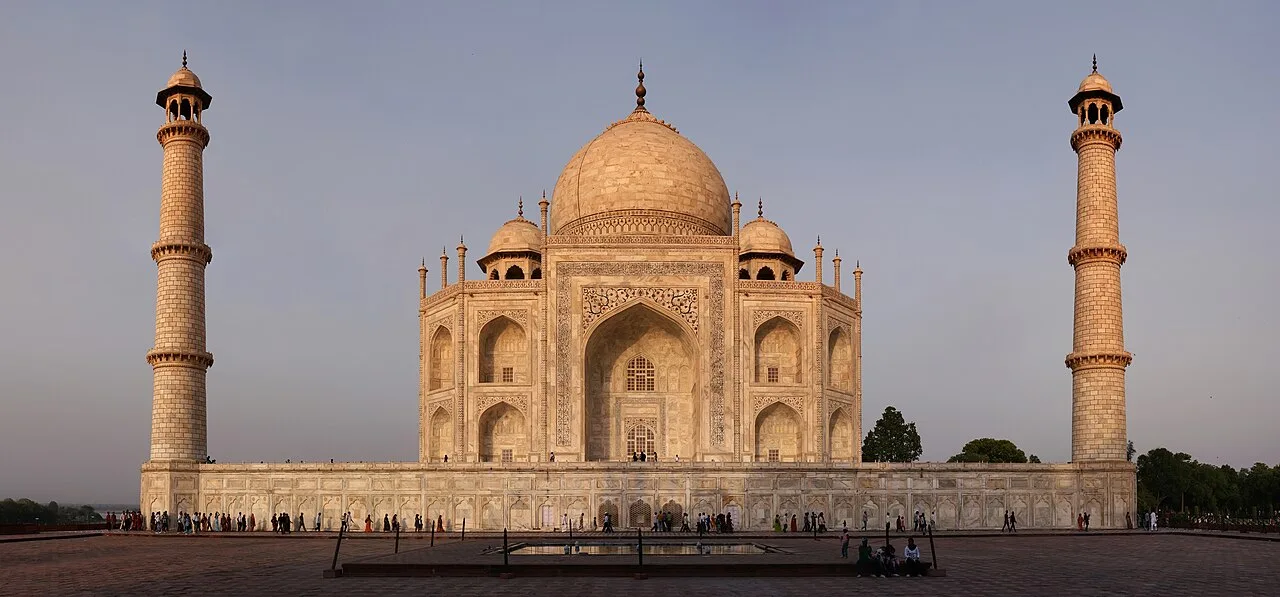
In Agra district, Uttar Pradesh, the Taj Mahal stands alongside the Yamuna. Shah Jahan, the fifth Mughal emperor, ordered its construction in 1631 as the resting place of his wife, Mumtaz Mahal. His own tomb was later placed there as well. The mausoleum forms the heart of a 17-hectare (42-acre) site, which also contains a mosque, a guest house and formal gardens. A crenellated wall encloses the grounds on three sides. The main tomb was finished in 1648, while construction elsewhere on the site carried on for five more years. On 6 February 1643, Shah Jahan held the first ceremony at the mausoleum, marking twelve years since Mumtaz Mahal’s death. The complete complex is thought to have been ready by 1653. Its reported cost at the time was about ₹32 million, equivalent to roughly ₹52.8 billion (US$827 million) in 2015. The design brings together Mughal and Indo-Islamic architectural traditions, using symmetry, varied forms and symbolic details. White marble set with semi-precious stones was used for the tomb; the other structures are made of red sandstone, as was common in Mughal-era buildings. More than 20,000 workers and craftspeople took part. A group of architects and specialists worked under Ustad Ahmad Lahori, Shah Jahan’s court architect. The team included Ottoman dome designer Ismail Afandi; Persian architects Ustad Isa, Isa Muhammad Effendi and Puru; calligrapher Amanat Khan Shirazi; finial caster Qazim Khan; and masonry supervisors. Uttar Pradesh is India's great heritage heartland: the Taj Mahal, Agra Fort and Fatehpur Sikri of the Mughals; Varanasi's ghats on the Ganga; the Krishna towns of Mathura and Vrindavan; Ayodhya, Prayagraj's Triveni Sangam; the Buddhist circuit of Sarnath, Kushinagar and Shravasti; Lucknow's Nawabi monuments and food; and the terai forests of Dudhwa and Pilibhit. Summers from April to June are very hot (often 43–47°C), the monsoon from July to September is humid with heavy showers, and winter from December to January is cold, with dense morning fog that regularly delays trains and flights by hours. The usual best time to visit is October to March. Timings, fees and access arrangements must be confirmed locally. For official information, see Uttar Pradesh Tourism at https://uptourism.gov.in.
Why it matters
The Taj Mahal is a Mughal-era mausoleum in Agra, Uttar Pradesh, commissioned by Shah Jahan for his wife Mumtaz Mahal and later used as his own tomb. It is an important part of Agra’s heritage and a major example of the city’s Mughal history. The UNESCO World Heritage List inscribed the Taj Mahal in 1983, recognising its cultural significance. The Archaeological Survey of India protects and maintains the monument. Its design brings together Indo-Islamic and Mughal architectural traditions, while its marble surfaces, gardens and riverside setting make it a distinctive part of the Yamuna landscape. The wider complex includes a mosque, a guest house and formal gardens, so a visit reveals more than the central mausoleum alone.
Shah Jahan commissioned the Taj Mahal in 1631, following the death of Mumtaz Mahal, his wife, during childbirth. The mausoleum was intended to house her tomb. Construction drew on the work of thousands of labourers and artisans, guided by a board of architects and specialists. The main mausoleum was completed in 1648; work on the wider complex continued, and the whole ensemble is generally considered to have been completed by 1653. The first ceremony at the mausoleum was held by Shah Jahan on 6 February 1643, marking the anniversary of Mumtaz Mahal’s death. The complex combines the tomb, a mosque, a guest house and gardens within an enclosed site beside the Yamuna. Shah Jahan was later buried beside Mumtaz Mahal, making their cenotaphs a rare departure from the building’s otherwise carefully balanced design. Agra remained an important centre of Mughal power during the period in which the monument was built. The Taj has since been cared for as a protected monument; the Archaeological Survey of India undertakes its conservation. It is also listed by UNESCO as a World Heritage Site, a status it received in 1983.
Origin stories & folklore
According to a popular local legend, Shah Jahan planned to build a second, black-marble tomb for himself across the Yamuna, facing the Taj Mahal. The story says the river would divide the two mausoleums. It has inspired many retellings, but historians have found no firm evidence that such a building was begun or planned. Other tales describe Shah Jahan’s grief and portray the Taj as a monument to a promise between the couple; these are best understood as stories rather than documented details of the commission. Visitors may also hear dramatic claims about the fate of the artisans after construction. Such accounts are widely repeated, but are not supported by reliable historical evidence.
Architecture & design
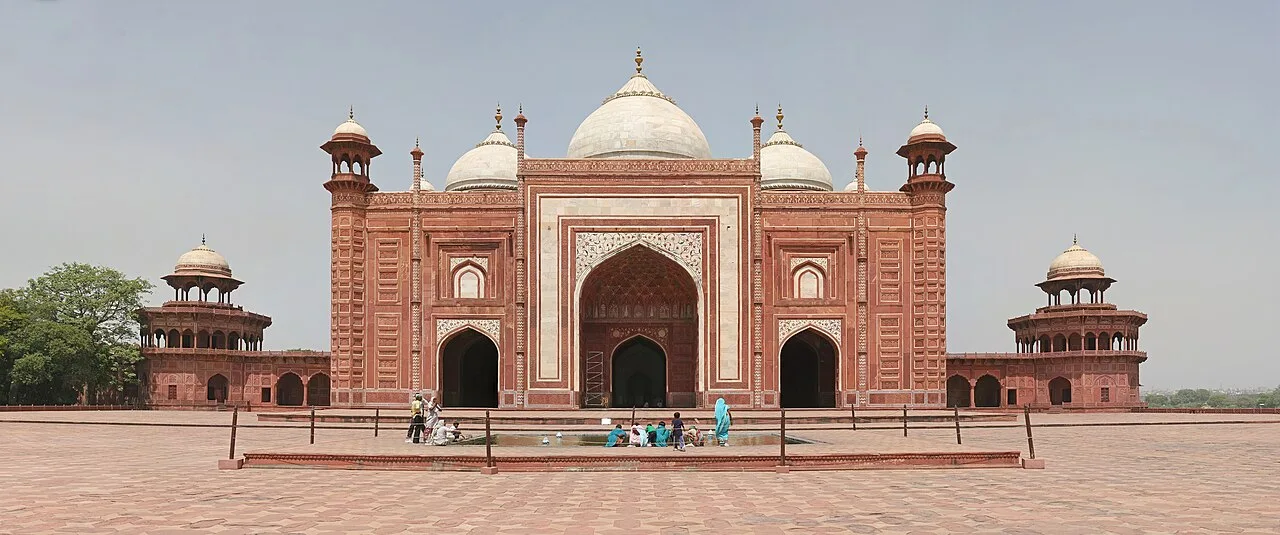
The Taj Mahal complex follows a carefully ordered plan, with the white-marble mausoleum set at the northern end of formal gardens beside the Yamuna. A monumental gateway marks the southern approach. The central tomb stands on a raised platform and is framed by four minarets. Its large central dome, smaller surrounding domes and symmetrical façades are characteristic features of Mughal design. The building combines Indo-Islamic and Mughal architectural traditions, using balanced proportions, arches and geometric forms. White marble forms the mausoleum, while red sandstone is used for other buildings, including the mosque and its matching guest house. The marble is decorated with fine inlay work using semi-precious stones, carved floral details and calligraphy. The gardens are laid out in formal paths and water channels, creating a strong central approach to the tomb. A skilled, multinational team of architects, calligraphers, stoneworkers and other artisans contributed to the complex.
Important objects & sculptures
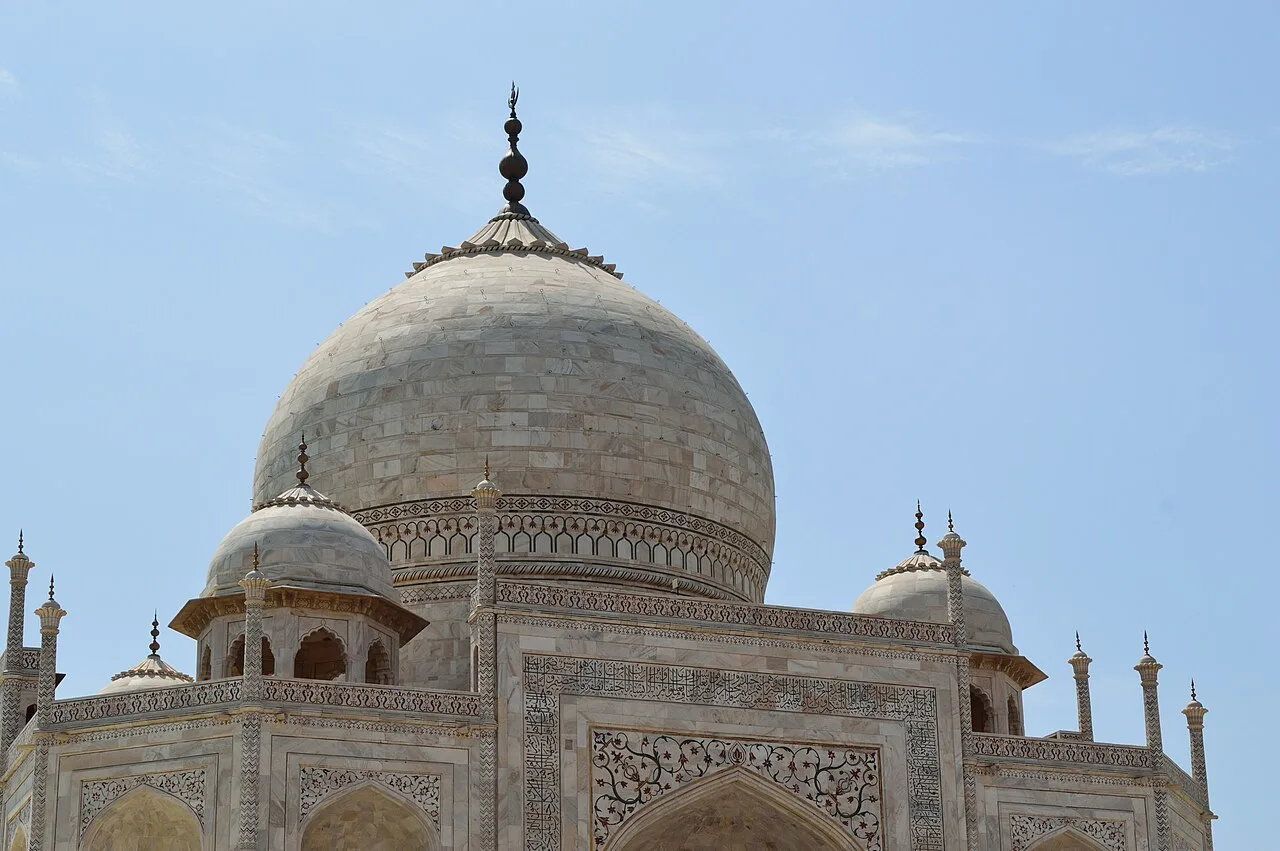
Look closely at the marble surfaces for pietra dura inlay: semi-precious stones arranged into delicate floral and plant patterns. Carved flowers and geometric details add texture to the otherwise smooth façades. Quranic calligraphy, associated with master calligrapher Amanat Khan Shirazi, frames portals and other architectural features; the lettering is carefully sized to appear balanced from the ground. Inside the main chamber, the carved marble screen surrounds the cenotaphs of Mumtaz Mahal and Shah Jahan. These are commemorative markers; the actual graves lie in a lower chamber that is generally not part of the visitor route. The cenotaphs are not identical: Shah Jahan’s was placed beside Mumtaz Mahal’s, disrupting the tomb’s otherwise symmetrical arrangement.
See the Taj Mahal at sunrise, when crowds are thinnest and the marble turns pink and gold; the monument is closed on Fridays. Food, tripods, drones and most bags are not allowed inside — carry only a phone, camera, water and your ID. Walk the Mughal garden to the main mausoleum, visit the mosque and the riverside terrace, and see the view across the Yamuna from Mehtab Bagh at sunset. Night viewing on full-moon nights is offered on limited tickets. A comfortable itinerary is one main visit in the morning, a local meal at midday and a short nearby stop before an afternoon return. Use the district list on this site to find other places in Agra, but check the route and its condition before combining stops. If a festival is on — such as Dev Deepawali on the Varanasi ghats, Holi in Mathura, Vrindavan and Barsana, the Magh Mela or Kumbh at Prayagraj, Deepotsav in Ayodhya or the Taj Mahotsav in Agra — roads and stays can be busy, and the experience can be unforgettable. Leave no litter: many sites are protected by the communities around them.
Suggested itineraries
Half day: Arrive early; spend about 2–3 hours exploring the gateway, gardens, mausoleum, mosque and riverside terrace; take a meal nearby. Full day: Visit the Taj Mahal in the morning (about 2–3 hours), pause for lunch, then explore Agra Fort (about 2 hours) and finish with the view from Mehtab Bagh near sunset. Gentler option: Focus on the main garden paths and a comfortable viewpoint, take seated breaks, and skip the longer walk to additional monuments.
Agra remains a living city as well as a heritage destination. Hindi and Urdu are widely used, and Braj influences can be heard in the region’s speech and devotional traditions. The city is known for crafts associated with the monument, particularly marble inlay, as well as embroidery and leatherwork. Visitors will also encounter local food traditions, including Agra petha. At the Taj Mahal, the everyday experience is shaped by visitors, guides, conservation staff and worshippers at the mosque. The monument is a place for quiet, respectful observation: follow posted rules, avoid touching delicate surfaces and be considerate of people praying or taking photographs. The mausoleum is not a venue for performances or public celebrations.
Festivals & events
The Taj Mahotsav, an arts and crafts festival held in Agra, usually takes place in February near the Taj Mahal and can bring extra visitors and traffic to the area. Holi is celebrated with particular energy in the wider Braj region, including Mathura and Vrindavan; its season can make regional transport and accommodation busy. Diwali and Eid are observed in Agra and may affect local services and visitor numbers. Festival schedules and venues can vary from year to year, so check locally before planning a visit. Large events in the wider region can make roads and stays busier even when they are not held at the monument itself.
Local food in Uttar Pradesh includes Lucknow's Awadhi kebabs (galouti and kakori), biryani and sheermal, Agra's petha and bedai-jalebi breakfasts, Mathura's peda and Vrindavan's rabri, Varanasi's kachori-sabzi, tamatar chaat, winter malaiyyo, thick kulhad lassi and Banarasi paan. Ask what is fresh that day; many small eateries cook a limited daily menu. Street food is excellent but rich; choose busy stalls where food is cooked fresh in front of you. In Mathura, Vrindavan and Ayodhya, meat and alcohol are not served near the temples. Remote sites may have no restaurant at all. Carry water and snacks, eat a proper breakfast before long drives, and ask your accommodation for a packed lunch if you are heading out early. Try a home-cooked or local thali meal when you can — it is often the best food on the route. Choose clean places, drink sealed or filtered water, and carry your packaging back with you.
Shopping & local experiences
Agra is known for marble inlay work inspired by the Taj Mahal, along with embroidery, leather goods and other handicrafts. Visitors can browse established shops and city markets such as Sadar Bazaar and Kinari Bazaar. Compare workmanship and materials carefully: souvenirs vary in quality, and a small decorative item is not necessarily made using traditional inlay techniques. Agra petha, a local sweet, is a popular food souvenir; buy it from a reputable shop and consider how it will travel. Avoid purchasing anything made from protected wildlife or other restricted materials.
October to March
The nearest principal railway station by straight-line distance is Agra Fort, roughly 2 km away. The nearest operating airport by straight-line distance is Agra Airport (Kheria), roughly 8 km away. These figures are calculated from map coordinates — actual road distance is longer. Agra, Mathura, Lucknow, Kanpur, Prayagraj, Varanasi, Gorakhpur and Jhansi are the main rail hubs; Lucknow and Varanasi have the busiest airports, and western UP is also served from Delhi. For the final leg, UPSRTC buses (including air-conditioned Janrath and Volvo services), private coaches on the expressways, shared autos, e-rickshaws and cycle-rickshaws in the old cities link district towns. In the old cities of Varanasi, Mathura and Lucknow, lanes are too narrow for cars — the last stretch is on foot or by cycle-rickshaw. When comparing train, bus and flight, count the complete door-to-door time: a flight saves the most time only if the onward road transfer is short, while an overnight train can save a hotel night. In December and January, fog can delay trains and flights for hours — keep a buffer before onward connections. The Yamuna, Agra–Lucknow and Purvanchal expressways make road travel fast between the big cities. Book your return before you leave, because seats fill quickly on weekends, festivals and holidays. Current train numbers, timings, return services and fares are not listed here; check IRCTC and NTES for trains and the airline's own schedule for flights. No permit is needed to visit Uttar Pradesh. The Taj Mahal is closed to visitors every Friday, and monument tickets for the Taj, Agra Fort and Fatehpur Sikri are cheaper when bought online on the ASI portal. Jungle safaris in Dudhwa, Pilibhit and Katarniaghat must be booked through the UP forest department's official ecotourism booking, and the parks close for the monsoon, roughly mid-June to mid-November.
Confirm onward and return timings on IRCTC / NTES, the state bus operator or your airline before travel. A dash means current timings or fares have not been verified.
Getting around
Autos, e-rickshaws, cycle-rickshaws and taxis can take visitors around Agra, while local buses serve parts of the city. From the drop-off or parking area, visitors may need to continue on foot or use locally arranged transfers, as vehicle access is restricted near the monument. Walking is the easiest way to explore the gardens and the main complex, though the grounds are extensive. Agree on a clear pick-up point with a driver, especially during busy periods. Traffic can be heavy, so allow extra time when travelling between the Taj Mahal, Agra Fort and other city sights.
Hours, tickets & permissions
Entry is ticketed, and access rules can differ between the main complex and special viewing arrangements. The Taj Mahal is closed to general visitors on Fridays; limited night viewing is offered on selected full-moon nights through a separate ticketing process. Food, tripods, drones and many kinds of bags are not allowed inside, and security screening applies. Carry identification and only permitted belongings. Rules, availability and entry procedures can change, so confirm current hours and fees with the Archaeological Survey of India or the monument’s official visitor information before travelling.
Facilities
The complex usually has visitor amenities such as toilets, drinking-water points and security screening; availability and locations can change, so check on arrival. Food is not allowed inside, but cafés and restaurants are available in Agra outside the monument. Parking and visitor drop-off arrangements are generally located away from the central mausoleum; confirm the current approach locally. Guides can be arranged in the city, but check credentials and agree on the scope of the visit beforehand. ATMs and other services are available around Agra rather than within the monument itself.
Accessibility
Expect substantial walking across the gardens and between the entrance, main mausoleum and other parts of the complex. Paths are broad in places, but the route includes uneven surfaces and steps, including at the raised mausoleum platform. Shade and places to rest may be limited, especially in hot weather. Wheelchair and stroller access may be difficult on some sections; do not assume every route or building is step-free. Elderly visitors and people with limited mobility may prefer to focus on the main garden views and take frequent breaks. Contact the managing authority ahead of time to check current assistance and access arrangements.
No permit is needed to visit Uttar Pradesh. The Taj Mahal is closed to visitors every Friday, and monument tickets for the Taj, Agra Fort and Fatehpur Sikri are cheaper when bought online on the ASI portal. Jungle safaris in Dudhwa, Pilibhit and Katarniaghat must be booked through the UP forest department's official ecotourism booking, and the parks close for the monsoon, roughly mid-June to mid-November. Carry a photo ID at all times and save the emergency number 112 and your accommodation's contact offline. Summer heat is a serious risk — carry water, cover your head and avoid midday sightseeing. Crowds at ghats, temples and festivals can be overwhelming; agree a meeting point with your group. Watch your belongings in crowds and on public transport, and follow posted instructions.
Photography
Early morning offers softer light and, as noted in the visitor guide, the marble can take on pink and golden tones; sunset views from Mehtab Bagh look across the Yamuna. Handheld phone and camera photography is generally allowed in outdoor areas, but restrictions apply in parts of the mausoleum. Tripods and drones are not allowed inside, and rules can change, so follow signs and staff instructions. Be considerate when photographing other visitors, worshippers or staff, and avoid blocking paths or touching the marble for a shot.
Choose a stay by the full journey to Taj Mahal, not just the district name. Agra, Lucknow and Varanasi have the widest choice; in Varanasi, a riverside guesthouse puts you on the ghats but involves walking through narrow lanes with luggage, while pilgrim towns have dharamshalas and ashram stays. In summer, check air-conditioning and backup power; in the monsoon, check that the property is accessible if roads flood. Book in advance for weekends, festivals and the peak season (October to March). Confirm the exact location, meals included, check-in time and cancellation terms in writing. Avoid sending money to unverified contacts or touts at stations. Carry some cash, as card and digital payments can be unreliable in remote areas.
Agra Fort is a major Mughal complex within the city and makes a natural pairing with the Taj Mahal. Itmad-ud-Daulah’s Tomb, another Mughal-era mausoleum, is also in Agra. Mehtab Bagh, across the Yamuna, is a popular place to view the Taj from the river’s opposite bank. Akbar’s Tomb at Sikandra is another significant Agra-area monument. With more time, visitors can make a separate trip to Fatehpur Sikri, a historic Mughal city in Agra district. Check routes and current conditions before combining several sites, especially on busy days.
For couples, Taj Mahal rewards a slow pace: arrive early for soft light and fewer crowds, share a local meal and keep the evening free. Sunrise at the Taj Mahal, an evening boat during the Varanasi aarti or a Nawabi dinner in old Lucknow makes the trip memorable. Public displays of affection can be frowned upon in conservative communities and at religious sites, so be discreet. Keep a buffer in your itinerary, because weather and road conditions can delay plans.
Q: How much time should I allow for a visit? A: Allow around two to three hours for the main complex, with extra time for security, walking and nearby viewpoints. Q: What is the best season to visit? A: October to March is generally more comfortable than the very hot summer or humid monsoon. Winter mornings can be foggy, so check travel conditions. Q: Do I need a ticket, and is the monument open every day? A: Entry is ticketed, and the Taj Mahal is closed to general visitors on Fridays. Confirm current admission rules and fees with the managing authority. Q: Is it suitable for children and elderly visitors? A: Families can visit, but expect security checks and a lot of walking. People with limited mobility should plan breaks and check access arrangements in advance. Q: Where should I stay nearby? A: Agra has accommodation across several parts of the city. Choose based on your transport needs and check recent reviews, access and local conditions before booking.
Be the first to share photos, stories, advice or a helpful contact for Taj Mahal.
Loading…