
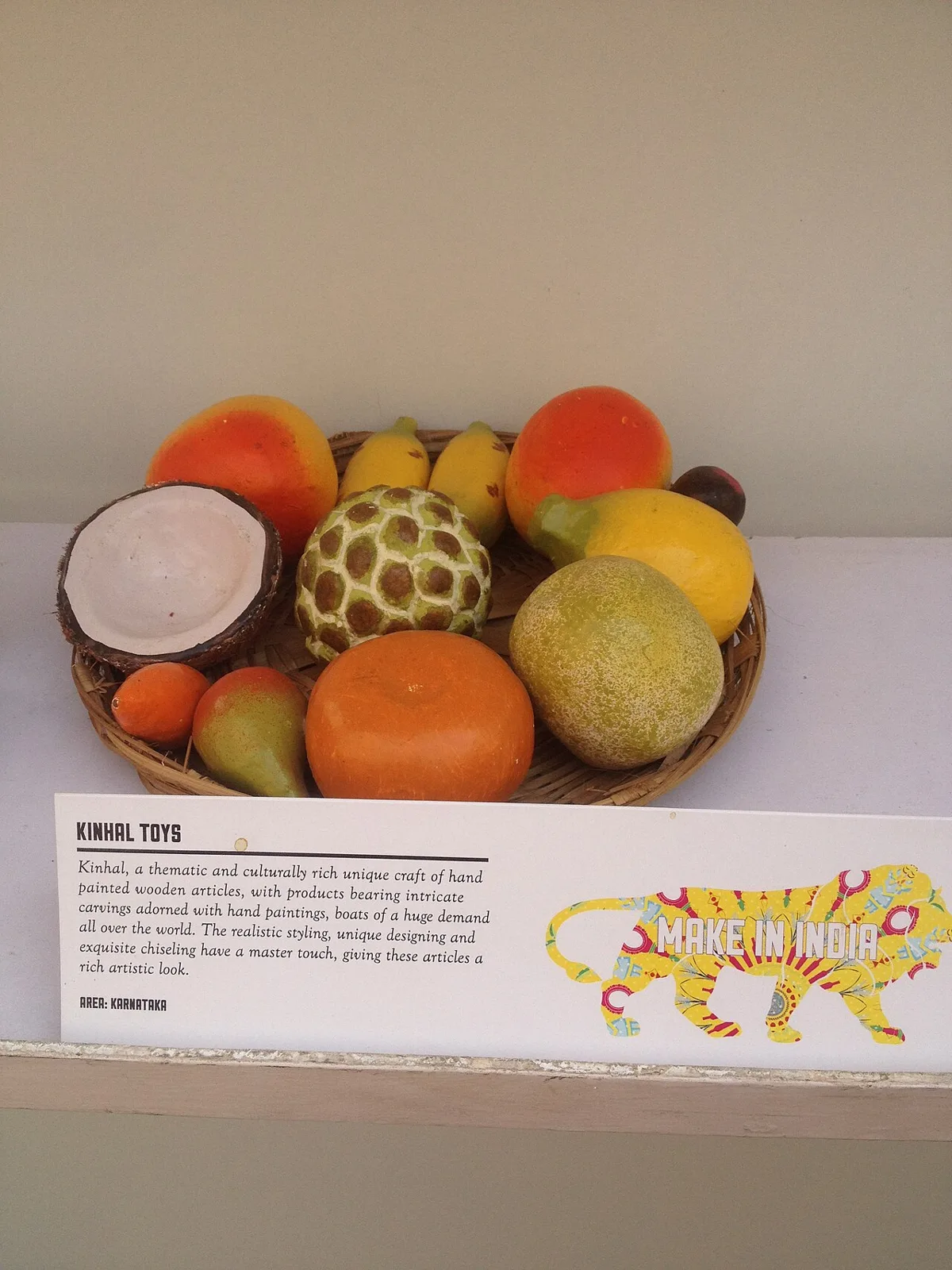
Kinhal Lacquer-Craft Village
Kinhal Lacquer-Craft Village, also called Kinnal, is a settlement in Karnataka’s Koppal district. Visitors are drawn by its connection with Kinnal craft, which has geographical indication recognition.
Key facts · verified by Ghumoopedia editors
- Type of place
- Community & living culture
- Best time to visit
- October to February; June to September for monsoon greenery in the Western Ghats
- Nearest railway station
- Hosapete Junction (for Hampi) · about 35 km (straight line)
- Verified
- 21 Nov 2026
Plan a trip from Kinhal Lacquer-Craft Village — a day-by-day route through places nearby.
Kinhal Lacquer-Craft Village is in Koppal taluk, within Koppal district in Karnataka, a state in southern India. The settlement is also known as Kinnal. It is associated with Kinnal craft, the craft for which the village is known. Kinnal craft has been granted a geographical indication (GI), with tag number 159. The names Kinnal and Kinhal are both used for the village. Its location is identified at both taluk and district level as Koppal, in the Indian state of Karnataka. Karnataka holds the boulder-strewn ruins of Hampi, the Hoysala temple jewels of Belur and Halebidu, the Chalukyan monuments of Badami, Aihole and Pattadakal, the palaces of Mysuru, the coffee hills of Coorg and Chikkamagaluru, the temple-and-beach town of Gokarna and the tiger forests of Bandipur and Nagarhole. Bengaluru and the plateau are mild most of the year; the coast is hot and humid; the Malnad hills (Coorg, Chikkamagaluru, Agumbe) get very heavy monsoon rain from June to September. October to February is pleasant almost everywhere. The usual best time to visit is October to February; June to September for monsoon greenery in the Western Ghats. For official information, see Karnataka Tourism at https://karnatakatourism.org.
Why it matters
Kinnal, also spelled Kinhal, is a village in Koppal taluk and district, Karnataka, best known for its handmade lacquer craft. The craft is part of the region’s living artisan culture: visitors may encounter work being made in household or small courtyard workshops rather than in a purpose-built museum. Kinnal craft has been granted a Geographical Indication (GI), listed as GI number 159 in the guide information for this destination. The GI recognition identifies and protects the craft’s regional association; it does not mean that every object sold locally is necessarily handmade or GI-certified. For travellers, the village offers a chance to learn about a working craft tradition and to support makers directly, provided visits are arranged respectfully.
The history of Kinnal craft is closely associated with the village of Kinnal, also called Kinhal, in Koppal district. The craft is handed on through artisan practice, but a securely documented founding date, named founder or single account of its earliest development is not established. It is therefore better not to assign it a precise origin century. Makers produce decorative and figurative objects using locally transmitted skills, including shaping, surface preparation and lacquer finishing. The tradition has continued through household and small-workshop production, with artisans adapting their work to changing buyers and markets. Kinnal craft received Geographical Indication recognition, listed as GI number 159; this formal recognition connects the named craft to its place of origin and helps distinguish it in the marketplace. It is not a restoration project or a monument designation. Today, the village remains a place of production as well as a destination for visitors. Workshop activity and availability can vary with family commitments, sales, fairs and other work, so visitors should confirm a visit locally rather than assume a public display or fixed demonstration schedule.
Origin stories & folklore
Local stories may be shared by makers or residents, and accounts can differ between families; visitors should treat them as oral tradition rather than settled historical fact. Some Kinnal objects depict religious or traditional subjects, but the subject of an artwork should not be mistaken for evidence of a particular founding story. If an artisan shares a family account, listen respectfully and ask whether it may be repeated or photographed. The craft’s documented regional association and GI recognition can be discussed separately from folklore, without presenting an unverified tale as history.
The heart of a visit to Kinhal Lacquer-Craft Village is meeting the artisans at work. Ask to see each stage of the work, from raw material to finishing; most families work at home or in small courtyard workshops, and a single piece can take hours or days. Many households and cooperative societies welcome visitors who show genuine interest, but this is a working village, not a museum: ask before entering a home or workshop, keep visits short during busy hours, and accept that some families may be away at fairs or markets. Buying directly from the maker or a registered cooperative is the best way to support the craft. Where a product carries a Geographical Indication (GI) tag or a handloom mark, ask for it; prices for handmade work reflect the time and skill involved, so bargain gently, if at all. Some workshops offer short hands-on sessions — ask locally rather than expecting a fixed schedule.
Suggested itineraries
Half day: Arrange a workshop visit; spend about 1–2 hours learning about the craft stages; browse makers’ work or a cooperative; allow time for a relaxed meal nearby. Full day: Begin with an arranged artisan visit; allow about 2–3 hours for demonstrations and conversation; take a meal break; spend the afternoon meeting another maker or cooperative if invited, then browse and purchase directly. Gentler option: Arrange one nearby workshop, remain seated for the demonstration where possible, and keep transfers by vehicle; avoid trying to visit several homes in one outing.
Kinnal’s most visible living tradition is craftwork: visitors may see artisans shaping, preparing and finishing objects in family homes or small courtyard workshops. Skills are commonly transmitted through practice and observation, though arrangements differ by household. Kannada is the principal regional language; visitors may find some people able to communicate in other languages, but should not assume this. The craft includes decorative and figurative work, and designs may draw on religious, festive or everyday themes. This is a working village rather than a staged cultural venue: demonstrations are not guaranteed, and ordinary family routines take priority. Ask before entering a workspace, and show interest without treating artisans or their homes as exhibits.
Local communities
Kinnal is home to artisan households whose livelihoods are connected with making and selling the village’s named craft. Work may take place at home or in small courtyard workshops, and some makers also sell through cooperatives, markets or fairs. Other residents contribute to the village’s everyday life and local services; not everyone is a craft worker. The guide information does not establish a single community identity for all makers, so visitors should avoid assumptions about caste, religion or family practice. Buying directly from a maker or registered cooperative can support the craft, while asking permission and respecting household privacy helps keep visits on residents’ terms.
Festivals & events
Festival activity follows local and regional calendars, and no fixed annual craft festival schedule is established here. Visitors may encounter observances such as Ugadi or Ganesh Chaturthi in the wider region, while temple fairs and village gatherings vary by locality and year. Dussehra is widely observed across Karnataka, but the form and scale of celebrations differ from place to place. Artisans may take work to fairs or markets, so a workshop may be quieter or temporarily unavailable during busy periods. Festival days can bring more local movement and crowded market or temple areas; confirm locally before planning a workshop visit around a celebration.
Village food in Karnataka is home cooking: bisi bele bath, Mysore masala dosa, ragi mudde with sambar, Coorg's pandi (pork) curry, Mangalorean fish curry with neer dosa, Davangere benne dosa, Dharwad pedha and filter coffee everywhere. Kinhal Lacquer-Craft Village itself may have only tea stalls and small eateries, so ask your host or guide where to eat, or arrange a home-cooked meal in advance — it is often the highlight of a village visit. Carry water and a snack if you plan to spend the whole day, and eat your main meal in the nearest town if no local option is open.
Shopping & local experiences
Look for handmade Kinnal craft directly from makers or through a registered cooperative. Ask about the materials, making process and whether a particular piece carries the Geographical Indication label; do not assume every item is GI-tagged. Handmade work can vary in finish and design, and its price reflects labour and skill, so bargain gently, if at all. Some workshops may offer short hands-on sessions, but these are not on a guaranteed schedule. Local markets and fairs may provide additional opportunities to find craftwork. For food, ask residents about nearby everyday eateries rather than expecting a dedicated tourist dining area.
Kinhal lies in Karnataka’s inland Deccan landscape, within Koppal district. The surroundings are generally a mix of settled village land and cultivated, open terrain, with a drier seasonal character than the state’s Western Ghats. The wider region experiences hot periods and a monsoon season; fields and roadside vegetation can look greener after rains, while exposed areas may offer limited shade. No particular forest, lake or wildlife-viewing site is established as part of the village visit, so it is best not to expect a nature reserve or guaranteed sightings. Birdlife may be seen around fields and settlement edges, but species and activity vary with season and conditions. Carry water, protect yourself from sun and check local conditions before walking beyond the village streets.
October to February; June to September for monsoon greenery in the Western Ghats
The nearest principal railway station by straight-line distance is Hosapete Junction (for Hampi), roughly 35 km away. The nearest operating airport by straight-line distance is Jindal Vijayanagar Airport, Toranagallu (for Hampi), roughly 60 km away. These figures are calculated from map coordinates — actual road distance is longer. Bengaluru is the hub for the south and centre; Hubballi and Belagavi serve the north; Mangaluru serves the coast; Mysuru is the gateway to Coorg, and Hosapete is the railhead for Hampi. Kinhal Lacquer-Craft Village is a village, so the last stretch is by road: KSRTC buses including comfortable Airavat coaches, private sleeper coaches, and app cabs in Bengaluru, Mysuru and Mangaluru reach the nearest town, and from there a shared auto, local bus or reserved taxi covers the final few kilometres. Village roads can be narrow and unpaved; a taxi hired for the day from the nearest town is the simplest way to combine Kinhal Lacquer-Craft Village with nearby sights and get back before dark. When comparing train, bus and flight, count the complete door-to-door time: a flight saves the most time only if the onward road transfer is short, while an overnight train can save a hotel night. Book your return before you leave, because seats fill quickly on weekends, festivals and holidays. Current train numbers, timings, return services and fares are not listed here; check IRCTC and NTES for trains and the airline's own schedule for flights. No permit is needed to visit Karnataka. Tiger safaris in Bandipur, Nagarhole and the Kali Tiger Reserve must be booked in advance through the forest department or authorised lodges — weekend slots sell out. Treks in Kudremukh National Park and some Western Ghat peaks need forest entry permission. Hampi's monuments have ASI entry tickets; the core zone is best seen with a bicycle, moped or autorickshaw for the day.
Confirm onward and return timings on IRCTC / NTES, the state bus operator or your airline before travel. A dash means current timings or fares have not been verified.
Getting around
Kinhal’s final approach and movement within the village are by road. From the nearest town, a local bus, shared auto or reserved taxi may be needed, but availability should be checked locally. Within the village, walking between workshops may be practical if artisans confirm where visits are welcome. Autos or taxis can help with longer local transfers. Ask where parking is appropriate and avoid blocking workshop entrances or narrow lanes.
Hours, tickets & permissions
Kinhal is a living village, not a single gated attraction with one visitor schedule. Workshop access, demonstrations and any hands-on activity depend on the individual household or cooperative, and visits should be agreed locally. Do not assume that a ticket office, permit system, camera fee or public visitor centre is available. There is no village-wide dress or identification rule stated here, though specific venues may set their own conditions. Confirm current access arrangements, any fees and suitable visiting periods with the artisan or managing group before travelling.
Facilities
Facilities are those of a village rather than a large visitor attraction. Food, drinking water, toilets and parking may be available in the village or nearby, but provision and condition can vary; check locally and carry water. A dedicated visitor centre, formal guide desk or public workshop timetable is not established here. Makers or cooperative members may be able to explain the craft when available, but this should be arranged rather than expected on arrival. ATMs and a broader choice of services are more likely in larger nearby towns. Keep small waste with you if a suitable bin is not available.
Accessibility
The village visit may involve uneven lanes, thresholds, workshop floors and standing or walking between separate homes. Exact surfaces and access differ by household, and ramps, accessible toilets or step-free workshop entrances should not be assumed. Shade and seating may be limited outdoors, though a host may be able to offer a place to sit if asked in advance. Wheelchair and stroller access will depend on the route and individual workshop; contact the host before travelling and describe any access needs. Elderly visitors may prefer one pre-arranged visit, short walking distances and a vehicle for transfers. Avoid entering private spaces without permission.
No permit is needed to visit Karnataka. Tiger safaris in Bandipur, Nagarhole and the Kali Tiger Reserve must be booked in advance through the forest department or authorised lodges — weekend slots sell out. Treks in Kudremukh National Park and some Western Ghat peaks need forest entry permission. Hampi's monuments have ASI entry tickets; the core zone is best seen with a bicycle, moped or autorickshaw for the day. Carry a photo ID, some cash (card and UPI acceptance varies in villages) and a charged phone with offline maps; save the emergency number 112 and your host's contact. Heat in summer and heavy rain in the monsoon are the main weather risks; carry water, avoid midday sun and allow extra time when village roads flood. Respect local customs: dress modestly, remove footwear where asked, and always ask before photographing people, homes or rituals.
Visitor rules
Ask the artisan or household before entering a home, workshop or courtyard, and follow any instructions about where visitors may stand. Dress modestly for a village setting and wear secure footwear suitable for uneven lanes. Do not touch tools, unfinished work or materials unless invited. Keep visits considerate and brief if makers are busy, and do not block work areas or doorways. Carry litter out and avoid single-use plastic where possible. There is no single village-wide visitor code stated here; individual workshops may restrict access to parts of a workspace or set their own conditions.
Photography
Ask permission before photographing artisans, family members, work in progress or the inside of a home or workshop. Some makers may welcome photographs of finished pieces but prefer not to have their process or household documented; accept a refusal without debate. Soft morning or late-afternoon light can be comfortable for village walks, while indoor workshop light varies. Ask before moving objects for a picture, and do not interrupt work for repeated takes. Drone use should not be assumed to be permitted: check applicable aviation rules and obtain local consent before any flight. Avoid intrusive photography during worship or private gatherings.
Most visitors see Kinhal Lacquer-Craft Village on a day trip from the nearest town, which has the widest choice of hotels. A few villages have homestays or heritage stays; otherwise base yourself in the district town and hire a taxi for the day. Confirm the booking and the exact location before you travel, because village addresses can be hard to find.
The wider Koppal region can be combined with a visit to Hampi, whose celebrated ruins are a UNESCO World Heritage site, and Anegundi, a historic settlement across the Tungabhadra from the Hampi area. Koppal Fort is another regional landmark. The Mahadeva Temple at Itagi is known for its Chalukyan architecture and may suit visitors interested in historic temples. These places are not all within the village, and road connections and journey times should be checked for the day. Plan the craft visit separately enough to allow for workshop availability rather than treating it as a guaranteed stop between attractions.
For couples, Kinhal Lacquer-Craft Village is a chance to slow down: spend an unhurried morning with the makers, choose a piece together directly from the family that made it, share a home-cooked meal and keep the afternoon free. Stay in a nearby homestay or heritage property to make it a quiet overnight escape.
Q: How much time should I allow for a visit? A: Allow at least a half day if you want to arrange a workshop visit and browse; a full day leaves more time for conversation or a nearby attraction. Q: When is the best season to visit? A: October to February is generally pleasant across much of Karnataka. Check local weather and workshop availability before travelling. Q: Is there an entry ticket or fixed workshop schedule? A: No village-wide ticket or schedule is established here. Ask an artisan or cooperative about access and any current arrangements. Q: Is the visit suitable for children or elderly visitors? A: It can be, with supervision and a short, pre-arranged visit. Lanes and workshop entrances may be uneven, so check access needs in advance. Q: Where can I stay nearby? A: Accommodation options are more likely in larger nearby towns and around the Hampi–Hosapete area. Confirm lodging and transport locally before setting out.
Be the first to share photos, stories, advice or a helpful contact for Kinhal Lacquer-Craft Village.
Loading…