
Haridwar Ardh Kumbh Mela 2027
Ten bathing days on the Ganga from 14 January to 20 April 2027 — Amrit Snans on 6 March, 8 March and 14 April at Har Ki Pauri.
Overview
Next date · Announced by the mela administration
Makar Sankranti — first snan
Thu, 14 January 2027 · in 58 days
Haridwar is where the Ganga leaves the Himalaya and enters the plains — the 'gateway' (dwar) to Hari (Vishnu) or Hara (Shiva), depending on whom you ask. Its Kumbh is centred on Har Ki Pauri, the stepped ghat on the Ganga canal where, tradition says, a drop of amrit fell into the pool called Brahmakund. Historians consider Haridwar's the original Kumbh: it is the only one timed to Jupiter in the sign Kumbha (Aquarius), and the earliest texts to use the name 'Kumbh Mela' describe it.
Haridwar holds a full Kumbh about every twelve years and an Ardh (half) Kumbh in between. The 2027 Ardh Kumbh will run for four months, January to April 2027, with ten major bathing days. For the first time at a Haridwar Ardh Kumbh, the akharas will take Amrit Snans (royal baths) as at a full Kumbh — on Mahashivratri (6 March), Phalgun Amavasya (8 March) and Mesh Sankranti (14 April 2027).
- 14 Jan – 20 Apr 2027
- Har Ki Pauri and the Ganga ghats, Haridwar
- Haridwar Junction (Northern Railway)
- Dehradun (Jolly Grant) airport
- Emergency: 112
Ardh Kumbh 2027: the ten bathing days
Announced by the mela administration
Thu, 14 January 2027 — Makar Sankranti — first snan
The Sun enters Capricorn; the mela opens.
Sat, 6 February 2027 — Mauni Amavasya
The silent new moon of Magh.
Thu, 11 February 2027 — Basant Panchami
Spring festival of Saraswati.
Sat, 20 February 2027 — Magh Purnima
Full moon of Magh.
Sat, 6 March 2027 — Mahashivratri — first Amrit Snan
The akharas' first royal bath at Har Ki Pauri.
Mon, 8 March 2027 — Phalgun Amavasya — second Amrit Snan
Two days after Shivratri.
Wed, 7 April 2027 — Nav Samvatsar
Hindu New Year (Chaitra Shukla Pratipada).
Wed, 14 April 2027 — Mesh Sankranti (Baisakhi) — third Amrit Snan
The Sun enters Aries — the day traditionally linked to the Haridwar Kumbh.
Thu, 15 April 2027 — Ram Navami
Birth of Rama.
Tue, 20 April 2027 — Chaitra Purnima — final snan
The mela closes.
Uttarakhand's Chief Minister announced the ten bathing days at a meeting with all 13 akharas on the Ganga bank in November 2025, and Mela Officer Sonika Singh confirmed them on 14 April 2026, naming 6 March, 8 March and 14 April as the three Amrit Snans. (Some early reports counted Chaitra Purnima as a fourth Amrit Snan; the mela administration's later list names three.) Exact timings for each akhara's procession are fixed closer to the day.
Why Baisakhi matters: the Haridwar Kumbh is reckoned from Jupiter's position in Aquarius and the Sun's entry into Aries, which falls on Mesh Sankranti in mid-April — that is why the biggest bath of every Haridwar Kumbh is on or around Baisakhi.
What comes next
- Ardh Kumbh14 January – 20 April 2027· Announced by the mela administration
- Purna (full) KumbhExpected around 2033· Expected by the traditional cycle — not yet announced
Religious significance and beliefs
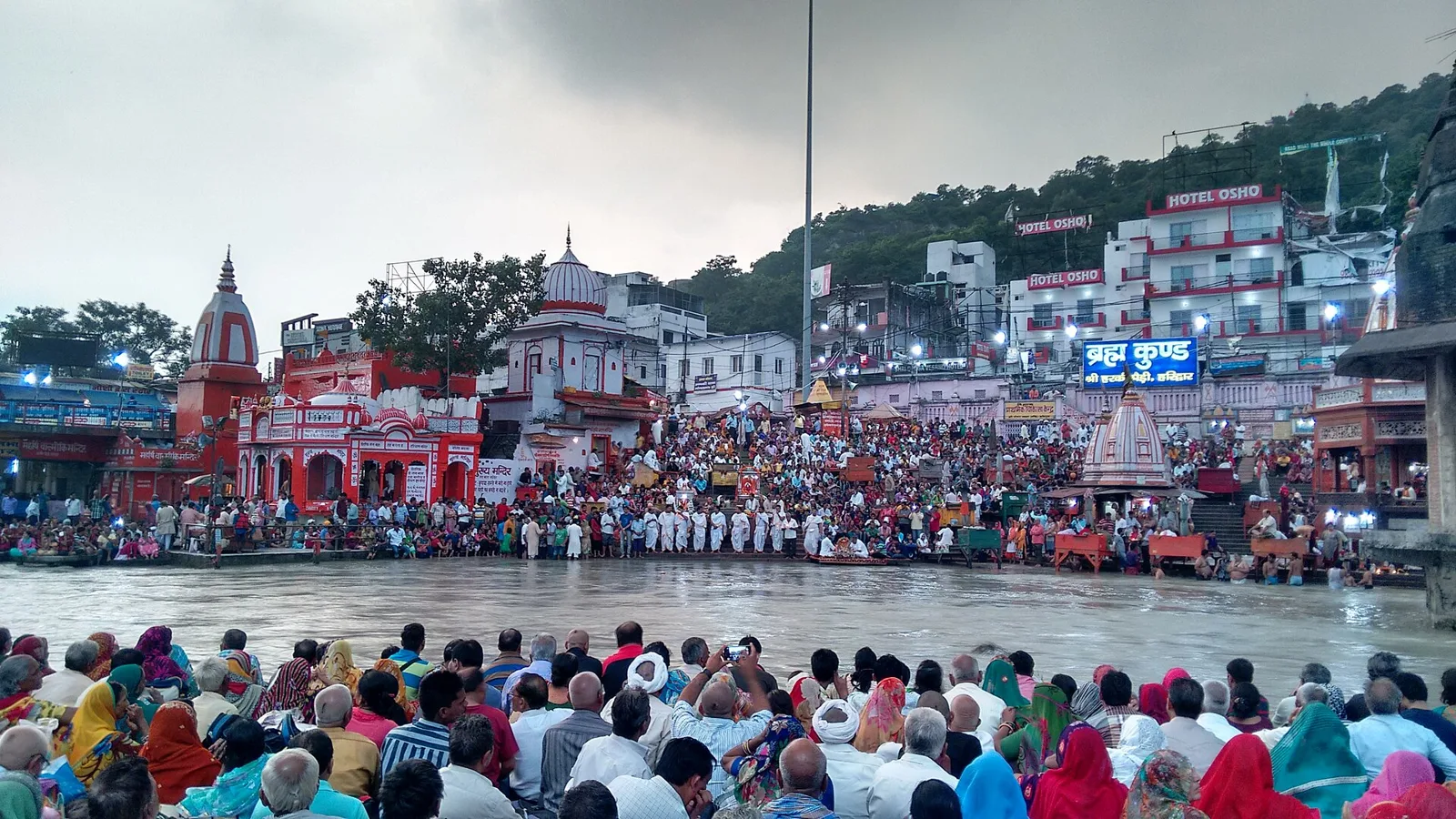
Brahmakund at Har Ki Pauri. Har Ki Pauri means 'the steps of Hari'; a stone set in the ghat wall is venerated as Vishnu's footprint. The bathing pool there, Brahmakund, is where the drop of amrit is believed to have fallen. The ghat is traditionally said to have been built by King Vikramaditya in memory of his brother Bhartrihari, who meditated here.
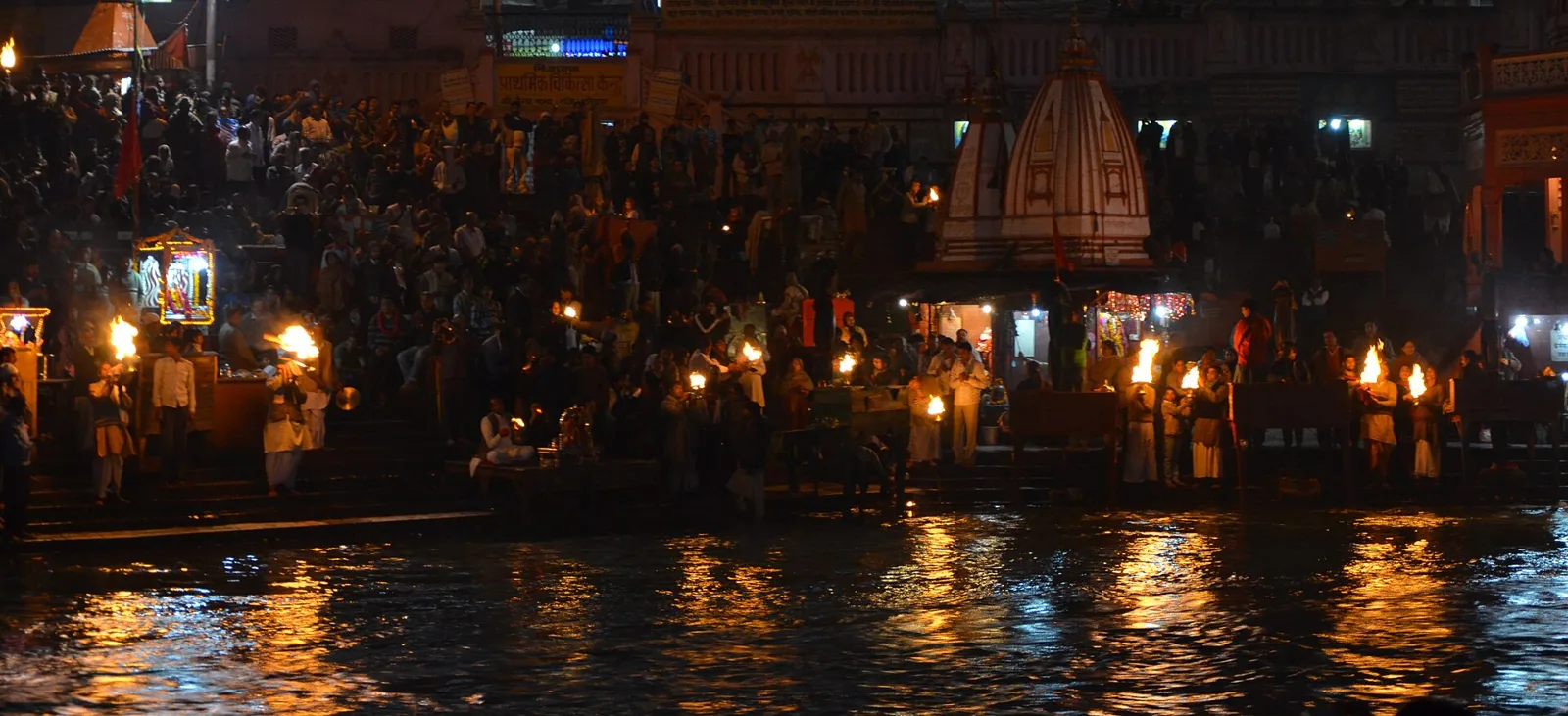
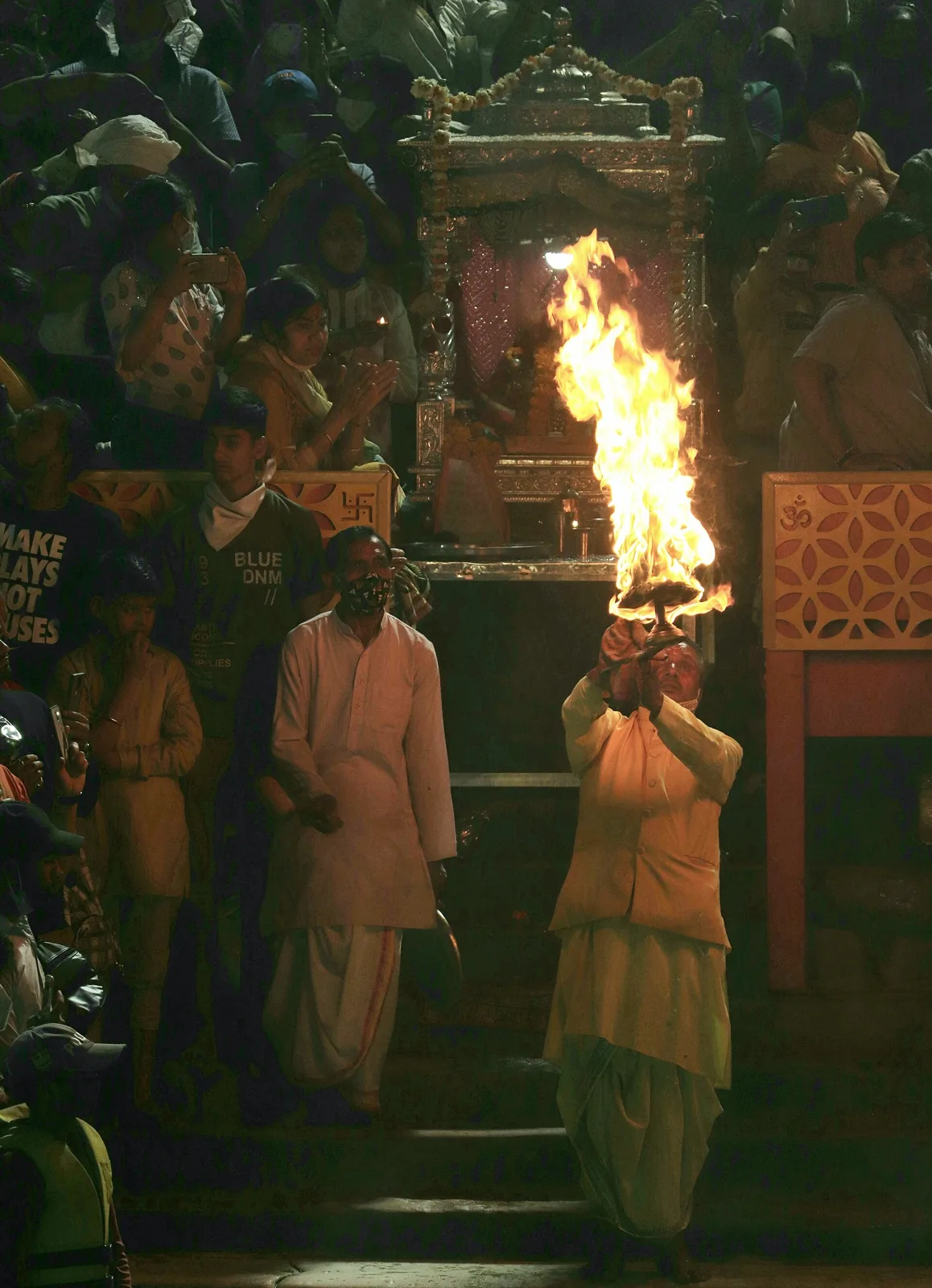
Ganga aarti. Every evening priests wave great multi-tiered brass lamps over the river while bells ring and thousands float leaf-cups of flowers and diyas downstream. During the Kumbh the aarti is the most crowded sight after the royal baths — go early and stay on the steps you reach.
Gateway to the Char Dham. Haridwar is the traditional starting point for the Himalayan pilgrimage to Yamunotri, Gangotri, Kedarnath and Badrinath, and families come here to record births, marriages and deaths in the genealogy registers kept by the pandas — some go back many generations.
Sati, Daksha and the goddesses. At Kankhal, just downstream, the Daksheswar Mahadev temple marks the place of King Daksha's sacrifice where Sati gave up her life. The three goddess shrines — Mansa Devi and Chandi Devi on the hills and Maya Devi in the old town, a Shakti Peetha — form Haridwar's 'Siddh Peeth' triangle.
Why Haridwar is the Kumbh of Aquarius
The word Kumbh means pot, and also names the sign Aquarius. Haridwar's mela is the only one fixed by Jupiter in Aquarius, which is one reason scholars think the name 'Kumbh Mela' began here and was later applied to the other three gatherings. Seventeenth- and eighteenth-century texts such as the Khulasat-ut-Tawarikh (1695) describe a great twelve-yearly fair at Haridwar that drew merchants from as far away as Central Asia and Arabia.
Geography does the rest: here the Ganga is still clear and swift from the mountains, and the British-era Upper Ganga Canal, which begins at Haridwar, gives the town its long line of ghats — so a mela can spread for kilometres along the water from Rishikesh down to Kankhal.
Sacred sites of Haridwar
Har Ki Pauri & Brahmakund
The heart of the Kumbh and of the evening aarti. On Amrit Snan days the ghat is reserved for the akharas for much of the day; pilgrims bathe at the other ghats along the canal.
Mansa Devi
The wish-fulfilling goddess on Bilwa hill above Har Ki Pauri, reached by ropeway or a steep footpath.
Chandi Devi
On Neel Parvat across the Ganga; also served by a ropeway.
Maya Devi
The old town's Shakti Peetha and the presiding goddess of Haridwar, whose name some take to be the town's ancient name, Mayapuri.
Daksheswar Mahadev, Kankhal
Shiva's temple at the site of Daksha's yagna, in the quiet ashram quarter of Kankhal.
Shantikunj
The large ashram of the Gayatri Pariwar on the Rishikesh road, open to visitors.
History and past melas
- 1695The Khulasat-ut-Tawarikh, one of the earliest texts to use the name 'Kumbh Mela', describes the Haridwar fair as a twelve-yearly gathering.
- 1796A violent clash between Shaiva sannyasis and Udasi sadhus at the Kumbh, recorded by the British officer Thomas Hardwicke, leaves many dead; the order of bathing becomes a matter of strict rules.
- 1854The Upper Ganga Canal opens, taking water from the river at Haridwar and giving Har Ki Pauri its present canal-side setting.
- 2010Full Kumbh, 14 January – 28 April. On the last Shahi Snan, 14 April, a crowd crush on the Birla Ghat bridge during an akhara procession killed at least seven pilgrims.
- 2016Ardh Kumbh at Haridwar.
- 2021Full Kumbh, held a year early by the astrological reckoning and cut to one month (1–30 April) by the Covid-19 pandemic, with Shahi Snans on 12, 14 and 27 April and a negative test report required to enter.
- 2027Ardh Kumbh, January to April, with the first Amrit Snans ever held at a Haridwar Ardh Kumbh.
How the 2027 Ardh Kumbh is being planned
The mela is run by the Haridwar Mela Adhikari (mela officer) under the Uttarakhand government with the district administration, police, the Akhil Bharatiya Akhara Parishad and the railways. The Chief Minister held the first planning meeting with all 13 akharas on the Ganga bank itself in November 2025, and said the state expects many more devotees than in 2010 and 2021 and would plan the Ardh Kumbh 'on the lines of the Purna Kumbh'.
Announced priorities include crowd and traffic plans drawn up with officers who have managed past Kumbhs, coordination of local police, PAC, NDRF, health and fire services, and waste management along the ghats. As in 2021, the notified Kumbh area is expected to stretch along the Ganga well beyond Haridwar town, towards Rishikesh in the north and Kankhal and Jwalapur in the south.
Haridwar Kumbh map guide: ghats, temples and stations
- 1Har Ki Pauri & Brahmakund · Sacred bathing place
The main bathing ghat and aarti point. Directions - 2Gurdwara Gyan Godri Sahib · Temple / shrine
Marks Guru Nanak's visit to Haridwar, beside Har Ki Pauri. Directions - 3Bhimgoda Barrage · Landmark
Where the Ganga is diverted into the canal that runs past Har Ki Pauri. Directions - 4Mansa Devi Temple · Temple / shrine
Hilltop goddess above Har Ki Pauri; ropeway. Directions - 5Maya Devi Temple · Temple / shrine
Shakti Peetha in the old town. Directions - 6Chandi Devi Temple · Temple / shrine
Hilltop goddess across the Ganga; ropeway. Directions - 7Daksheswar Mahadev, Kankhal · Temple / shrine
Site of Daksha's yagna. Directions - 8Shantikunj · Landmark
Gayatri Pariwar ashram on the Rishikesh road. Directions - 9Haridwar Junction · Railway station
Main station; most long-distance trains stop here. Directions - 10Jwalapur · Railway station
Station south of the town, useful when Haridwar Junction is crowded. Directions - 11Motichur · Railway station
Small station on the Rishikesh line north of the town. Directions
Rishikesh (25 km upstream) and Dehradun's Jolly Grant airport lie outside this view. Akhara camps, parking areas and temporary bridges are laid out for each mela and are not pinned; follow the signs and the police on the ground.
How to reach Haridwar
By train
Haridwar Junction (Northern Railway) has direct trains from Delhi, Mumbai, Kolkata, Ahmedabad, Amritsar and many other cities; Jwalapur and Motichur are small alternatives, and the line continues to Yog Nagari Rishikesh. Special trains are usually added for a Kumbh — book early for the Amrit Snan weeks.
By air
Dehradun's Jolly Grant airport is about 35 km away, with flights from Delhi, Mumbai, Bengaluru and other cities; Delhi airport is about 220 km by road.
By bus
Uttarakhand and Uttar Pradesh roadways buses link Haridwar with Delhi, Dehradun, Rishikesh, Chandigarh and towns across western UP. During the mela, temporary bus stands are set up on the entry roads.
By road, cab or taxi
National Highway 334 links Haridwar with Meerut and Delhi (around 5–6 hours on a normal day), and good roads run to Dehradun and Rishikesh. On bathing days private vehicles are held at parking areas outside the town and shuttles or walking take you to the ghats; taxis and autos wait at the station and bus stand — fix fares before you start.
Build a Haridwar itinerary · Pilgrimage circuits · Festival calendar entry
Where to stay and staying safe
Haridwar has dharamshalas, ashrams and hotels of every budget, and Rishikesh is an alternative base 25 km upstream. Rooms near Har Ki Pauri go first — book months ahead for the Amrit Snan dates, and arrive the day before rather than on the morning itself.
January and February mornings are cold and the river is icy even in April; take warm clothes, a towel and a change of clothes. The Ganga runs fast here — hold the chains on the ghats, keep children in hand, and bathe only where the ghat is barricaded. Carry a printed contact card for each child and elder and agree a meeting point. Emergency number: 112.
The four Kumbh Melas compared
Every Kumbh shares the story of the pot of amrit and the holy bath, but each has its own river, season and character. Follow the links for the full guide to each.
| Kumbh | River | Planetary sign | Season | Presiding deity | What makes it distinct | Last held | Next |
|---|---|---|---|---|---|---|---|
| Nashik–Trimbakeshwar | Godavari (Ramkund & Kushavarta) | Jupiter in Leo (Simha) | Monsoon — Shravan–Bhadrapad | Rama (Panchavati) and Trimbakeshwar Jyotirlinga | Two bathing sites 28 km apart: Vaishnavas at Ramkund, Shaivas at Kushavarta; river source on Brahmagiri. | 2015 (Jul–Sep) | 2027 Amrit Snans; Simhastha Oct 2026 – Jul 2028 |
| Ujjain | Kshipra (Shipra) | Jupiter in Leo (Simha) | Spring — Chaitra–Vaishakh | Mahakaleshwar Jyotirlinga | Began in the 18th century when Ranoji Shinde invited the Nashik akharas; main bath on Vaishakh Purnima. | 2016 (22 Apr – 21 May) | 27 Mar – 27 May 2028 (planned) |
| Prayagraj | Triveni Sangam — Ganga, Yamuna and the unseen Saraswati | Jupiter in Taurus, Sun in Capricorn (Magh) | Winter — Magh | Sangam itself; Bade Hanuman | Kalpavas tradition; annual Magh Mela, Ardh Kumbh every six years and the Maha Kumbh. | Maha Kumbh 13 Jan – 26 Feb 2025 (about 660 million visitors) | Ardh Kumbh expected 2031; Magh Mela every year |
| Haridwar | Ganga at Har ki Pauri | Jupiter in Aquarius (Kumbha) | Spring — Chaitra–Vaishakh | Ganga; Mansa Devi and Chandi Devi | Historically the original 'Kumbh' — the only one named after the sign Kumbha; Ganga enters the plains. | 2021 (1–30 Apr) | Ardh Kumbh 14 Jan – 20 Apr 2027 |
Photos of the Haridwar Kumbh
Frequently asked questions
When is the Haridwar Kumbh Mela 2027?
The Ardh Kumbh runs from Makar Sankranti on 14 January to Chaitra Purnima on 20 April 2027, with ten major bathing days.
What are the Amrit Snan (Shahi Snan) dates for Haridwar 2027?
6 March 2027 (Mahashivratri), 8 March 2027 (Phalgun Amavasya) and 14 April 2027 (Mesh Sankranti / Baisakhi), as announced by the mela administration.
Is 2027 a full Kumbh or an Ardh Kumbh in Haridwar?
It is an Ardh (half) Kumbh — the last full Kumbh was in 2021 — but for the first time the akharas will hold Amrit Snans at an Ardh Kumbh, as at a full Kumbh.
Which is the best day to visit if I want to avoid crowds?
Any weekday that is not one of the ten bathing days, especially in late January or late March. If you must come on a bathing day, choose one of the non-Amrit Snan days and bathe at a ghat away from Har Ki Pauri.
How do I reach Haridwar for the Kumbh?
By train to Haridwar Junction, by air to Dehradun's Jolly Grant airport (about 35 km), or by road from Delhi (about 220 km). On bathing days vehicles are stopped at parking areas outside town and the last stretch is by shuttle or on foot.
Can I see the Ganga aarti during the Kumbh?
Yes — the evening aarti at Har Ki Pauri continues every day. Arrive well before sunset; on bathing days police may close the approach roads early.
Bathing dates follow the Uttarakhand Chief Minister's announcement of November 2025 and the Haridwar Mela Officer's list of April 2026 (as reported by PTI); history draws on contemporary news reports. Map points come from public map records and Ghumoopedia's place guides. Last checked 19 November 2026. Timings can change — follow announcements on the ground.