
Ghumoopedia — Explore, Discover, Experience
Sign in
Santiniketan, near Santiniketan

City guide · West Bengal

Santiniketan

Santiniketan is a neighbourhood of Bolpur in West Bengal, associated with the Tagore family and Visva-Bharati. Visitors come to explore its heritage and its status as a UNESCO World Heritage site.

Famous for

  • Visva-Bharati University
  • Rabindra Sangeet
  • Santiniketan leather craft
  • Poush Mela
  • Basanta Utsav
  • Khoai landscape
In the city
1
District
Birbhum

Why Santiniketan matters

Santiniketan is a neighbourhood of Bolpur in Birbhum district, best known as the setting for Rabindranath Tagore’s educational and cultural vision. Its centre is Visva-Bharati, the university founded by Tagore, where learning, art and the natural environment have long been closely connected. The campus and surrounding heritage sites were inscribed on UNESCO’s World Heritage List in 2023.

Visitors come to see the Ashram Complex, the houses of the Uttarayana Complex and Rabindra Bhavana, which preserves material relating to Tagore’s life and work. Art is also part of the everyday landscape: sculptures by Ramkinkar Baij and buildings decorated by artists associated with Kala Bhavana can be found across the campus. Seasonal festivals, craft traditions and the distinctive red-earth terrain of the nearby Khoai add to the appeal. Santiniketan is not a separate large city but part of the Bolpur urban area; its university, cultural heritage and visitor economy give it a national profile while retaining a quieter, campus-centred character.

Famous for: crafts, trade & products

Santiniketan and nearby Bolpur are associated with handmade leather goods, often decorated with batik-style designs. Santiniketan leather goods have a Geographical Indication, and examples can be found at craft outlets, seasonal fairs and local markets. Batik printing, kantha embroidery, handwoven textiles and small works of art are also sold in the area. Craft traditions are linked to Visva-Bharati’s teaching and cultural work, particularly Kala Bhavana and the rural reconstruction centre at Sriniketan.

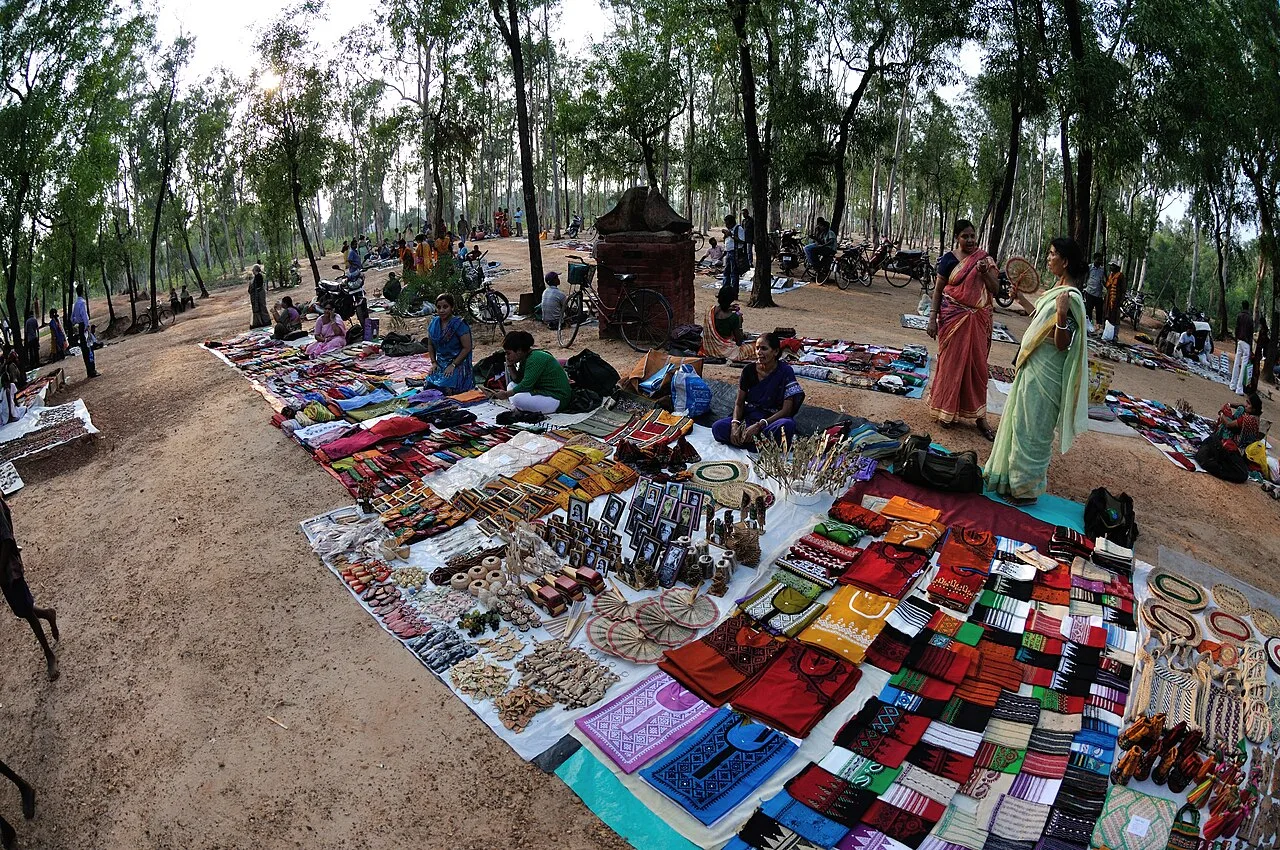
Sonajhuri Haat, near the Khoai landscape, is a popular place to browse locally made crafts, textiles, jewellery and artwork, especially when its market is in session. Stalls also appear around Bolpur and during Poush Mela, when artisans and performers gather. Availability and the range of goods vary, so visitors looking for a particular craft may wish to compare pieces across more than one outlet. Santiniketan is not a major textile-manufacturing centre; its appeal lies in small-scale craft, artistic production and the connection between local making and the region’s educational institutions.

History

Santiniketan began with Debendranath Tagore, who took a permanent lease on land near Bolpur in 1863 and built a retreat he named Santiniketan, or “abode of peace.” A prayer hall and an ashram grew around it. The area was then part of a largely rural Birbhum landscape, within a local landholding associated with the Sinha family of Raipur.

Rabindranath Tagore first visited as a child and later shaped the settlement into an educational community. In 1901 he began a school, initially known as a Brahmacharya ashrama and later called Patha Bhavana. He founded Visva-Bharati in 1921 as a centre for learning and cultural exchange. After India’s independence, it became a central university in 1951. The Tagore family and generations of artists and teachers influenced its architecture, education and public life. From an ashram and school, Santiniketan developed into a university neighbourhood and a destination for cultural tourism, while remaining part of Bolpur.

Food, festivals & culture

Bengali is the principal local language; Hindi and English are also commonly heard, especially around the university and visitor areas. Rabindra Sangeet is central to Santiniketan’s cultural life, alongside Bengali folk traditions such as Baul music. Dance, recitation, theatre and visual arts feature in university programmes and seasonal celebrations. Meals are typically Bengali, with rice, fish, vegetables and lentils; local eateries also serve snacks, tea and sweets. Pithe and other rice- and date-palm-jaggery preparations are especially associated with the winter season.

Poush Mela, held around the Bengali month of Poush in winter, brings together music, crafts and cultural performances. Basanta Utsav welcomes spring with colour, song and dance, usually around the Holi season. Visva-Bharati’s Upasana Griha is a notable Brahmo prayer hall, while the nearby Kankalitala temple is an important regional place of worship. Visitors should check locally for current festival arrangements, as programmes and access can vary.

Visiting the city

October to March is generally the most comfortable period to visit, with winter also bringing Poush Mela and other cultural events. Summers can be hot, while monsoon rains may affect outdoor plans. The nearest major airport is Netaji Subhas Chandra Bose International Airport in Kolkata. Bolpur Shantiniketan railway station is the main rail gateway, with onward travel by road into Santiniketan.

Auto-rickshaws and battery-powered toto vehicles connect the station, town and campus; walking is a pleasant way to explore some of the university grounds and heritage areas. Allow time for the Ashram Complex, Uttarayana Complex, Rabindra Bhavana and Kala Bhavana, and explore the Khoai and Sonajhuri area for its landscape and crafts. Sriniketan, associated with Visva-Bharati’s rural reconstruction work, offers another perspective on the region. Check campus access arrangements before visiting individual buildings or collections.

Attractions

Places to visit in Santiniketan

Sights within about 12 km of each other, even when they fall in different districts.

Map

Santiniketan on the map

  1. 1Santiniketan

West Bengal

Other cities to explore