
District · Telangana
Jogulamba Gadwal
Jogulamba Gadwal lies in southwestern Telangana, in a region shaped by the Deccan plateau and the Krishna and Tungabhadra river systems.
Jogulamba Gadwal lies in southern Telangana, where the Deccan plateau’s generally dry, gently rolling country meets fertile stretches along the Krishna and Tungabhadra river systems. The district is best known to many visitors for Alampur’s Jogulamba Temple and its group of historic temples, which reflect the area’s long religious and architectural history. Gadwal town was once the centre of the Gadwal Samsthanam, a princely estate remembered for its cultural patronage and weaving traditions. Today, the district combines market towns and agricultural villages with important pilgrimage sites. Its character is quieter and more rural than that of Hyderabad, while its location near the Andhra Pradesh and Karnataka borders gives it regional connections in several directions.
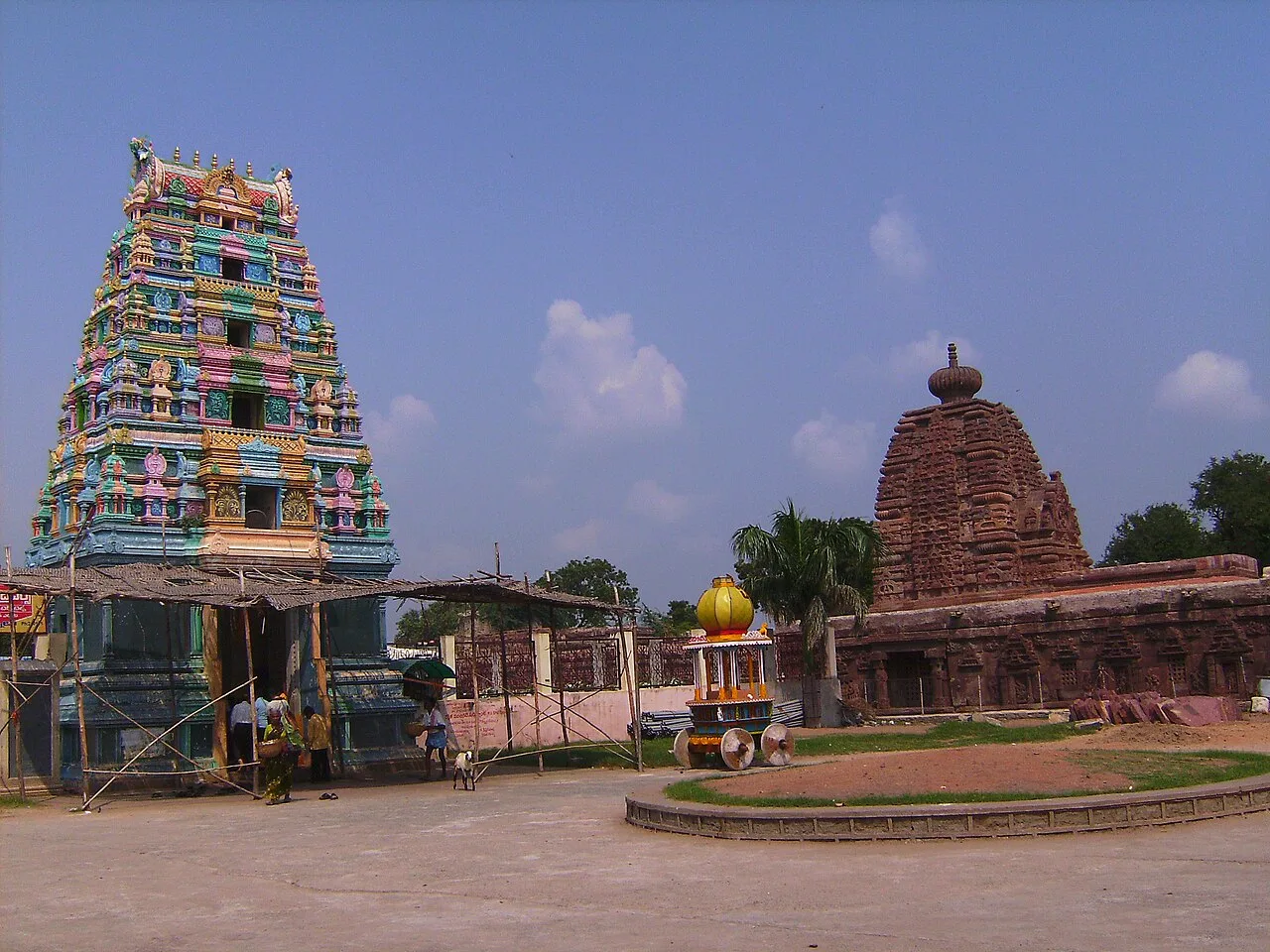
Jogulamba Gadwal lies in southwestern Telangana, in a region shaped by the Deccan plateau and the Krishna and Tungabhadra river systems. It is best known to visitors for Jogulamba Temple at Alampur, an important Shakti shrine traditionally counted among the Shakti Peethas, and the nearby group of early Chalukyan temples. The district also has a living handloom tradition associated with Gadwal. It suits travellers interested in religious heritage, historic temple architecture and a quieter regional journey. The published places listed for the district are not a complete record of every local site.
Alampur’s temple heritage is associated with the Badami Chalukyas, who built major shrines there during the seventh and eighth centuries. The surviving temples, including the Navabrahma group, reflect the region’s early medieval religious and architectural history. Over subsequent centuries, the wider area came under the influence or rule of regional powers including the Kakatiyas, Vijayanagara rulers and the Deccan sultanates. Gadwal developed as the centre of a local samsthanam, or estate, within the dominions of the Nizams of Hyderabad. The area was not directly governed as part of British India; Hyderabad was a princely state under British paramountcy until its integration into the Indian Union in 1948. Telangana became a separate state in 2014. Jogulamba Gadwal district was formed in 2016 from the former Mahabubnagar district as part of Telangana’s administrative reorganisation. Its history is visible in both the temple landscape at Alampur and the region’s continuing craft traditions.
Food here draws on Telangana’s village cooking and the wider southern Deccan. Jonna rotte (sorghum flatbread), spicy pachadi, lentil dishes and seasonal vegetables are common elements of home-style meals; some local eateries also serve country-chicken curry. Across Telangana, sarva pindi and festive snacks such as sakinalu are familiar, though what is made varies by household and season. Hyderabad specialities such as biryani, haleem and Irani chai belong to the wider regional food scene rather than being particular to this district. Small eateries may prepare a limited daily menu, so ask what is fresh that day.
Gadwal is widely associated with Gadwal sarees, a recognised handloom tradition linked especially to Gadwal town. Traditional examples combine a cotton body with silk borders and a silk pallu, joined using a distinctive interlocking technique. The contrast between the lighter body and richly coloured border is a familiar feature, though designs and materials vary among weavers and contemporary versions. Weaving remains an important part of the district’s cultural identity, but it is not something visitors should expect to encounter in every village. Ask locally about genuine handwoven pieces and where they are made.
Major Hindu festivals are observed at Alampur and in towns across the district. Temple celebrations and pilgrim visits are especially prominent around Maha Shivaratri, usually in late winter, and Navaratri, in autumn; Ugadi and Sankranti are also observed regionally. Annual festivities at Jogulamba Temple can draw larger crowds than an ordinary visit, while festival seasons may make nearby rooms harder to find. Alampur has limited accommodation choices, so visitors planning around a major observance should check locally and arrange a stay in advance.
The district lies on the generally dry Deccan plateau, with open agricultural country, rocky rises and scattered scrub rather than a continuous forest or mountain landscape. The Krishna and Tungabhadra rivers are defining features of the wider region, and their meeting near Alampur gives the temple area a strong river setting. Roads link settlements across mostly open terrain, but services become less frequent away from towns. Riverbanks and exposed temple surroundings can be hot in the dry season and slippery or harder to reach during heavy monsoon conditions.
Summers, broadly from March into June, are hot and sunny, making midday sightseeing tiring. The monsoon usually brings rain from around June through September; showers can affect rural roads and make river edges slippery. Winter, from roughly November to February, is generally the most comfortable season for temple visits and road travel. These cooler months are usually the best time to visit, though festival periods may be busier. Pack light, breathable clothing, sun protection and water for warmer days, plus a light layer for cooler evenings. In the monsoon, carry rain protection and footwear with a good grip.
Gadwal railway station serves the district headquarters and regional rail journeys. For Alampur, Kurnool City is a nearby major railhead. Kurnool Airport is geographically the closest airport to Alampur, but flight availability may be limited; Hyderabad’s Rajiv Gandhi International Airport is the more established air gateway. Roads connect the district with Hyderabad and Mahabubnagar to the north, and Kurnool and Raichur in neighbouring states. State buses and private buses serve larger towns; autos and locally arranged taxis are useful for reaching temples and villages beyond bus routes. Check current services locally before travelling.
Gadwal town and Alampur are connected by road, and visitors can use regional buses for journeys between larger settlements. Local buses, shared autos and jeeps may serve shorter routes, but availability can be limited outside towns and may vary by day. Autos are useful for short local trips; arranging a private taxi or car can make a temple visit and return journey easier, particularly for families or travellers with limited time. There is no need for a boat to reach the listed destination. Confirm onward transport locally, especially for travel later in the day.
Gadwal is the more practical base for a district visit, with a broader choice of basic hotels and access to local services. Staying in or near Alampur is convenient for an early or unhurried visit to Jogulamba Temple, though accommodation choices there may be limited. Depending on availability, travellers may find simple guesthouses, dharamshalas or other basic lodging; do not assume that homestays or government lodges are available. For festival periods, check options in advance and consider Gadwal if Alampur is full.
Carry drinking water and sun protection, particularly in the hot season, and use sealed or treated water if its source is uncertain. Take care on uneven temple grounds and near riverbanks, which can be slippery or unsafe after rain; avoid entering fast-flowing water. Monsoon showers can affect rural road conditions, so check locally before setting out and avoid relying on late-day transport in remote areas. Mobile connectivity may be weaker outside towns. Expect larger crowds during festivals and follow temple guidance. No special permit is ordinarily associated with visiting the listed temple; check with official local sources if access rules change.
- Kurnool · Andhra Pradeshabout 13 km
- Wanaparthyabout 54 km
- Nandyal · Andhra Pradeshabout 65 km
- Raichur · Karnatakaabout 89 km
- Nagarkurnoolabout 98 km
- Narayanpetabout 118 km
- YSR · Andhra Pradeshabout 144 km
- Palnadu · Andhra Pradeshabout 150 km
Straight-line distance between the centres of each district's destinations; road distance is longer.
All districts of Telangana
- Adilabad
- Bhadradri Kothagudem
- Hanamkonda
- Hyderabad
- Jagtial
- Jangaon
- Jayashankar Bhupalpally
- Kamareddy
- Karimnagar
- Khammam
- Kumuram Bheem Asifabad
- Mahabubabad
- Mahabubnagar
- Mancherial
- Medak
- Medchal–Malkajgiri
- Mulugu
- Nagarkurnool
- Nalgonda
- Narayanpet
- Nirmal
- Nizamabad
- Rajanna Sircilla
- Ranga Reddy
- Sangareddy
- Siddipet
- Suryapet
- Wanaparthy
- Warangal
- Yadadri Bhuvanagiri
Q: How many days should I spend in Jogulamba Gadwal? A: Two days can cover a visit to Jogulamba Temple at Alampur at a relaxed pace. Allow three days if you prefer a slower trip and more time in the district. Q: When is the best time to visit? A: November to February is generally the most comfortable period. Festival days can be crowded, and summer is hot. Q: What is the best base for a visit? A: Gadwal is a practical base for services and accommodation; staying near Alampur is convenient for the temple. Q: How do I get to the district and Alampur? A: Reach the area by road or rail through regional connections, then continue to Alampur by road. Check current onward transport locally. Q: Is the district suitable for families or elderly travellers? A: Yes, with planning. Choose road transport suited to your needs, allow time for uneven temple surfaces, and avoid strenuous outdoor visits in the midday heat.
This page draws on our 1 destination guides for Jogulamba Gadwal and is updated as our team checks it.
Be the first to share photos, stories, advice or a helpful contact for Jogulamba Gadwal.
Loading…