
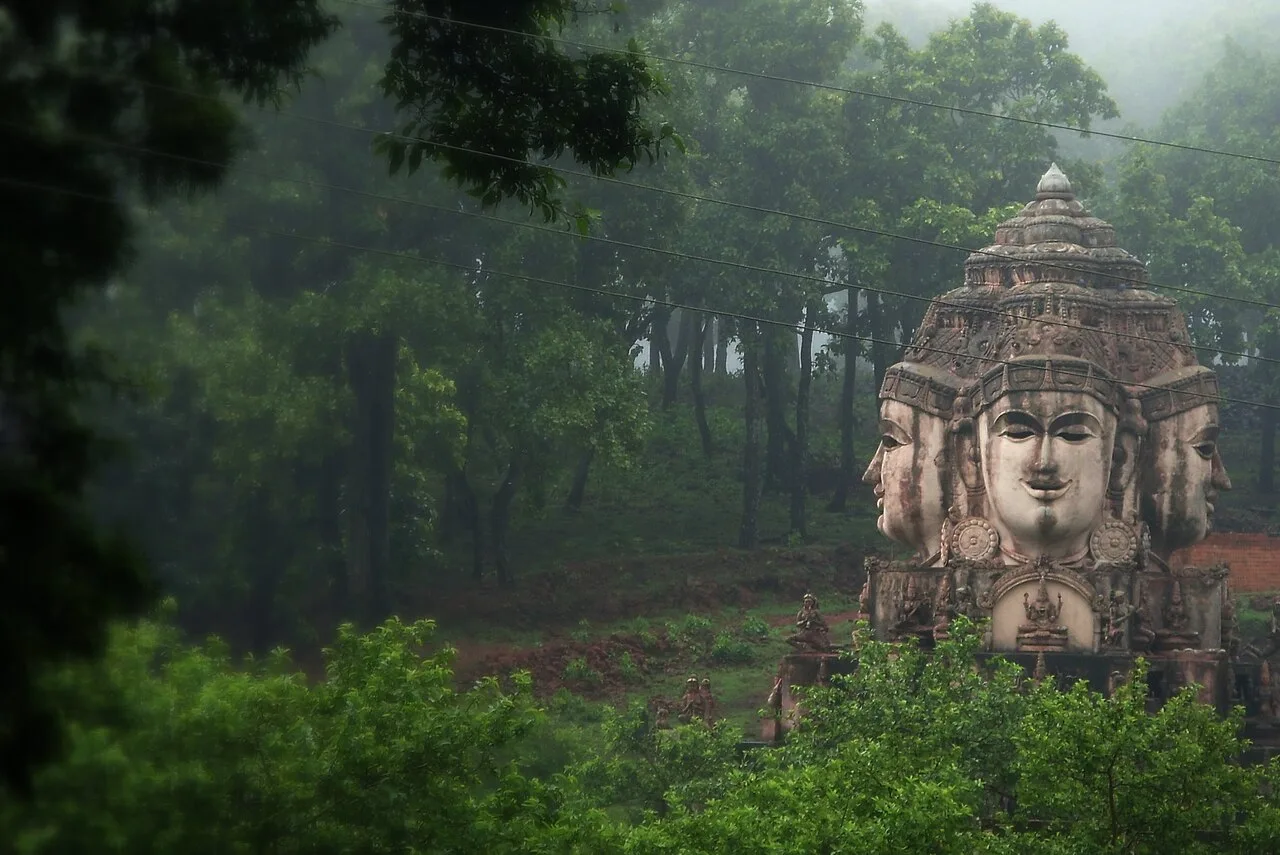
District · Madhya Pradesh
Amarkantak
Amarkantak is a pilgrimage town in Anuppur district, in the Maikal hills of eastern Madhya Pradesh.
Amarkantak is a pilgrimage town in Anuppur district, Madhya Pradesh, rather than a separate administrative district. Set in the forested Maikal hills, it is closely associated with the sources of the Narmada and Son rivers. Its landscape combines wooded slopes, sacred pools, temples and waterfalls, giving the town a quieter, hill-country character. The Narmada’s religious importance shapes daily life, drawing pilgrims to its source and to shrines around the town. Ancient temples associated with the Kalachuri period add a historical dimension beyond the active pilgrimage sites. Amarkantak is best understood as both a sacred river landscape and a base for exploring the surrounding uplands.
Amarkantak is a pilgrimage town in Anuppur district, in the Maikal hills of eastern Madhya Pradesh. It is best known as the sacred source region of the Narmada and Son rivers, and for the temples and water features associated with the Narmada’s origin. Pilgrims come to worship and visit the river’s source, while other travellers find a quieter hill-country setting of forested slopes, streams and waterfalls. The town’s Kalachuri-era temples add an important historical dimension. Amarkantak also serves as a base for exploring the surrounding uplands, though it is not a separate administrative district.
Amarkantak’s significance is closely tied to the Narmada, whose source has long been revered in Hindu tradition. The town’s temple complex includes structures associated with the Kalachuri rulers of Tripuri, who held power in parts of central India during the medieval period. The surviving Kalachuri temples are generally dated to around the eleventh century and reflect the region’s role as a centre of religious patronage. In later centuries, the wider area formed part of the political landscape of Baghelkhand, associated with the kingdom and princely state of Rewa and with local Gond histories. Under British rule, the region came within the changing administrative arrangements of central India; Rewa remained a princely state under British paramountcy. After Indian independence, the area became part of Madhya Pradesh. Amarkantak is now a Nagar Panchayat within Anuppur district, not a district headquarters. Anuppur district was formed in 2003 from the eastern part of Shahdol district.
Food around Amarkantak’s pilgrimage areas tends towards straightforward vegetarian meals, with dal, rice, roti and seasonal vegetables forming dependable choices. Across Madhya Pradesh, poha with jalebi is a familiar breakfast combination, while dal bafla and sweets such as mawa-bati belong to the wider regional repertoire rather than being Amarkantak specialities. Availability varies, so ask what has been prepared fresh instead of expecting every regional dish on local menus. Mahua also has a place in the food traditions of forest communities in the wider region, but such preparations should not be assumed to be routine restaurant offerings.
Amarkantak is not generally identified with a single signature craft, so its craft connections are better described through the wider region. Gond painting is an important art tradition associated with Madhya Pradesh, often depicting animals, trees and stories through patterned forms; it should not automatically be presented as locally made in Amarkantak. Bamboo work and practical basketry are also associated with forest communities across central India. When browsing souvenirs or devotional goods, ask where an item was made and who produced it, rather than assuming that everything sold near a pilgrimage site represents a local tradition.
Narmada Jayanti, usually observed in January or February, is a major occasion in Amarkantak, with worship and gatherings around the river’s source and temples. Mahashivratri, generally in February or March, also draws devotees to the town’s shrines. These observances can make the pilgrimage areas busier and accommodation more sought after, particularly during festival periods and the broader winter pilgrimage season. Celebrations elsewhere in the region may follow Madhya Pradesh’s wider festival calendar, but the scale and customs vary locally. Travellers planning to visit during a major observance should arrange a room ahead and expect crowds near central shrines.
Elsewhere in Madhya Pradesh
Amarkantak sits among the forested Maikal hills, where upland slopes, valleys and streams shape the surrounding terrain. The town is associated with the origins of the Narmada and Son rivers, and sacred pools, temple sites and waterfalls are part of its setting. Forest and hilly ground make journeys between attractions less straightforward than moving around the compact pilgrimage centre. Central sites can often be visited on foot, while dispersed sights require road travel and may involve uneven paths or steps. Monsoon conditions can make smaller roads and trails slippery, and the wooded landscape is best explored with local guidance where appropriate.
Amarkantak has a seasonal climate shaped by its upland setting. Summer, from roughly March into June, can be warm, although the hills may feel less oppressive than the plains. The monsoon, usually from June to September, brings rain, greener scenery and the possibility of slippery paths or slower road journeys. Winter, from about November to February, is generally the most comfortable season for walking and pilgrimage visits, though mornings and evenings can be cool. October to March is usually a practical period to visit. Pack layers for winter, sun protection and water for daytime outings, and a rain jacket with footwear suitable for wet or uneven paths during the monsoon.
Pendra Road is the principal nearby railway station used for reaching Amarkantak, with an onward road journey to the town. Jabalpur’s Dumna Airport is an air gateway, but reaching Amarkantak from there involves a substantial road transfer. Road approaches connect the town with Pendra Road, Anuppur and the wider Bilaspur region. Buses and hired vehicles are options, though connections should be confirmed before travel. Within the town, central pilgrimage sites can be explored on foot, while a locally arranged vehicle is useful for more dispersed sights. Check current services locally.
Amarkantak’s central temple and pilgrimage areas are compact enough to explore on foot, though steps and uneven surfaces may affect walking. A locally arranged taxi or other hired vehicle is useful for reaching sights scattered beyond the centre. Road connections link the town with Pendra Road, Anuppur and the wider Bilaspur region, but public transport options and onward connections can vary. Buses and shared vehicles may be available on regional routes; confirm services locally rather than relying on a fixed schedule. Autos or local vehicles may help within the town, but availability can be limited during quieter periods. There are no routine sightseeing boat links to rely on.
Amarkantak is the most practical base for visits focused on the pilgrimage centre and nearby upland sights. Accommodation generally includes modest hotels, guesthouses and lodges, with dharamshalas serving pilgrims; availability and standards vary. A longer circuit based on this district can still use Amarkantak as the overnight base, since it is the only listed destination here. During major religious observances and busy winter periods, rooms may be harder to find, so advance arrangements are sensible. Travellers seeking particular facilities should confirm what is available directly before setting out.
Wear sturdy footwear for steps, uneven paths and wet ground, especially during the monsoon. Stay on established paths in forested areas, do not approach wildlife, and avoid walking alone in isolated places after dark. Use treated or sealed drinking water and take usual precautions with food. Crowds can build around temples during festivals, so keep valuables secure and agree on a meeting point if travelling in a group. Mobile connectivity may be inconsistent outside the town centre. No special visitor permit is generally required for the town, but confirm any restrictions or permissions for forest areas with local authorities before visiting.
- Korba · Chhattisgarhabout 56 km
- Bilaspur · Chhattisgarhabout 73 km
- Kabirdham · Chhattisgarhabout 88 km
- Kanhaabout 125 km
- Koriya · Chhattisgarhabout 126 km
- Balrampur · Chhattisgarhabout 128 km
- Bandhavgarhabout 137 km
- Sidhiabout 139 km
Straight-line distance between the centres of each district's destinations; road distance is longer.
All districts of Madhya Pradesh
Q: How many days should I spend in Amarkantak? A: Two days suit a focused visit to the town; three days allow a slower pace and time for nearby upland sights. Q: When is the best time to visit? A: October to March is generally comfortable for walking and pilgrimage visits. Monsoon brings lush scenery but can make paths slippery. Q: What is the best base for visiting? A: Stay in Amarkantak for access to the pilgrimage centre and surrounding sights. Q: How do I get to Amarkantak? A: Pendra Road is the principal nearby railway station used by visitors, followed by a road transfer. Jabalpur is an air gateway with a substantial onward road journey; confirm current connections locally. Q: Is Amarkantak suitable for families or elderly travellers? A: Yes, with planning. Central sites are accessible, but steps, uneven paths and vehicle journeys to dispersed sights may be challenging; choose outings to suit individual mobility.
This page draws on our 1 destination guides for Amarkantak and is updated as our team checks it.
Be the first to share photos, stories, advice or a helpful contact for Amarkantak.
Loading…